

In the world of agile project management, clarity is currency. Teams often stumble not because of a lack of skill, but because of ambiguity in terminology. When a team member asks, "Should this be an Epic or a Story?", the answer dictates the workflow, the estimation, and the delivery cadence. Understanding the hierarchy of work artifacts is essential for maintaining velocity and value.
This guide breaks down the distinctions between the three primary levels of work: the Epic, the User Story, and the Task. We will explore when to use each, how they relate, and the common pitfalls that slow down progress. By the end, you will have a clear framework for structuring your backlog.
What is a User Story? 📝
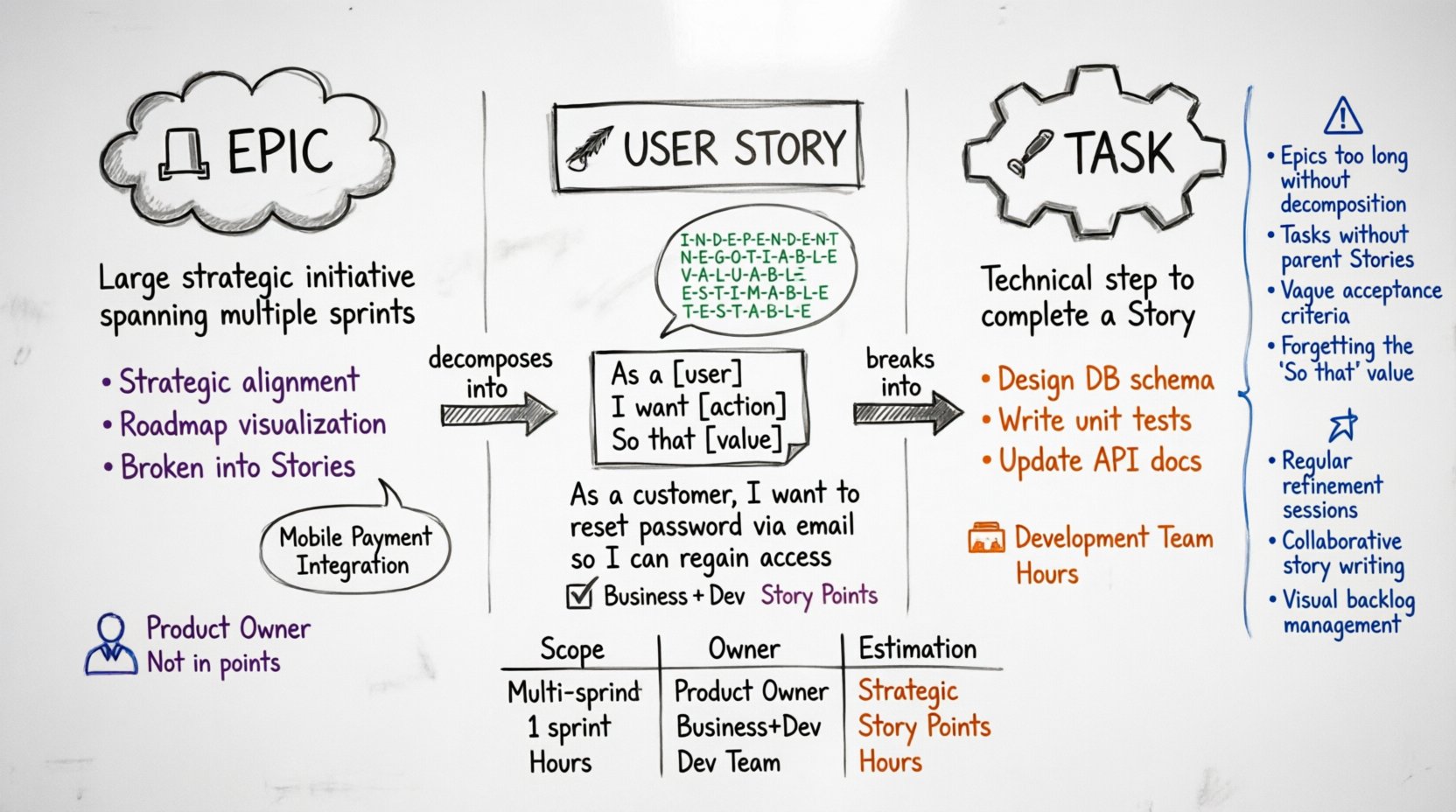
A User Story is the smallest unit of work in an agile framework. It represents a specific feature or capability requested by a stakeholder. It is not a specification document; rather, it is a placeholder for a conversation. The focus is always on the value delivered to the end user, not the technical implementation details.
The Standard Format
To maintain consistency, most teams adopt a standard template. This ensures that every item captures the persona, the need, and the benefit.
- As a: [Type of User]
- I want to: [Action or Goal]
- So that: [Value or Benefit]
Example: "As a registered customer, I want to reset my password via email so that I can regain access to my account securely."
Key Characteristics of a Story
- Independent: A story should stand alone and not rely on another story to be delivered.
- Negotiable: Details are discussed between the team and the stakeholder; they are not fixed at the point of creation.
- Valuable: It must deliver tangible value to the user or business immediately upon completion.
- Estimable: The team must be able to determine the effort required to complete the story.
- Small: It should be small enough to be completed within a single sprint or iteration.
- Testable: There must be clear acceptance criteria to verify the story is complete.
These criteria are often referred to as INVEST. When a story violates these principles, it is usually a sign that the work is not ready for development.
Acceptance Criteria
Every user story needs a set of acceptance criteria. These are conditions that must be met for the story to be accepted by the product owner. They act as the contract between the development team and the business.
- Define the boundaries of the feature.
- Specify error handling behaviors.
- Outline specific UI states or data requirements.
What is an Epic? 🏛️
An Epic is a large body of work that is too big to be completed in a single sprint. It is a collection of user stories that share a common theme or goal. Epics are typically used for strategic planning and high-level roadmap visualization.
The Purpose of an Epic
Epics provide context. They answer the question, "What major initiative are we working towards?" Without epics, a backlog can become a flat list of disconnected items, making it difficult to see the big picture.
- Strategic Alignment: Epics map directly to business objectives.
- Tracking Progress: They allow leadership to track the completion of major initiatives over quarters or years.
- Resource Planning: They help identify when multiple teams might need to coordinate.
Breaking Down Epics
An Epic cannot be developed directly. It must be broken down into smaller, manageable user stories. This process is called decomposition. As the team gains clarity on the work, the Epic shrinks, and the stories grow in detail.
Consider an Epic titled "Mobile Payment Integration". This is too vague to build. It needs to be split into stories like:
- Integrate Apple Pay API.
- Support Google Pay functionality.
- Handle payment tokenization securely.
- Update the checkout UI to show payment icons.
What is a Task? 🛠️
A Task is a technical step required to complete a User Story. Tasks are usually visible only to the development team and are not typically prioritized by the product owner. They represent the "how" rather than the "what".
Granularity of Tasks
Tasks are the smallest unit of work. They are often estimated in hours rather than story points. A single User Story might contain multiple Tasks. These tasks break the story down into actionable items for individual developers.
Examples of Tasks
- Design the database schema for the new table.
- Write unit tests for the authentication module.
- Update the API documentation.
- Configure the firewall rules for the new endpoint.
While tasks are internal, they are critical for accurate estimation. If a team consistently misses sprint commitments, it is often because tasks were underestimated.
Comparison: Epic vs. User Story vs. Task 📊
Understanding the differences is easier when viewed side-by-side. The following table outlines the key distinctions in scope, ownership, and timeframes.
| Feature | Epic 🏛️ | User Story 📝 | Task 🛠️ |
|---|---|---|---|
| Scope | Large initiative, spans multiple sprints | Specific feature, fits in one sprint | Technical step, fits in hours |
| Owner | Product Owner / Management | Product Owner / Business | Development Team |
| Estimation | Not estimated in points (often) | Story Points (T-Shirt sizing) | Hours |
| Benefit | Strategic Value | User Value | Technical Progress |
| Definition of Done | All linked stories completed | Acceptance Criteria met | Code reviewed & merged |
When to Write Which? 🧭
Knowing the definitions is one thing; knowing when to create them is another. Misplacing work in the hierarchy leads to bottlenecks and wasted effort.
When to Write an Epic
Create an Epic when you have a strategic goal that requires significant effort. If the work cannot be defined in enough detail to be built in a few weeks, it belongs in an Epic.
- New Product Line: If you are launching a new category of products.
- Major Migration: Moving infrastructure from on-premise to cloud.
- Compliance Projects: Initiatives driven by external regulations that span months.
When to Write a User Story
Create a User Story when you have a clear user need that can be validated within a sprint. This is the primary unit of execution.
- Feature Requests: A specific button, form, or report needed by a user.
- Bug Fixes: While bugs are issues, they are often treated as stories if they require significant refactoring.
- Technical Debt: Refactoring work that improves system health but isn’t visible to the user.
When to Write a Task
Create Tasks during the sprint planning or refinement phase, once the Story has been accepted.
- During Planning: When the team breaks down the story into technical steps.
- During Development: When a story reveals hidden complexity requiring specific sub-steps.
- For Collaboration: When multiple developers need to work on different parts of the same story.
Common Pitfalls and How to Avoid Them ⚠️
Even experienced teams make mistakes in hierarchy management. Recognizing these patterns early can save weeks of rework.
1. Writing Epics Instead of Stories
Teams often leave work at the Epic level for too long. This creates a "black box" where stakeholders see progress but the team lacks clarity. If an Epic has been open for more than three months, it is likely time to decompose it further.
2. Tasks Without Stories
It is a common error to create Tasks without a parent User Story. This leads to technical work that may not deliver user value. Every Task must trace back to a Story that provides business context.
3. Vague Acceptance Criteria
Stories often fail because the criteria are subjective. Avoid terms like "fast", "user-friendly", or "easy". Use measurable terms like "loads in under 2 seconds" or "supports 10,000 concurrent users".
4. Over-Slicing Stories
Breaking a story into pieces that are too small can result in high overhead. If a story takes less than half a day to complete, it might be better grouped with a related story to ensure meaningful increments of value.
5. Ignoring the "So That"
Many teams write "As a user, I want a button" but forget the "So that". Without the "So that", the team builds features that solve no problem. Always validate the value proposition before starting development.
Best Practices for Agile Teams 🚀
To maintain a healthy workflow, adopt these operational habits. Consistency in documentation and structure pays dividends in speed and quality.
Regular Refinement Sessions
Do not wait until sprint planning to discuss work. Hold regular refinement sessions where stories are reviewed, estimated, and split. This ensures that stories entering a sprint are ready to be built.
Collaborative Definition
Do not write User Stories in isolation. The Product Owner brings the business context, but the developers bring the technical feasibility. A story written by a developer alone often lacks user focus; one written by a PM alone often lacks technical reality.
Visual Management
Use a board or tracking system to visualize the hierarchy. Epics should sit at the top, Stories in the middle, and Tasks at the bottom. This visual layer helps identify when an Epic is stalled because stories are not being broken down.
Continuous Feedback
Once a story is delivered, verify that it meets the acceptance criteria. If it does not, the "Done" definition was misunderstood. Continuous feedback loops prevent technical debt from accumulating.
Measuring Success in Your Workflow 📈
How do you know if your hierarchy is working? Look for these indicators.
- Velocity Stability: If sprint velocity fluctuates wildly, your estimation of stories may be inconsistent.
- Carryover Rate: If tasks are frequently carried over to the next sprint, your stories are likely too large or tasks were underestimated.
- Epic Completion: Are Epics being closed at a predictable rate? If Epics remain open for years, your decomposition is insufficient.
- Team Morale: Do developers feel they understand the "why"? If they are just coding tasks without context, they are likely disconnected from the user story.
Final Thoughts on Hierarchy Structure 🎯
The distinction between Epic, Story, and Task is not just administrative; it is cognitive. It shapes how a team thinks about work. Epics keep the vision clear. Stories keep the focus on value. Tasks keep the execution grounded.
By adhering to these definitions and avoiding common traps, teams can streamline their delivery pipeline. The goal is not to fill a tracking system with entries, but to create a transparent flow of value from idea to delivery.
Start by auditing your current backlog. Identify items that are too large to be stories. Identify tasks that lack a story parent. Adjust your process to ensure every piece of work fits into the correct layer. This structural integrity is the foundation of sustainable agile development.
Related posts:
 The Complete Checklist for Writing High-Quality User Stories in Agile Teams
 Q&A: Answering the Top 10 Confusing Questions About User Stories for New Agilites
 Stop Wasting Time on Bad User Stories: A Practical Tutorial for Beginners
 How to Use User Stories to Align Engineering, Design, and Product Teams Effectively