

Entering the world of Agile development often feels like learning a new language. Among the various terminologies, the user story stands as a cornerstone of effective backlog management and iterative delivery. Yet, for those new to this methodology, questions often arise regarding format, ownership, and implementation. This guide addresses the most common points of confusion to provide clarity on how to craft valuable user stories.
Understanding the mechanics of a user story is not merely about filling out a template; it is about shifting focus from technical specifications to user value. Whether you are a Product Owner, a Scrum Master, or a Development Team member, grasping these concepts ensures smoother collaboration and better outcomes.
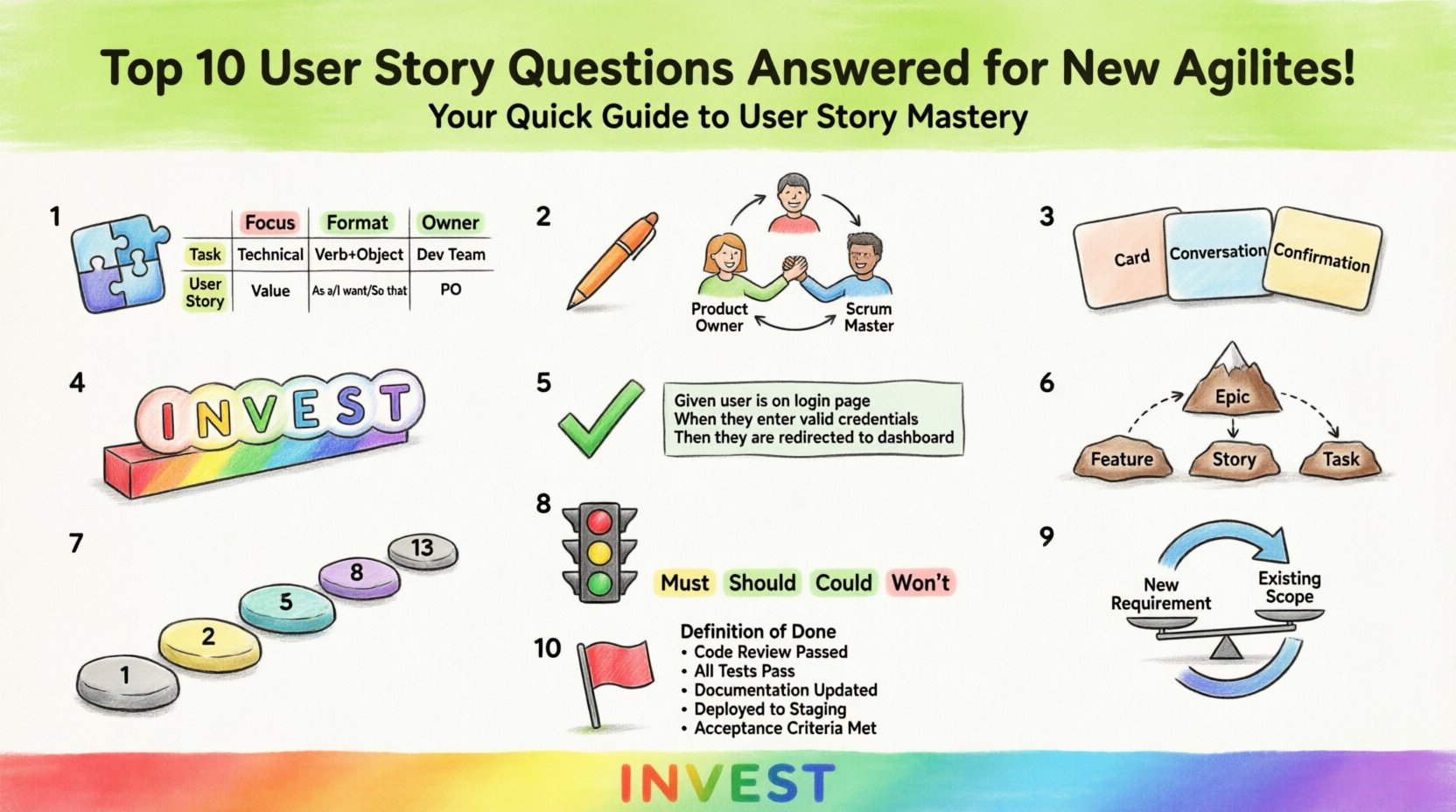
1. What is the fundamental difference between a Task and a User Story? 🧩
Confusion often stems from mixing up tasks with user stories. While both appear in a project backlog, they serve distinct purposes.
- User Stories: Focus on the value delivered to the end user. They answer who wants what and why.
- Tasks: Focus on the technical implementation required to build the story. They answer how the work will be done.
Consider a scenario where a user needs to reset their password. The user story describes the benefit (security and access), while the tasks describe the steps (create email function, validate input, update database).
| Feature | User Story | Task |
|---|---|---|
| Focus | Value to the User | Technical Implementation |
| Format | As a [role], I want [action], so that [benefit] | Verb + Object (e.g., “Configure server”) |
| Owner | Product Owner | Development Team |
| Priority | Business Value | Technical Necessity |
Keeping these separate prevents the team from getting lost in technical details before agreeing on the value proposition.
2. Who is responsible for writing the User Stories? 📝
In many organizations, the responsibility lies primarily with the Product Owner. They represent the voice of the customer and understand the market needs best. However, Agile encourages collaboration.
While the Product Owner drafts the initial narrative, the development team should contribute to the refinement process. This ensures technical feasibility is considered early. Collaborative writing often involves:
- Product Owner defining the who and why.
- Developers clarifying the what and constraints.
- Stakeholders validating the business value.
It is not a solitary activity. The best stories emerge from conversation, often referred to as the “Three Amigos” technique involving Product, Development, and Testing perspectives.
3. How does the 3C model apply to User Stories? 📋
Ken Schwaber introduced the 3C model to ensure stories are complete and communicative. It stands for Card, Conversation, and Confirmation.
- Card: The physical or digital representation of the story. This is the brief summary written on a sticky note or ticket.
- Conversation: The dialogue between the team and stakeholders to flesh out details. This is the most critical part where requirements are clarified.
- Confirmation: The test cases or acceptance criteria that prove the story is complete. This validates the outcome.
Skipping the Conversation is a common pitfall. A story written in isolation without dialogue often leads to misinterpretation. The card is just the reminder; the conversation holds the knowledge.
4. What does it mean for a User Story to be Independent? 🧱
The INVEST model is a guideline for creating high-quality user stories. The ‘I’ stands for Independent. This means a story should not be tightly coupled to another story in a way that blocks delivery.
Dependency creates bottlenecks. If Story A cannot be completed until Story B is done, the team loses flexibility. Ideally, stories should be shippable individually.
- Bad Dependency: “Login System” must be done before “Profile Settings” can be tested.
- Independent Approach: “Login System” is a story. “Profile Settings” is a separate story. If “Profile Settings” requires login, it uses a stub or mock, but logically they are distinct.
Reducing dependencies allows the team to prioritize based on value rather than technical constraints.
5. How do we define Acceptance Criteria effectively? ✅
Acceptance criteria are the conditions that must be met for a story to be considered complete. They act as the contract between the team and the Product Owner.
Effective criteria should be:
- Specific: Avoid vague terms like “fast” or “easy”.
- Testable: There must be a clear pass or fail condition.
- Unambiguous: No room for interpretation.
Using Gherkin syntax (Given/When/Then) is a popular method to structure these criteria.
| Component | Description | Example |
|---|---|---|
| Given | The initial context or state | Given the user is logged out |
| When | The action taken by the user | When the user enters an incorrect password |
| Then | The expected outcome | Then the system displays an error message |
This structure ensures everyone agrees on what success looks like before coding begins.
6. When does a User Story become an Epic? 🏔️
Epics are large bodies of work that are too big to complete in a single iteration. They are essentially collections of user stories.
The transition happens when a story exceeds the capacity of a single sprint or requires too much effort to estimate accurately. If a story is estimated to take months rather than weeks, it should be broken down.
Key indicators that a story is too big include:
- Unclear scope or requirements.
- Multiple distinct features bundled together.
- Excessive technical complexity that cannot be decomposed.
Breaking epics down allows for incremental delivery and early feedback. It transforms a massive risk into manageable chunks.
7. How do we estimate User Stories without hours? 📊
Traditional project management often relies on hours. Agile prefers Story Points. This method focuses on relative complexity rather than absolute time.
Why use points?
- Complexity: How difficult is the work?
- Risk: What is the uncertainty involved?
- Effort: How much work is required?
Teams often use the Fibonacci sequence (1, 2, 3, 5, 8, 13) for estimation. The gaps between numbers encourage discussion about the difficulty of the story. If two stories are estimated as 5 and 8, the team discusses why the second is significantly harder.
This approach avoids the false precision of hours. A developer might say “2 hours” but encounter a blocker, whereas a “5 point” story implies a level of effort relative to the team’s baseline.
8. Who decides the Priority of User Stories? 🚦
Priority is the sole responsibility of the Product Owner. They balance business value, technical debt, and stakeholder requests.
However, the team provides input. If the team knows a story is technically risky or requires significant resources, they inform the Product Owner. This influences the decision but does not dictate it.
Common prioritization techniques include:
- MoSCoW: Must have, Should have, Could have, Won’t have.
- Value vs. Effort: Plot stories on a matrix to find quick wins.
- Kano Model: Classify features by basic needs, performance, and delighters.
The Product Owner ensures the backlog is ordered to maximize value delivery for the next sprint.
9. How do we handle changes to User Stories during a Sprint? 🔄
Agile embraces change, but stability is needed for execution. If a change is requested mid-sprint, the Product Owner and Team must evaluate the impact.
Standard practice:
- Accept the change: If the new value outweighs the cost, the Product Owner may add a story and remove one of equal size to maintain velocity.
- Reject the change: If the change disrupts the sprint goal, it is pushed to the backlog for future consideration.
Changing scope mid-sprint without trade-offs usually leads to incomplete work and missed commitments. The team must protect the sprint goal while remaining flexible to high-value shifts.
10. What defines a User Story as “Done”? 🏁
A story is not done when the code is written. It is done when it meets the Definition of Done (DoD). This is a shared checklist agreed upon by the whole team.
Typical DoD criteria include:
- Code reviewed by peers.
- Automated tests passed.
- Documentation updated.
- Deployed to the staging environment.
- Acceptance criteria met.
Without a clear Definition of Done, a “Done” story might be buggy or incomplete, creating technical debt for the next sprint. This standard ensures quality is not sacrificed for speed.
Summary of the INVEST Model 📌
To recap the quality standards for user stories, remember the INVEST mnemonic:
- Independent
- Negotiable
- Valuable
- Estimable
- Small
- Testable
Applying these principles consistently transforms the backlog from a list of tasks into a roadmap of value. It requires discipline and communication, but the result is a predictable and high-performing delivery cycle.
Final Thoughts on User Story Management 💡
Mastering the user story is a journey. It involves continuous refinement and conversation. By focusing on value, independence, and clear criteria, new Agilites can navigate the complexities of Agile development with confidence.
Remember, the goal is not to fill a backlog, but to deliver software that solves real problems. Keep the conversation alive, keep the scope small, and keep the focus on the user.
Related posts:
 User Story Best Practices: The Hidden Rules Every Beginner Product Manager Must Follow
 Troubleshooting Blurry Acceptance Criteria: How to Fix Your User Stories Before Coding Starts
 Comparison: User Story vs. Epic vs. Task: Which Should You Write When?
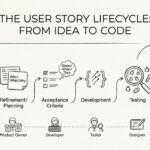 From Idea to Code: The Comprehensive Walkthrough of the User Story Lifecycle