

In modern software development, the efficiency of a team is often dictated by the clarity of its communication. When development teams spend excessive time in retrospectives discussing vague requirements, the cost extends far beyond the meeting room. It impacts velocity, morale, and the quality of the final product. This case study examines a specific instance where restructuring the user story format led to a measurable reduction in retrospective duration and an increase in development focus.
The Cost of Ambiguity in Agile Workflows 🛑
Ambiguity is the silent killer of productivity. In an agile environment, where iteration speed is paramount, unclear instructions create a ripple effect. Developers must pause to seek clarification. Designers may create assets that do not align with backend logic. QA engineers struggle to write test cases without concrete boundaries. The result is a cycle of rework that surfaces during retrospectives.
Typically, retrospectives are meant to focus on process improvement and team dynamics. However, when stories are poorly defined, these meetings often devolve into blame sessions regarding why work took longer than expected or why bugs appeared in production. The root cause is frequently the initial input: the user story.
Common Symptoms of Poor Story Definition
- Unclear Acceptance Criteria: Stories that lack specific conditions for completion lead to subjective interpretations.
- Missing Context: Developers often lack the business logic required to make technical trade-offs.
- Implicit Dependencies: Work items that rely on unstated prerequisites cause blockers during sprint execution.
- Variable Complexity: Stories that vary wildly in size prevent accurate sprint planning.
When these symptoms appear, the retrospective becomes a place to manage fallout rather than improve the system. The goal of this case study was to shift the team from reactive problem-solving to proactive prevention.
The Scenario: A High-Performance Team Stalled by Process ⚙️
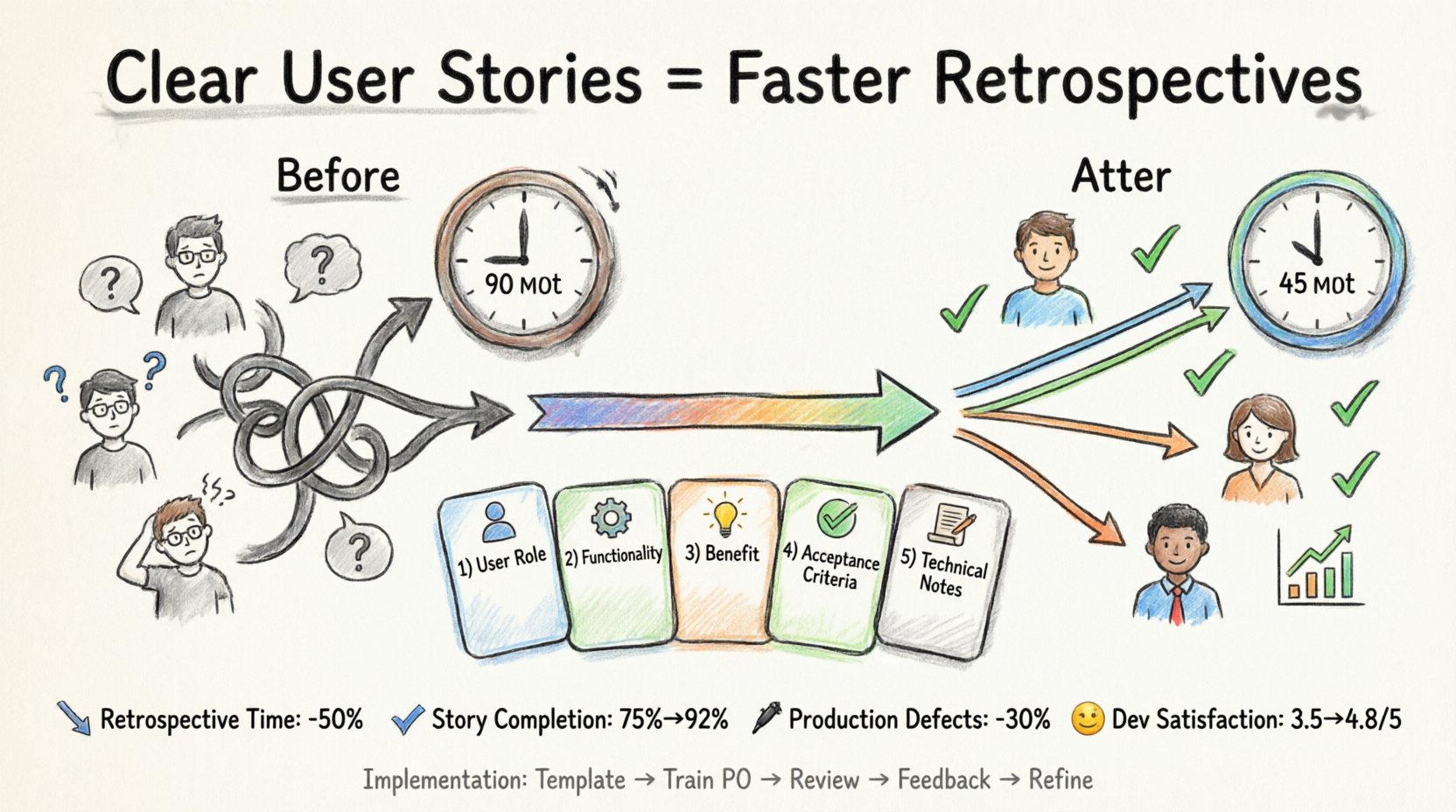
The team in question consisted of mid-level developers, a product owner, and a QA engineer. They were competent in their individual domains but struggled with cohesion. Their sprint retrospectives averaged 90 minutes. Of that time, approximately 40 minutes were spent debating the scope of the previous sprint’s work.
Questions like “Was this feature supposed to support mobile?” or “Did the backend team agree on this API structure?” were common. The team felt frustrated. They were not coding; they were constantly negotiating definitions. The product owner felt the developers were slow. The developers felt the requirements were moving targets. This friction drained the energy needed for actual development.
The Intervention: Structuring the User Story 📝
The solution was not to add more meetings or tools, but to refine the artifact used to describe work. The team adopted a standardized format for user stories. This format was designed to force clarity at the point of creation, ensuring that by the time the story reached the development board, it was ready to be worked on.
The new format required five distinct sections for every story:
- User Role: Who is using this feature?
- Functionality: What do they want to do?
- Benefit: Why does this matter to them or the business?
- Acceptance Criteria: A bulleted list of pass/fail conditions.
- Technical Notes: Specific constraints or architecture decisions required.
Before vs. After: Story Structure
| Component | Old Format | New Format |
|---|---|---|
| Clarity | One paragraph, loose language | Bulleted criteria, strict language |
| Completeness | Often missing edge cases | Includes negative test scenarios |
| Technical Context | Added during development | Defined before sprint start |
| QA Readiness | QA guesses requirements | QA tests against defined criteria |
This shift moved the cognitive load from the development phase to the planning phase. While it initially slowed down the writing of stories, it drastically reduced the time spent coding incorrect features.
The Retrospective Shift: Less Time, More Insight 🕒
After implementing the new format for three sprints, the team observed a significant change in their retrospective meetings. The average duration dropped from 90 minutes to 45 minutes. More importantly, the content of the meeting changed.
Without the need to argue about what was supposed to be built, the team could focus on how they built it. They discussed technical debt, deployment pipelines, and communication gaps between roles. The friction regarding scope disappeared because the scope was explicitly defined in the acceptance criteria.
Key Changes in Retrospective Dynamics
- Faster Consensus: Ambiguity was the main blocker to agreement. Removing it sped up decision-making.
- Reduced Blame: When a story failed, it was clear if it was a definition issue or an execution issue.
- Focus on Process: Discussions shifted from “Why did this fail?” to “How can we prevent this?”
- Higher Confidence: Developers felt more confident committing to work because the requirements were stable.
Implementing the Standard Format 🔧
Adopting a new workflow requires discipline. The team did not enforce the format immediately. They started with a pilot phase where stories were reviewed before entering the sprint.
Step-by-Step Implementation
- Define the Template: Create a shared document or template that includes the five required sections.
- Train the Product Owner: Ensure the person writing the stories understands the value of the acceptance criteria section.
- Review Before Sprint: Implement a “Definition of Ready” check. If a story does not meet the format, it cannot be pulled into the sprint.
- Feedback Loop: Ask developers after each story if the format helped them work faster. Adjust based on their feedback.
- Refine Over Time: As the team matures, the format may evolve. Allow for minor tweaks but keep the core structure.
This approach ensures that the format serves the team, rather than the team serving the format. It prevents bureaucracy while maintaining rigor.
Measuring the Impact on Velocity and Quality 📊
Data collection is essential to validate these changes. The team tracked several metrics over a six-month period.
Metric Changes
- Story Completion Rate: Increased from 75% to 92%. Fewer stories were left unfinished at the end of the sprint.
- Production Defects: Decreased by 30%. Clearer acceptance criteria meant fewer bugs slipped through QA.
- Retrospective Duration: Reduced by 50%. Meetings became more efficient and actionable.
- Developer Satisfaction: Survey scores regarding “Clarity of Work” rose from 3.5 to 4.8 out of 5.
The reduction in retrospective time was the most immediate benefit. It freed up two hours per sprint for the entire team. For a team of six, that is 12 hours of reclaimed productivity every two weeks. Over a quarter, this equates to nearly three weeks of additional development capacity.
Common Pitfalls to Avoid ⚠️
While the new format was successful, the team encountered challenges. Recognizing these pitfalls can help other teams avoid similar struggles.
Pitfall 1: Over-Engineering the Story
Initially, the team wrote stories that were too detailed. They spent days refining a simple button click. The lesson learned was to match the detail level to the complexity of the task. Simple tasks need simple stories. Complex tasks need detailed technical notes.
Pitfall 2: Ignoring Technical Debt
Focus on the new format sometimes led to neglecting refactoring. The team had to explicitly reserve capacity for technical debt in the sprint, ensuring the new format did not create a “new feature only” culture.
Pitfall 3: Rigidity in Definition
Teams sometimes treat the format as a rigid rule. If a story is urgent, the format can be simplified. The goal is clarity, not compliance. If a developer understands the requirement without the full template, that is acceptable.
Sustaining the Improvement 🌱
Improvements in process do not happen once. They require maintenance. The team established a quarterly review of their user story format. They asked:
- Are we spending too much time writing stories?
- Are we spending too little time clarifying them?
- Is the acceptance criteria still useful for QA?
This ongoing review ensures the process adapts as the team grows. New members are onboarded with the format, and veterans are encouraged to suggest refinements. The culture of clarity becomes part of the team identity.
The Psychological Impact on Developers 🧠
Beyond the metrics, there was a noticeable shift in the team’s psychology. Ambiguity creates anxiety. When developers do not know what is expected, they worry about failure. Clear requirements reduce this cognitive load.
Developers reported feeling less stressed during the sprint. They knew the goalposts. They knew when they were done. This reduction in stress allowed them to focus on solving problems rather than guessing requirements. It created a safer environment for innovation.
Long-Term Effects on Team Culture 🤝
Over time, the impact extended beyond the immediate team. The product owner began to understand the value of investing time upfront. They stopped treating requirements as fluid until the last minute. The QA team felt more empowered to challenge the product owner on the acceptance criteria.
This shift in culture created a shared responsibility for quality. Everyone understood that clarity is a prerequisite for speed. The retrospective became a place for celebration of what went well, not just a post-mortem of what went wrong.
Final Thoughts on Process Optimization 💡
Optimizing the user story format is a small change with a large impact. It addresses the root cause of many agile problems: misalignment. By investing in the clarity of the input, teams save time on the output. The reduction in retrospective time is a symptom of a healthier system.
Teams looking to improve their workflow should start by examining their artifacts. If the stories are vague, the process will suffer. Standardizing the format provides a foundation for trust and efficiency. It allows the team to move faster, not by working harder, but by thinking clearer.
Summary of Recommendations
- Standardize Input: Use a consistent template for all user stories.
- Define Done: Ensure acceptance criteria are testable and specific.
- Review Retrospectives: Monitor meeting duration and focus.
- Iterate on Process: Adjust the format as the team evolves.
- Focus on Clarity: Prioritize understanding over speed in the planning phase.
By following these principles, teams can reclaim the time lost to ambiguity and focus on what matters most: building valuable software efficiently.
Related posts:
 User Story Best Practices: The Hidden Rules Every Beginner Product Manager Must Follow
 Troubleshooting Blurry Acceptance Criteria: How to Fix Your User Stories Before Coding Starts
 Future Outlook: How User Stories Are Evolving with AI and Modern Product Teams
 User Story Refinement Secrets: How to Prepare Stories for Sprint Planning Like a Pro