

In the fast-paced environment of product development, clarity is currency. Product Owners frequently find themselves navigating a complex landscape of stakeholder expectations, technical constraints, and user needs. A common source of friction lies in the distinction between a User Story and a Feature Request. While both represent work to be done, they serve different purposes, require different levels of detail, and follow distinct paths through the development lifecycle. Misunderstanding these differences can lead to bloated backlogs, misaligned engineering efforts, and frustrated stakeholders.
This guide provides a comprehensive breakdown of these two critical artifacts. We will explore their definitions, structural differences, and the strategic implications of choosing one over the other. By understanding the nuance between these concepts, Product Owners can streamline their backlog management and ensure that every item moved forward delivers tangible value.
Understanding the Core Distinction 🧠
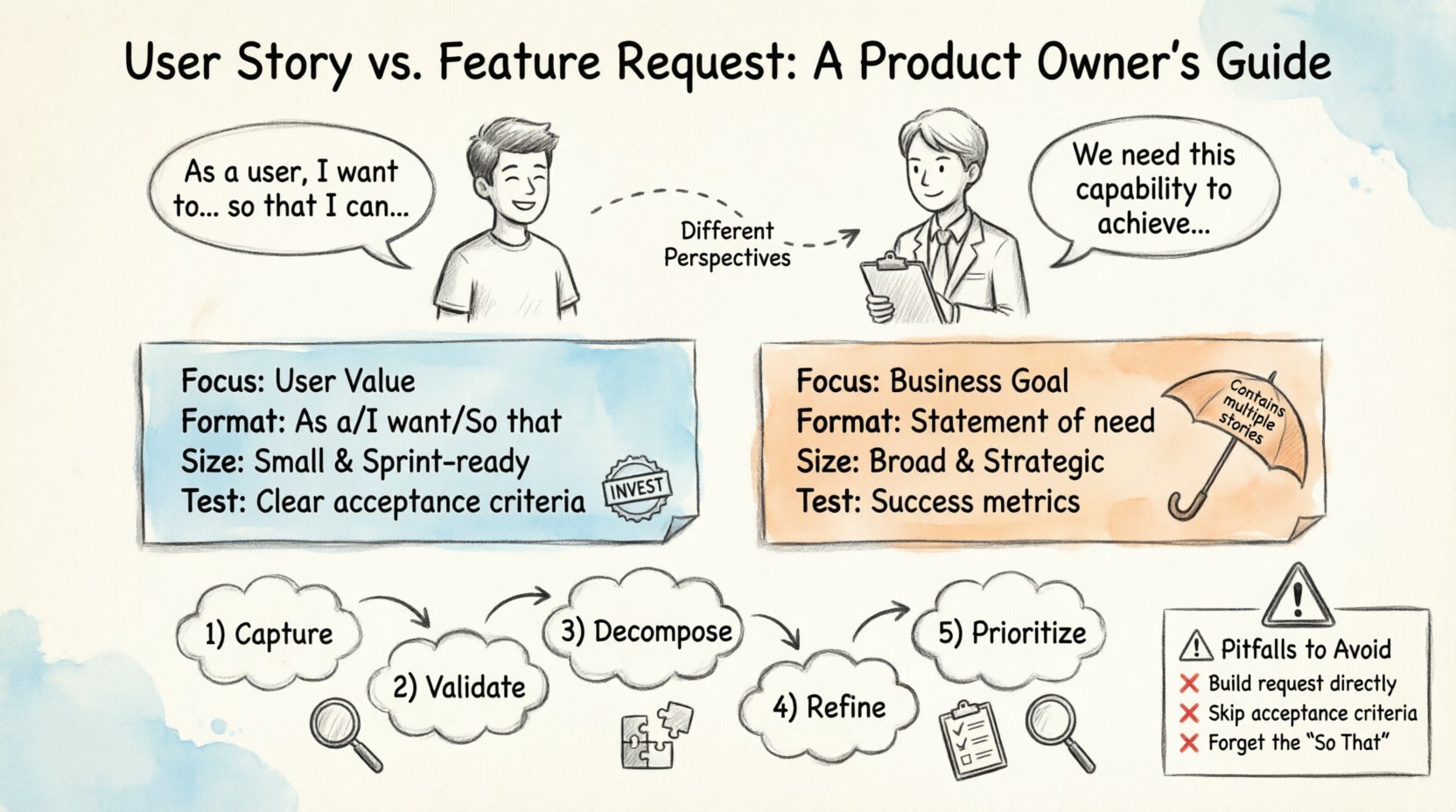
At a high level, the difference lies in focus. A User Story centers on the user and their specific experience within the product. It describes a capability from the perspective of an end-user who benefits from the work. A Feature Request, conversely, centers on the business or the system. It describes a capability that needs to exist in the product to meet a business goal, often without immediately detailing how a specific user interacts with it.
Confusion arises when stakeholders submit Feature Requests when User Stories are required, or when Product Owners attempt to build User Stories without understanding the broader business context provided by Feature Requests. Both are necessary components of a healthy product roadmap, but they require different handling during backlog refinement.
- User Stories are typically granular, testable, and focused on individual value delivery.
- Feature Requests are often broader, focused on business outcomes, and may encompass multiple User Stories.
What is a User Story? 📝
A User Story is a lightweight, informal description of a feature told from the perspective of the person who desires the new capability. It is a tool for communication, not a specification document. The primary goal is to capture a specific piece of value that a user can realize.
The Standard Format
Most teams utilize a standard template to ensure clarity:
- As a [type of user]
- I want to [perform an action]
- So that [achieve a benefit]
This format forces the writer to consider the user and the value proposition. Without the “So that” component, the development team might build the functionality but fail to solve the underlying problem.
Key Characteristics of a Strong User Story
To ensure a User Story is actionable, it must meet specific criteria. These criteria help the team determine when a story is ready for development.
- Independent: The story should be able to be developed without relying on other stories, though dependencies can exist.
- Negotiable: Details are not fixed at the outset; they are discussed during refinement.
- Valuable: It must deliver value to the user or the business.
- Estimable: The team must be able to estimate the effort required to complete the work.
- Small: It should be small enough to be completed within a single iteration or sprint.
- Testable: There must be clear criteria to determine when the story is complete.
When a Product Owner writes a User Story, they are essentially making a promise to the team about what value is being delivered. This clarity reduces ambiguity and helps engineers focus on the right problem.
What is a Feature Request? 🚀
A Feature Request is a proposal for a new capability or a change to an existing one. It is often initiated by stakeholders, sales teams, or customer support to address a gap in the current product offering. Unlike a User Story, a Feature Request does not always detail the user interaction. It describes the “what” without always explaining the “how” or the “who”.
The Purpose of a Feature Request
Feature Requests serve as a high-level capture mechanism for business needs. They are essential for tracking demand and identifying trends. For example, a request to “Add Multi-Language Support” is a Feature Request. It does not specify which languages, how the UI changes, or which user roles are affected. These details need to be fleshed out later.
When Feature Requests Are Appropriate
Not all work begins as a User Story. There are scenarios where a Feature Request is the correct starting point:
- Strategic Initiatives: When a new market expansion is planned, the feature is defined before the user details are known.
- Compliance Requirements: Legal or regulatory changes may require specific functionality without immediate user context.
- Technical Debt: Refactoring efforts often start as requests to improve system stability rather than user-facing stories.
- Stakeholder Input: When a key client requests a capability that impacts the entire platform, it is logged as a request first.
Feature Requests act as the umbrella under which multiple User Stories may eventually fall. They provide the context that helps Product Owners prioritize which stories matter most.
Key Differences at a Glance 📊
Visualizing the differences can help Product Owners quickly identify which format to use for incoming work. The table below outlines the primary distinctions.
| Aspect | User Story | Feature Request |
|---|---|---|
| Focus | User value and experience | Business capability or requirement |
| Granularity | Small, specific, actionable | Broad, high-level, conceptual |
| Owner | Product Owner (internal) | Stakeholders, Customers, Sales |
| Format | As a… I want… So that… | Statement of need or requirement |
| Lifecycle | Ready for development | Needs refinement into stories |
| Testing | Clear acceptance criteria | General acceptance or success metrics |
Understanding this table helps prevent the common error of trying to build a Feature Request directly as a ticket for engineering. Engineering teams need the specificity that User Stories provide to execute code effectively.
The Lifecycle: From Request to Story 🔁
In many organizations, work begins as a Feature Request and evolves into a set of User Stories. This transformation process is critical for Product Owners to manage. It involves breaking down a large business need into manageable, testable units of work.
Step 1: Capture the Request
When a stakeholder submits a request, it should be logged in a central repository. This ensures nothing is lost and allows for future analysis of demand patterns. At this stage, the focus is on recording the business value and the urgency.
Step 2: Initial Validation
Before breaking down the work, the Product Owner must validate the request. Is this aligned with the product vision? Does it solve a real problem? Is the timing appropriate? This step filters out noise and ensures resources are not wasted on low-value initiatives.
Step 3: Decomposition
Once validated, the Feature Request is broken down. The Product Owner works with the team to identify the specific user interactions required. For example, a request for “Export Data” becomes stories for “Export as CSV,” “Export as PDF,” and “Schedule Auto-Export.” Each of these is now a distinct User Story.
Step 4: Refinement and Acceptance Criteria
Each new User Story must have clear acceptance criteria. This defines the boundaries of the work. What happens if the export fails? Who can access the file? These details ensure that the development team and the Product Owner share a single understanding of the goal.
Step 5: Prioritization
Finally, the resulting User Stories are prioritized against other work in the backlog. A Feature Request might be approved, but the individual stories within it might be scheduled for later sprints based on capacity and strategic alignment.
Common Pitfalls to Avoid ⚠️
Even experienced Product Owners can stumble when managing these artifacts. Awareness of common mistakes helps maintain a healthy workflow.
1. Treating Feature Requests as Ready-to-Build Items
Assigning a Feature Request directly to an engineering sprint without decomposition leads to scope creep. Developers may make assumptions that do not align with the product vision. Always break down Feature Requests into Stories before planning.
2. Writing Stories Without Acceptance Criteria
A User Story without acceptance criteria is merely a wish list. It leaves too much room for interpretation. This often results in rework, as the delivered feature may not meet the actual needs of the user or the business.
3. Ignoring the “So That” Component
When focusing too much on the “As a” and “I want” parts, the value proposition is lost. If a team builds a feature but cannot articulate the benefit, the product may drift away from its core purpose. Always ensure the benefit is clear.
4. Over-Documenting User Stories
User Stories are meant to be lightweight. If a story requires a 20-page document to be understood, it is likely too complex. It should be broken into smaller stories. The conversation is more important than the documentation.
5. Confusing Technical Tasks with User Stories
Tasks like “Update Database Schema” are not User Stories. They are technical implementation details. While necessary, they do not deliver value to the end-user directly. These should be linked to a User Story that describes the user-facing change.
Collaboration Strategies 🤝
The distinction between User Stories and Feature Requests is not just about documentation; it is about communication. How the Product Owner engages with stakeholders and the engineering team determines the success of the process.
Engaging Stakeholders
When a stakeholder asks for a Feature Request, the Product Owner should guide them toward thinking about the user. Instead of accepting a vague requirement, ask questions like: “Who will use this?” and “What problem are they facing?” This helps convert a Feature Request into a User Story naturally.
Working with Engineering
Developers often prefer User Stories because they provide clear boundaries. They also prefer to understand the “why.” When a Product Owner explains the user value, engineers are more motivated to find creative technical solutions. Treat the backlog as a collaborative tool, not a mandate.
Feedback Loops
Once a User Story is delivered, feedback is crucial. Did the user achieve the benefit described in the “So that” clause? If not, the Product Owner must revisit the understanding. This feedback loop informs future Feature Requests and ensures continuous improvement.
Measuring the Impact 📈
How do you know if the distinction between these artifacts is working? Metrics can provide insight into the health of the product process.
- Refinement Velocity: How long does it take to turn a Feature Request into ready User Stories? A shorter time indicates clear communication.
- Rejection Rate: How many User Stories are rejected during development due to missing criteria? A high rate suggests poor initial definition.
- Stakeholder Satisfaction: Are stakeholders feeling heard? Feature Requests ensure their input is captured, even if it is not implemented immediately.
- Delivery Frequency: Are teams delivering value more consistently? Clear User Stories reduce ambiguity and speed up delivery.
Conclusion and Final Thoughts 📌
The difference between a User Story and a Feature Request is a matter of perspective. One looks outward to the user, while the other looks inward to the business. Both are vital for a successful product. By maintaining a clear distinction and understanding how to transform one into the other, Product Owners can create a roadmap that is both strategically sound and operationally efficient.
Remember, the goal is not to force every request into a User Story immediately. Sometimes a Feature Request is the right tool for the job. The key is to know when to use each and how to manage the transition between them. Clarity in these definitions reduces friction, aligns teams, and ultimately leads to better products for the people who use them.
As you manage your backlog, keep these distinctions in mind. Encourage your team to ask the right questions. Focus on value over output. By doing so, you build a culture of precision and purpose that drives long-term success.
Related posts:
 How to Write Your First User Story: A Step-by-Step Guide for New Product Managers
 Q&A: Answering the Top 10 Confusing Questions About User Stories for New Agilites
 How to Write User Stories That Cut Down on Clarification Meetings by Half
 The Ultimate Checklist for Reviewing User Stories Before Adding Them to the Backlog