


In the landscape of modern business strategy, few tools have endured as long as Porter’s Five Forces. While new methodologies emerge constantly, the core logic behind this framework remains a bedrock for understanding industry profitability. This is particularly true when evaluating disruptive markets where traditional boundaries blur. Understanding the competitive forces at play allows organizations to anticipate shifts rather than merely react to them.
This guide provides a deep dive into the mechanics of the Five Forces model. We will examine how these forces manifest in volatile sectors, why the framework retains relevance despite the rise of platforms and gig economies, and how to apply it without relying on software shortcuts. Strategic clarity comes from rigorous analysis, not just the adoption of new buzzwords.
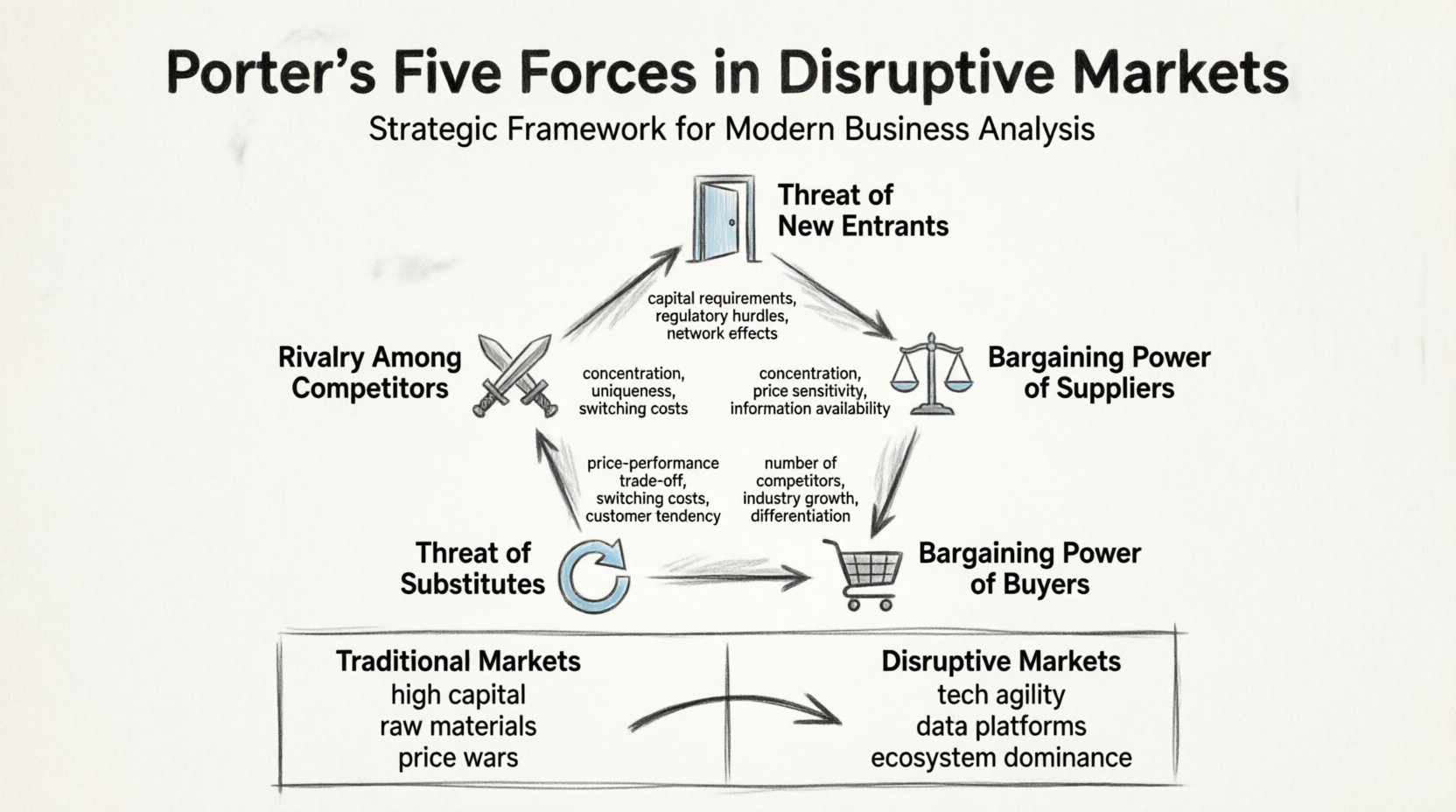
🔍 What is Porter’s Five Forces Framework?
Developed by Michael Porter in 1979, this model assesses the competitive intensity and attractiveness of a market. It moves beyond simple revenue projections to examine the structural drivers of profit. The framework posits that the profitability of an industry depends on five specific forces. These forces dictate the balance of power between companies, customers, and suppliers.
When applied correctly, the analysis reveals where power lies within the value chain. It helps answer critical questions:
- Can suppliers dictate prices?
- Is it easy for new competitors to enter?
- Do customers have leverage to demand lower costs?
- Are there viable alternatives to the current offering?
- How intense is the rivalry among existing players?
In stable industries, these dynamics change slowly. In disruptive markets, they shift rapidly. This volatility makes the framework even more critical, as it provides a structure to categorize chaos.
📊 The Five Forces Explained
To utilize this tool effectively, one must understand the specific mechanics of each force. Below is a breakdown of each component, including factors that influence them in both traditional and emerging contexts.
1. Threat of New Entrants 🚪
This force measures how easy it is for new competitors to enter the market. High barriers to entry protect existing players; low barriers invite saturation.
- Capital Requirements: Traditional manufacturing requires heavy investment. Tech startups may need less capital but significant intellectual property.
- Regulatory Hurdles: Healthcare and finance often face strict government oversight. Disruptive models sometimes challenge these regulations, creating friction.
- Access to Distribution: Established companies often own key channels. New entrants must find alternative routes, such as direct-to-consumer models.
- Switching Costs: If customers face high costs to switch, new entrants struggle. Low switching costs increase the threat.
- Network Effects: In platform markets, the value increases as more users join. This creates a massive barrier for newcomers.
2. Bargaining Power of Suppliers ⚖️
Suppliers can exert pressure by raising prices or reducing quality. This is most potent when there are few suppliers and few substitutes for their input.
- Concentration: A monopoly or oligopoly of suppliers gives them significant leverage over buyers.
- Uniqueness of Product: Specialized components or proprietary technology increase supplier power.
- Switching Costs: If changing suppliers requires retooling or retraining, the current supplier holds power.
- Forward Integration: Suppliers may threaten to enter the buyer’s market directly, forcing concessions.
3. Bargaining Power of Buyers 🛒
Buyers exert pressure by demanding lower prices or higher quality. This force grows when customers are large or when the product is commoditized.
- Concentration: A few large customers buying in bulk hold more power than a fragmented mass market.
- Price Sensitivity: In markets where the product cost is a small fraction of total buyer expenses, power is lower.
- Threat of Backward Integration: If buyers can make the product themselves, they can negotiate harder.
- Information Availability: When buyers can easily compare prices and features, they gain leverage.
4. Threat of Substitutes 🔄
Substitutes are products from outside the industry that solve the same problem. This is often the most overlooked force in disruptive contexts.
- Price-Performance Trade-off: If a substitute is cheaper or better, demand shifts away.
- Switching Costs: High switching costs reduce the threat. Low switching costs increase it.
- Customer Tendency: Some buyers are naturally open to trying new solutions, increasing the threat.
- Examples: Video conferencing substitutes for business travel. Plant-based meats substitute for traditional livestock.
5. Rivalry Among Existing Competitors ⚔️
This force looks at the intensity of competition between current players. It is the most visible aspect of industry analysis.
- Number of Competitors: More competitors usually mean more intense rivalry.
- Industry Growth: In stagnant markets, companies fight for market share. In growing markets, they grow together.
- Product Differentiation: Commodity products lead to price wars. Differentiated products allow for premium pricing.
- Exit Barriers: If it is hard to leave the industry, companies fight harder to survive, intensifying competition.
🌪️ Applying the Framework in Disruptive Markets
Disruption changes the rules. Technology accelerates change, and new business models redefine value. The Five Forces framework does not disappear; it adapts. Here is how the dynamics shift in modern environments.
Consider the difference between a traditional utility company and a decentralized energy grid. The supplier power might shift from raw material providers to technology platforms. The threat of new entrants moves from capital-heavy construction to software-enabled aggregation.
The table below illustrates how these forces manifest differently across traditional and disruptive sectors.
| Force | Traditional Market Context | Disruptive Market Context |
|---|---|---|
| New Entrants | High capital, regulatory barriers | Low capital, high tech agility, regulatory arbitrage |
| Suppliers | Raw material focus, long contracts | Data providers, platform APIs, talent scarcity |
| Buyers | Price sensitivity, loyalty programs | Network influence, expectation of customization |
| Substitutes | Direct functional alternatives | Non-consumption, behavioral shifts |
| Rivalry | Price wars, market share battles | Speed wars, ecosystem dominance, data control |
🛠️ Conducting the Analysis: A Step-by-Step Approach
Executing a robust analysis requires discipline and data. It is not a one-time exercise but a recurring review of the strategic environment. Follow these steps to build a comprehensive assessment.
Step 1: Define the Industry Scope 📏
Before analyzing, you must define the boundaries. Is the market defined by geography, product type, or customer segment? In disruptive sectors, the definition is fluid. A ride-sharing company competes with public transit, car ownership, and walking. Define the scope clearly to avoid data dilution.
Step 2: Gather Qualitative and Quantitative Data 📝
Data collection should be thorough. Avoid relying on a single source. Use a mix of:
- Financial reports from competitors
- Customer feedback and reviews
- Industry expert interviews
- Regulatory filings
- Market research reports
Ensure the data is current. In fast-moving markets, data from two years ago may be irrelevant. Validate assumptions with fresh evidence.
Step 3: Assess Each Force Individually 🧩
Dedicate specific time to each of the five forces. Do not rush this process. For each force, identify the key drivers. Ask:
- What is the trend? Is power increasing or decreasing?
- Who holds the power? Is it shifting?
- What are the critical success factors?
Document your findings clearly. Use scoring systems (e.g., High, Medium, Low) to visualize the intensity.
Step 4: Synthesize the Findings 🧠
Combine the individual assessments to form an overall view. Does one force dominate the others? Is the industry becoming more attractive or less so? This synthesis forms the basis for strategic decisions.
Step 5: Formulate Strategic Responses 🎯
Analysis is useless without action. Based on the findings, determine the strategic posture:
- Defense: Strengthen barriers to protect existing position.
- Offense: Exploit weaknesses in competitor positions.
- Innovation: Develop new offerings to neutralize substitutes.
- Partnership: Align with suppliers or buyers to balance power.
⚠️ Limitations and Challenges
While powerful, the framework is not a crystal ball. It has limitations that analysts must acknowledge. Understanding these weaknesses prevents strategic blind spots.
- Static Nature: The model was designed for stable environments. It may struggle to capture rapid, exponential changes in tech sectors.
- Focus on Industry, Not Firm: It explains industry profitability but does not fully account for internal capabilities like culture or talent.
- Interdependence: Forces do not operate in isolation. A change in supplier power might affect buyer power.
- External Factors: Macro trends like climate change or geopolitical shifts are not explicitly included.
To mitigate these issues, combine the Five Forces with other analytical tools. Use the Resource-Based View (RBV) to assess internal strengths. Use PESTLE analysis to capture macro-environmental factors. This holistic approach creates a more robust strategic picture.
🚀 Strategic Implications for Disruption
When disruption occurs, the goal is often to render the existing forces obsolete. This is how new entrants gain footholds. However, incumbents can also adapt.
For New Entrants: The strategy often involves attacking a specific force where incumbents are vulnerable. For example, a new fintech company might attack the “Bargaining Power of Suppliers” by bypassing traditional banking infrastructure entirely.
For Incumbents: The strategy involves fortifying the forces that protect them. This could mean acquiring startups to neutralize the “Threat of New Entrants” or bundling services to increase “Switching Costs” for buyers.
In platform economies, the “Threat of Substitutes” is often replaced by the “Threat of Ecosystems.” Competitors are no longer just other companies; they are entire ecosystems vying for user attention and time.
📈 Long-Term Value of the Framework
Why continue using a model from the late 1970s? Because human behavior and economic incentives do not change fundamentally. The desire to maximize profit and minimize cost remains constant. The Five Forces simply map these incentives.
Even in AI-driven markets, the dynamics of supply and demand, bargaining power, and competition still apply. The medium changes, but the mechanics of value exchange remain. Organizations that ignore these structural forces often find themselves blindsided by shifts they thought they controlled.
Strategic planning is not about predicting the future with certainty. It is about preparing for multiple possibilities. The Five Forces provide a structured way to explore those possibilities. It forces leaders to look beyond their immediate product and see the broader ecosystem.
🤔 Frequently Asked Questions
How often should I conduct a Five Forces analysis?
In stable industries, an annual review may suffice. In highly volatile or disruptive markets, a quarterly review is advisable. Major shifts in technology or regulation should trigger an immediate re-evaluation.
Can this framework work for non-profits?
Yes. The forces apply to any competitive environment. For a non-profit, “customers” might be donors, and “revenue” might be grants. The dynamics of scarcity and competition remain relevant.
What if the forces seem contradictory?
It is common for forces to pull in different directions. For example, low rivalry might exist, but high supplier power could erode profits. The analysis should weigh the forces based on their impact on your specific business model.
Is this framework applicable to B2B or B2C?
It applies to both. The definition of “buyer” and “supplier” changes, but the underlying logic of power dynamics remains the same. B2B often involves longer relationships, while B2C might involve higher volume and lower switching costs.
🔮 Looking Ahead
The business environment continues to evolve. New tools and technologies will emerge. However, the need for structured strategic thinking persists. Porter’s Five Forces offers a durable lens for viewing these changes. It compels leaders to ask hard questions about where power lies and how it might shift.
By integrating this framework into regular planning cycles, organizations can build resilience. They become better equipped to navigate the turbulence of disruption. The goal is not to eliminate uncertainty but to understand the forces that shape it. This understanding is the foundation of sustainable competitive advantage.
Start by mapping your current industry. Identify the dominant forces. Then, challenge the assumptions. The insights gained will inform decisions that matter. Strategy is a practice, not a destination. Keep refining your analysis as the market evolves.
Related posts:
 What Is Porter Five Forces Analysis? A Simple Breakdown for Strategy Students
 Porter Five Forces Analysis: A Myth-Buster Guide for Students Confused by the Framework
 Porter Five Forces Analysis: A Practical Guide to Analyzing Buyer Bargaining Power
 Porter Five Forces Analysis: A Q&A for Students Struggling with the Framework