


Understanding how industries work is a core skill for anyone studying business strategy. One of the most enduring frameworks in this field is the Porter Five Forces Analysis. Created by Michael Porter in 1979, this model helps you look at the competitive landscape of an industry. It moves beyond simple competitor names and looks at the structural forces that shape profitability.
For students entering strategy courses, this framework can seem dense. There is often a lot of academic jargon that obscures the practical value. This guide strips away the complexity. It explains what each force means, how they interact, and how you can apply the analysis to real-world scenarios. You do not need expensive software or complex spreadsheets to begin. You need a clear mind and a willingness to look at the market structure.
📚 What Is Industry Structure? 🏭
Before diving into the five specific forces, it is important to understand the concept of industry structure. In economics and strategy, an industry is not just a group of companies selling similar products. It is a system of relationships. The structure determines the overall profit potential of the industry. If the structure is favorable, companies can make high returns. If the structure is unfavorable, even the best companies might struggle to survive.
Porter argued that profitability is not just about good management. It is about where the company sits within the industry. The Five Forces framework maps the power dynamics in that environment. It helps you see where pressure comes from. This pressure can squeeze margins. It can force prices down. It can increase costs. By understanding these pressures, a strategist can choose where to position the company to defend against them.
🔍 The Five Forces Explained 🧩
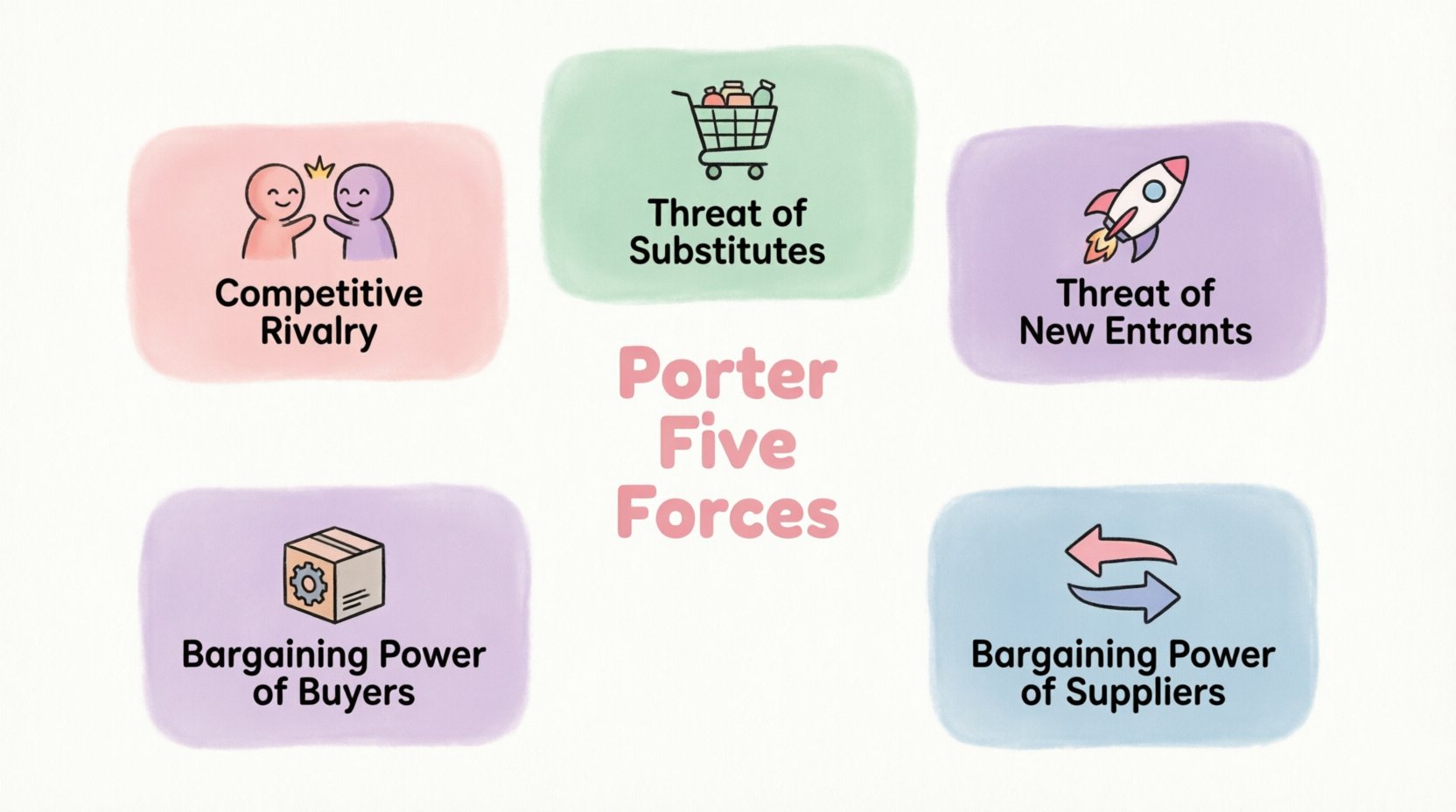
The framework consists of five distinct forces. Each one represents a different source of competitive pressure. To use this tool effectively, you must evaluate each force separately. Then, you must consider how they work together. Below is a detailed breakdown of each force.
1. Competitive Rivalry 🔥
This force refers to the intensity of competition among existing firms in the industry. It is often considered the most visible force. You see it in price wars, advertising battles, and new product launches. However, the intensity varies wildly depending on the industry.
Key Drivers of Rivalry:
- Number of Competitors: When there are many players of similar size, rivalry tends to be high. When one or two firms dominate, rivalry may be lower.
- Industry Growth: In a slow-growth market, companies fight for market share. In a fast-growth market, they fight for customers. Stealing share is harder when the total pie is expanding.
- Product Differentiation: If products are commoditized (like steel or sugar), companies compete primarily on price. If products are unique, they compete on features and brand.
- Switching Costs: If it is easy for a customer to switch to a competitor, rivalry is high. If it is difficult, companies have more loyalty.
- Capacity Augmentation: If companies need to build large new plants to grow, they often lower prices to fill capacity, driving rivalry up.
Strategic Implication: High rivalry usually leads to lower profits. A strategy here focuses on differentiation or cost leadership to survive the squeeze.
2. Threat of New Entrants 🚀
This force looks at how easy or difficult it is for new companies to enter the market. If entry is easy, new competitors can flood the market and drive down prices. If entry is hard, existing companies can protect their profits.
Barriers to Entry:
- Capital Requirements: Does starting the business require millions of dollars? Industries like aerospace or manufacturing have high barriers. Retail or consulting often have low barriers.
- Regulatory Hurdles: Government licenses, patents, and environmental regulations can block new players.
- Access to Distribution Channels: Can the new entrant get their product onto shelves or online platforms? Incumbents often control these relationships.
- Economies of Scale: If large companies have much lower costs per unit, new small players cannot compete on price.
- Brand Loyalty: If customers strongly prefer existing brands, a new entrant must spend heavily to win them over.
Strategic Implication: Strong barriers protect incumbents. A company with high barriers can focus on long-term planning without worrying about a sudden influx of rivals.
3. Threat of Substitutes 🔄
Substitutes are not direct competitors. They are different products that solve the same problem. For example, butter and margarine are substitutes. Video conferencing and business travel are substitutes. This force is often overlooked but is critical.
Key Considerations:
- Price-Performance Trade-off: If a substitute is cheaper and performs well enough, customers will switch. Even if your product is better, price matters.
- Switching Costs: Substitutes often have low switching costs. If a customer can easily try a new solution, the threat is higher.
- Perceived Value: Do customers see the substitute as a viable alternative? If they do not, the threat is low.
Strategic Implication: Substitutes put a ceiling on the prices you can charge. If prices go too high, customers will find another way to solve their problem.
4. Bargaining Power of Suppliers 📦
Suppliers are the companies that provide your inputs. They can be raw material providers, technology vendors, or service partners. If suppliers are powerful, they can raise prices or reduce quality, hurting your profitability.
When Suppliers Are Powerful:
- Few Suppliers: If there are only a few companies making the input, they hold the leverage.
- Unique Inputs: If the input is specialized or patented, you cannot easily switch.
- Threat of Forward Integration: Can the supplier start making your product themselves? If they can, they have leverage.
- Switching Costs: If changing suppliers requires retraining staff or changing machinery, you are locked in.
Strategic Implication: Weak supplier power allows you to negotiate better terms. Strong supplier power requires you to build relationships or find alternatives.
5. Bargaining Power of Buyers 🛒
Buyers are the customers. They can demand lower prices or higher quality. If buyers are powerful, they capture value that would otherwise go to the company.
When Buyers Are Powerful:
- Concentration: If a few large customers buy most of your product, they have leverage.
- Standardized Products: If your product is the same as everyone else’s, buyers will choose the cheapest option.
- Threat of Backward Integration: Can the buyer make the product themselves? If they can, they can threaten to stop buying.
- Price Sensitivity: If the cost of your product is a large part of the buyer’s total cost, they will fight hard to lower it.
Strategic Implication: High buyer power squeezes margins. You must build brand loyalty or product uniqueness to reduce this power.
📊 Comparing the Forces: A Quick Overview 📋
To help you remember the distinctions, here is a comparison table. It highlights the primary focus and the main lever for each force.
| Force | Primary Focus | Main Lever |
|---|---|---|
| Competitive Rivalry | Existing companies | Market share & pricing |
| New Entrants | Future competitors | Barriers to entry |
| Substitutes | Different solutions | Price-performance ratio |
| Suppliers | Input providers | Cost & availability |
| Buyers | Customers | Price & quality demands |
🛠️ How to Conduct a Five Forces Analysis 📝
Conducting this analysis is a structured process. You do not need to guess. You follow a logical path to gather data and draw conclusions. Here is a step-by-step approach.
Step 1: Define the Industry 🌍
First, you must define the boundaries. What exactly are you analyzing? Is it the “Coffee Industry” or the “Fast Food Industry”? The definition matters. If you define it too broadly, the analysis becomes vague. If you define it too narrowly, it becomes irrelevant. Be specific about the product and the geographic scope.
Step 2: Gather Data 🔎
You need information to answer the questions for each force. You can find this data in several ways without buying expensive reports.
- Financial Reports: Public companies publish annual reports. Look at profit margins and cost structures.
- News Articles: Industry news often discusses pricing wars or supply chain issues.
- Customer Reviews: Read what customers say about competitors. What are they complaining about?
- Expert Interviews: Talk to people who work in the industry. They know the hidden dynamics.
Step 3: Evaluate Each Force 🧠
For each of the five forces, decide if the pressure is Low, Medium, or High. Use the drivers listed in the section above to guide your decision.
- For Rivalry: Is the market growing? Are products different?
- For Entrants: Is it hard to get a license? Is capital expensive?
- For Substitutes: Are there new technologies replacing the old?
- For Suppliers: Are there few vendors for the key components?
- For Buyers: Are the customers large corporations or individuals?
Step 4: Assess Profitability Potential 💰
Once you have rated each force, look at the overall picture. If most forces are High, the industry has low profitability potential. If most are Low, the industry is attractive. This does not mean you will succeed, but the structural conditions are favorable.
Step 5: Identify Strategic Actions 🚀
Finally, use the findings to make decisions. If supplier power is high, look for alternative sources. If buyer power is high, try to differentiate the product. If rivalry is high, find a niche segment to serve.
🌐 Real-World Example: The Airline Industry ✈️
Let us apply this to a concrete example. Consider the commercial airline industry. This industry is known for thin margins. Let us see why the Five Forces model explains this.
- Competitive Rivalry: High. There are many airlines. Prices are transparent. Customers compare prices instantly. Capacity is high.
- Threat of New Entrants: Medium to Low. Buying planes is expensive. Building a brand takes time. However, low-cost carriers can still enter easily.
- Threat of Substitutes: Medium. Trains, cars, and video calls can replace short-haul flights. Long-haul travel has fewer substitutes.
- Bargaining Power of Suppliers: High. There are only two major manufacturers for large commercial jets (Boeing and Airbus). This creates an oligopoly on the supply side.
- Bargaining Power of Buyers: High. Customers can easily compare fares online. Frequent flyer programs help, but price is still the main driver.
Conclusion: The industry structure is difficult. High rivalry and high buyer power squeeze margins. High supplier power raises costs. This explains why airlines often struggle to make significant profits compared to other industries.
⚖️ Limitations of the Framework ⚠️
While useful, this framework is not perfect. It has limitations that you should be aware of. Relying on it blindly can lead to errors.
- Static Nature: The model looks at a snapshot in time. Industries change rapidly. Technology can shift the balance in a year.
- Focus on Competition: It focuses on rivalry. It does not always account for collaboration or ecosystem building.
- Definition of Industry: In the digital age, industry boundaries are blurry. A tech company might compete with a media company. The model struggles with these blurred lines.
- Internal Focus: It looks at the industry, not the company. Two companies in the same industry can have very different strategies. The model does not explain internal strengths.
🤝 Integrating with Other Tools 🔗
Strategy is rarely about one tool. You should combine the Five Forces with other frameworks for a complete picture.
SWOT Analysis 📊
SWOT stands for Strengths, Weaknesses, Opportunities, and Threats. The Five Forces feed directly into the Threats and Opportunities sections of a SWOT analysis. The forces tell you about the external environment. SWOT helps you match that environment with your internal capabilities.
PESTLE Analysis 🌍
PESTLE looks at Political, Economic, Social, Technological, Legal, and Environmental factors. These macro factors often drive the Five Forces. For example, a new law (Political) might raise barriers to entry. A new technology (Technological) might increase the threat of substitutes. Use PESTLE to understand why the forces are changing.
🎓 Tips for Strategy Students 💡
If you are studying this for a course, keep these tips in mind to ensure success.
- Be Specific: Do not analyze “The Tech Industry.” Analyze “The Cloud Storage Industry for Small Businesses.” Specificity leads to accuracy.
- Use Evidence: Do not just say rivalry is high. Explain why. Mention specific competitors or pricing data.
- Think Dynamically: Ask how the forces might change in the next five years. Strategy is about the future, not just the present.
- Focus on the Bottom Line: Remember that the goal is profitability. Every force should be linked back to how it affects margins and revenue.
- Practice: Try analyzing industries you know. Think about the coffee shop down the street or the streaming service you use. Apply the five forces to your daily life.
📈 The Value of Understanding Structure 💎
Why does this matter? Because strategy is not just about doing things better. It is about doing the right things. The Five Forces framework helps you identify the right things to do. It shows you where the pressure points are.
When you understand the structure, you stop fighting battles you cannot win. You stop trying to compete on price when the market is saturated. You start looking for niches where the forces are weaker. This saves resources. It improves efficiency. It leads to sustainable growth.
For beginners, this framework provides a mental map. It organizes the chaos of the market into manageable parts. It gives you a vocabulary to discuss strategy with confidence. It moves the conversation from “I think we should” to “The data shows we must.”
🔚 Final Thoughts 🏁
The Porter Five Forces Analysis remains a cornerstone of strategic management. It offers a clear way to dissect an industry. It helps you see beyond the surface level of competitors. By understanding the five forces, you gain insight into the root causes of profitability.
Remember that this is a tool, not a crystal ball. Use it to guide your thinking. Combine it with other insights. Keep your analysis up to date. With practice, you will develop the ability to see the hidden structures in any market. This skill is valuable in business school and in the real world. It allows you to navigate complexity with clarity and purpose.
Start your analysis today. Pick an industry. Ask the questions. Map the forces. You will find that the market makes more sense when you know where the power lies.
Related posts:
 Porter Five Forces Analysis: A Step-by-Step Walkthrough for Business School Beginners
 Porter Five Forces Analysis: A Checklist for Evaluating Market Competition Accurately
 Porter Five Forces Analysis: How New Entrants Shape Industry Dynamics (And How to Predict Them)
 Porter Five Forces Analysis: Applying It to Tech, Retail, and Healthcare Industries