


Strategic planning requires more than intuition. It demands a structured view of the market dynamics that influence profitability and long-term viability. Michael Porter introduced the Five Forces framework in 1979, and it remains a cornerstone for understanding industry attractiveness. This guide details how to apply this model to refine your business model decisions, ensuring your strategy aligns with external realities.
🔍 Understanding the Framework
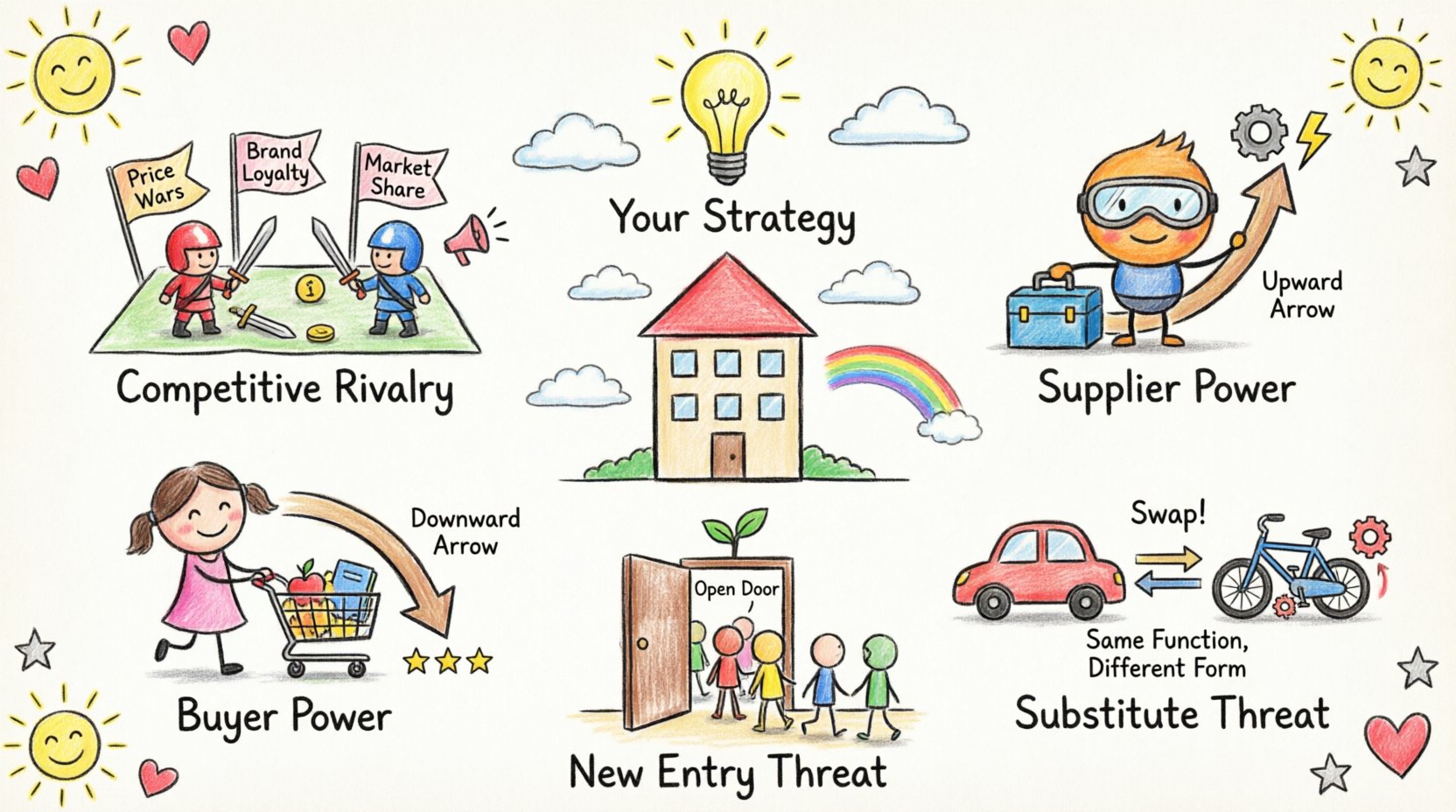
The core premise is simple: industry competition is not just about existing rivals. It includes potential entrants, substitutes, and the bargaining power of both suppliers and customers. By evaluating these five distinct pressures, you can determine the profit potential of a specific market sector. This analysis serves as the foundation for setting pricing, managing costs, and defining value propositions.
When applied correctly, this tool moves beyond simple competitor tracking. It reveals structural weaknesses in your current approach. For instance, high supplier power might dictate that you need to integrate backward or diversify your supply chain. Conversely, low buyer power might allow for premium pricing strategies.
- Industry Structure: Understand the rules of the game.
- Competitive Pressure: Identify where margins are squeezed.
- Strategic Positioning: Locate areas where you can defend against threats.
🔥 Force 1: Competitive Rivalry Among Existing Firms
This force examines the intensity of competition among current players. High rivalry leads to aggressive marketing, price wars, and increased investment in product innovation. It is often the most visible force.
📉 Indicators of High Rivalry
- A large number of competitors with similar market share.
- Slow industry growth rates forcing fights for market share.
- High fixed costs requiring maximum capacity utilization.
- Low switching costs for customers.
- Industry fragmentation with many small players.
When rivalry is high, profit margins tend to compress. Your business model must account for this by either differentiating your offering significantly or achieving lower operational costs than the competition. If the industry is saturated, entering without a distinct advantage is risky.
💡 Strategic Implications
- Differentiation: Focus on unique features that reduce price sensitivity.
- Niche Focus: Target a specific segment where rivalry is lower.
- Cost Leadership: Optimize operations to survive price wars.
⚖️ Force 2: Bargaining Power of Suppliers
Suppliers exert power by raising prices or reducing the quality of goods and services. If suppliers are strong, they can capture a significant portion of the industry’s profits. This force is critical for businesses relying on specialized inputs or raw materials.
📈 Signs of Strong Supplier Power
- Few dominant suppliers controlling the market.
- Unique, differentiated products or services with no substitutes.
- High switching costs for buyers to change suppliers.
- Threat of forward integration (suppliers entering your business).
- Suppliers are not dependent on your industry for revenue.
Consider a scenario where a few companies control the supply of a critical component. They can dictate terms, affecting your cost structure directly. In your business model, this often necessitates vertical integration or long-term contracts to secure stability.
💡 Strategic Implications
- Diversification: Source from multiple suppliers to reduce dependency.
- Backward Integration: Acquire or build your own supply capability.
- Standardization: Design products to use generic, widely available components.
🤝 Force 3: Bargaining Power of Buyers
Buyers drive down prices or demand higher quality and service. Strong buyer power squeezes margins and forces companies to invest more in customer satisfaction. This force is often the most significant for businesses selling directly to consumers or large corporations.
📉 Indicators of Strong Buyer Power
- Concentration of buyers (few large customers).
- Standardized products with little differentiation.
- Low switching costs for buyers.
- Buyers have full information about costs and prices.
- Threat of backward integration (buyers producing the product themselves).
If your customers can easily find alternatives, they hold the leverage. They will demand better terms, forcing your business model to be more efficient or more customer-centric. In B2B contexts, this often means shifting from transactional relationships to strategic partnerships.
💡 Strategic Implications
- Customer Lock-in: Create ecosystems that make switching difficult.
- Value-Added Services: Offer support or training that competitors do not.
- Segmentation: Focus on customers who value quality over price.
🔄 Force 4: Threat of Substitute Products or Services
Substitutes are products from outside the industry that solve the same problem. They place a ceiling on prices. If a substitute is cheaper or better, customers will switch, regardless of the brand loyalty within the original industry.
📈 Factors Increasing Substitution Threat
- Low switching costs for customers.
- Superior price-performance trade-off of substitutes.
- Buyer propensity to substitute is high.
- Rapid technological changes enabling new solutions.
For example, video conferencing software is a substitute for business travel. Airlines cannot raise prices too high without losing customers to Zoom. Recognizing these external threats is vital. Your business model must offer value that a substitute cannot easily replicate.
💡 Strategic Implications
- Innovation: Continuously improve to stay ahead of substitutes.
- Brand Building: Cultivate loyalty that transcends price.
- Diversification: Develop offerings that compete with substitutes.
🚪 Force 5: Threat of New Entry
New competitors can bring new capacity and a desire to gain market share. The threat depends on the barriers to entry. High barriers protect existing firms; low barriers invite a flood of new competition.
📉 Barriers to Entry
- Capital requirements for starting the business.
- Regulatory hurdles and licensing requirements.
- Access to distribution channels.
- Proprietary technology or patents.
- Strong brand identity and customer loyalty.
If barriers are low, profitability attracts new entrants quickly. This erodes margins over time. To protect your position, you must build structural advantages that are difficult for newcomers to overcome. This might involve economies of scale or exclusive partnerships.
💡 Strategic Implications
- Scale: Grow to lower unit costs faster than entrants.
- Regulation: Engage with policy to ensure standards are met.
- Brand Equity: Invest in reputation to deter newcomers.
📊 Synthesizing the Analysis
Conducting the analysis involves more than just listing forces. It requires assessing the overall intensity. The table below summarizes the questions you should ask for each force to determine its impact on your strategy.
| Force | Key Question | Strategic Focus |
|---|---|---|
| Competitive Rivalry | How aggressive are current competitors? | Differentiation or Cost Leadership |
| Supplier Power | Can suppliers raise prices easily? | Supply Chain Security |
| Buyer Power | Can customers dictate terms? | Customer Retention & Value |
| Substitution Threat | What else solves this problem? | Innovation & Adaptation |
| New Entry | How easy is it for others to join? | Barriers & Moats |
🛠️ Integrating Insights into Business Model Decisions
Once you have mapped the forces, the next step is translating those insights into actionable business model changes. The business model canvas typically includes value propositions, customer segments, revenue streams, and cost structures. Here is how the Five Forces influence these components.
💰 Revenue Streams
- Pricing Strategy: If buyer power is high, consider subscription models to lock in recurring revenue.
- Upselling: If rivalry is high, bundle services to increase average order value.
- Freemium: If new entry is easy, use a free tier to capture users before competitors do.
🏗️ Cost Structure
- Supplier Management: If supplier power is high, invest in inventory management to reduce dependency.
- Technology: If substitution is a threat, allocate budget to R&D to maintain a technological edge.
- Marketing: If rivalry is intense, increase spend on brand building to reduce price sensitivity.
🎯 Value Proposition
- Customization: If buyer power is high, offer personalized solutions.
- Speed: If new entry is fast, compete on time-to-market.
- Reliability: If substitutes are risky, emphasize stability and trust.
⚠️ Common Pitfalls to Avoid
Even with a robust framework, errors in execution can lead to flawed strategies. Be aware of these common mistakes when applying the analysis.
- Static View: Markets change. An analysis done today may be obsolete in a year. Review it regularly.
- Ignoring the Ecosystem: Don’t just look at direct competitors. Look at adjacent industries that might disrupt you.
- Data Bias: Relying on outdated internal data can skew your perception of the forces.
- Overgeneralization: An industry is not a monolith. High rivalry in one segment might not exist in another.
- Action Paralysis: Analysis is useless without action. Ensure insights lead to specific decisions.
🌍 Real-World Application Example
Consider the ride-sharing industry. Applying the Five Forces reveals a specific set of challenges.
- Rivalry: High. Multiple platforms compete for drivers and riders.
- Supplier Power: Low. Drivers are abundant and can switch apps easily.
- Buyer Power: High. Riders can switch apps instantly for a lower price.
- Substitution: Moderate. Public transport and personal cars are alternatives.
- New Entry: Moderate. Low capital costs for the app, but high costs for market penetration.
A company in this space might decide to focus on safety features (differentiation) and driver benefits (reducing churn) to mitigate the high rivalry and buyer power. They might also invest in autonomous technology to disrupt the substitution threat of human drivers.
📝 Final Considerations
Porter’s Five Forces provides a structured approach to understanding the external environment. It does not predict the future, but it clarifies the risks and opportunities that exist today. By systematically evaluating each force, you can build a business model that is resilient to market shifts.
Use this framework as a living document. Revisit it as new competitors emerge or as technology changes the landscape. The goal is not just to survive the forces, but to position your organization where they are weakest. Strategic clarity comes from understanding where the pressure lies and how to navigate it effectively.
Start by defining your industry boundaries clearly. Gather data on supplier concentration and buyer behavior. Assess the technological trends that enable substitution. Map these findings against your current costs and revenue models. The result is a strategy grounded in reality rather than assumption.
Remember that the framework is a tool for thinking, not a crystal ball. It requires judgment to interpret the data correctly. Combine this analysis with internal capabilities to form a complete picture. When done well, it informs decisions on where to invest, where to cut costs, and where to innovate.
Related posts:
 Porter Five Forces Analysis Explained: How to Assess Industry Attractiveness in 10 Minutes
 Porter Five Forces Analysis: How to Apply It to Your Next Business Case Study
 Porter Five Forces Analysis: Understanding Competitive Rivalry in Real Business Contexts
 Porter Five Forces Analysis: A No-Jargon Guide for Strategy Course Beginners