


The competitive environment defines the profitability and sustainability of any business. For business school assignments, demonstrating a clear understanding of this environment is crucial. Michael Porter’s Five Forces framework remains the gold standard for industry analysis. It provides a structured method to evaluate the intensity of competition and the potential for profit within a specific market. This guide outlines how to conduct a rigorous analysis, ensuring your academic work reflects deep strategic insight and critical thinking. 🧠
Understanding the Framework 🔍
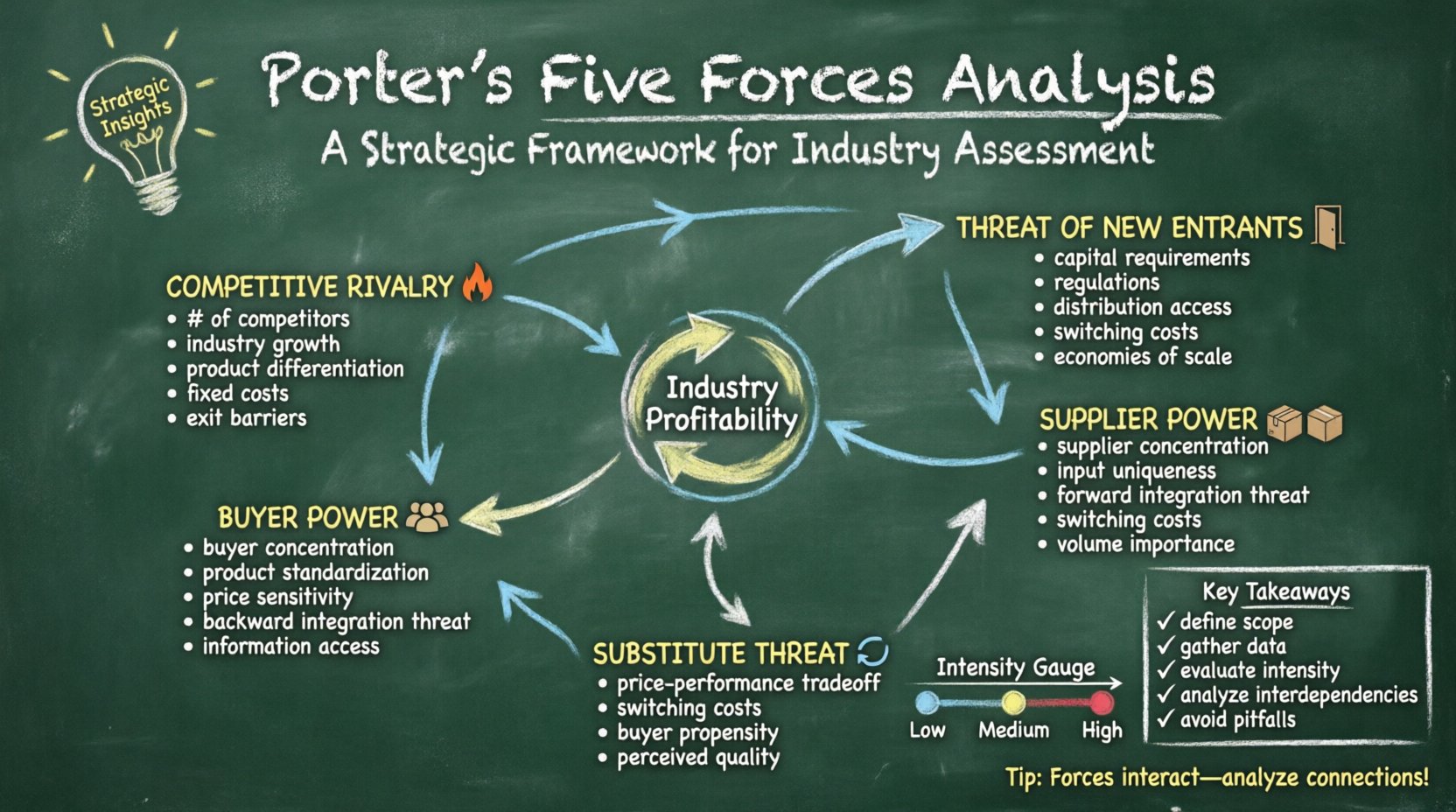
Developed by Harvard Business School professor Michael Porter in 1979, this model identifies five key forces that shape every market and industry. These forces determine the intensity of competition and the profitability of an industry. Unlike a SWOT analysis, which looks at internal and external factors broadly, the Five Forces focus specifically on the structural characteristics of the industry.
When applying this to business school assignments, the goal is not merely to list the forces. It is to evaluate the intensity of each force and explain how it influences strategic decisions. A high intensity indicates a less attractive industry, while low intensity suggests opportunities for above-average returns.
The Five Forces Explained in Detail ⚖️
To achieve a high grade, you must understand the nuances of each force. Below is a comprehensive breakdown of what to analyze for each component.
1. Competitive Rivalry 🔥
This force examines the intensity of competition among existing firms. High rivalry leads to price wars, increased marketing costs, and innovation pressure, which can erode profit margins. When analyzing this for an assignment, consider the following factors:
Number of Competitors: Is the market fragmented with many small players, or is it an oligopoly with a few dominant firms?
Industry Growth: Slow growth often leads to fierce competition for market share. Fast growth allows companies to expand without biting into each other’s territory.
Product Differentiation: If products are commoditized, price becomes the main competitive lever. If differentiated, firms can charge premium prices.
Fixed Costs: High fixed costs encourage firms to utilize capacity, often leading to price cuts to fill production lines.
Exit Barriers: High exit barriers (e.g., specialized assets, emotional ties) keep unprofitable firms in the market, increasing supply and rivalry.
2. Threat of New Entrants 🚪
This force assesses how easy it is for new competitors to enter the market. If entry is easy, incumbents face constant pressure to defend their position. The barrier to entry is the primary metric here.
Capital Requirements: Does the industry require massive investment in R&D, manufacturing, or distribution? High capital needs deter new players.
Regulatory Policies: Government licensing, patents, or safety standards can legally block new entrants.
Access to Distribution Channels: If existing firms control shelf space or logistics networks, new firms struggle to reach customers.
Switching Costs: If customers face high costs to switch to a new provider, entrants must offer significant value to overcome this inertia.
Economies of Scale: Incumbents with low unit costs due to volume can price out smaller, new competitors.
3. Bargaining Power of Suppliers 📦
Suppliers can squeeze industry profitability by raising prices or reducing quality. This force is strong when suppliers are concentrated or when the industry they serve is fragmented.
Supplier Concentration: If there are only a few suppliers for a critical input, they hold significant leverage.
Uniqueness of Inputs: If the raw material is specialized or patented, buyers have few alternatives.
Threat of Forward Integration: Can the supplier enter the industry and become a competitor? This threat limits how much they can charge.
Switching Costs: How difficult is it for the industry to switch to a different supplier? High costs increase supplier power.
Importance of Volume: If the industry is not a significant customer for the supplier, the supplier may not prioritize the industry’s needs.
4. Bargaining Power of Buyers 👥
Buyers drive prices down, demand better quality, or play competitors against each other. Their power is determined by their ability to dictate terms.
Concentration of Buyers: If a few large customers purchase a significant portion of the industry’s output, they can demand lower prices.
Standardization of Products: If the product is a commodity, buyers can easily switch to a competitor based on price alone.
Price Sensitivity: If the product represents a significant portion of the buyer’s costs, they will be more aggressive in negotiating.
Threat of Backward Integration: Can the buyers enter the industry and produce the product themselves? This limits the supplier’s pricing power.
Information Availability: Buyers with full knowledge of costs and market prices can negotiate more effectively.
5. Threat of Substitutes 🔄
Substitutes are products from outside the industry that perform the same function. They place a ceiling on prices. If a substitute is available at a lower price or higher quality, demand shifts.
Price-Performance Trade-off: Is the substitute cheaper but less effective? Or more effective but more expensive? Both scenarios impact demand.
Switching Costs: Are customers loyal to the current product due to habit or training? High switching costs reduce the threat.
Buyer Propensity to Substitute: Some industries face high substitution threats (e.g., coffee vs. tea), while others face low threats (e.g., specialized medical equipment).
Perceived Quality: If the substitute is perceived as inferior, the threat remains low regardless of price.
Executing the Analysis for Your Assignment 📝
Conducting the analysis requires more than just theory. You need a systematic approach to gather evidence and form conclusions. Follow these steps to ensure your assignment meets academic rigor.
Step 1: Define the Industry Scope 🗺️
Start by clearly defining what constitutes the industry. Is it “Airlines” or “Commercial Aviation Services”? Is it “Smartphones” or “Consumer Electronics”? A narrow scope allows for deeper analysis. A broad scope may dilute your findings. Specify the geographic region if relevant.
Step 2: Gather Quantitative and Qualitative Data 📊
Support every claim with data. Rely on industry reports, financial statements, and market research. Avoid anecdotal evidence.
Data Type | Examples | Purpose |
|---|---|---|
Market Concentration | Herfindahl-Hirschman Index (HHI), Market Share % | Evaluate Rivalry and Supplier Power |
Financial Margins | Gross Margin, Operating Margin trends | Assess Profitability Pressure |
Customer Metrics | Churn Rate, Retention Rate, Price Elasticity | Measure Buyer Power |
Barriers | Capital Expenditure requirements, Patent counts | Analyze Entry Threats |
Step 3: Evaluate Intensity Levels 🎚️
For each force, assign an intensity level: Low, Medium, or High. Do not leave it ambiguous. Justify this rating with the data gathered in Step 2. For example, if supplier power is high, cite the number of suppliers and the uniqueness of their input.
Step 4: Analyze Interdependencies 🔗
The forces do not exist in isolation. They interact. For instance, high supplier power might increase the threat of new entrants if the new entrants cannot secure materials. Discuss how one force amplifies or dampens another. This demonstrates advanced strategic thinking.
Common Pitfalls in Student Assignments ⚠️
Many students understand the definitions but fail in application. Avoid these common errors to secure a better grade.
Confusing Forces: Do not confuse “Threat of Substitutes” with “Competitive Rivalry”. A substitute is a different product solving the same problem (e.g., Zoom vs. Business Travel). Rivalry is within the same product category (e.g., Delta vs. United).
Generalizing Without Evidence: Avoid statements like “Technology makes entry easier.” Specify which technology and how it lowers barriers in your specific industry.
Ignoring the Dynamic: Industries change. A force that was strong five years ago may be weak today. Address recent trends and future outlooks.
Skipping the Synthesis: Do not end the analysis after listing the forces. Explain what the overall industry attractiveness is. Is it a good place to compete?
Internal vs. External Confusion: The Five Forces are strictly external. Do not include internal company strengths or weaknesses here. Save that for a separate SWOT or Resource-Based View analysis.
Strategic Implications and Recommendations 💡
The end goal of the analysis is to inform strategy. Once you have mapped the forces, what should the company do?
If Rivalry is High: Consider differentiation or niche targeting to avoid price wars.
If Supplier Power is High: Consider backward integration or finding alternative suppliers to reduce dependency.
If Buyer Power is High: Increase switching costs through loyalty programs or integrated services.
If Threat of Entry is High: Build stronger brand equity or secure patents to raise barriers.
If Substitutes are Strong: Innovate to improve the core value proposition or adjust pricing to match the substitute’s value.
Visualizing the Data for Presentations 📈
In business school, you may need to present your findings visually. Since you cannot rely on specialized software for every step, manual tools work effectively.
Spider Charts: Plot the intensity of each force on a radial chart. This provides an immediate visual of where the pressure points are.
Heat Maps: Use a grid to color-code the forces (Red for High Intensity, Green for Low Intensity). This helps stakeholders grasp the risks quickly.
Force Interaction Diagrams: Draw arrows between forces to show how they influence each other. This adds depth to the static analysis.
Ensuring Data Integrity and Credibility 🔒
Your analysis is only as good as your data sources. In an academic setting, credibility is paramount.
Primary Sources: Use annual reports, SEC filings, and direct interviews if possible. These provide the most accurate financial and operational data.
Secondary Sources: Industry reports from reputable firms (e.g., Gartner, McKinsey, Statista) provide context and benchmarks.
Recent Data: Ensure your data is from the last 3 to 5 years. Historical data is useful for trends, but current data is necessary for the “now” analysis.
Critical Evaluation: Question the methodology of the reports you cite. Are they biased? Do they cover the specific geographic region you are analyzing?
Integrating with Other Strategic Tools 🧩
While the Five Forces are powerful, they are often used in conjunction with other frameworks for a holistic view.
SWOT Analysis: Use the Five Forces to inform the “Opportunities” and “Threats” sections of a SWOT. Use internal analysis for “Strengths” and “Weaknesses”.
PESTLE Analysis: Use PESTLE to understand the macro-environmental factors (Political, Economic, Social, Technological, Legal, Environmental) that shift the Five Forces over time.
Value Chain Analysis: Once the industry forces are understood, use Value Chain to see where the company can create unique value to counteract those forces.
Final Considerations for Academic Success 🏆
Writing a Five Forces analysis requires patience and precision. It is not about memorizing definitions but about applying logic to real-world scenarios. Your professor is looking for evidence that you can think like a strategist.
Ensure your argument flows logically from the data to the conclusion. Avoid generic statements. Be specific about the industry, the companies, and the dynamics at play. Use clear headings and bullet points to make your document readable. A well-structured document is easier to grade and more likely to receive a high mark.
Remember, the framework is a tool, not a rigid rulebook. Adapt it to the context of your assignment. If a force is irrelevant to a specific industry, acknowledge it and explain why. This shows critical judgment rather than rote application.
By following these best practices, you will produce an analysis that is robust, evidence-based, and strategically sound. This approach not only helps you in your current course but also builds a foundation for your future career in business and management. Good luck with your analysis. 🚀
Related posts:
 Porter Five Forces Analysis: A Step-by-Step Walkthrough for Business School Beginners
 Porter Five Forces Analysis: A Checklist for Evaluating Market Competition Accurately
 Porter Five Forces Analysis: How New Entrants Shape Industry Dynamics (And How to Predict Them)
 Porter Five Forces Analysis: Applying It to Tech, Retail, and Healthcare Industries