


Market structures are never static. What defines a competitive landscape today may be obsolete tomorrow. This volatility often stems from one specific force: the threat of new entrants. Understanding this dynamic is not just about spotting competitors; it is about anticipating the structural shifts that alter profitability and strategy across an entire sector.
When analyzing an industry, the Porter Five Forces Framework provides a structured approach to evaluating competitive intensity. While all five forces matter, the entry of new players often acts as the catalyst for broader change. It challenges established pricing models, forces innovation, and can erode margins faster than any other factor.
This guide explores the mechanics of new entrants, the barriers that protect incumbents, and the methods to predict when the market will open up. We will move beyond surface-level definitions to examine the economic and behavioral signals that precede a disruption.
Understanding the Five Forces Framework 🧩
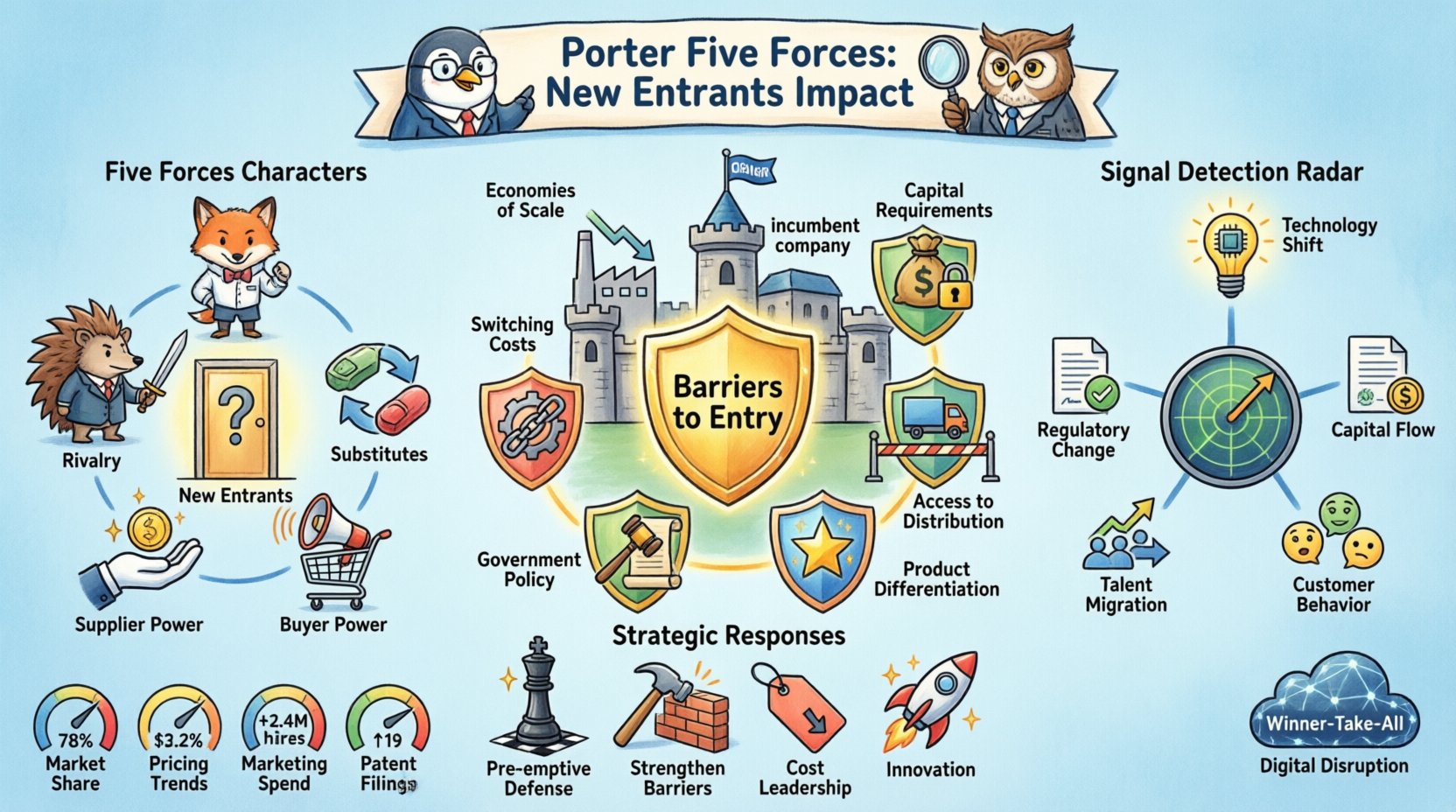
Michael Porter introduced this model to help businesses understand the profitability of an industry. The framework consists of five distinct forces that determine the intensity of competition and the attractiveness of a market.
- Rivalry Among Existing Competitors: How aggressive are current players?
- Threat of New Entrants: How easy is it for others to join?
- Threat of Substitute Products: Can customers switch to alternatives?
- Bargaining Power of Suppliers: Do vendors control costs?
- Bargaining Power of Buyers: Do customers dictate prices?
The threat of new entrants is unique because it represents potential energy. Existing rivals are already active; new entrants represent the future. When barriers are low, this force exerts constant pressure, keeping prices near the cost of production. When barriers are high, incumbents enjoy stability and higher returns.
The Mechanics of the Threat of New Entrants 🚪
For a new company to enter a market, it must overcome specific hurdles. These hurdles determine the level of risk and the required capital investment. If the hurdles are insurmountable, the threat remains low. If they are porous, the threat is high.
Consider a scenario where a new player can replicate your product with a fraction of your investment. They can undercut your price, capture market share, and force you to defend aggressively. This scenario is common in industries with low switching costs and minimal regulation.
Conversely, imagine an industry where new players need billions in capital and regulatory approval that takes years. Here, the threat is minimal, allowing established firms to focus on optimization rather than defense.
Why New Entrants Matter for Strategy
Ignoring this force leads to strategic blindness. Companies that assume their position is secure often fail when a new model disrupts the status quo. The following points highlight why this analysis is critical:
- Profitability Protection: High entry barriers protect margins from erosion.
- Innovation Pressure: The fear of entry drives incumbents to improve.
- Resource Allocation: Knowing where threats exist helps prioritize R&D.
- M&A Opportunities: Acquiring a potential entrant can neutralize a threat.
Barriers to Entry: The Structural Defenses 🛡️
Barriers to entry are the obstacles that make it difficult for new competitors to start operating. These are not random; they are structural features of the industry. We can categorize them into economic, structural, and regulatory types.
When evaluating an industry, you must assess the strength of these barriers. A single strong barrier can sometimes be enough to deter entry. However, multiple weak barriers can combine to create a significant challenge.
| Barrier Type | Description | Impact on Entry |
|---|---|---|
| Economies of Scale | Cost advantages achieved due to size and volume. | High: New players struggle to match unit costs. |
| Capital Requirements | Financial investment needed for facilities and inventory. | Medium to High: Limits who can afford to enter. |
| Switching Costs | Costs incurred by customers when changing providers. | High: Locks in the customer base. |
| Access to Distribution | Availability of channels to reach end-users. | High: Hard to sell without a sales network. |
| Government Policy | Licensing, regulations, and trade barriers. | Variable: Can block or encourage entry. |
| Product Differentiation | Brand loyalty and perceived uniqueness. | Medium: Hard to compete on trust. |
Detailed Breakdown of Key Barriers
Let us examine the specific mechanisms behind these barriers.
1. Economies of Scale
As production volume increases, the cost per unit decreases. Large incumbents benefit from this. A new entrant starting small will have higher costs. To compete, they must either accept lower margins or find a way to grow quickly. This is often impossible if the market is saturated.
2. Capital Requirements
Some industries require heavy upfront investment. Think of manufacturing plants or infrastructure. If a competitor cannot secure financing, they cannot enter. This barrier protects cash-rich incumbents from agile startups in capital-intensive sectors.
3. Switching Costs
These are the costs a customer faces when changing suppliers. They include training, data migration, or contract penalties. If switching costs are high, customers stay even if a new entrant offers a slightly better price. This creates a sticky revenue stream for incumbents.
4. Access to Distribution Channels
Getting a product to the shelf or the customer is often harder than making it. Incumbents may have exclusive contracts with distributors. A new player might make a great product but fail to get it seen. Breaking these relationships requires significant resources.
5. Government Policy and Regulation
Licensing, patents, and environmental standards can legally prevent entry. In pharmaceuticals or telecommunications, these barriers are the primary defense against competition. Changes in regulation can suddenly open or close markets.
6. Product Differentiation
Brand loyalty is a psychological barrier. Customers prefer a known name over an unknown one. Incumbents invest heavily in marketing to maintain this perception. A new entrant must spend heavily just to be noticed, reducing their ability to compete on price.
Predicting New Entrants: The Signal Detection Method 🔍
Barriers are not static. They erode over time due to technology, regulation changes, or shifts in consumer behavior. Predicting when a new entrant will appear requires monitoring specific signals. You cannot rely on historical data alone; you must look for leading indicators.
1. Technological Shifts
Technology often lowers barriers. For example, cloud computing reduced the capital requirement for software startups. If a new technology emerges that simplifies a complex process, watch for entrants. They will not come from the traditional industry; they will come from adjacent sectors.
2. Regulatory Deregulation
Changes in law can instantly open a market. If a government removes a licensing requirement, expect a rush of new competitors. Conversely, tightening regulations can consolidate the market. Keep a close watch on legislative trends.
3. Capital Flow Trends
Venture capital and private equity flow where growth is expected. If investors start funding startups in your sector, a new entrant wave is imminent. Funding rounds are a leading indicator of market activity.
4. Talent Migration
Look at where employees are moving. If key talent from your industry starts working on side projects or joining startups, they are often validating a new business model. The best ideas often come from people who understand the industry’s pain points.
5. Customer Behavior Changes
If customers start complaining about incumbents or demanding new features that existing players cannot deliver, the market is vulnerable. Dissatisfaction creates an opening for a challenger brand.
Strategic Responses for Incumbents 🛠️
Once you identify a threat, you must decide how to respond. There are several strategic options available. The goal is not necessarily to stop entry entirely, but to make it unattractive.
Pre-emptive Defense
This involves acting before the threat materializes. It might mean launching a lower-cost line to saturate the bottom of the market. It could also mean acquiring a potential competitor before they gain traction.
Strengthening Barriers
Invest in the barriers that already exist. Increase switching costs by offering better loyalty programs. Secure exclusive distribution deals. Patent key technologies to block imitation. The more you invest in these defenses, the less attractive the market becomes to newcomers.
Cost Leadership
If you are the lowest-cost producer, you can survive price wars that would bankrupt a new entrant. New players often enter with low prices. If you can match or beat them while remaining profitable, you deter entry.
Innovation and Differentiation
Make your product so unique that price becomes secondary. Focus on brand, service, and integration. If customers value your ecosystem, they will not switch easily. This moves the competition away from price and into value.
The Digital Disruption Factor 💻
In the modern economy, the traditional barriers are changing rapidly. Digital platforms have lowered capital requirements in many sectors. A software company can scale globally without building factories. This has increased the threat of new entrants in technology, media, and finance.
However, digital also creates new barriers. Network effects mean that a platform becomes more valuable as more people use it. This creates a “winner-take-all” dynamic. Once a leader establishes a network, it is incredibly difficult for a new entrant to displace them.
When analyzing industries with digital components, consider:
- Data Moats: Does the incumbent have proprietary data that improves their product?
- Platform Effects: Does the product become better as more users join?
- Integration: How deeply is the product embedded in customer workflows?
These factors can be stronger than traditional capital barriers. A company with a massive user base can leverage that data to improve its offering faster than a new entrant ever could.
Monitoring Metrics for Early Warning 📊
To maintain awareness, track specific metrics. Do not wait for a competitor to announce themselves. Use data to see the signs.
- Market Share Volatility: Is your share slowly declining even without a known competitor?
- Pricing Trends: Are prices dropping across the industry? This signals new supply.
- Marketing Spend: Are unknown brands increasing ad spend?
- Talent Hiring: Are new companies hiring aggressively in your field?
- Patent Filings: Are competitors filing patents for similar technologies?
Long-Term Sustainability and Adaptability 🌱
No strategy is permanent. What protects you today might not work tomorrow. The key to long-term success is adaptability. You must continuously reassess the barriers and the threat of new entrants.
Regularly update your analysis. Conduct this review annually or whenever a major shift occurs. This ensures that your strategic planning remains grounded in reality rather than assumptions.
Remember that the goal is not to eliminate competition, but to manage it. A healthy level of competition drives innovation and keeps the market dynamic. The danger lies in complacency. Assume that someone is trying to enter your market. Plan for it. Prepare your defenses. And remain ready to pivot when the landscape shifts.
Key Takeaways 📝
- The threat of new entrants is a primary driver of industry profitability.
- Barriers like scale, capital, and switching costs determine the level of threat.
- Technology and regulation can rapidly change these barriers.
- Predicting entry requires monitoring capital flows, talent, and customer sentiment.
- Incumbents can defend by strengthening barriers or innovating faster.
- Digital markets introduce network effects that can create new, stronger barriers.
By understanding these dynamics, you move from reacting to competition to anticipating it. This shift in perspective allows for more robust strategic planning and long-term resilience in a volatile business environment.
Related posts:
 Porter Five Forces Analysis: Common Mistakes New Strategy Students Make (And How to Avoid Them)
 Porter Five Forces Analysis: A Comparative Look at Industry Dynamics Across Sectors
 Porter Five Forces Analysis: A Best Practices Guide for Business School Assignments
 Porter Five Forces Analysis: Why the Framework Matters Even in Disruptive Markets