


Understanding the dynamics of an industry requires more than just looking at current competitors. It demands a structural view of the forces shaping profitability. Among the various frameworks available, the Porter Five Forces model remains a cornerstone for strategic planning. While all five forces interact, the power of buyers often dictates the ceiling for potential margins. This guide explores how to assess buyer bargaining power effectively, providing a roadmap for identifying leverage points and crafting resilient strategies.
🧐 What is Buyer Bargaining Power?
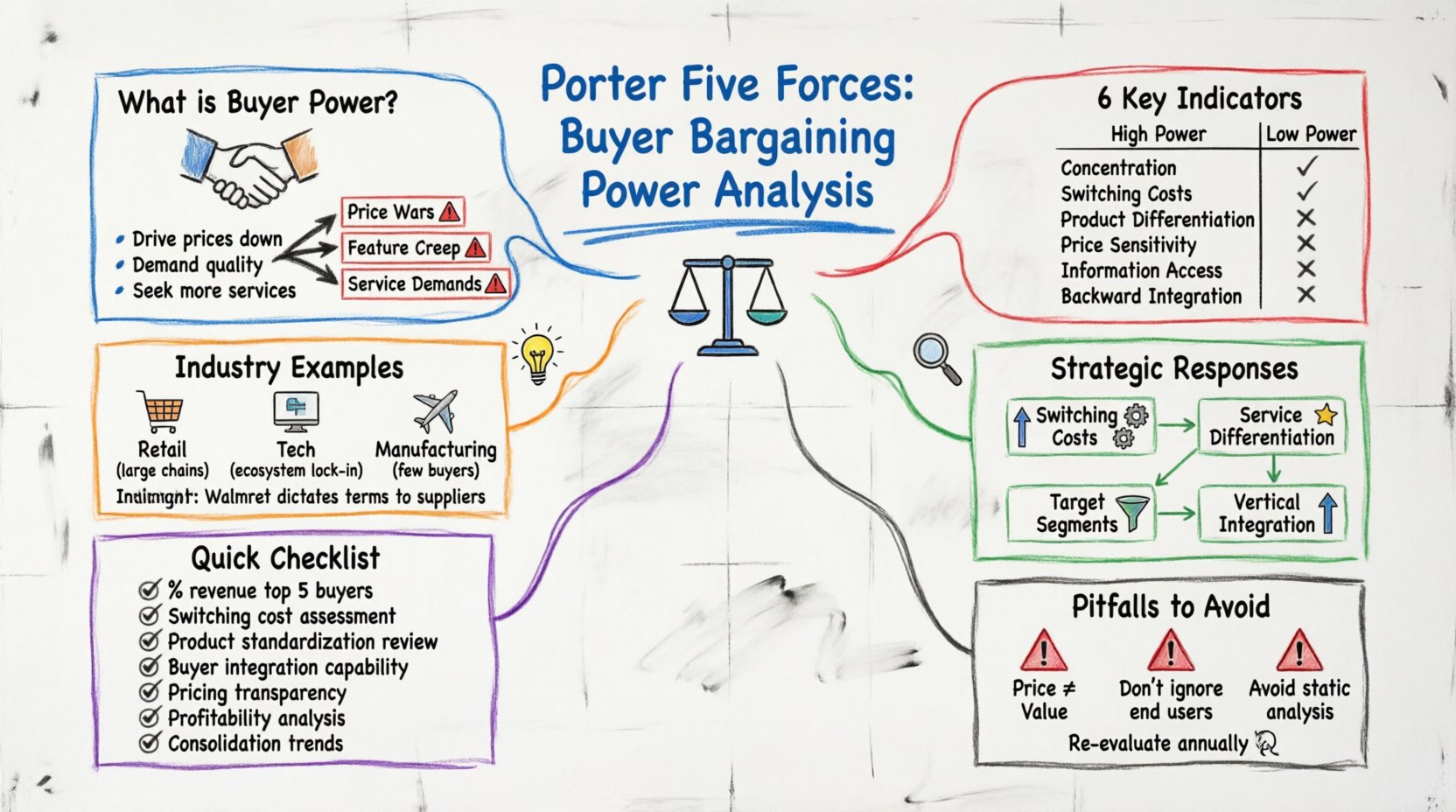
Buyer bargaining power refers to the ability of customers to drive prices down, demand higher quality, or seek more services from sellers. When buyers hold significant power, they can erode the profitability of an entire sector. This power stems from several structural factors within the market, including the volume of purchases, the uniqueness of the product, and the cost of switching providers.
High buyer power typically results in:
- Price Wars: Competitors undercut each other to secure contracts.
- Feature Creep: Suppliers must add features without charging extra.
- Service Demands: Extended warranties or faster delivery become standard expectations.
Conversely, low buyer power allows suppliers to maintain pricing discipline and invest in innovation. The goal of this analysis is to determine where your organization sits on this spectrum and how to shift the balance.
📊 Key Indicators of High Buyer Power
To evaluate buyer power accurately, one must look at specific structural conditions. The following table outlines the primary indicators and how they influence the negotiation landscape.
| Indicator | High Buyer Power Scenario | Low Buyer Power Scenario |
|---|---|---|
| Concentration | Few large buyers dominate the market. | Many small buyers with low individual volume. |
| Switching Costs | Low cost to change suppliers. | High cost or technical barriers to switching. |
| Product Differentiation | Standardized or commoditized products. | Unique, branded, or proprietary offerings. |
| Price Sensitivity | Buyers are highly sensitive to price changes. | Buyers prioritize quality or speed over cost. |
| Information Access | Buyers know costs and alternatives clearly. | Buyers lack transparency regarding market rates. |
| Backward Integration | Buyers can produce the product themselves. | Buyers rely entirely on external suppliers. |
🔍 Deep Dive: Factors Influencing Buyer Leverage
Each indicator above contributes to the overall assessment. Let us examine the mechanics behind these factors to understand the nuances of buyer influence.
1. Volume and Concentration
When a single client accounts for a significant portion of your revenue, their influence is naturally amplified. They are not just a customer; they are a stakeholder. Large retailers or government entities often fall into this category. If a buyer purchases a large percentage of your output, they can threaten to shift business to a competitor with minimal impact on their own operations.
- Impact: They can demand volume discounts.
- Mitigation: Diversify your customer base to reduce reliance on any single entity.
2. Switching Costs
Switching costs are the barriers a buyer faces when changing suppliers. These can be financial, technical, or psychological.
- Technical: Integration with existing systems, data migration, or retraining staff.
- Contractual: Long-term agreements with penalties for early termination.
- Relational: Established trust and familiarity with the sales team.
When switching costs are low, buyers can walk away easily. This creates a constant threat of churn and forces suppliers to compete aggressively on price.
3. Product Differentiation
Standardized products are commodities. If you sell steel, aluminum, or basic office supplies, the product is largely the same regardless of the source. In these markets, price is the primary differentiator, giving buyers immense power.
However, if your offering includes proprietary technology, unique design, or specialized expertise, the buyer has fewer alternatives. This shifts the power dynamic toward the seller.
4. Price Sensitivity
Buyers weigh the cost of the product against their budget constraints. This sensitivity is influenced by:
- Percentage of Total Cost: If the product represents a tiny fraction of the buyer’s total cost, they may not negotiate hard.
- Quality Impact: If the product significantly affects the buyer’s final output quality, they may prioritize performance over price.
- Availability of Funds: Economic downturns often increase price sensitivity across all sectors.
5. Threat of Forward Integration
This occurs when buyers decide to manufacture the product themselves. If a restaurant chain decides to grow its own vegetables, it removes the need for the produce supplier. The mere threat of this happening can force suppliers to lower prices to keep the buyer from integrating.
📉 Analyzing Specific Industry Dynamics
Buyer power varies significantly across different sectors. Understanding the context is essential for accurate analysis.
The Retail Sector
In retail, buyers often have low individual power, but when aggregated through large chains, their power skyrockets. Major supermarket chains negotiate terms with thousands of suppliers simultaneously. Suppliers must offer the best price and logistics support to secure shelf space.
The Technology Sector
In software and hardware, buyer power depends heavily on ecosystem lock-in. If a buyer uses a specific operating system or suite of tools, switching to a competitor becomes expensive and disruptive. This creates a high barrier, reducing buyer power for the incumbent.
The Manufacturing Sector
Heavy manufacturing often involves few buyers and many sellers. A company building a specialized aircraft engine might only have a few potential buyers (airlines or defense contractors). These buyers hold significant leverage because the market is small and the product is specialized.
🛠️ Strategic Responses to High Buyer Power
Identifying high buyer power is only the first step. The value lies in formulating a response. Here are practical approaches to reclaiming leverage.
1. Increase Switching Costs
Make it difficult for buyers to leave. This does not mean creating a hostile environment, but rather building value that is hard to replicate elsewhere.
- Integration: Build tools that connect deeply with the buyer’s workflow.
- Customization: Tailor solutions to specific needs that generic competitors cannot match.
- Training: Offer certification programs that make your staff the only ones qualified to use your system.
2. Differentiate Through Service
If the product is commoditized, the service surrounding it must not be. Fast response times, proactive support, and consulting services add value beyond the physical good.
- Consultative Selling: Act as an advisor rather than just a vendor.
- Value-Added Services: Include logistics, installation, or maintenance in the package.
3. Target Different Segments
Not all buyers have the same power. A large enterprise might dictate terms, but a small business might be more price-insensitive if they value speed. Diversifying your portfolio allows you to balance risk.
- Long-Tail Customers: Serve smaller clients who value agility over bulk discounts.
- Niche Markets: Focus on specialized segments where your expertise is unmatched.
4. Vertical Integration
In some cases, the best defense is offense. Acquiring a piece of the supply chain or moving closer to the end consumer can reduce dependence on powerful intermediaries.
- Direct-to-Consumer: Selling directly to the end user bypasses distributors who might hold the power.
- Supply Chain Control: Owning upstream resources protects against input cost volatility.
⚠️ Common Pitfalls in Analysis
Even experienced strategists can misjudge buyer power. Avoid these common errors to ensure your assessment remains accurate.
Mistaking Price for Value
Just because a buyer is looking for the lowest price does not mean they have high power. If they are willing to pay more for reliability, you have room to maneuver. Focus on the value drivers, not just the sticker price.
Ignoring End Users
In B2B contexts, the purchasing department is the buyer, but the end user is the consumer. If the end user demands a specific feature, the purchasing department has no choice but to buy it, even if the price is high. Analyzing both layers provides a complete picture.
Static Analysis
Power dynamics are not fixed. A buyer might be weak today but become strong tomorrow if the market consolidates. Regularly revisit your assessment to account for market shifts.
🔄 Integrating with Other Strategic Tools
Buyer power does not exist in a vacuum. It interacts with supplier power, the threat of new entrants, substitutes, and rivalry.
- Supplier Power: If suppliers are strong and buyers are strong, margins get squeezed from both sides. This creates a “crushing zone” where profitability is rare.
- Substitutes: If a buyer can easily switch to a substitute product, their bargaining power increases. Understanding the availability of alternatives is crucial.
- Rivalry: High buyer power often intensifies rivalry among competitors. They fight harder for the same contracts, leading to price erosion.
📝 Actionable Checklist for Assessment
Use this checklist to conduct a systematic review of your buyer landscape.
- [ ] Calculate the percentage of revenue derived from the top 5 buyers.
- [ ] Assess the cost of switching for your customers (time, money, effort).
- [ ] Review the standardization level of your core product.
- [ ] Determine if buyers have the capability to produce the product internally.
- [ ] Analyze the transparency of pricing in your industry.
- [ ] Evaluate the profitability of serving these buyers compared to others.
- [ ] Identify any trends in buyer consolidation in your sector.
❓ Frequently Asked Questions
How often should I re-evaluate buyer power?
Market conditions change. A thorough review should happen annually, or whenever a major shift occurs, such as a new competitor entering the market or a significant economic event.
Can low buyer power guarantee high profits?
No. Low buyer power removes one constraint, but other forces like supplier power or high rivalry can still suppress margins. All five forces must be considered together.
What if I cannot change the buyer power?
If structural factors prevent you from shifting power, focus on efficiency. Reducing your own cost base allows you to maintain profitability even when buyers demand lower prices.
📈 Final Thoughts
Analyzing buyer bargaining power is a critical component of strategic foresight. It reveals where the pressure points are in your business model and where opportunities for differentiation lie. By understanding the structural drivers of this power, organizations can make informed decisions about pricing, product development, and market focus.
The landscape is rarely static. Buyers evolve, technology changes, and market structures shift. Continuous monitoring ensures that your strategy remains aligned with reality. Use the frameworks and indicators provided here to build a robust understanding of your position. This clarity forms the foundation for sustainable competitive advantage.
Start your assessment today. Identify the factors that matter most to your specific industry. Apply the mitigation strategies where leverage is low. The goal is not just survival, but the creation of value that withstands market pressures.
Related posts:
 Porter Five Forces Analysis: Common Mistakes New Strategy Students Make (And How to Avoid Them)
 Porter Five Forces Analysis: A Comparative Look at Industry Dynamics Across Sectors
 Porter Five Forces Analysis: A Best Practices Guide for Business School Assignments
 Porter Five Forces Analysis: Why the Framework Matters Even in Disruptive Markets