


Understanding the competitive landscape is fundamental for any business aiming for long-term success. One of the most enduring frameworks in strategic management is the Porter Five Forces Analysis. Developed by Michael E. Porter at Harvard Business School in 1979, this model helps organizations understand the intensity of competition and the profitability of an industry. This guide provides a comprehensive, step-by-step tutorial for beginners looking to apply this critical tool in their strategic planning.
Whether you are an entrepreneur launching a startup or a manager evaluating a market shift, knowing the forces at play allows for informed decision-making. This tutorial avoids technical jargon where possible and focuses on practical application, ensuring you can implement the analysis effectively.
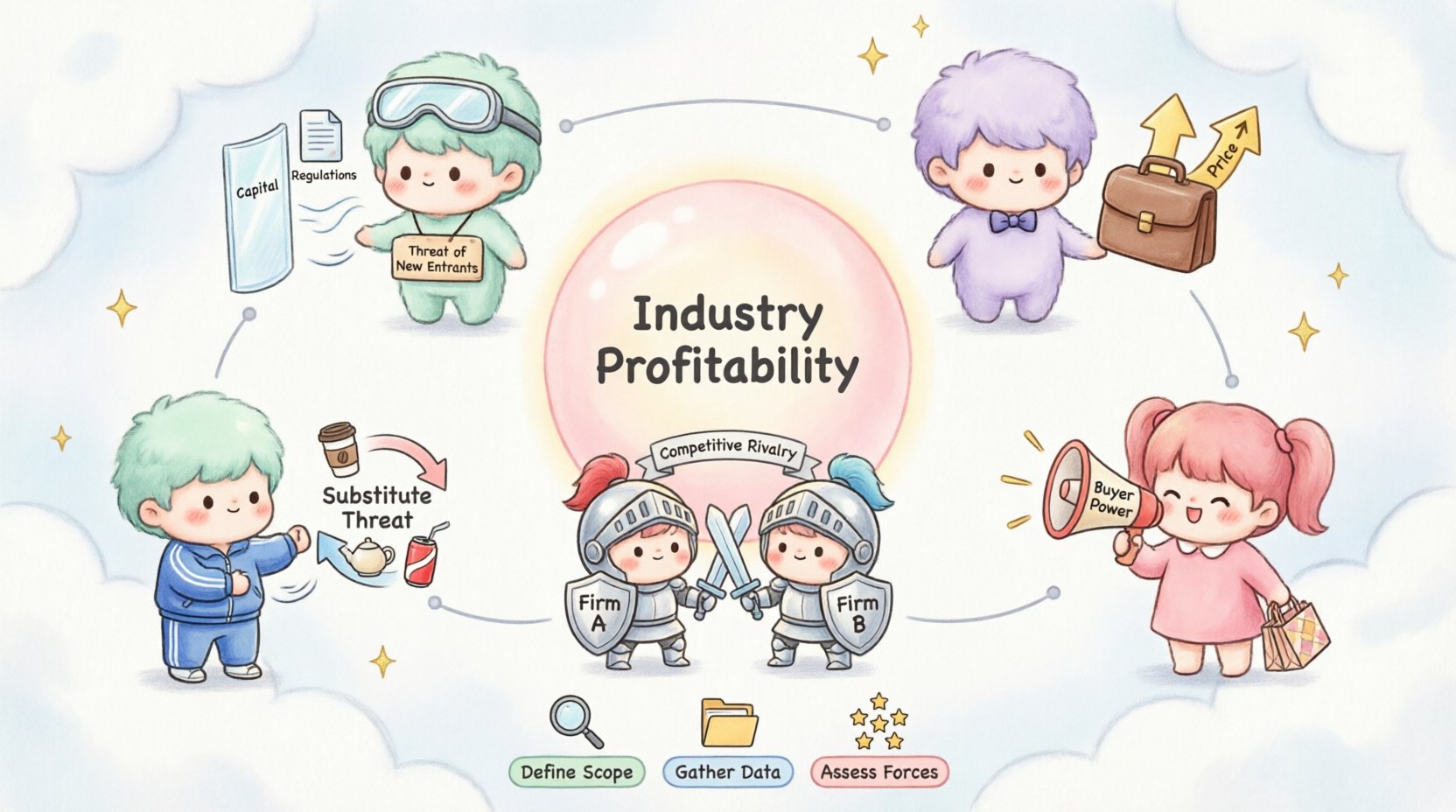
What is the Porter Five Forces Framework? 🤔
The Porter Five Forces Analysis is a method for evaluating the competitive environment of an industry. It suggests that five forces determine the competitive intensity and attractiveness of a market. These forces work together to shape the profit potential of a business. If these forces are intense, the industry is often less attractive because it is difficult to make high profits. If they are weak, the industry offers opportunities for growth and profitability.
This framework moves beyond simple competitor analysis. It considers suppliers, buyers, substitutes, new entrants, and existing rivals. By understanding these dynamics, a company can position itself to defend against these forces or influence them in its favor.
The Five Forces Explained 🧩
To conduct a proper analysis, you must understand each force individually. Below is a detailed breakdown of what constitutes each force and how to assess it.
1. Threat of New Entrants 👥
This force measures how easy or difficult it is for new competitors to enter your market. If entry barriers are low, new competitors can easily enter the market, increasing competition and driving down prices. If barriers are high, existing companies are safer from new competition.
- Capital Requirements: How much money is needed to start? High costs discourage entry.
- Switching Costs: How hard is it for customers to switch to a new provider? High costs protect incumbents.
- Regulatory Policies: Are there licenses or permits required? Strict regulations limit entry.
- Access to Distribution Channels: Can new players easily get their products to customers?
- Government Policy: Trade restrictions or subsidies can alter the landscape.
If the threat of new entrants is high, you must focus on building strong barriers, such as patents, brand loyalty, or exclusive contracts.
2. Bargaining Power of Suppliers 💼
Suppliers can drive up prices or reduce the quality of goods and services. This force assesses how much leverage suppliers have over your business. High supplier power can squeeze your margins significantly.
- Supplier Concentration: If there are few suppliers, they hold more power.
- Uniqueness of Inputs: If your inputs are unique or specialized, suppliers are more powerful.
- Switching Costs: Can you easily switch to another supplier? High costs increase supplier power.
- Threat of Forward Integration: Can the supplier enter your industry and compete with you?
- Importance of Volume: If your business is a large customer for them, they have less power.
Strategies to mitigate this include diversifying your supplier base or bringing production in-house.
3. Bargaining Power of Buyers 🛒
Buyers (customers) can demand lower prices or higher quality. When buyer power is high, they can squeeze profitability. This force looks at the relationship between your customers and your organization.
- Buyer Concentration: Are there few buyers or many? Fewer buyers usually mean more power.
- Price Sensitivity: Are customers looking for the best deal or do they value other factors?
- Availability of Substitute Products: Can buyers easily find alternatives?
- Quality vs. Price: Does the buyer care more about the price or the quality?
- Information Access: Do buyers know more about your costs and products than you do?
Reducing buyer power often involves creating brand loyalty or differentiating your product so it is not easily compared to others.
4. Threat of Substitute Products 🔄
Substitutes are products from outside your industry that satisfy the same need. For example, tea is a substitute for coffee. This force is often overlooked but is critical for long-term survival.
- Price-Performance Trade-off: Is the substitute cheaper or better?
- Switching Costs: How much effort does it take for a customer to switch to a substitute?
- Buyer Propensity to Substitute: Are customers open to trying new solutions?
- Availability: Is the substitute widely available?
If substitutes are readily available and perform well, your pricing power is limited. Monitoring innovation in adjacent industries is key here.
5. Rivalry Among Existing Competitors ⚔️
This is the most visible force. It looks at the competition between existing companies in the industry. High rivalry leads to price wars, advertising battles, and new product introductions, which can hurt profitability.
- Number of Competitors: More competitors usually mean more rivalry.
- Industry Growth: Slow growth forces companies to fight for market share.
- Exit Barriers: Is it hard to leave the industry? High exit barriers keep companies fighting.
- Differentiation: If products are identical, price becomes the main battle.
- Capacity Expansion: Is there a lot of overcapacity in the industry?
Reducing rivalry often requires differentiation or focusing on niche markets where competition is less intense.
Conducting the Analysis: Step-by-Step Guide 📝
Now that you understand the theory, here is how to execute the analysis in a practical setting. Follow these steps to ensure a thorough evaluation.
Step 1: Define the Industry and Scope
Before analyzing, clearly define what industry you are studying. Is it the “Automobile Industry” or specifically “Electric Vehicle Manufacturing”? The scope matters because the forces change depending on the level of detail. A narrow scope might reveal different opportunities than a broad one.
Step 2: Gather Data
Collect information relevant to each of the five forces. This data comes from various sources:
- Industry reports and market research.
- Financial statements of competitors.
- Customer surveys and feedback.
- Supplier interviews and contracts.
- Publicly available regulatory documents.
Ensure your data is current. Market conditions change rapidly, and outdated information can lead to flawed strategies.
Step 3: Assess the Intensity of Each Force
For each force, determine if it is low, medium, or high. Use a scoring system to make the assessment objective. For example:
- Low: The force has little impact on profitability.
- Medium: The force has a moderate impact.
- High: The force significantly impacts profitability and strategy.
Step 4: Analyze Interactions
The forces do not exist in isolation. They interact with one another. For instance, high bargaining power of suppliers might lead to high prices, which increases the threat of substitutes. Consider how one force influences the others.
Step 5: Formulate Strategy
Based on your assessment, decide how to respond. You might choose to:
- Defend: Build barriers to protect your position.
- Influence: Change the balance of power (e.g., negotiate better supplier terms).
- Exploit: Focus on segments where the forces are weakest.
Practical Example: The Airline Industry ✈️
To make this concrete, let us apply the framework to the commercial airline industry. This sector is known for thin margins and high competition.
| Force | Intensity | Reasoning |
|---|---|---|
| Threat of New Entrants | Medium | High capital costs and regulations limit entry, but low-cost carriers often emerge. |
| Bargaining Power of Suppliers | High | Only a few manufacturers produce commercial jets (Boeing, Airbus). Fuel costs are also volatile. |
| Bargaining Power of Buyers | High | Customers can easily compare prices online and switch airlines based on cost. |
| Threat of Substitutes | Medium | Trains or cars are substitutes for short distances; video conferencing reduces business travel. |
| Rivalry Among Existing Competitors | High | Price wars are common, and capacity is often high relative to demand. |
This analysis explains why airlines struggle to maintain high profits. They are squeezed by powerful suppliers (aircraft makers), powerful buyers (customers), and fierce rivalry. A strategic response might involve focusing on loyalty programs to reduce buyer power or securing fuel hedging contracts to manage supplier volatility.
Limitations and Considerations ⚠️
While the Porter Five Forces Analysis is a powerful tool, it is not perfect. Understanding its limitations helps you use it more effectively.
- Static Nature: The model was designed for a more stable environment. In today’s fast-moving tech landscape, forces can change rapidly.
- Focus on Industry: It looks at the industry, not the internal capabilities of the company. A company with superior management might succeed even in a tough industry.
- Definition of Industry: It can be difficult to define where one industry ends and another begins, especially with digital convergence.
- Value Chains: It does not explicitly account for the internal value chain of the firm.
For a complete picture, combine this analysis with other tools like SWOT analysis or PESTEL analysis.
Integrating with Other Strategic Tools 🔗
To enhance your strategic planning, integrate the Five Forces with other frameworks. This creates a more robust view of the business environment.
SWOT Analysis
Use the Five Forces to inform the “Threats” and “Opportunities” sections of a SWOT analysis. If the forces indicate high rivalry, that is a clear Threat. If there is a low threat of entry, that is an Opportunity.
PESTEL Analysis
PESTEL examines macro-environmental factors (Political, Economic, Social, Technological, Environmental, Legal). These factors often drive the Five Forces. For example, a new regulation (Political) might increase the threat of new entrants.
Value Chain Analysis
Once you understand the external forces, use Value Chain Analysis to see where you can create value internally to counteract those forces. If buyer power is high, focus on customer service within your value chain to differentiate.
Common Mistakes to Avoid 🚫
Even experienced strategists can make errors when applying this framework. Avoid these common pitfalls to ensure your analysis is accurate.
- Ignoring Substitutes: Many focus only on direct competitors. Remember that substitutes can come from completely different industries.
- Overgeneralizing: Do not assume all companies in an industry face the same forces. A niche player might face different pressures than a market leader.
- Static Assessment: Do not treat the analysis as a one-time event. Revisit it regularly as market conditions change.
- Neglecting Internal Factors: An analysis of external forces is useless if the internal organization cannot execute the strategy.
- Qualitative Bias: Relying solely on intuition without data. Where possible, quantify the forces to make the assessment more objective.
Conclusion 🏁
The Porter Five Forces Analysis remains a cornerstone of strategic management. It provides a structured way to look at the competitive dynamics that affect profitability. By understanding the threat of new entrants, the power of suppliers and buyers, the threat of substitutes, and the intensity of rivalry, you can make better strategic decisions.
While it has limitations, its ability to highlight external risks and opportunities makes it invaluable. When used alongside other tools and updated regularly, it forms a solid foundation for business planning. Start applying these concepts to your own projects to gain deeper insights into your market position. Success in strategy comes from clarity of thought and a deep understanding of the environment in which you operate.
Remember, the goal is not just to analyze, but to act. Use the insights gained to shape your business model, pricing strategy, and operational focus. With a clear view of the forces at play, you are better equipped to navigate the complexities of the modern business world.
Related posts:
 Porter Five Forces Analysis: A Beginner’s Quick Start Guide to Understanding Industry Competition
 Porter Five Forces Analysis: A Component Breakdown for Undergrads Learning Strategy
 Porter Five Forces Analysis: A Deep Dive into Supplier Power and Its Strategic Implications
 Porter Five Forces Analysis: Troubleshooting When Your Analysis Feels Off Target