


Market dynamics shift constantly. What protects a business today might be obsolete tomorrow. To navigate this landscape, organizations need a structured approach to evaluate industry profitability and strategic positioning. The Porter Five Forces Analysis provides a robust framework for this purpose. Originally developed by Michael Porter in 1979, this model examines the competitive intensity and attractiveness of a market. It helps leaders understand the underlying structure of an industry before committing resources.
This guide delves deep into the mechanics of the framework. It focuses specifically on competitive rivalry, yet covers all five dimensions to ensure a holistic view. By analyzing these forces, businesses can identify where power lies and where opportunities for growth exist.
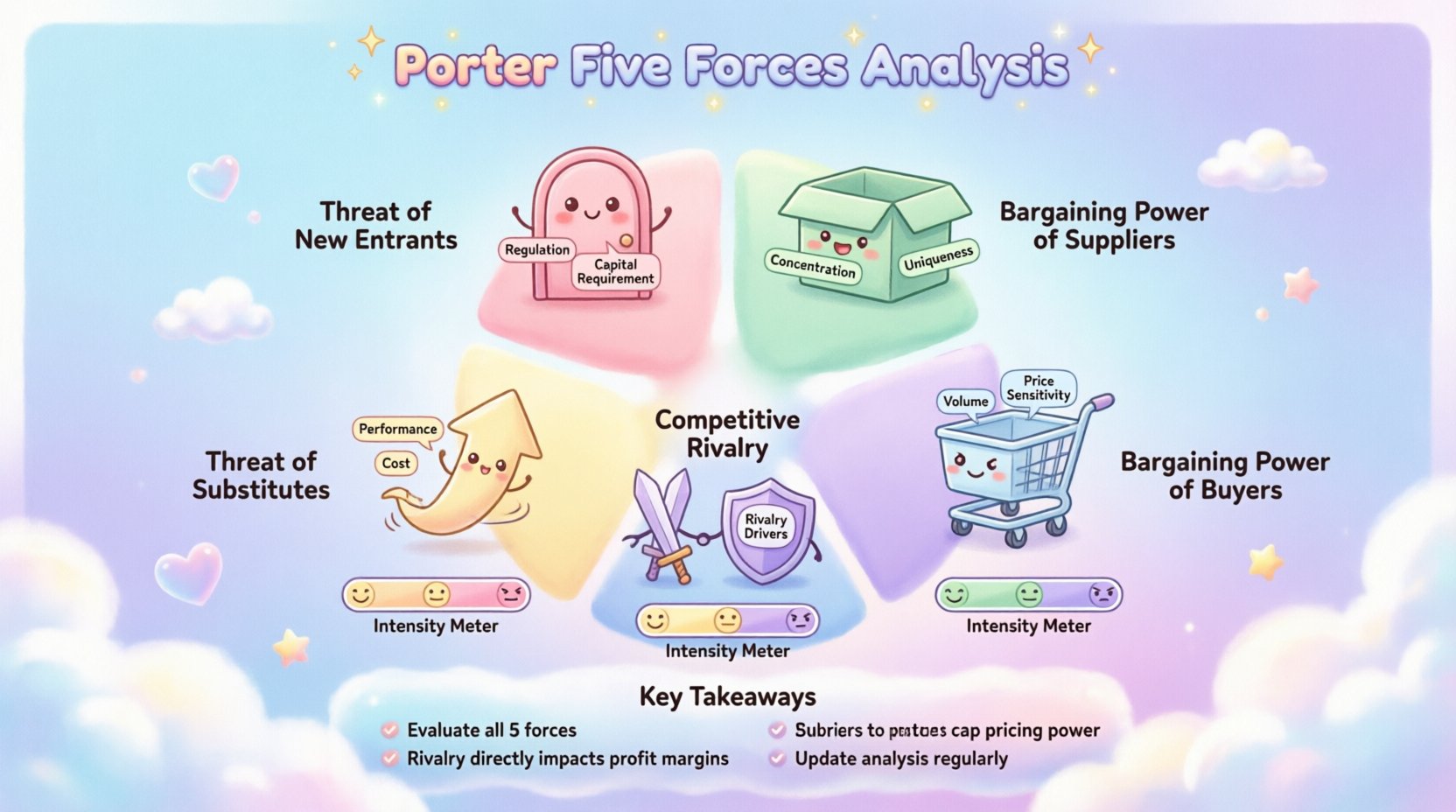
Core Components of the Framework ⚙️
The model identifies five distinct forces that shape every market. These forces determine the overall profit potential of an industry. When these forces are intense, profitability tends to suffer. When they are weak, opportunities for high returns emerge.
- Threat of New Entrants: How easy is it for competitors to enter the market?
- Bargaining Power of Suppliers: How much control do vendors have over pricing?
- Bargaining Power of Buyers: Can customers drive prices down?
- Threat of Substitute Products: Are there alternative solutions outside the industry?
- Competitive Rivalry: How fierce is the competition among existing firms?
Understanding these elements requires looking beyond surface-level revenue figures. It demands an analysis of barriers, switching costs, and market saturation.
1. Threat of New Entrants 🚪
New competitors entering a market can erode profits and increase competition. This force assesses the barriers to entry. High barriers protect existing players. Low barriers invite disruption.
Key Barriers to Entry
- Capital Requirements: Does the industry require massive upfront investment? Heavy manufacturing often has high capital needs, while service industries often do not.
- Regulatory Hurdles: Licenses, patents, and compliance standards can block new players. Pharmaceuticals and utilities often face strict regulations.
- Access to Distribution: Can a new company reach customers effectively? Established brands often control shelf space or channels.
- Economies of Scale: Incumbents may produce at lower costs due to volume. New entrants struggle to match these prices initially.
When barriers are low, the threat is high. Existing companies must innovate continuously to maintain their lead. If barriers are high, incumbents can enjoy more stable margins, provided they maintain quality.
2. Bargaining Power of Suppliers 📦
Suppliers influence prices and quality. If a company relies on a single source, the supplier holds significant leverage. This dynamic affects the entire supply chain.
Indicators of Supplier Power
- Concentration: Are there few suppliers or many? Fewer suppliers mean more power.
- Uniqueness of Supply: Is the input generic or specialized? Specialized materials increase supplier leverage.
- Switching Costs: How expensive is it to change vendors? High switching costs lock buyers into relationships.
- Threat of Forward Integration: Can the supplier start making the product themselves? This possibility keeps buyers on their toes.
Companies mitigate this risk by diversifying their vendor base. Building strong relationships and investing in long-term contracts can also stabilize costs. Without these strategies, margins may shrink as suppliers demand better terms.
3. Bargaining Power of Buyers 🛒
Customers are often more powerful than businesses realize. If buyers can demand lower prices or higher quality, profitability drops. This force measures the leverage customers hold.
Factors Influencing Buyer Power
- Volume of Purchase: Large bulk buyers negotiate harder than individual consumers.
- Price Sensitivity: How much does the cost matter to the buyer? Commodities attract high sensitivity.
- Availability of Information: Modern buyers research extensively. Transparency reduces vendor advantage.
- Product Differentiation: Is the product unique? Customized solutions reduce buyer power compared to standard goods.
In a market with many alternatives, buyers hold the power. They can switch vendors easily. To counter this, businesses focus on brand loyalty, customer service, and unique value propositions. Reducing the incentive for customers to leave is a primary defensive tactic.
4. Threat of Substitute Products 🔄
Substitutes are not direct competitors. They are different products that solve the same problem. For example, video conferencing is a substitute for business travel. This force sets a ceiling on prices.
Identifying Substitutes
- Performance: Does the substitute work as well as the original?
- Cost: Is the substitute cheaper?
- Convenience: Is it easier to use?
- Brand Perception: Do customers prefer the alternative?
Technological change accelerates the threat of substitutes. A product that seems secure today might be replaced by an innovation tomorrow. Companies must monitor adjacent industries for disruptive technologies. Ignoring this force often leads to obsolescence.
5. Competitive Rivalry ⚔️
This is often the most visible force. It involves the intensity of competition among existing firms. High rivalry leads to price wars, advertising battles, and innovation races.
Drivers of Intense Rivalry
- Number of Competitors: Many firms of equal size create tension.
- Industry Growth: Slow growth forces companies to fight for market share.
- Fixed Costs: High fixed costs pressure firms to fill capacity, often through discounting.
- Product Homogeneity: If products look the same, price becomes the main differentiator.
- Exit Barriers: If it is hard to leave the industry, firms stay and fight.
High rivalry compresses margins. Companies must differentiate themselves through service, technology, or brand equity. In some sectors, rivalry is so intense that only the most efficient survive. Strategic alliances or mergers are common responses to stabilize the market.
Competitive Rivalry Matrix
| Force | High Intensity Implications | Low Intensity Implications |
|---|---|---|
| New Entrants | Price pressure, need for constant innovation | Stable market share, higher margins |
| Supplier Power | Increased input costs, reduced flexibility | Better terms, cost control |
| Buyer Power | Discounting required, focus on retention | Premium pricing, loyalty focus |
| Substitutes | Price caps, need for reinvention | Stable demand, clear value prop |
| Rivalry | Marketing spend, price wars | Collaboration, niche focus |
Applying the Framework in Real Contexts 🌍
Theoretical models must be applied practically to yield value. Here is how organizations utilize this analysis in actual business scenarios.
Step 1: Data Collection
Gathering information is the foundation. This involves reviewing industry reports, speaking with stakeholders, and analyzing financial statements. Data should cover market size, growth rates, and competitor strategies. Relying on assumptions leads to flawed strategies.
Step 2: Assessment of Each Force
Rate each force as High, Medium, or Low. Be specific. Do not guess. Use evidence to support the rating. For example, if supplier power is high, list the specific vendors that control the market.
Step 3: Strategy Formulation
Once the landscape is mapped, strategies emerge. If rivalry is high, consider differentiation. If buyer power is high, focus on service. If barriers to entry are low, build a moat through intellectual property or brand strength.
Step 4: Continuous Monitoring
Markets change. A force that was weak five years ago might be strong today. Regular reviews ensure the strategy remains relevant. Static analysis leads to stagnation.
Deep Dive: Competitive Rivalry Dynamics ⚡
While all five forces matter, competitive rivalry often dictates short-term survival. It is the immediate pressure felt by management teams. Understanding the nuances of rivalry is critical.
Price Competition
When products are similar, price is the easiest lever. However, price wars destroy value for everyone involved. Companies that avoid this path invest heavily in branding and customer experience. They compete on value rather than cost.
Non-Price Competition
- Innovation: Launching new features keeps the brand ahead.
- Customer Service: Support can be a key differentiator.
- Marketing: Strong messaging captures mindshare.
- Distribution: Being available where the customer is matters.
Global vs. Local Rivalry
Competition is not always local. A business might face local competitors for physical presence but global competitors for digital reach. Analyzing the geographic scope of rivalry is essential. A local monopoly might still face competition from international giants entering the digital space.
Limitations of the Analysis ⚠️
No framework is perfect. The Porter Five Forces has limitations that leaders must acknowledge.
- Static Nature: It captures a snapshot in time. It does not predict future disruptions well.
- Industry Focus: It assumes clear industry boundaries. In a digital economy, boundaries often blur.
- Supply Chain Complexity: It simplifies the supply chain. Modern networks are complex and interconnected.
- Complementors: It does not explicitly include the role of complementary products, which can be vital in tech ecosystems.
Using this model alongside other tools, such as SWOT analysis or PESTLE, provides a more complete picture. It should be part of a broader strategic toolkit.
Strategic Integration 🤝
How does this fit with overall business planning? The analysis informs the strategic plan. It helps decide where to invest capital. It highlights risks that need mitigation. It identifies areas where the company holds a competitive advantage.
Resource Allocation
If supplier power is high, invest in vertical integration. If rivalry is low, invest in expansion. If buyer power is high, invest in customer retention programs. Resources follow the strategy derived from the analysis.
Risk Management
Identify which forces pose the greatest threat. Create contingency plans for those specific areas. For example, if a key supplier is a risk, find backup vendors. If substitutes are a threat, develop a roadmap for product evolution.
Case Context: The Retail Sector 🏪
Consider the retail industry. The landscape has shifted dramatically.
- New Entrants: Low barriers allow new brands to launch online quickly.
- Suppliers: Large retailers often dictate terms to suppliers due to volume.
- Buyers: High power due to easy price comparison online.
- Substitutes: Online shopping is a substitute for brick-and-mortar.
- Rivalry: Intense competition between legacy chains and new digital natives.
Companies in this sector must adapt quickly. Physical locations are now part of an omnichannel strategy. The model helps explain why traditional retail struggles when digital alternatives emerge.
Case Context: The Software Industry 💻
In software, the dynamics differ.
- New Entrants: Capital requirements are lower, but network effects create barriers.
- Suppliers: Cloud providers and developers are key inputs.
- Buyers: Switching costs can be high due to data migration.
- Substitutes: Manual processes or competitor solutions are substitutes.
- Rivalry: Fast-paced innovation drives constant competition.
Here, the focus is often on ecosystem lock-in and rapid iteration. The model explains why pricing strategies vary from subscription models to freemium structures.
Final Thoughts on Strategic Planning 🧭
Strategic planning requires clarity. The Porter Five Forces Analysis offers that clarity. It forces leaders to look outside their organization. It challenges assumptions about the market. It provides a vocabulary for discussing competitive dynamics.
Success depends on execution. The analysis is a map, not the journey. Teams must still build the product, serve the customer, and manage the finances. However, knowing the terrain helps avoid pitfalls. It ensures that energy is directed toward the most impactful areas.
By regularly revisiting these forces, organizations stay alert to changes. They remain agile. They position themselves to capitalize on shifts in the market rather than being caught off guard. This proactive stance is the hallmark of a resilient business.
Summary of Key Takeaways 📝
- The framework evaluates five specific forces affecting industry profitability.
- Competitive rivalry is often the most immediate pressure on existing firms.
- High supplier or buyer power can squeeze margins significantly.
- Barriers to entry protect incumbents from new competition.
- Substitutes set a price ceiling for any product or service.
- Regular updates to the analysis are necessary as markets evolve.
- Combining this model with other strategic tools yields better results.
Using this structured approach ensures decisions are based on evidence rather than intuition. It brings discipline to the strategic process. For any organization seeking sustainable growth, understanding these competitive dynamics is not optional. It is a necessity for long-term viability.
Related posts:
 Porter Five Forces Analysis: A Beginner’s Quick Start Guide to Understanding Industry Competition
 Porter Five Forces Analysis: A Component Breakdown for Undergrads Learning Strategy
 Porter Five Forces Analysis: How to Spot Emerging Threats Before They Become Problems
 Porter Five Forces Analysis: Troubleshooting When Your Analysis Feels Off Target