


Understanding the competitive landscape is fundamental to building a sustainable business strategy. Whether you are launching a new product, entering a mature market, or reassessing your current position, knowing where the power lies is critical. The Porter Five Forces Analysis provides a structured framework for this evaluation. Developed by Michael Porter in 1979, this model helps businesses understand the intensity of competition and the profitability of an industry.
This guide serves as a comprehensive resource for executing a Five Forces Analysis. It outlines the five key forces, provides a detailed checklist for assessment, and explains how to translate findings into actionable strategic decisions. By following this process, organizations can identify risks and opportunities with greater precision.
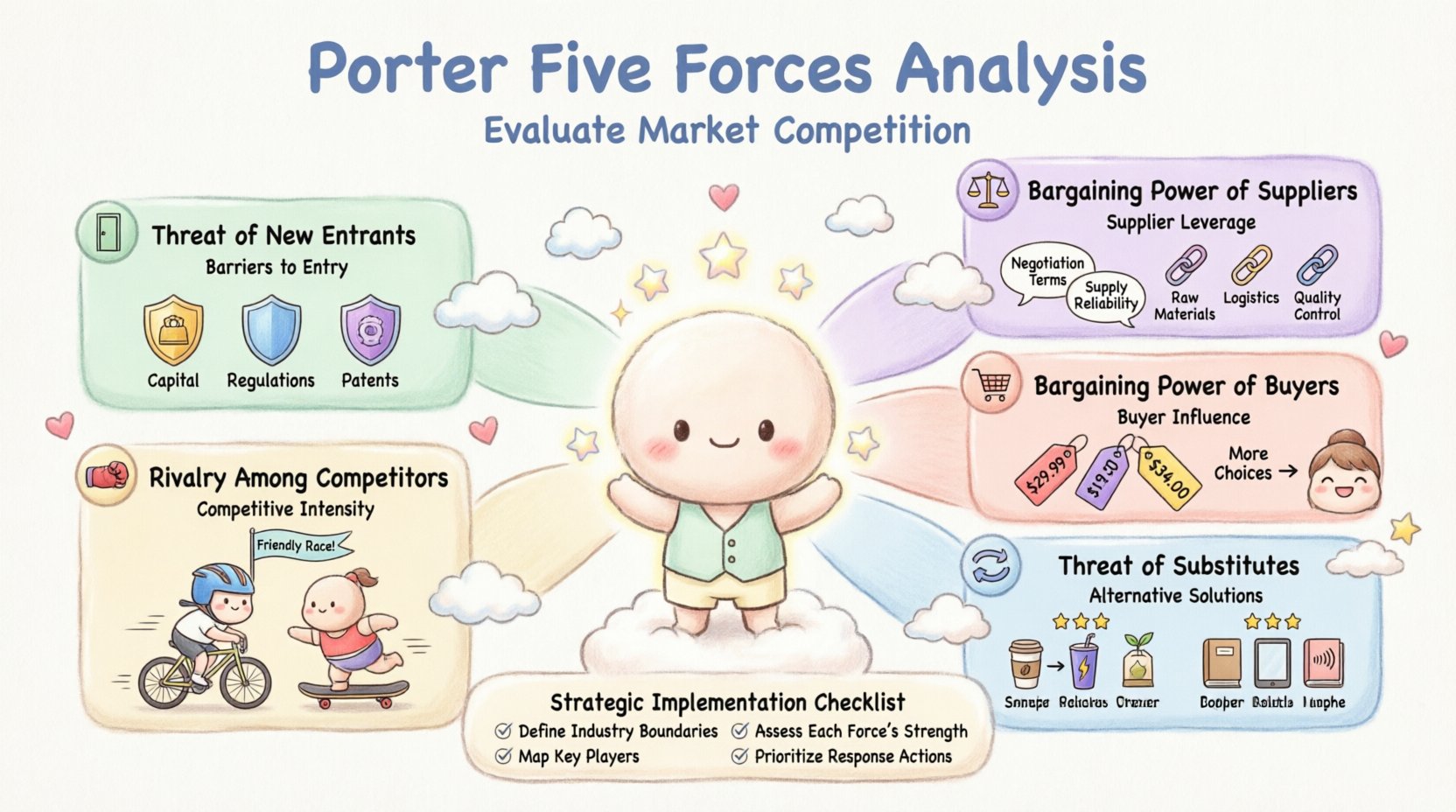
🧠 Understanding the Five Forces Framework
The core premise of this model is that industry profitability is determined by five specific competitive forces. These forces dictate the level of competition and the potential for financial gain. An industry characterized by strong forces generally offers lower average profitability, while weak forces suggest a more favorable environment for growth and margins.
When conducting this analysis, you are not just looking at direct competitors. You are examining the entire ecosystem that influences pricing, costs, and investment requirements. The goal is to map the structural characteristics of the market to predict future performance.
Key benefits of this approach include:
- Strategic Clarity: Moves decision-making beyond intuition to data-driven insights.
- Risk Identification: Highlights threats before they become critical issues.
- Resource Allocation: Helps direct capital toward areas with the strongest returns.
- Competitive Positioning: Defines where a company stands relative to the broader market structure.
🚪 1. Threat of New Entrants
This force assesses how easy or difficult it is for new competitors to enter the market. High barriers to entry protect existing companies from competition, while low barriers invite a flood of new players, driving down prices and margins.
Key Indicators to Evaluate
- Capital Requirements: How much money is needed to start operations? High costs deter entry.
- Regulatory Hurdles: Are there licenses, permits, or compliance standards that are difficult to meet?
- Access to Distribution Channels: Can new players easily get their products to customers?
- Switching Costs: How much does it cost a customer to switch from an existing provider to a new one?
- economies of Scale: Can established players produce at a lower cost per unit than a new entrant?
- Proprietary Technology: Are there patents or trade secrets that block competitors?
- Brand Loyalty: Is the existing customer base resistant to trying new brands?
If the threat is high, established companies must invest heavily in defensive measures. If the threat is low, the industry offers more stability. However, low barriers often lead to rapid consolidation or price wars.
⚖️ 2. Bargaining Power of Suppliers
Suppliers can influence the market by raising prices or reducing the quality of goods and services. When suppliers have significant power, they capture more of the industry’s profit potential, squeezing the margins of businesses within the sector.
Factors Influencing Supplier Power
- Number of Suppliers: Fewer suppliers generally mean more power.
- Uniqueness of Product: If the input is specialized or unique, the supplier holds leverage.
- Switching Costs: If changing suppliers is expensive or risky, the current supplier is powerful.
- Threat of Forward Integration: Can the supplier start making the final product themselves?
- Availability of Substitutes: Are there alternative materials or inputs available?
For businesses, understanding supplier power is essential for supply chain management. It dictates negotiation strategies and the need for diversification. A high power dynamic suggests a need to build strong relationships or vertically integrate to control the supply chain.
🛒 3. Bargaining Power of Buyers
Buyers are powerful when they can demand lower prices or higher quality. This force directly impacts revenue. If buyers have many options or high switching costs are low, they can drive prices down, reducing profitability.
Assessing Buyer Influence
- Concentration of Buyers: If a few large customers buy most of the product, they have leverage.
- Price Sensitivity: How much does price affect the buying decision?
- Product Differentiation: Is the product commoditized or unique? Unique products reduce buyer power.
- Switching Costs: How easy is it for the buyer to move to a competitor?
- Threat of Backward Integration: Can the buyer start making the product themselves?
- Information Availability: Do buyers know the market price and quality of alternatives?
When buyer power is high, companies must focus on differentiation and customer service to retain clients. Reducing the ability of buyers to compare prices easily can also help maintain margins.
🔄 4. Threat of Substitute Products
Substitutes are products or services from outside the industry that satisfy the same need. They place a ceiling on prices. If a substitute is cheaper or better, customers will switch, limiting the revenue potential of the industry.
Identifying Substitute Risks
- Price-Performance Ratio: Is the substitute more cost-effective or higher quality?
- Switching Costs: How difficult is it for the customer to adopt the substitute?
- Customer Tendency to Substitute: Are buyers accustomed to changing solutions?
- Emerging Technologies: Is there new tech that renders the current product obsolete?
For example, in the beverage industry, water or tea might be substitutes for soda. In the travel industry, video conferencing is a substitute for business travel. Recognizing these external threats is vital for long-term planning.
🥊 5. Rivalry Among Existing Competitors
This is often the most visible force. It measures how intensely companies in the industry compete with one another. High rivalry leads to price wars, advertising battles, and innovation races, all of which increase costs and reduce profits.
Drivers of Competitive Rivalry
- Number of Competitors: More competitors usually mean more intense rivalry.
- Industry Growth Rate: Slow growth forces companies to fight for market share.
- Fixed Costs: High fixed costs encourage price cuts to maintain volume.
- Lack of Differentiation: If products are similar, competition is primarily on price.
- Exit Barriers: If it is hard to leave the industry, companies may stay and fight longer than is profitable.
Reducing rivalry often involves finding a niche, creating barriers to entry, or forming alliances. It requires a deep understanding of competitor moves and market dynamics.
📋 Implementation Checklist for Accurate Evaluation
To ensure you evaluate market competition accurately, use this structured checklist. It aligns the five forces with specific data points and questions to answer during your analysis.
| Force | Key Question | High Impact Indicator | Low Impact Indicator |
|---|---|---|---|
| New Entrants | How easy is it to start a business here? | Low capital, few regulations, easy distribution. | High capital, strict regulations, patent protection. |
| Supplier Power | Can suppliers raise prices without losing business? | Single source, unique input, high switching costs. | Many suppliers, commoditized input, low switching costs. |
| Buyer Power | Can customers force prices down? | Large volume buyers, many alternatives, low differentiation. | Fragmented buyers, high switching costs, unique product. |
| Substitutes | Can customers solve the problem differently? | Low cost, high performance alternative exists. | High switching cost, no viable alternative. |
| Rivalry | How aggressive are competitors? | Slow growth, similar products, high fixed costs. | Fast growth, high differentiation, low exit barriers. |
🧩 Strategic Integration and Action
Once the analysis is complete, the data must be integrated into the broader strategic plan. A Five Forces Analysis is not an end in itself; it is a tool for decision-making.
Steps to Translate Analysis into Strategy
- Identify Weaknesses: Pinpoint which forces are currently pressuring profitability the most.
- Assess Opportunities: Look for forces that are weakening, such as a new entrant threatening a dominant supplier.
- Develop Countermeasures: Create specific strategies to mitigate high-impact forces. For example, if supplier power is high, negotiate long-term contracts or find alternative sources.
- Monitor Changes: The competitive landscape is dynamic. Schedule regular reviews to update the analysis.
- Align Resources: Direct investment toward areas where the industry structure is favorable.
It is important to remember that this framework applies to any industry, regardless of size or sector. Whether in manufacturing, services, or technology, the structural forces remain consistent.
⚠️ Common Analytical Pitfalls
Even with a robust framework, errors can occur during the analysis process. Avoiding these common mistakes ensures the accuracy of your findings.
1. Static Analysis
The market changes rapidly. A static snapshot may become obsolete quickly. Regular updates are necessary to reflect new technologies, regulations, and consumer behaviors.
2. Ignoring Complementary Products
While not one of the original five forces, complementary products can significantly impact value. If the value of a product increases when paired with another, that relationship affects competition.
3. Overlooking Global Dynamics
Local analysis might miss global competitors. In a connected world, a threat in one region can impact profitability in another.
4. Confusing Industry with Market
Ensure you are defining the industry boundaries correctly. A narrow definition might hide substitute threats, while a broad definition might dilute the analysis of direct rivalry.
5. Focusing Only on Price
Competition is not always about price. It can be about quality, speed, service, or brand. The analysis should account for all dimensions of competition.
🌐 Final Thoughts on Industry Dynamics
Evaluating market competition accurately requires diligence and a structured approach. The Porter Five Forces Analysis offers a proven method to dissect the complexity of an industry. By systematically examining the threat of new entrants, supplier and buyer power, substitutes, and rivalry, organizations gain a clearer picture of their operating environment.
Successful strategy depends on recognizing these structural forces and adapting to them. It is not about fighting every battle but knowing which battles are worth fighting. When the forces align favorably, the business can thrive. When they align unfavorably, the business must innovate or pivot to survive.
Use this checklist as a living document. Revisit it as new data emerges. Maintain a focus on long-term value creation rather than short-term tactical wins. By grounding your strategy in this rigorous analysis, you build a foundation for sustainable growth and resilience.
Remember, the goal is not just to understand the competition, but to understand the rules of the game. With this understanding, you can position your organization to play the game better than anyone else.
Related posts:
 Porter Five Forces Analysis: A Beginner’s Quick Start Guide to Understanding Industry Competition
 Porter Five Forces Analysis: A Component Breakdown for Undergrads Learning Strategy
 Porter Five Forces Analysis: A Deep Dive into Supplier Power and Its Strategic Implications
 Porter Five Forces Analysis: Troubleshooting When Your Analysis Feels Off Target