


Strategic decision-making requires a clear understanding of the competitive landscape. Whether you are preparing for a university assignment, a consulting engagement, or internal planning, the Porter Five Forces Analysis provides a robust framework for evaluating industry attractiveness. Developed by Michael Porter in 1979, this model helps identify the intensity of competition and the profit potential within a specific market sector.
When tackling a business case study, simply listing the forces is not enough. You must demonstrate how these dynamics influence specific business outcomes. This guide walks you through the mechanics of the framework, how to gather relevant data, and how to structure your analysis for maximum impact.
Understanding the Framework 🧩
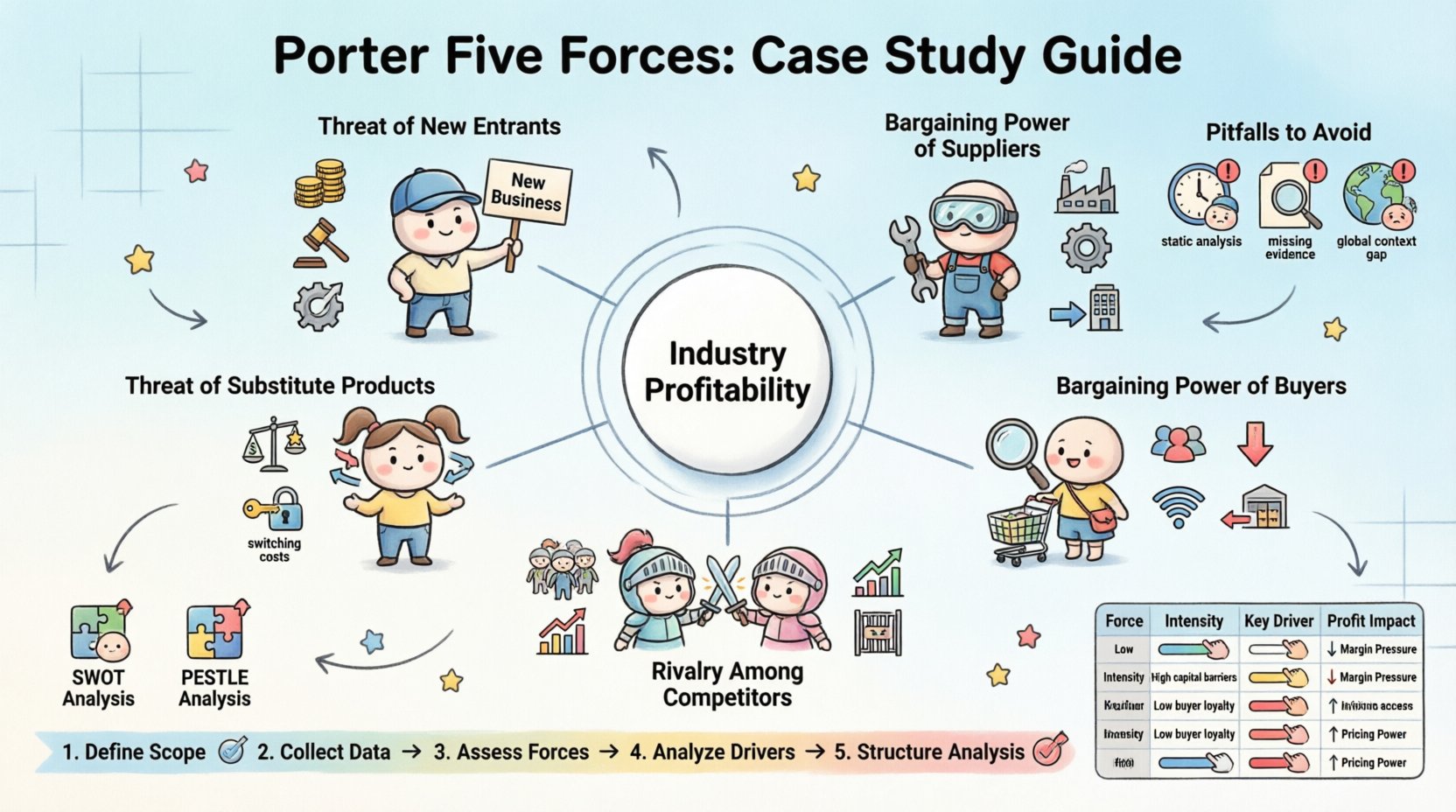
The core premise of this model is that profitability depends on the structural characteristics of the industry. It moves beyond internal company metrics to look at external pressures. There are five distinct forces that determine the competitive intensity and attractiveness of a market.
- Threat of New Entrants: How easy is it for new competitors to enter the market?
- Bargaining Power of Suppliers: Can suppliers drive up prices or reduce quality?
- Bargaining Power of Buyers: Can customers drive prices down or demand higher quality?
- Threat of Substitute Products: Are there alternative solutions that customers might switch to?
- Rivalry Among Existing Competitors: How intense is the competition between current players?
Step-by-Step Application in a Case Study 📝
Applying this framework to a case study requires a structured approach. You cannot simply guess the dynamics; you need evidence. Follow this workflow to ensure your analysis is grounded in logic and data.
1. Define the Scope and Industry
Before diving into the forces, you must clearly define the industry boundaries. Is the case study about “Automobiles” or specifically “Electric Vehicle Manufacturers”? The scope changes the analysis entirely.
- Identify the specific product or service being analyzed.
- Define the geographic market (global, regional, or local).
- Identify the primary customers and the key players already in the space.
2. Data Collection and Research
Accurate analysis relies on credible information. Gather data regarding market size, growth rates, switching costs, and concentration ratios. You do not need proprietary software to do this; industry reports, financial statements, and news archives are sufficient.
- Review annual reports from major competitors.
- Look for regulatory changes that might affect entry barriers.
- Analyze pricing trends over the last 3 to 5 years.
3. Assess Each Force Independently
Rate each of the five forces on a scale of Low, Medium, or High. This rating represents the threat or pressure exerted on the industry’s profitability.
- Low Force: Minimal pressure on profitability.
- Medium Force: Some pressure exists, manageable with strategy.
- High Force: Significant pressure that erodes margins.
Deep Dive: Analyzing the Five Forces 🔍
To write a compelling case study, you need to explain why a force is rated High or Low. Below is a breakdown of the key drivers for each force.
1. Threat of New Entrants 🚪
This force measures how difficult it is for new companies to start competing. High barriers to entry protect existing companies from new rivals.
- Capital Requirements: Does the industry require massive upfront investment? (e.g., Manufacturing vs. Consulting).
- Regulatory Hurdles: Are there licenses or patents required?
- Economies of Scale: Can large incumbents produce cheaper than new small players?
- Switching Costs: How much does it cost a customer to switch to a new entrant?
2. Bargaining Power of Suppliers 🏭
Suppliers can squeeze industry profitability by raising prices or lowering quality. This power depends on the supplier concentration relative to the industry.
- Number of Suppliers: Are there few suppliers (monopoly/oligopoly) or many?
- Uniqueness of Product: Are the inputs standardized or specialized?
- Threat of Forward Integration: Can suppliers start doing the work of the industry themselves?
- Importance of Volume: Is the supplier’s business dependent on the industry’s volume?
3. Bargaining Power of Buyers 🛒
Buyers exert power by demanding lower prices or higher quality. This force is strong when buyers have many alternatives or when the product is undifferentiated.
- Concentration of Buyers: Are there a few large customers or many small ones?
- Price Sensitivity: Is the product a significant portion of the buyer’s costs?
- Availability of Information: Do buyers know the costs and prices of competitors?
- Threat of Backward Integration: Can buyers start producing the product themselves?
4. Threat of Substitute Products 🔄
Substitutes are not direct competitors but fulfill the same need in a different way. They place a ceiling on the prices a company can charge.
- Price-Performance Ratio: Are substitutes cheaper or better?
- Switching Costs: How easy is it for a customer to change habits?
- Trend Adoption: Is technology moving towards a different solution?
5. Rivalry Among Existing Competitors ⚔️
This is the most visible force. It involves the intensity of competition between current players in the industry.
- Number of Competitors: Are there many equal-sized players or one dominant leader?
- Industry Growth: Is the market growing? Slow growth leads to fights for market share.
- Differentiation: Are products commoditized or unique?
- Exit Barriers: Is it difficult to leave the industry if it is unprofitable?
Structuring the Analysis for Your Case Study 📑
Once you have analyzed the forces, you need to present them logically. A well-structured document guides the reader through your reasoning.
Visual Representation
Include a diagram showing the five forces surrounding the industry. This visual anchor helps stakeholders quickly grasp the complexity of the environment.
Summary Table
A summary table allows for quick comparison of the forces and their specific implications.
| Force | Intensity (Low/Med/High) | Key Driver | Impact on Profitability |
|---|---|---|---|
| Threat of New Entrants | High | Low Capital Requirements | Decreases margins due to price wars |
| Bargaining Power of Suppliers | Medium | Many Alternative Suppliers | Neutral impact on costs |
| Bargaining Power of Buyers | Low | High Switching Costs | Protects pricing power |
| Threat of Substitutes | Medium | Emerging Technology | Limits price increases |
| Rivalry Among Competitors | High | Slow Industry Growth | Increases marketing spend |
Pitfalls to Avoid 🚫
Even with a solid framework, errors can undermine your case study. Be aware of these common mistakes.
- Static Analysis: Markets change. An analysis that ignores current trends will be outdated quickly. Consider dynamic factors like technological disruption.
- Ignoring Complements: Porter’s original model focused on substitutes. Complementary products (goods used together) can also drive value. Ensure you distinguish between them.
- Lack of Evidence: Do not state that a force is “High” without explaining the data that supports this claim. Case studies require justification.
- Confusing Industry with Company: This framework analyzes the industry, not just the specific company. The company’s strategy is the response to these forces.
- Overlooking Global Dynamics: In modern case studies, local forces might be influenced by global supply chains. Always check the scope.
Integrating with Other Strategic Tools 🧠
While the Five Forces is powerful, it works best when combined with other analytical tools. This creates a more holistic view for your case study.
SWOT Analysis
Use the Five Forces to inform the Threats and Opportunities sections of a SWOT analysis. The internal strengths and weaknesses come from a different assessment, but the external environment comes from the Five Forces.
PESTLE Analysis
PESTLE (Political, Economic, Social, Technological, Legal, Environmental) looks at the macro-environment. Some of these factors directly influence the Five Forces. For example, a new Law (Legal) might increase the Threat of New Entrants by changing licensing requirements.
Writing the Conclusion of Your Analysis 🏁
End your case study by synthesizing the findings into actionable recommendations. Do not simply summarize what you wrote. Focus on the strategic implications.
- Strategic Fit: Does the current strategy of the company align with the industry forces?
- Risk Mitigation: What specific risks does the company face from the High forces?
- Growth Opportunities: Are there gaps in the market where the forces are weak?
By grounding your recommendations in the structural analysis, you provide a logical basis for your advice. This demonstrates critical thinking and a deep understanding of business dynamics.
Final Thoughts on Strategic Planning 🧭
The Porter Five Forces Analysis remains a cornerstone of strategic management. It forces you to look outward, beyond the company walls, to understand the true sources of value and risk. When applied correctly in a business case study, it transforms a simple description of a company into a rigorous evaluation of its future viability.
Remember that data drives the analysis. Use credible sources, question your assumptions, and present your findings clearly. With this framework, you can navigate complex market scenarios with confidence and clarity.
Related posts:
 Porter Five Forces Analysis: A Beginner’s Quick Start Guide to Understanding Industry Competition
 Porter Five Forces Analysis: A Component Breakdown for Undergrads Learning Strategy
 Porter Five Forces Analysis: A Deep Dive into Supplier Power and Its Strategic Implications
 Porter Five Forces Analysis: Troubleshooting When Your Analysis Feels Off Target