


Understanding the competitive landscape is a fundamental skill for any business student. Michael Porter introduced a framework in 1979 that remains relevant today for evaluating industry attractiveness. This method, known as the Porter Five Forces Analysis, helps students dissect the forces that shape an industry’s profitability. For undergraduates studying strategy, mastering this tool provides a structured way to assess risk and opportunity without relying on guesswork.
Unlike generic business theories, this framework forces you to look beyond the company itself and examine the external environment. It breaks down the competitive intensity and attractiveness of a market into five specific components. By analyzing these forces, you can determine where the power lies in an industry and how it affects the bottom line. This guide provides a detailed component breakdown, practical application steps, and a discussion on limitations to support your academic and professional growth.
Why This Framework Matters for Strategy Students 🎓
When studying business strategy, you will encounter various models. However, Porter’s framework is distinct because it focuses on industry structure rather than just internal capabilities. It answers the question: Why do some industries earn higher returns than others?
- Academic Relevance: It is a standard topic in core strategy courses and case studies.
- Practical Application: Investors and consultants use this to decide where to allocate capital.
- Decision Making: It helps identify whether a specific market is worth entering or exiting.
For an undergraduate, this is not just about passing an exam. It is about learning to think like a strategist. You learn to identify barriers, understand supply chains, and predict competitor behavior. This analytical mindset is transferable across almost every sector of the economy.
The Five Components Explained 🧩
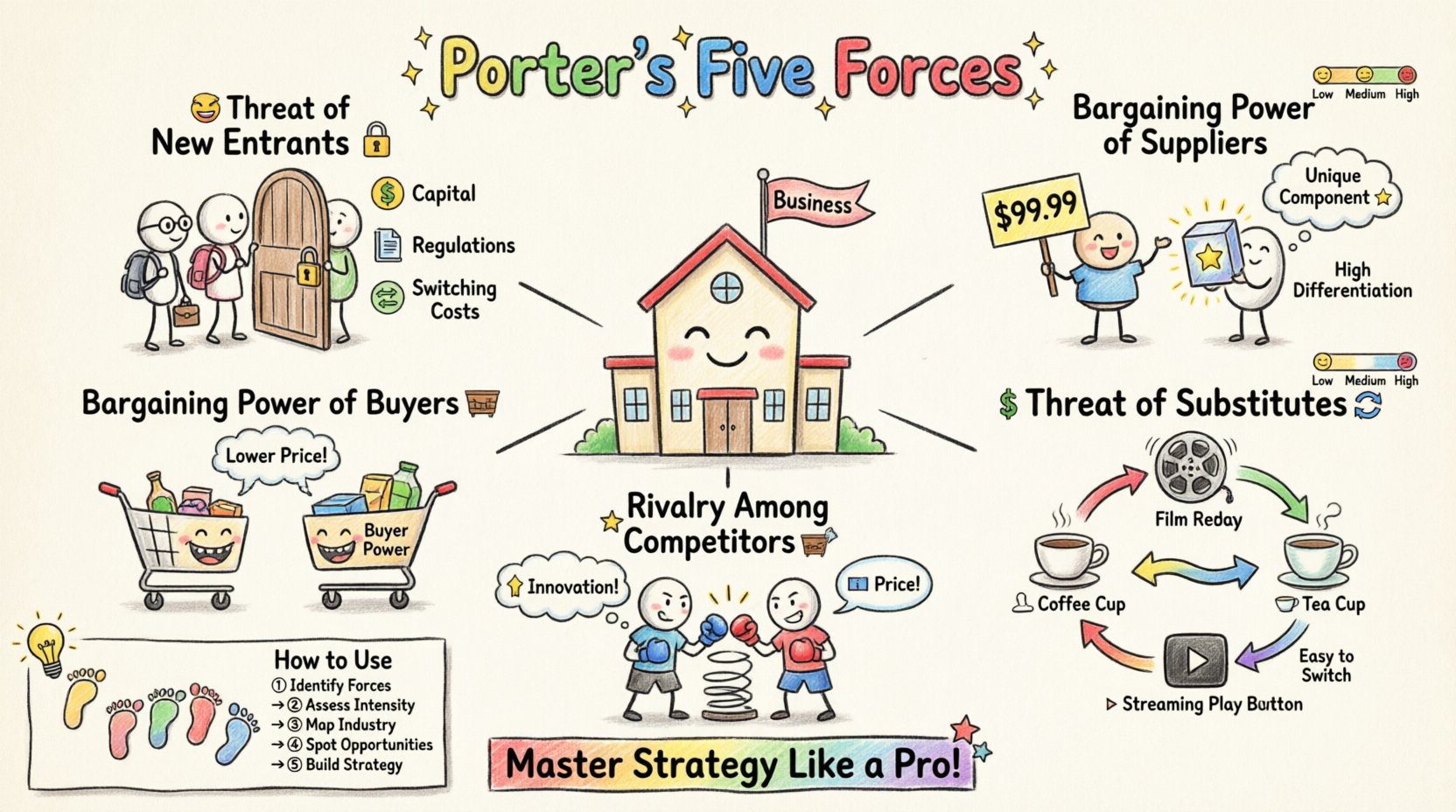
The model consists of five distinct forces. Each force represents a specific type of pressure on profitability. To understand the industry, you must evaluate the intensity of each force on a scale from low to high. Let us break down each component in detail.
1. Threat of New Entrants 🔓
This force measures how easy it is for new competitors to enter the market. If entry is easy, existing companies face constant pressure to lower prices or improve quality, which reduces margins. High barriers to entry protect the profits of incumbents.
Key factors to consider include:
- Capital Requirements: Does starting a business require massive investment? (e.g., manufacturing vs. consulting).
- Regulatory Barriers: Are there licenses, patents, or government permits required?
- Switching Costs: How hard is it for customers to change from an existing provider to a new one?
- Access to Distribution: Are established channels controlled by current players?
- Economies of Scale: Can existing players produce at a lower cost due to volume?
Example: In the airline industry, the threat of new entrants is low. The capital needed for aircraft, the strict regulatory environment, and the need for slot allocations at major airports create high barriers. In contrast, the threat is high for a mobile app developer, where a laptop and code are the primary requirements.
2. Bargaining Power of Suppliers 💰
Suppliers can raise prices or reduce quality, squeezing industry profits. This force is strong when suppliers are concentrated or when their products are unique.
Indicators of high supplier power:
- Supplier Concentration: Are there only a few suppliers for a critical input?
- Uniqueness of Input: Is the material specialized or patented?
- Switching Costs: Is it expensive to switch from Supplier A to Supplier B?
- Threat of Forward Integration: Can the supplier start making the product themselves?
Example: In the smartphone industry, component suppliers like chip manufacturers often hold significant power. If a specific processor is required and only one or two companies make it, the phone makers must accept the pricing. Conversely, if you sell widgets made from common steel, the supplier power is low because steel is a commodity available from many sources.
3. Bargaining Power of Buyers 🛒
Buyers exert pressure by demanding lower prices or higher quality. This force is strong when buyers are large, purchase in volume, or can easily switch.
Key considerations for buyer power:
- Concentration: Are there few buyers purchasing a large volume?
- Price Sensitivity: Is the product a significant portion of the buyer’s cost?
- Availability of Information: Do buyers know exactly what competitors are charging?
- Threat of Backward Integration: Can the buyer start producing the product themselves?
- Product Differentiation: Is the product unique, or is it a commodity?
Example: Large retail chains like Walmart have immense bargaining power over their suppliers. They buy in such volume that they can dictate terms. On the other hand, an individual consumer buying a specialized medical device has low bargaining power because there are few alternatives and high switching costs.
4. Threat of Substitute Products 🔄
Substitutes are products from outside the industry that satisfy the same need. This force limits the price customers are willing to pay. If a substitute is cheap and effective, the industry ceiling for pricing is low.
Factors influencing substitution:
- Price-Performance Trade-off: Is the substitute cheaper or better?
- Switching Costs: Do customers need to learn a new skill or buy new equipment?
- Customer Propensity to Substitute: Are buyers already looking for alternatives?
Example: The tea industry faces a threat from coffee, energy drinks, and bottled water. If coffee prices drop, tea sales might suffer. Similarly, the film industry faced a massive threat from streaming services. The substitute did not come from within the film industry but from the broader entertainment sector.
5. Rivalry Among Existing Competitors 🥊
This is the most visible force. It describes the intensity of competition between current players. High rivalry leads to price wars, advertising battles, and innovation races.
Drivers of intense rivalry:
- Number of Competitors: Are there many firms of similar size?
- Industry Growth: Is the market growing slowly (fight for market share) or quickly (everyone grows)?
- Exit Barriers: Is it hard to leave the industry (e.g., specialized assets, emotional ties)?
- Product Differentiation: Are products identical, forcing competition on price?
- Capacity Augmentation: Does a small increase in capacity cause a price crash?
Example: The airline industry is famous for high rivalry. Margins are thin, fixed costs are high, and products are largely identical. This leads to constant price competition. In contrast, a luxury brand market often has lower rivalry because brands differentiate themselves through status and heritage, allowing for higher prices.
Structured Comparison of the Five Forces 📋
To help visualize how these forces interact, refer to the table below. This summary helps you quickly recall the primary drivers for each category during an exam or analysis.
| Force | Primary Question | Key Driver | Impact on Profit |
|---|---|---|---|
| Threat of New Entrants | Can new players enter easily? | Barriers to Entry | Lower prices, lower margins |
| Bargaining Power of Suppliers | Can suppliers raise costs? | Supplier Concentration | Higher input costs |
| Bargaining Power of Buyers | Can buyers demand lower prices? | Buyer Concentration | Lower revenue per unit |
| Threat of Substitutes | Are there other solutions? | Price-Performance Ratio | Price ceiling reduction |
| Rivalry Among Competitors | How aggressive are current players? | Industry Growth & Exit Costs | Marketing & Price Wars |
How to Conduct the Analysis Step-by-Step 📝
Applying this framework requires a systematic approach. It is not enough to guess; you must gather data. Follow these steps to perform a robust analysis for your strategy assignments.
Step 1: Define the Industry Boundaries
Before analyzing, you must define what the industry actually is. Is it the “beverage industry” or specifically the “carbonated soft drink industry”? A broad definition hides specific risks. Be precise about the product category and the geographic scope.
Step 2: Gather Data for Each Force
For each of the five forces, collect evidence. Look for market reports, financial statements, and news articles. Do not rely on assumptions. For example, to assess supplier power, look at the market share of the top three suppliers.
Step 3: Assess the Intensity
Categorize each force as High, Medium, or Low intensity. This helps visualize the overall landscape. A common mistake is to say all forces are “medium.” Be decisive based on the evidence you found.
Step 4: Synthesize Findings into Strategy
What does this mean for the company? If the threat of new entrants is high, the strategy might be to build a brand that creates loyalty. If supplier power is high, the strategy might be to find alternative sources or integrate backward. The analysis should lead directly to actionable strategic recommendations.
Step 5: Review and Update
Industries change. A framework snapshot today might be obsolete in five years. Always consider the trend. For instance, technology often lowers barriers to entry over time. Update your assessment as new information becomes available.
Common Limitations to Consider ⚠️
While powerful, this framework is not a magic bullet. As a student, you should demonstrate critical thinking by acknowledging its limitations. Ignoring these weaknesses can lead to flawed strategic advice.
- Static Nature: The model captures a moment in time. It does not easily account for rapid technological disruption or dynamic market shifts.
- Industry Definition: It assumes industries are clearly defined. In the modern digital economy, boundaries are often blurred (e.g., banks vs. tech companies).
- Internal Focus: It focuses heavily on external forces. It does not account for internal company capabilities, culture, or management quality.
- Complements Ignored: Porter originally did not include complements. Products that increase the value of your product (like apps for a smartphone) are crucial in modern strategy.
- Assumption of Profit Maximization: It assumes companies always want to maximize profit. Some firms prioritize market share or social goals over short-term profitability.
Integrating with Other Frameworks 🔄
Advanced strategy analysis rarely relies on a single model. You should combine the Five Forces with other tools to get a complete picture.
SWOT Analysis
Use the Five Forces to inform the Opportunities and Threats sections of a SWOT analysis. The internal Strengths and Weaknesses are then matched against these external pressures. This creates a bridge between the outside world and the inside of the firm.
PESTLE Analysis
PESTLE looks at macro-environmental factors (Political, Economic, Social, Technological, Legal, Environmental). These factors often drive the Five Forces. For example, a change in technology (PESTLE) might lower the barrier to entry (Five Forces). Using both provides depth to your analysis.
Real-World Application for Students 💼
How can you use this in your coursework and career?
- Case Studies: When analyzing a company case, start with the Five Forces to set the context. Explain why the company is profitable or struggling based on these forces.
- Internships: If you work in a strategy or sales role, you can use this to understand your client’s market position. It shows you think about the big picture.
- Investing: Even as an individual investor, this framework helps you evaluate whether a company operates in a “moated” industry or a commodity trap.
For example, if you are analyzing a startup, ask yourself: What stops a giant from copying this idea? That is the Threat of New Entrants. If the answer is “nothing,” the risk is high. This simple question can save you from bad investments or poor project choices.
Key Takeaways for Undergraduates 🎓
To wrap up this comprehensive guide, remember these core principles.
- Focus on Structure: Profitability is determined by industry structure, not just good management.
- Look for Power: The goal is to find where power lies in the value chain. Power comes from scarcity and lack of alternatives.
- Be Dynamic: Forces change. Technology, regulation, and consumer behavior shift the balance constantly.
- Use Evidence: Support every claim about a force with data or logical reasoning.
- Combine Tools: Use this alongside SWOT or PESTLE for a holistic view.
Mastering the Porter Five Forces Analysis gives you a language to discuss competitive strategy with confidence. It moves you from vague opinions to structured analysis. As you progress in your studies, you will find this framework is the foundation upon which more complex strategic theories are built. Use it to navigate your case studies and prepare for the competitive realities of the business world.
By understanding the interplay between suppliers, buyers, entrants, substitutes, and rivals, you gain a clearer view of the business environment. This clarity is the first step toward formulating effective strategy. Whether you are writing a paper or advising a future employer, this tool remains essential for anyone serious about business strategy.
Continue to practice applying this model to different industries. The more you analyze, the more intuitive the process becomes. Eventually, you will see these forces at work in everyday business news, deepening your understanding of the market dynamics that drive the global economy.
Related posts:
 Porter Five Forces Analysis: Common Mistakes New Strategy Students Make (And How to Avoid Them)
 Porter Five Forces Analysis: What Students Often Misunderstand (And How to Fix It)
 Porter Five Forces Analysis: A Best Practices Guide for Business School Assignments
 Porter Five Forces Analysis: Why the Framework Matters Even in Disruptive Markets