


If you’re reading this, you might be wondering: “Do I really need another AI tool?” Maybe you’ve heard the hype, seen the buzzwords, and felt that familiar hesitation. You’re not alone. In sensitive fields like healthcare, finance, or government systems, trusting an AI textual analysis tool with critical requirements can feel like handing over the keys to your professional judgment. This guide is written for you—the thoughtful analyst who values precision, control, and human oversight. Let’s explore how an online AI diagram generator can actually support your expertise, not replace it.
Think of this AI-powered modeling software not as an autonomous decision-maker, but as a diligent junior analyst who never gets tired, never misses a noun, and always keeps your original notes visible. The goal isn’t to automate your thinking—it’s to amplify it. By using an intelligent diagramming tool like Visual Paradigm Desktop, you maintain full control while letting technology handle the tedious transcription work.
Why This Guide is Different: Addressing Real Concerns
Before we dive in, let’s acknowledge common worries:
- “Will the AI misunderstand my domain?” You remain the domain expert. The tool suggests; you decide.
- “What about data privacy?” Reputable online requirements engineering tools offer on-premise or secure cloud options—always verify compliance features.
- “I don’t want to learn another complex interface.” This AI UML maker integrates into familiar workflows with minimal setup.
- “Will this create more work reviewing AI output?” The time saved on manual extraction far outweighs quick validation steps.
Quick Summary: How an AI Requirements Assistant Supports (Not Replaces) You
- Controlled Extraction: The automated requirements extraction tool highlights candidates—you approve each one.
- Transparent Process: See exactly how text maps to model elements in a side-by-side view.
- Gap Awareness: Let the online system analysis tool flag potentially overlooked entities like “Audit Trail” or “Consent Record” for your review.
- Time Reclaimed: Spend less time copying text and more time on high-value analysis and stakeholder collaboration.
Step 1: Start with Your Problem Description—No AI Jargon Required
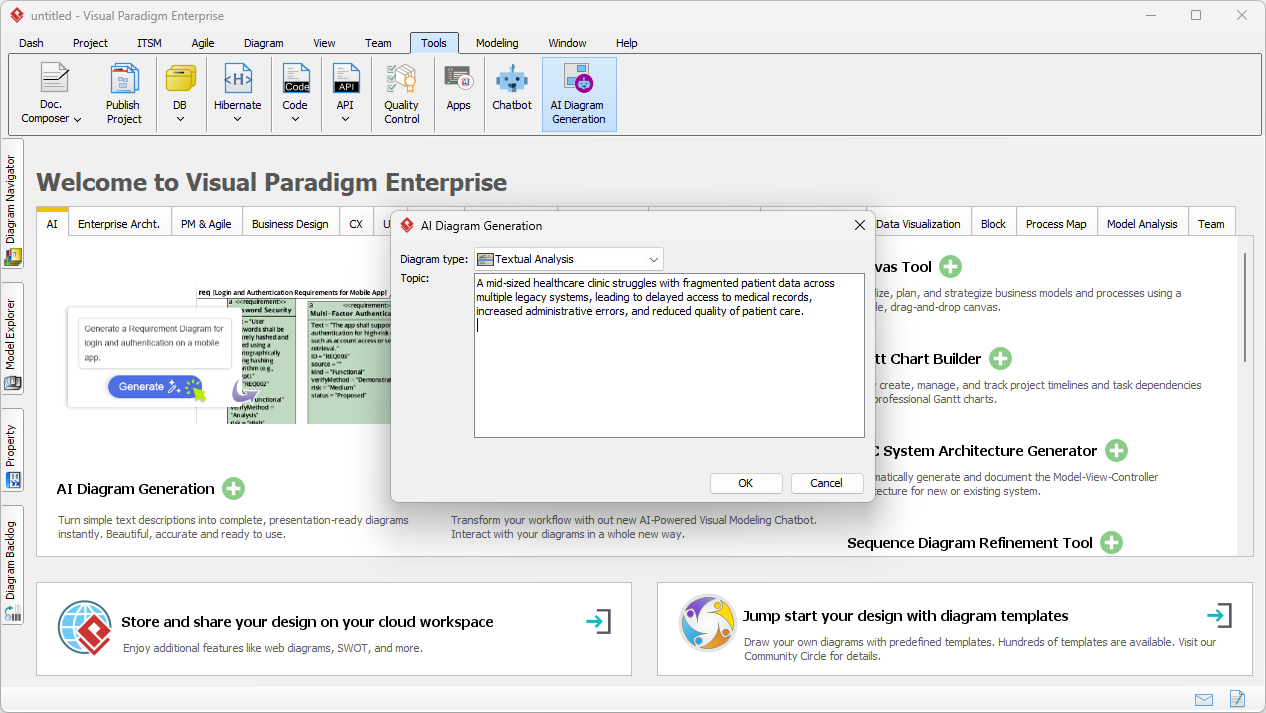
The process begins exactly where you always start: with a problem statement. Maybe it’s an email from a clinic manager describing fragmented patient records, or meeting notes about interoperability challenges. Instead of manually underlining terms or creating spreadsheets, you simply paste this narrative into the AI textual analysis tool within Visual Paradigm.
There’s no need to reformat, tag, or “speak AI.” The online AI diagram generator accepts natural language because it’s designed to assist human communication, not replace it. You’re not training a model—you’re giving a thoughtful colleague some context to help organize.
Step 2: Review, Don’t Rely—The AI as Your Second Pair of Eyes
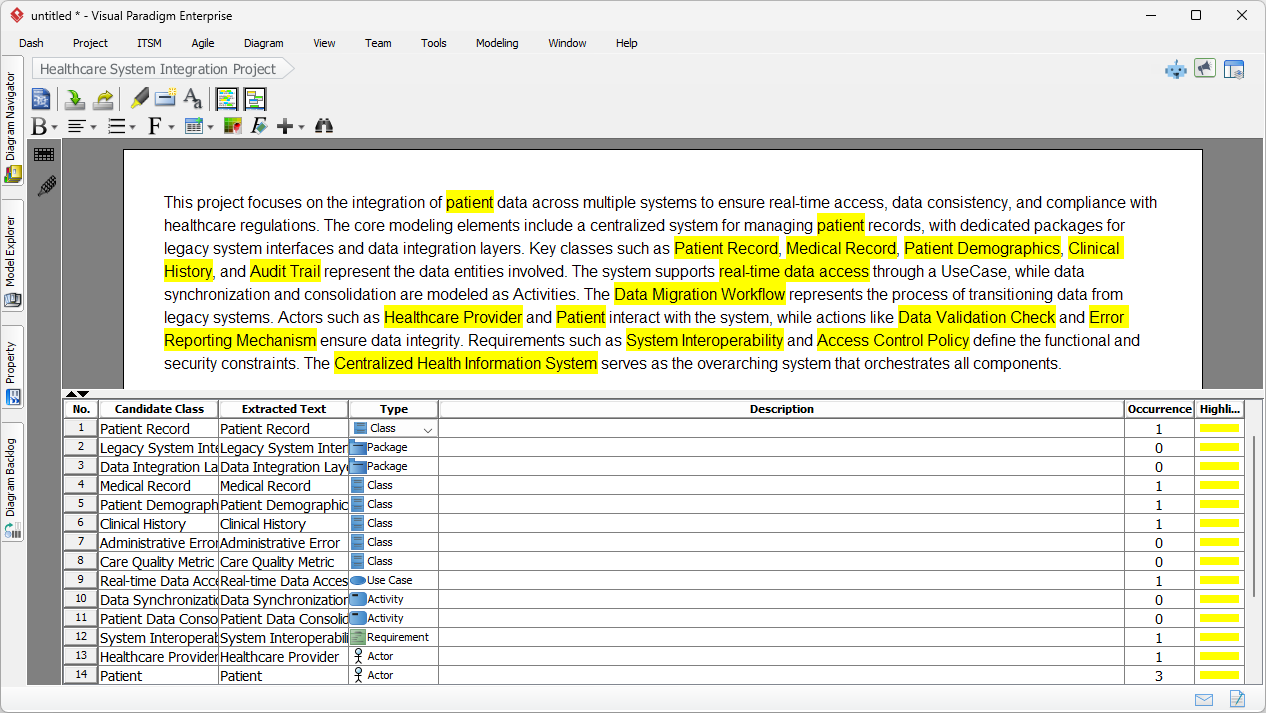
After clicking “OK,” the AI-powered modeling software analyzes the text. Here’s where your expertise takes center stage: the tool presents a dual-pane view. Your original text remains fully visible and highlighted, while a structured grid lists “Candidate Elements” it identified.
In our healthcare example, the intelligent diagramming tool might suggest “Patient Record,” “Medical History,” and “Provider Credential” as candidate classes. It may flag “System Interoperability” as a requirement and “Healthcare Administrator” as an actor. But notice: these are suggestions, not decrees. You can accept, reject, or modify any item. This transparent workflow turns the online class diagram generator into a collaborative thought partner.
Step 3: You’re in Control—Curating Model Elements Thoughtfully
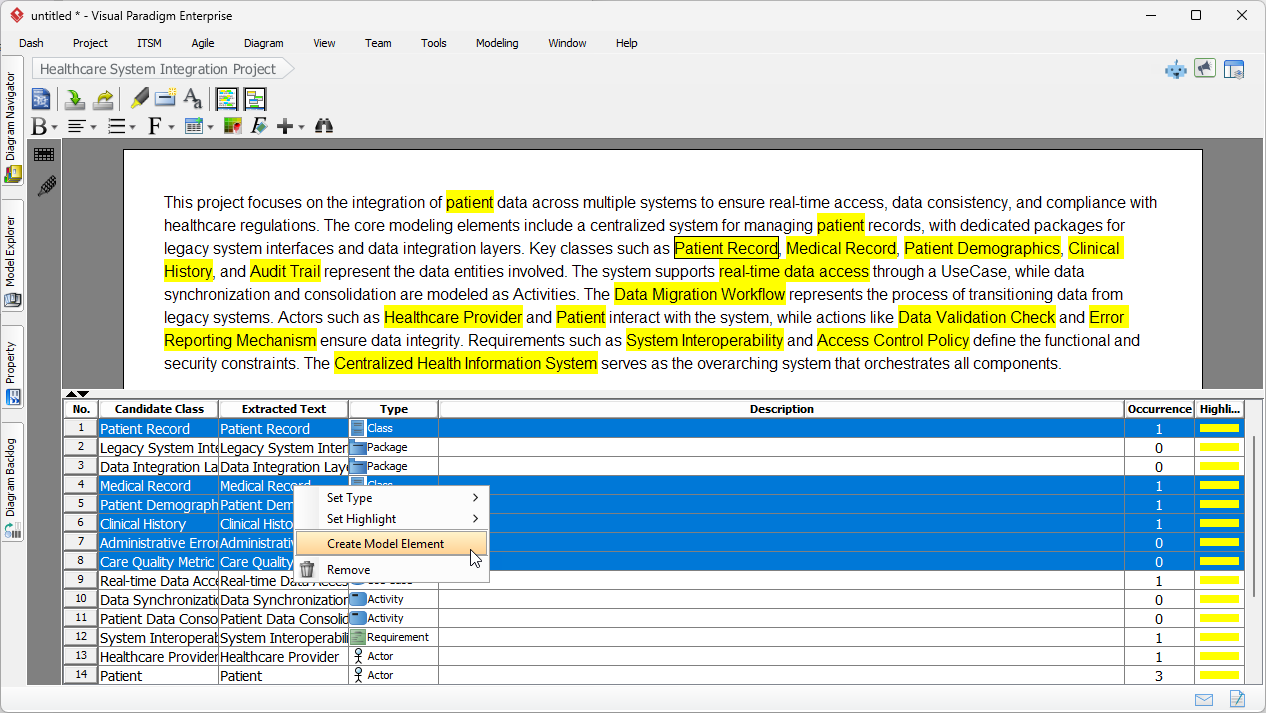
The true value of this AI business analyst assistant emerges when you selectively convert suggestions into model elements. No automatic diagram dumping. Instead, you review each candidate class, actor, or requirement. If “Audit Trail” makes sense for your compliance needs, you select it. If “Legacy System Interface” needs refinement, you edit the label first.
By right-clicking approved items and choosing “Create Model Element,” you transform the automated requirements extraction tool output into semantic components of your system model. This step ensures that every element in your diagram reflects your professional judgment, with the AI having simply accelerated the initial identification phase.
Step 4: Organize Your Model—Maintaining Project Structure
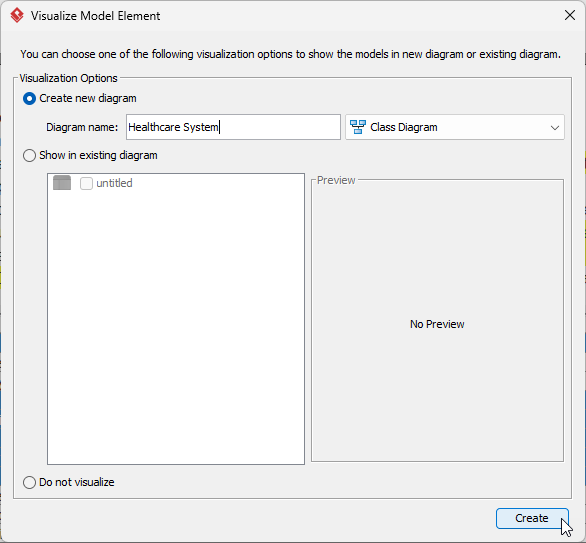
After curating your elements, the online AI diagram generator prompts you to visualize them. This isn’t an automatic canvas dump—it’s an intentional step where you decide: Should these elements join an existing diagram? Or create a new “Healthcare Data Model” view? You name the diagram, assign it to a package, and maintain your project’s organizational logic.
This deliberate pacing addresses a common skepticism: that AI tools create chaotic, unstructured outputs. Here, you’re using an AI UML maker that respects your methodology and documentation standards.
Step 5: Your Diagram, Enhanced—Not Replaced
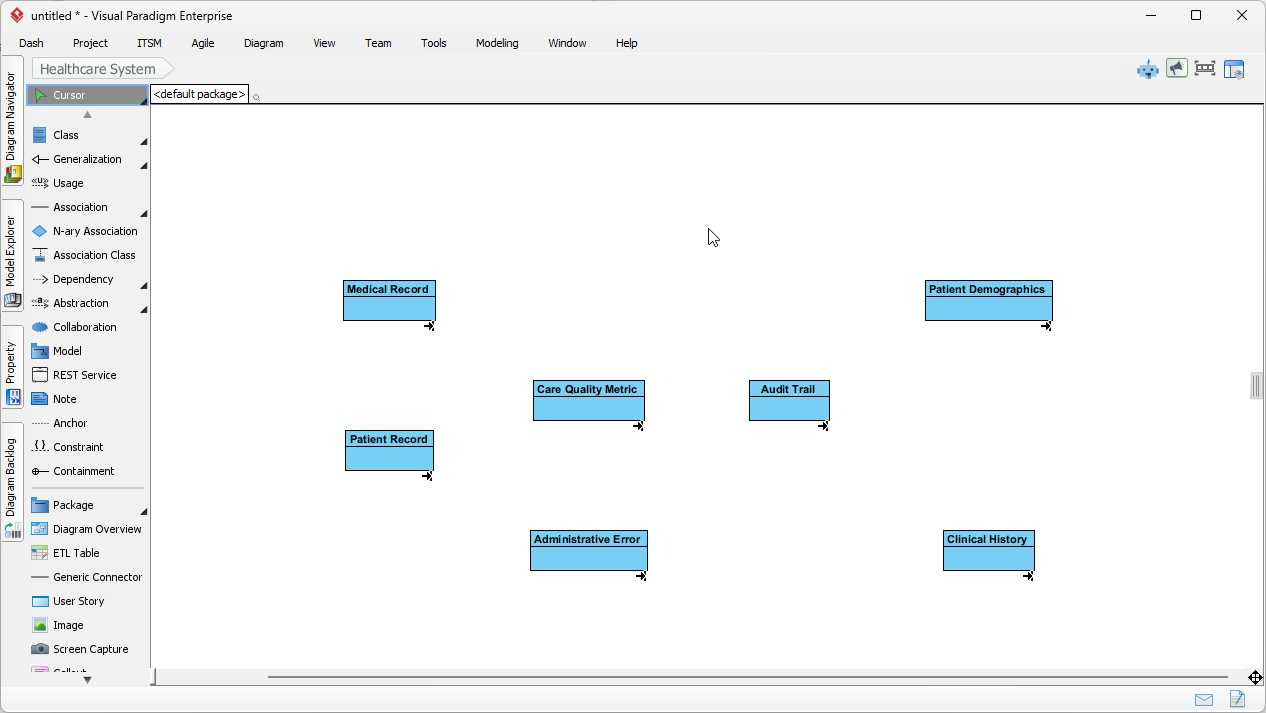
The result is an initial Class Diagram populated with domain classes you approved. Entities like Medical Record, Patient Demographics, and Care Quality Metric appear on the canvas as a starting point—not a final product. This addresses the “blank page” problem many analysts face, providing structure without imposing assumptions.
Now your expertise shines: you define relationships, add attributes, specify constraints, and validate business rules. The online requirements engineering tool handled the mechanical transcription; you focus on the analytical depth that only human experience provides.
Addressing Skepticism: Why This Approach Builds Trust
Transparency Over Black Boxes
Unlike opaque AI systems, this AI textual analysis tool shows its work. You see exactly which phrases triggered which suggestions. This auditability is crucial for regulated industries where traceability isn’t optional—it’s mandatory. Every model element can be traced back to the original stakeholder language.
Augmentation, Not Automation
The intelligent diagramming tool doesn’t make decisions about your system architecture. It surfaces possibilities from unstructured text, reducing the cognitive load of initial elicitation. You remain the architect; it’s simply a very thorough note-taker.
Learning at Your Pace
Start small: use the online AI diagram generator for one meeting transcript. See how it handles your domain language. Gradually expand usage as confidence grows. The tool adapts to your workflow, not vice versa.
Fresh Perspectives: Beyond the Basics
Handling Ambiguity with Human-in-the-Loop
Real-world requirements are messy. The phrase “patient data should be accessible” could mean different things to clinicians, administrators, and IT staff. A good AI business analyst assistant flags ambiguous terms for your clarification, turning potential misunderstandings into structured discussion points.
Supporting Regulatory Compliance
In healthcare, missing a requirement like “audit trail for record access” can have serious consequences. The automated requirements extraction tool systematically scans all input text, reducing the risk of human oversight. You then validate these findings against regulatory frameworks like HIPAA or GDPR.
Facilitating Stakeholder Alignment
When you share a diagram generated from their own words, stakeholders see their input reflected accurately. This online system analysis tool becomes a communication bridge, reducing misinterpretation and building consensus faster than manual methods.
Conclusion: A Thoughtful Path Forward
Adopting an AI-powered modeling software doesn’t require abandoning your professional skepticism. Instead, it invites you to channel that critical thinking toward higher-value activities: validating relationships, refining business rules, and ensuring ethical implementation. The online AI diagram generator from Visual Paradigm is designed for analysts who value precision, control, and traceability.
Start where you’re comfortable. Use the AI textual analysis tool for a single use case. Experience how it handles your domain language. Let the time savings and reduced cognitive load build your confidence gradually. Your expertise remains irreplaceable; this intelligent diagramming tool simply helps you apply it more efficiently.
Ready to explore how a supportive online requirements engineering tool can enhance your workflow? Try Visual Paradigm Desktop Now with no obligation to adopt AI features until you’re ready.
Related Resources for the Cautious Adopter
Visual Paradigm offers a comprehensive textual analysis toolset designed for professionals who value control and transparency. These tools analyze text documents to identify entities, relationships, and candidate patterns, which are then used to generate UML, BPMN, and ERD diagrams—all while keeping you in the decision loop.
- AI Textual Analysis – Transform Text into Visual Models Automatically: Learn how this online AI diagram generator maintains transparency while accelerating modeling.
- From Problem Description to Class Diagram: AI-Powered Textual Analysis: A step-by-step guide for skeptical analysts wanting to maintain control.
- Textual Analysis in Visual Paradigm: From Text to Diagram: Official documentation showing the human-in-the-loop workflow.
- AI Textual Analysis Tool by Visual Paradigm: Explore the interface of this AI business analyst assistant before committing.
- Visual Paradigm Textual Analysis Tool Features: Detailed capabilities of this automated requirements extraction tool with emphasis on user control.
- Documenting Requirements Using Textual Analysis: How to maintain traceability and compliance when using AI assistance.
- What is Textual Analysis? – Visual Paradigm Circle: Foundational concepts for analysts new to AI-assisted modeling.
- AI-Powered Textual Analysis Tutorial for Software Design: A hands-on walkthrough emphasizing human oversight.
- Case Study: AI-Powered Textual Analysis for UML Class Diagram Generation: Real-world results from teams who started skeptical.
- Textual Analysis in Use Case Modeling: How this online system analysis tool supports use case development with transparency.
Related posts:
 From Prompt to Precision: A User’s Journey with Visual Paradigm’s Enhanced AI ArchiMate Genera
AI-Powered ArchiMate Diagrams for Beginners: A Step-by-Step Guide to Smarter Architecture Modeling with Visual Paradigm
From Prompt to Precision: A User’s Journey with Visual Paradigm’s Enhanced AI ArchiMate Genera
AI-Powered ArchiMate Diagrams for Beginners: A Step-by-Step Guide to Smarter Architecture Modeling with Visual Paradigm
 5 Common BPMN Modeling Mistakes (And How to Avoid Them)
 Mastering UML for Exams and Projects: A Step-by-Step AI Assistant Guide
