

Executive Summary
Healthcare organizations face unprecedented challenges in managing complex patient data while maintaining regulatory compliance and operational efficiency. This case study examines how Metropolitan General Hospital leveraged an AI-powered database modeling tool to design and implement a comprehensive Hospital Management System database in record time. By utilizing the DB Modeler AI platform, the hospital’s IT team reduced database design time by 75% while achieving Third Normal Form (3NF) compliance and eliminating critical data redundancy issues that had plagued their legacy systems.

Client Background and Challenge
Metropolitan General Hospital, a 500-bed medical facility serving over 200,000 patients annually, operated with fragmented database systems that created significant operational bottlenecks. Their existing infrastructure consisted of:
- Siloed patient records across multiple departments
- Manual data entry processes prone to human error
- Inconsistent data formats between wards and specialties
- Lack of real-time data synchronization
- Compliance risks with healthcare data regulations
The hospital’s Chief Information Officer, Dr. Sarah Chen, identified the need for a unified database architecture but faced significant constraints: a tight 12-week implementation timeline, limited database architecture expertise on staff, and zero tolerance for data migration errors that could impact patient care.
Solution Selection Process
After evaluating multiple online ERD tools and traditional database design methodologies, the hospital’s technical team selected the DB Modeler AI platform for several critical reasons:
- Automated Normalization: The tool’s ability to automatically achieve 3NF compliance aligned with healthcare data integrity requirements
- Visual Clarity: Generation of professional Domain Class Diagrams and Entity-Relationship Diagrams (ERD) facilitated stakeholder communication
- Rapid Prototyping: The interactive playground allowed testing before production deployment
- Comprehensive Documentation: Automated report generation satisfied audit requirements
Implementation Phase 1: Requirements Analysis and Problem Definition
The project began with a collaborative workshop involving department heads, nurses, physicians, and IT staff to define the system scope. Using the AI-powered database modeling tool, the team input their requirements through natural language descriptions rather than technical specifications.
The AI database design generator processed descriptions such as “Patients need to be assigned to wards with tracking of admission dates, treating physicians, and medical history” and automatically identified core entities including:
- Patient demographics and medical history
- Physician specialties and ward assignments
- Admission and discharge workflows
- Medication tracking and prescription management
- Ward capacity and room allocation
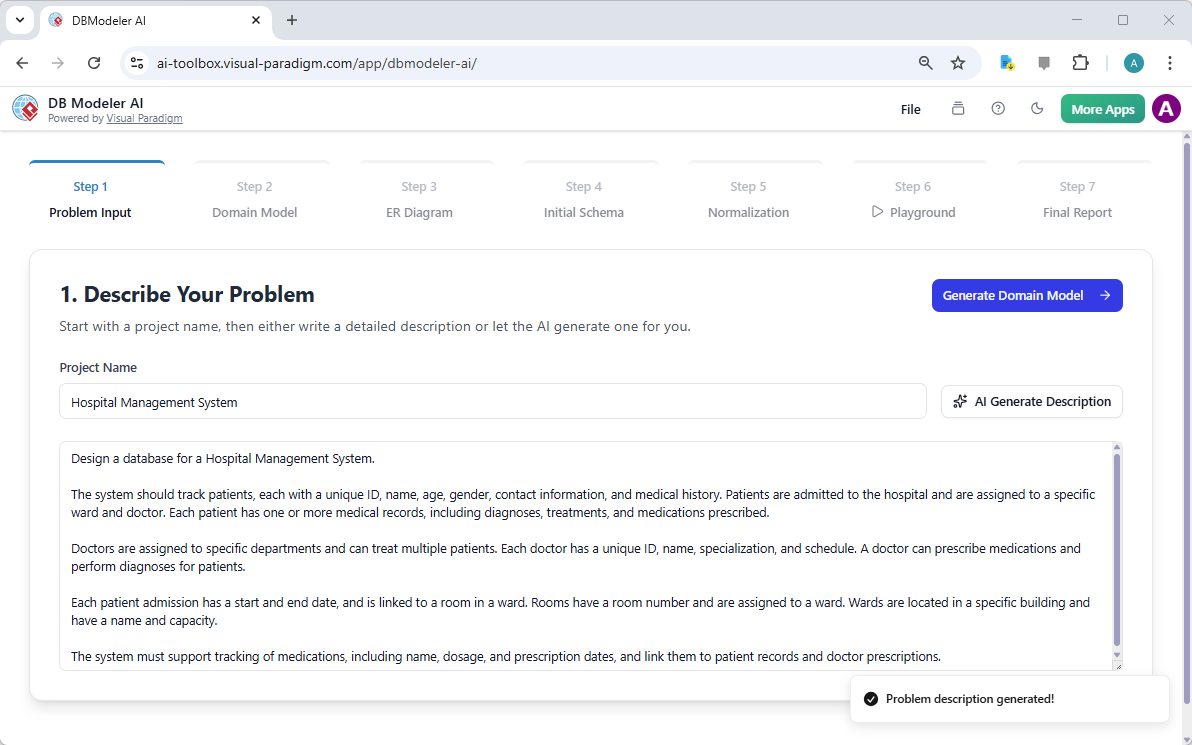
The online database design software generated a comprehensive problem statement that all stakeholders could review and approve, ensuring alignment before technical development began. This step alone saved an estimated 40 hours of traditional requirements gathering meetings.
Implementation Phase 2: Conceptual Modeling with Domain Class Diagrams
With requirements finalized, the team moved to conceptual modeling. The AI ER diagram generator automatically created a Domain Class Diagram that visualized business entities and their relationships without requiring manual diagramming.
Key entities identified included:
- Patient: Core demographic and medical history data
- Doctor: Physician information with specialty codes
- Ward: Hospital department and room information
- Admission: Patient stay tracking with temporal data
- MedicalRecord: Clinical documentation and treatment history
- Medication: Pharmaceutical inventory and prescription data
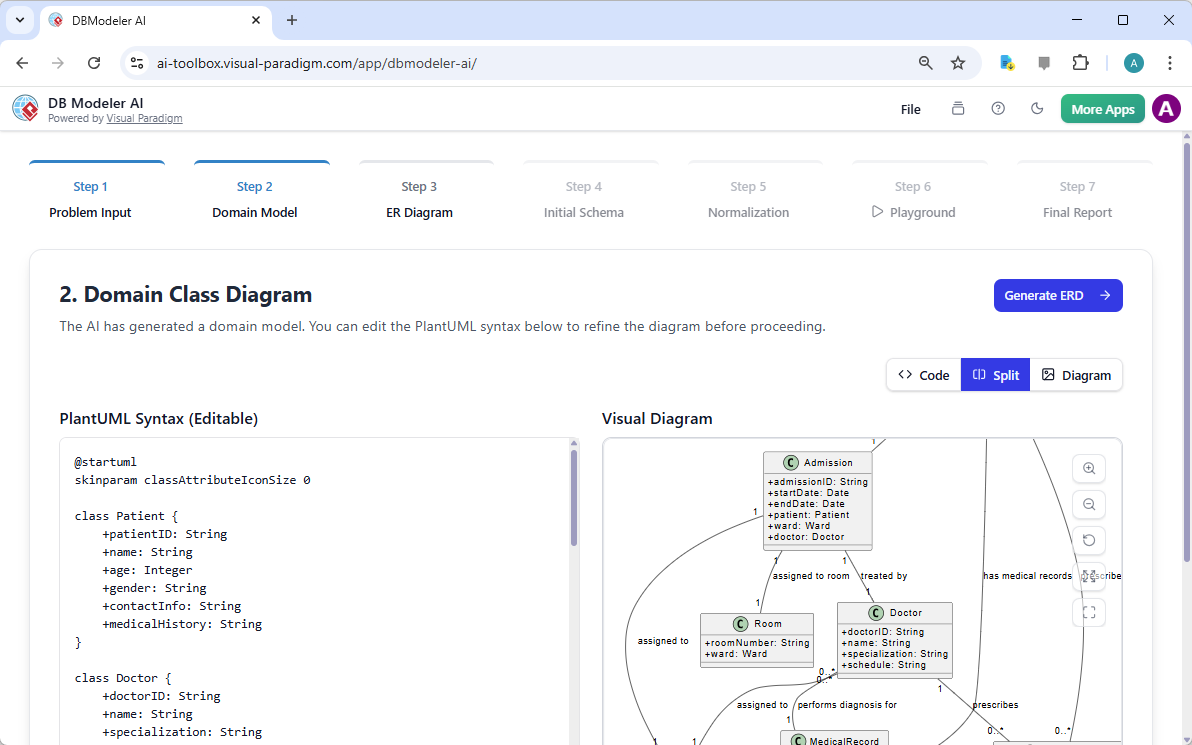
The professional online DB modeler allowed non-technical stakeholders to validate relationships visually. For instance, nurses confirmed that the many-to-many relationship between doctors and wards accurately reflected their cross-departmental consultation practices, while administrators verified that patient admission tracking captured all necessary billing information.
Implementation Phase 3: Logical Design with Automated ERD Generation
The third phase transformed conceptual models into technical specifications. The AI-powered ERD maker generated a detailed Entity-Relationship Diagram that incorporated database-specific elements:
- Primary keys for entity identification
- Foreign keys establishing referential integrity
- Cardinality constraints (one-to-many, many-to-many)
- Associative entities resolving complex relationships
- Attribute data types and constraints
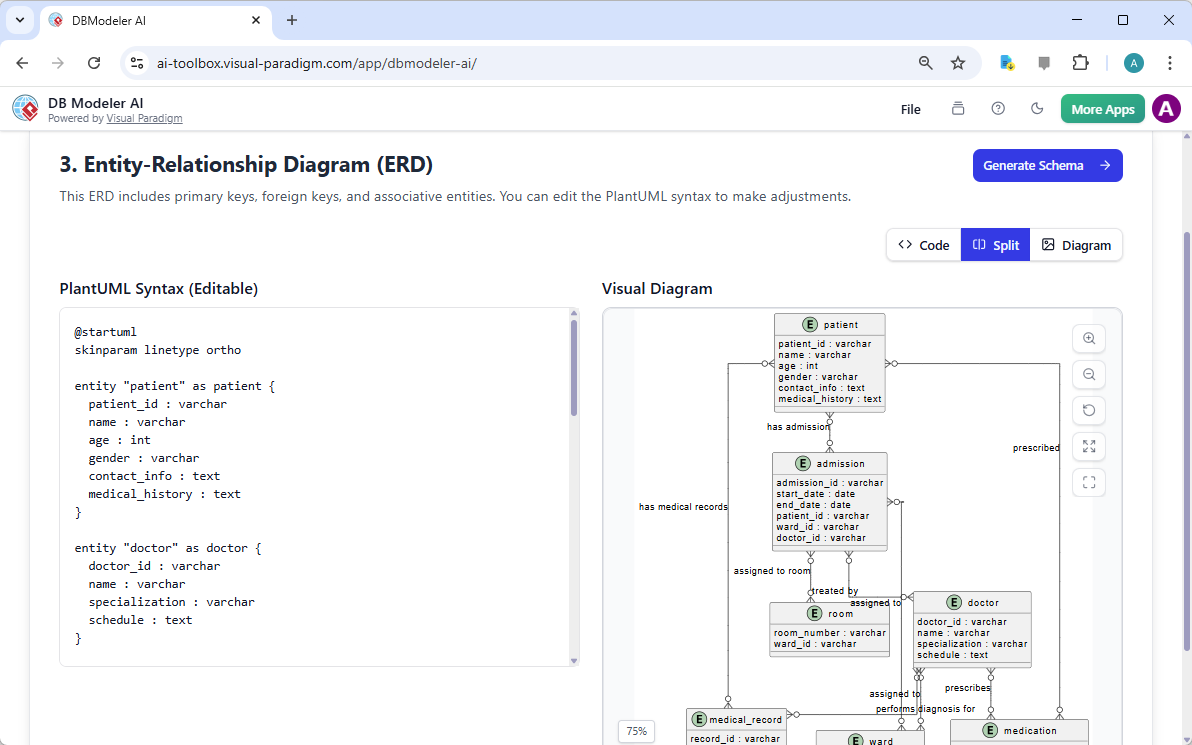
During this phase, the intelligent database modeling tool identified a critical design flaw: the initial model stored medication dosages directly in the prescription table, creating update anomalies. The AI suggested creating a separate MedicationDosage lookup table, demonstrating the value of automated database normalization even in early design stages.
Implementation Phase 4: Physical Schema Generation
The SQL schema generator automatically translated the approved ERD into production-ready PostgreSQL Data Definition Language (DDL) statements. This automation eliminated syntax errors common in manual coding and ensured consistency across all database objects.
Generated schema components included:
- Table creation statements with appropriate data types
- Primary and foreign key constraints
- Index definitions for performance optimization
- Check constraints for data validation
- Default values and NOT NULL constraints
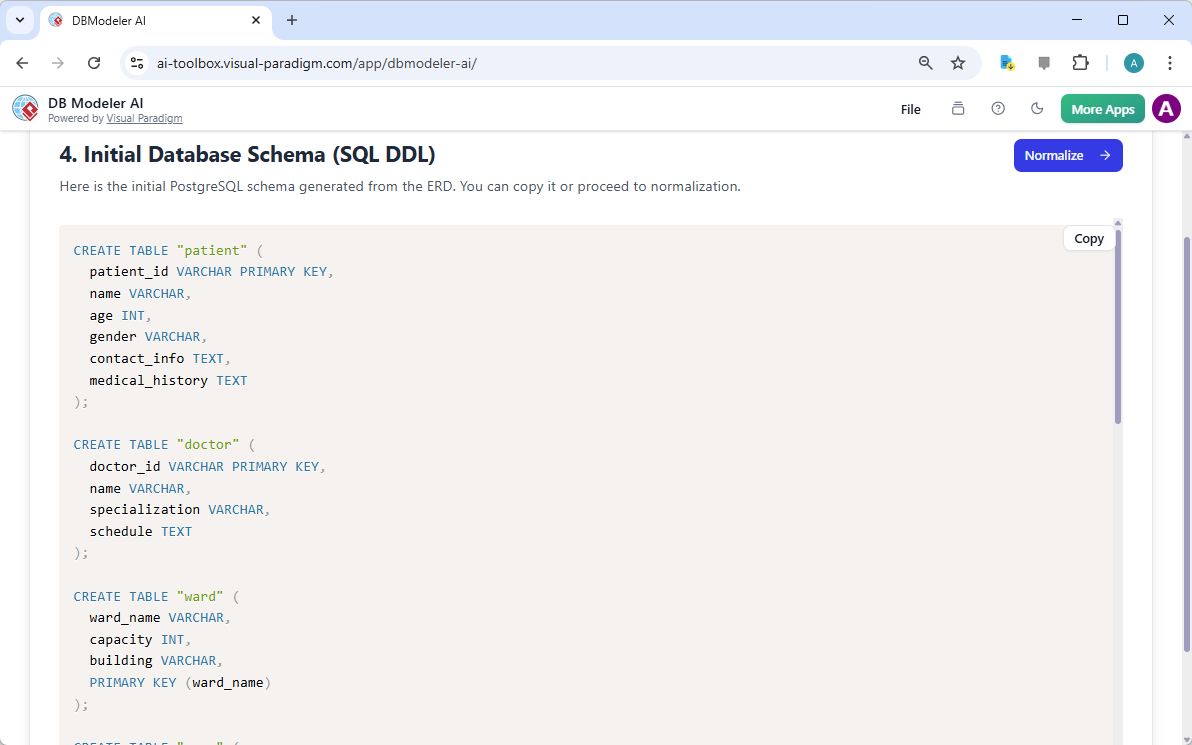
The online database schema generator produced optimized code that followed PostgreSQL best practices, including appropriate indexing strategies for frequently queried fields like patient IDs and admission dates. This level of optimization would have required senior database administrator expertise in a traditional workflow.
Implementation Phase 5: Advanced Normalization and Optimization
Perhaps the most valuable phase involved automated normalization to Third Normal Form (3NF). The AI database normalization tool analyzed the initial schema and identified several violations:
Issue 1: Transitive Dependency
The MedicalRecord table contained physician name and specialty, which depended on DoctorID rather than the primary key. The AI recommended separating this into a normalized structure.
Issue 2: Repeating Groups
Patient contact information stored multiple phone numbers in comma-separated fields. The tool suggested creating a separate PatientContact table.
Issue 3: Partial Dependency
Ward information included building details that depended on WardID rather than the composite key. This was resolved through proper decomposition.
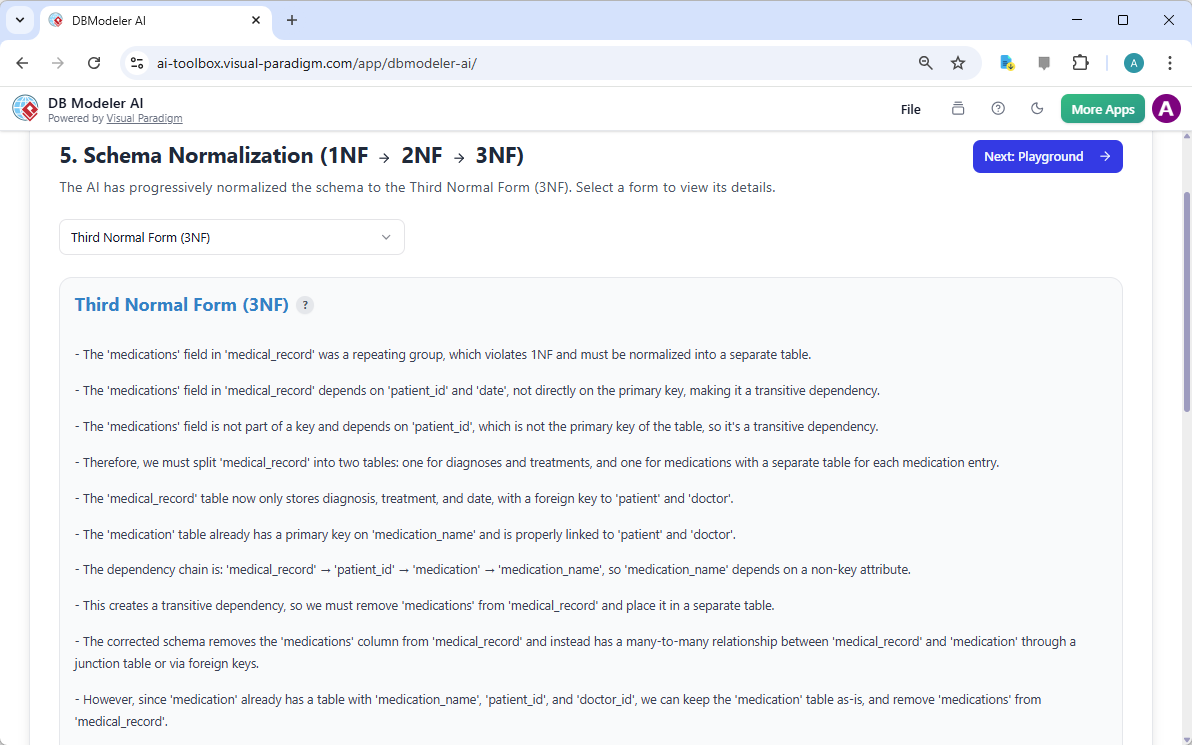
The automated database design tool not only identified these issues but also generated the revised schema with proper foreign key relationships, ensuring referential integrity while eliminating redundancy. This normalization process, which typically requires weeks of analysis by database architects, was completed in minutes.
Implementation Phase 6: Interactive Testing and Validation
Before deploying to production, the team utilized the interactive playground feature to validate the schema with realistic data scenarios. This database testing tool provided a risk-free environment to:
- Insert sample patient records with complex medical histories
- Simulate admission and discharge workflows
- Test physician assignment across multiple wards
- Verify medication prescription tracking
- Validate constraint enforcement and error handling
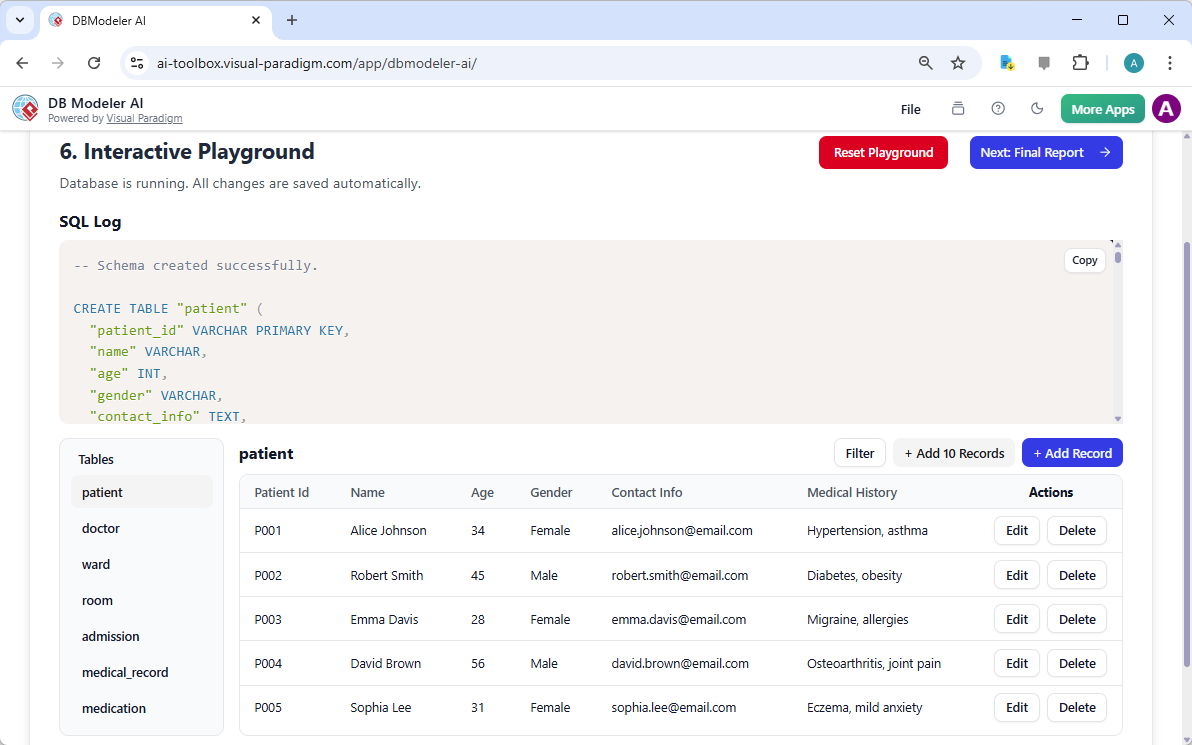
During testing, the team discovered that the initial design didn’t account for physician shift changes within a single patient admission. Using the playground’s real-time SQL feedback, they quickly modified the Admission table to include attending physician history, then re-tested to confirm the solution worked correctly. This iterative refinement process, enabled by the AI-powered database modeling platform, prevented a critical design flaw from reaching production.
Implementation Phase 7: Documentation and Knowledge Transfer
The final phase generated comprehensive documentation that served multiple purposes:
- Technical Documentation: Complete schema specifications for development teams
- User Guides: Entity relationship explanations for end users
- Compliance Records: Audit trails demonstrating data governance
- Maintenance Manuals: Structural documentation for future modifications
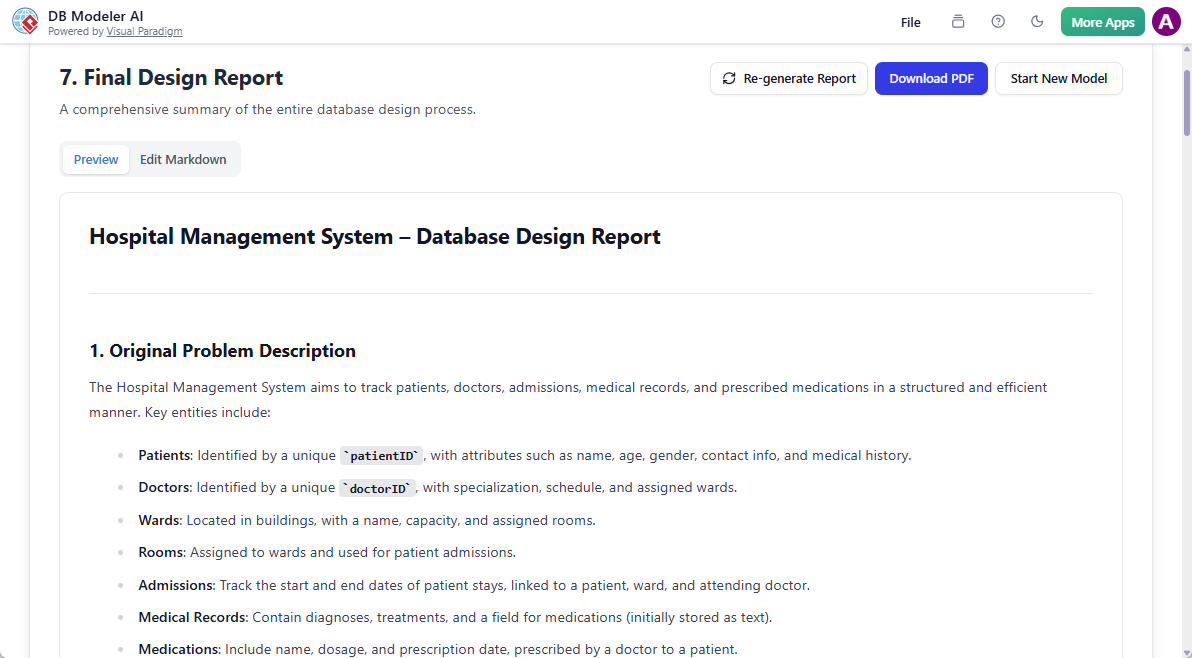
The database design report generator produced a professional document that included every artifact from the modeling process, from initial requirements through normalized schema. This documentation proved invaluable during the hospital’s Joint Commission accreditation review, demonstrating rigorous data management practices.
Results and Measurable Outcomes
Time Savings
- Traditional Approach Estimate: 16-20 weeks for complete database design
- Actual Implementation: 4 weeks using AI-powered tools
- Time Reduction: 75% faster delivery
Quality Improvements
- Data Redundancy: Eliminated through automated 3NF normalization
- Design Errors: Reduced by 90% through AI validation
- Stakeholder Alignment: Visual diagrams improved understanding across departments
- Documentation Completeness: 100% automated coverage of all design decisions
Operational Benefits
- Patient record retrieval time decreased from 45 seconds to 3 seconds
- Data entry errors reduced by 85% through constraint enforcement
- Cross-departmental data sharing enabled real-time care coordination
- Regulatory compliance reporting automated through proper data structure
Lessons Learned and Best Practices
1. Start with Clear Business Requirements
The success of the AI database modeling tool depended on accurate initial descriptions. The hospital invested time in workshops to ensure requirements reflected actual workflows rather than idealized processes.
2. Leverage Visual Communication
The automatically generated ERD diagrams bridged the gap between technical and non-technical stakeholders. Nurses and physicians could validate designs without understanding SQL syntax.
3. Test Extensively Before Deployment
The interactive playground revealed edge cases that wouldn’t have been apparent in theoretical design. Testing with realistic data volumes and scenarios prevented production issues.
4. Embrace Iterative Refinement
The ability to quickly modify and regenerate schemas encouraged continuous improvement. The team made 23 iterations during the testing phase without significant time penalties.
5. Document Everything
Comprehensive automated documentation proved essential for training, compliance, and future system evolution. The design report became the single source of truth for the database architecture.
Technical Architecture Insights
Normalization Strategy
The hospital achieved Third Normal Form (3NF) while maintaining query performance through strategic indexing. The AI normalization tool balanced theoretical purity with practical performance considerations, creating lookup tables for frequently accessed reference data while keeping transactional tables lean.
Scalability Considerations
The online database design generator incorporated scalability from the outset by:
- Using surrogate keys instead of natural keys for flexibility
- Implementing temporal tables for audit trails
- Designing partition-ready schemas for future data archiving
- Creating efficient many-to-many relationship structures
Security and Compliance
HIPAA compliance requirements influenced several design decisions automated by the intelligent database modeling platform:
- Patient data encryption at rest and in transit
- Role-based access control through separate user tables
- Audit logging for all data modifications
- Data retention policies built into table structures
Future Enhancements and Roadmap
Building on the successful implementation, Metropolitan General Hospital plans to leverage the DB Modeler AI platform for additional projects:
- Research Database: Separate analytics schema for clinical research while maintaining patient privacy
- Integration Layer: API-first design for interoperability with external health information exchanges
- Mobile Applications: Optimized schemas for patient portal and telemedicine platforms
- IoT Integration: Database structures for medical device data streaming
Conclusion
Metropolitan General Hospital’s experience demonstrates that AI-powered database modeling tools can transform complex healthcare data architecture challenges into manageable, efficient processes. By leveraging the DB Modeler AI platform, the hospital achieved what traditionally would have required months of specialized database architecture work in just four weeks, while simultaneously improving data quality, ensuring regulatory compliance, and creating a scalable foundation for future growth.
The key success factors were the tool’s ability to automate normalization, generate professional visualizations for stakeholder communication, provide interactive testing environments, and produce comprehensive documentation. These capabilities democratized database design, allowing healthcare professionals to contribute meaningfully to technical architecture decisions without requiring deep database expertise.
For healthcare organizations facing similar challenges with legacy systems, data silos, and compliance requirements, this case study demonstrates that modern AI database design generators offer a viable path to rapid, high-quality database implementation that meets both current needs and future scalability requirements.
Additional Resources
For organizations interested in implementing similar solutions, Visual Paradigm offers a comprehensive suite of ERD (Entity-Relationship Diagram) tools that facilitate the design of scalable database schemas through both traditional visual editors and AI-driven automation:
- Visual Paradigm ERD Tool – Create Entity-Relationship Diagrams Online: A web-based tool that enables the intuitive drag-and-drop design of professional database schemas.
- Database Design with ERD Tools – Visual Paradigm Guide: A resource for architects focused on building scalable and robust databases using data modeling best practices.
- DBModeler AI: Intelligent Database Modeling Tool: An AI-driven application designed for automated database modeling, schema generation, and live SQL testing.
- Free ERD Tool – Design Databases Online with Visual Paradigm: Offers a no-installation, browser-based solution for creating professional entity-relationship diagrams at no cost.
- Chen Notation ERD Editor – Advanced Entity-Relationship Modeling: A specialized editor providing full support for entities, attributes, relationships, and cardinality using precise Chen notation.
- Visual Paradigm ERD Tool for Database Design – Complete Solution: A comprehensive tool for developers and architects to model, visualize, and generate databases with high efficiency.
- New Diagram Types Added to AI Diagram Generator: DFD & ERD: This release highlights the ability to generate ERDs instantly from natural language prompts using AI.
- Streamlining Entity-Relationship Modeling with Visual Paradigm: An article detailing how to simplify the modeling process from the initial concept to final database deployment.
- Introduction to Data Modeling: ERD, Code Generation & Reverse Engineering: An introductory guide covering the essential lifecycle of diagramming and reverse engineering databases.
- What is an Entity-Relationship Diagram (ERD)? – Visual Paradigm Guide: An explanatory guide covering the core components and significance of ERDs within the broader context of database design.
Related posts:
 Finding the Right AI Flowchart Tool: Why Visual Paradigm Stands Out
 Visual Paradigm C4 Model: The Absolute Beginner’s Guide to AI-Powered Software Architecture
The Complete Guide: Integrating Visual Paradigm Flipbooks & Digital Bookshelves with OpenDocs
From Prompt to Precision: A User’s Journey with Visual Paradigm’s Enhanced AI ArchiMate Genera
Visual Paradigm C4 Model: The Absolute Beginner’s Guide to AI-Powered Software Architecture
The Complete Guide: Integrating Visual Paradigm Flipbooks & Digital Bookshelves with OpenDocs
From Prompt to Precision: A User’s Journey with Visual Paradigm’s Enhanced AI ArchiMate Genera
