

Enterprise architecture initiatives frequently stumble not because of technical limitations, but due to the gradual expansion of project boundaries. This phenomenon, known as scope creep, can drain resources, delay delivery, and dilute the strategic value of the architecture itself. In the context of ArchiMate modeling, controlling these boundaries is essential for maintaining clarity and ensuring that the resulting models remain actionable rather than becoming academic exercises.
This guide explores a pragmatic methodology for preventing scope creep within ArchiMate projects. It focuses on structural discipline, governance, and the specific capabilities of the modeling language to keep initiatives aligned with business objectives. By establishing clear limits and using the framework correctly, architects can deliver value without getting lost in the details of every possible requirement.
Understanding Scope Creep in Enterprise Architecture 🧐
Scope creep is the uncontrolled change or continuous growth in a project’s scope. In enterprise architecture, this often manifests as an architect attempting to model the entire organization simultaneously, or diving too deep into implementation details before the business context is settled.
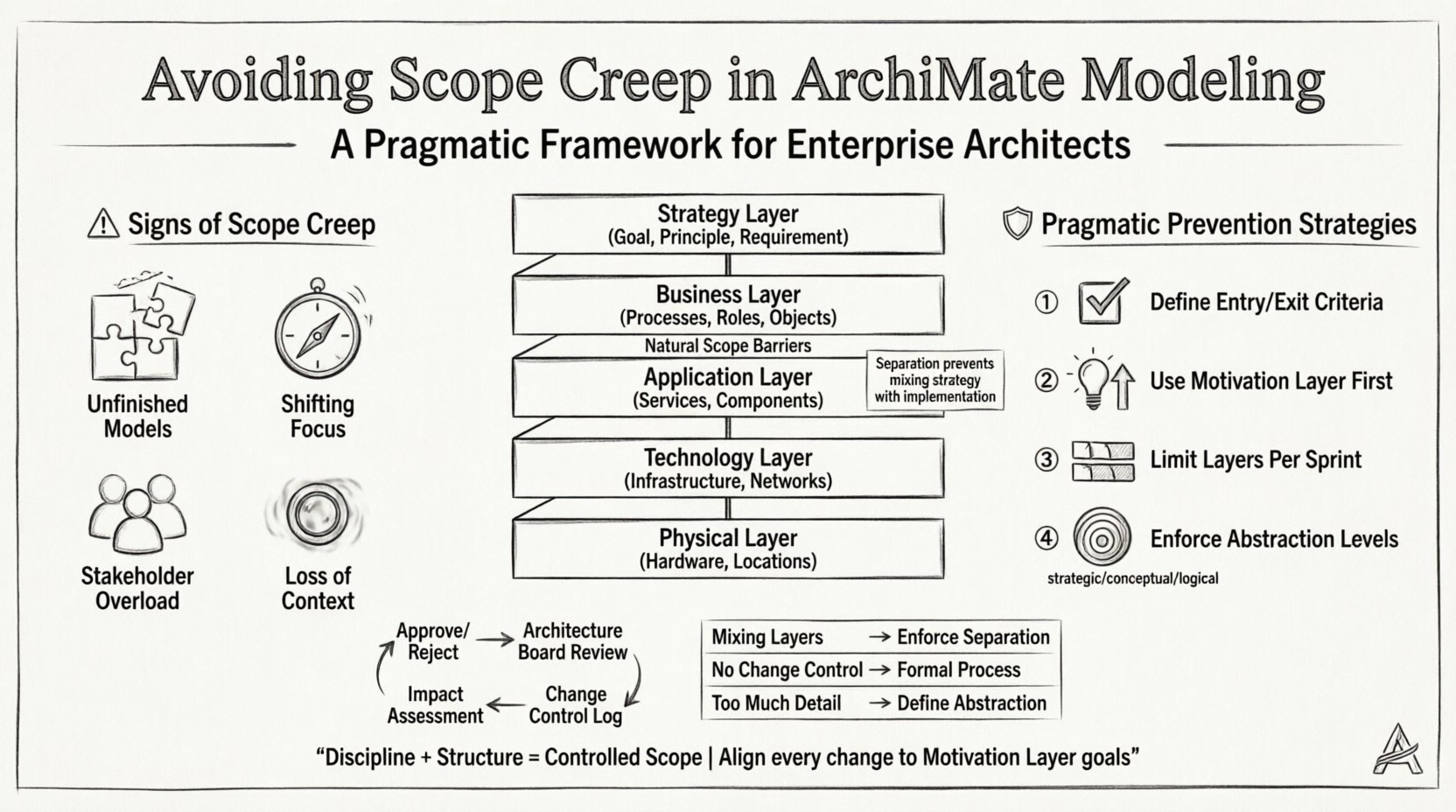
Signs of Scope Creep
- Unfinished Models: Layers remain incomplete because the team keeps adding new business capabilities to the Business Layer.
- Shifting Focus: The conversation moves from strategic alignment to technical configuration details too early.
- Stakeholder Overload: Too many departments are involved without a clear prioritization framework.
- Loss of Context: The model becomes so detailed that it loses its ability to communicate high-level strategy.
When an architecture project expands indefinitely, the return on investment diminishes. The goal is not to create a perfect digital twin of the entire enterprise, but to create a relevant representation that supports decision-making.
Why ArchiMate Helps Control Boundaries 🏗️
ArchiMate provides a structured way to view an enterprise. It is not just a diagramming language; it is a conceptual framework with distinct layers and relationships. This structure inherently limits scope by forcing architects to choose their level of abstraction.
The Power of Layers
The framework divides the architecture into specific domains:
- Strategy Layer: Drives the motivation (Goal, Principle, Requirement).
- Business Layer: Describes business processes, roles, and objects.
- Application Layer: Covers software services and components.
- Technology Layer: Addresses infrastructure and networks.
- Physical Layer: Represents hardware and locations.
By requiring a specific layer for specific information, ArchiMate prevents the common mistake of mixing business strategy with physical server configurations. This separation acts as a natural barrier against scope creep. If a stakeholder wants to discuss server hardware while the team is modeling business processes, the framework signals that this belongs to a different layer or a different workstream.
Pragmatic Strategies to Prevent Expansion 🛑
Preventing scope creep requires more than just technical rules; it requires a disciplined approach to project management and stakeholder engagement. The following strategies help maintain focus throughout the modeling lifecycle.
1. Define Clear Entry and Exit Criteria
Every modeling effort should have a defined start and end point. This is often referred to as the scope statement.
- Entry Criteria: What must be true before modeling begins? (e.g., Business case approved, key stakeholders identified).
- Exit Criteria: What defines completion? (e.g., All critical processes mapped, gaps identified).
Without these definitions, the project can drift. If a team cannot agree on what “done” looks like, the scope will expand until resources are exhausted.
2. Use the Motivation Layer Early
Many projects skip the Motivation Layer (Goals, Principles, Requirements) and jump straight to the Business Layer. This is a critical error. The Motivation Layer defines why the architecture is being built.
By explicitly modeling the drivers:
- Stakeholders understand the purpose of the initiative.
- Proposed changes can be checked against the original goals.
- Scope changes can be rejected if they do not serve the defined motivation.
When a new requirement arises, ask: Does this support the Goals or Principles defined at the start? If not, it is likely scope creep.
3. Limit the Number of Layers per Sprint
In agile architecture environments, it is tempting to model everything at once. Instead, adopt a phased approach.
- Phase 1: Business Layer only. Focus on processes and capabilities.
- Phase 2: Application Layer. Map applications to business processes.
- Phase 3: Technology Layer. Map infrastructure to applications.
This sequential approach ensures that the foundation is solid before adding complexity. It prevents the team from getting bogged down in technical details while trying to understand the business logic.
4. Enforce Abstraction Levels
ArchiMate allows for different levels of detail. A pragmatic approach requires strict adherence to the abstraction level agreed upon for the project.
- Strategic View: High-level capabilities and value streams. No specific process steps.
- Conceptual View: Detailed business processes and actors. No software specifics.
- Logical View: Software services and components. No hardware specs.
When a stakeholder asks for a specific server name in a business process model, the architect must politely redirect them to the Technology Layer. This discipline maintains the integrity of the model.
Governance and Review Processes 📋
Technical controls are not enough; human governance is required. Regular reviews ensure that the model stays on track.
Architecture Board Involvement
An Architecture Board should review the scope periodically. Their role is to ensure alignment with the broader enterprise strategy. They act as a checkpoint to approve any significant changes to the project boundaries.
Change Control Mechanisms
Every change to the model should be logged. This creates an audit trail.
- Log the Change: Record what was added or modified.
- Assess Impact: Determine how this affects other parts of the architecture.
- Approve or Reject: The board decides if the change fits the original scope.
This process makes scope creep visible. When stakeholders see that every change requires formal approval, they become more cautious about requesting unnecessary additions.
Handling Requirements and Dependencies 🔄
Scope creep often comes from poorly understood requirements. ArchiMate provides specific constructs to manage these.
Requirements Management
Use the Requirement object to capture stakeholder needs explicitly. Link these requirements to the architectural elements they affect.
- Traceability: Show which business process satisfies which requirement.
- Dependency: Show how one requirement depends on another.
If a new requirement is introduced, trace it back to the Motivation Layer. If there is no link to a Goal or Principle, flag it for review.
Dependency Management
Complex architectures have many dependencies. Modeling these explicitly helps identify where scope might expand unexpectedly.
- Access Relationships: Shows which applications use which data.
- Flow Relationships: Shows how business objects move between processes.
- Serves Relationships: Shows which applications support which business processes.
By visualizing these dependencies, architects can see the ripple effect of a change. If changing one process affects five applications, the scope impact is clear, and stakeholders can make informed decisions.
Common Pitfalls and Solutions Table 📊
The following table summarizes common issues in ArchiMate projects and how to address them pragmatically.
| Pitfall | Impact | Pragmatic Solution |
|---|---|---|
| Modeling Everything at Once | Overwhelming complexity, slow delivery | Adopt a phased approach (Strategy → Business → Tech) |
| Mixing Layers | Confusion, loss of clarity | Enforce strict layer separation rules |
| Ignoring the Motivation Layer | Projects drift from business goals | Start every project with Goals and Principles |
| No Change Control | Uncontrolled feature bloat | Implement a formal change request process |
| Too Much Detail Too Soon | Stakeholders lose interest, model becomes obsolete | Define abstraction levels and stick to them |
| Lack of Stakeholder Buy-in | Models are ignored or rejected | Involve stakeholders in the modeling process early |
The Role of Communication 🗣️
A model is only as good as its ability to communicate. Scope creep often happens because stakeholders do not understand the model’s purpose. They assume it will cover everything, so they keep adding requests.
Visualizing Boundaries
Use the model itself to show boundaries. Create a “Scope Diagram” that highlights what is in scope and what is out of scope.
- Highlight In-Scope: Use a specific color or shape for elements currently being modeled.
- Highlight Out-of-Scope: Use a grayed-out state or a dashed line for elements that are related but not part of this iteration.
This visual distinction helps manage expectations. When a stakeholder asks about an out-of-scope element, the architect can point to the diagram and explain the boundary.
Regular Walkthroughs
Hold regular sessions to walk through the model with stakeholders. This is not just for approval; it is for alignment.
- Confirm Understanding: Ensure everyone interprets the diagrams the same way.
- Validate Scope: Ask specifically if the current content matches the agreed scope.
- Address Gaps: Identify if anything critical is missing without adding non-essential details.
Iterative Refinement vs. Perfectionism 🔄
One of the biggest drivers of scope creep is the desire for perfection. Architects may feel the need to model every single process detail before declaring the project complete.
Adopt an Iterative Mindset
Treat the architecture as a living artifact that evolves over time. It does not need to be perfect on day one.
- MVP Approach: Create a Minimum Viable Architecture. Just enough to support the immediate decision.
- Incremental Detail: Add detail in subsequent iterations as the project matures.
- Review Cadence: Schedule reviews to decide if more detail is needed or if the current level is sufficient.
This approach reduces pressure on the initial delivery. It acknowledges that the enterprise environment changes, and the model must change with it. Trying to predict the future with high fidelity is a recipe for scope expansion.
Technical Implementation Considerations 💻
While avoiding software-specific advice, the technical implementation of the model matters for control.
Version Control
Use versioning for all models. This allows the team to revert changes if scope creep leads to a dead end.
- Tag Versions: Label major milestones (e.g., “v1.0 Business Layer Complete”).
- Branching: Create branches for experimental changes without affecting the main scope.
Metadata Management
Use metadata to track the status of elements.
- Status Tags: Draft, Review, Approved, Deprecated.
- Ownership: Assign owners to specific elements to ensure accountability.
Metadata helps in filtering views. For example, a view showing only “Approved” elements provides a stable baseline for stakeholders, reducing the temptation to request changes on unfinished work.
Conclusion on Discipline 🏁
Managing scope in ArchiMate modeling is primarily a discipline issue rather than a technical one. The framework provides the structure, but the people using it must enforce the boundaries. By defining clear criteria, leveraging the layering mechanism, and establishing robust governance, architects can prevent scope creep from undermining their efforts.
The goal is to produce models that are useful, accurate, and timely. This requires saying “no” to good ideas that do not fit the current scope, and “yes” to the essential requirements that drive business value. A disciplined approach ensures that the architecture remains a strategic asset rather than becoming a burden.
As projects evolve, the focus should remain on alignment with business goals. If a change does not serve the Motivation Layer, it does not belong in the model. This simple rule, applied consistently, is the most effective defense against scope creep.
By following these pragmatic steps, enterprise architects can deliver high-quality models that stand the test of time and change. The result is an architecture capability that supports the organization effectively without getting lost in the weeds.