

In the modern enterprise, the disconnect between strategic intent and technical execution remains a persistent challenge. Organizations often find themselves investing heavily in technology solutions that fail to deliver the anticipated business value. This misalignment results in wasted capital, operational inefficiency, and a lack of agility. To bridge this gap, a structured approach to enterprise architecture is necessary. ArchiMate provides a standardized modeling language that allows stakeholders to visualize, analyze, and document the relationships between business strategy and technology infrastructure.
By utilizing ArchiMate, organizations can create a transparent map that connects high-level objectives to the underlying systems and hardware that support them. This guide explores how to effectively use this framework to ensure technology investments directly support business goals.
🧩 Understanding the Core Layers of ArchiMate
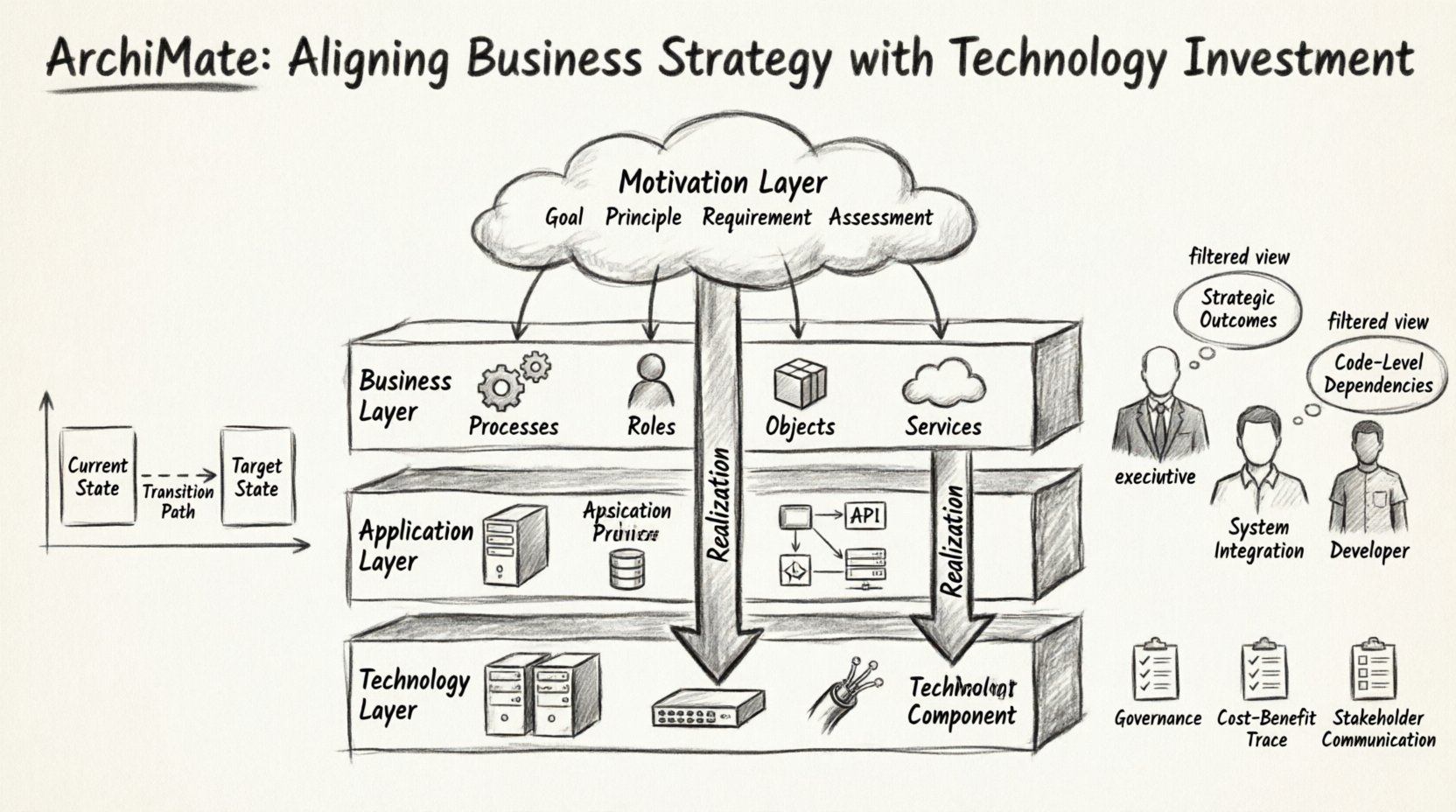
The power of ArchiMate lies in its layered structure. It separates concerns into distinct domains, allowing architects to focus on specific aspects of the enterprise without losing sight of the whole picture. To align business goals with technology, one must understand how these layers interact.
1. The Business Layer
This layer represents the activities, processes, and organizational structures that define what the enterprise does. It includes:
- Business Processes: The workflows and sequences of activities that create value for customers.
- Business Roles: The actors responsible for performing the business processes.
- Business Objects: The information or physical objects that are used or produced by the processes.
- Business Services: The capabilities exposed by the organization to its stakeholders.
2. The Application Layer
The application layer describes the software systems and applications that support the business processes. It acts as the intermediary between the business requirements and the technical infrastructure. Key elements include:
- Application Services: The functionality provided by the software to the business layer.
- Application Components: The modular parts of the software that realize the services.
- Application Interface: The points of interaction between applications.
3. The Technology Layer
This layer encompasses the physical and logical hardware, networks, and platforms that host the applications. It is the foundation upon which the digital ecosystem rests. Elements include:
- Technology Services: The capabilities provided by the hardware or network.
- Technology Components: The specific hardware devices or software platforms.
- Technology Interfaces: The connections between technology components.
The following table illustrates the relationship between these layers and their primary focus:
| Layer | Primary Focus | Key Question |
|---|---|---|
| Business | Value Creation | What does the business need to achieve? |
| Application | Functional Support | What software enables the business activities? |
| Technology | Infrastructure | What hardware runs the software? |
🎯 Integrating the Motivation Layer
One of the most critical aspects of alignment is the Motivation Layer. Without a clear understanding of why an investment is being made, the model lacks purpose. This layer captures the drivers behind architectural decisions.
Key Motivational Elements
- Goal: A desired state that an actor wishes to achieve. Goals provide the direction for the enterprise.
- Principle: A rule or guideline that constrains behavior and decision-making. Principles ensure consistency across investments.
- Requirement: A condition that must be met for a goal to be realized. Requirements translate goals into actionable constraints.
- Assessment: An evaluation of a capability or capability realization against a goal or requirement.
When initiating a technology investment project, start by defining the Business Goals. These goals must then be linked to specific Requirements. By tracing these requirements down through the Application and Technology layers, you can validate that every dollar spent contributes to a defined objective.
🔗 Creating Traceability: Linking Strategy to Execution
Traceability is the mechanism that ensures a line of sight exists from the boardroom to the server room. In ArchiMate, this is achieved through specific relationship types that define how elements interact across layers.
Realization Relationships
The Realization relationship is fundamental to alignment. It indicates that one element provides the capability to another. This is the primary link between layers.
- Business Goal Realization: A Business Process realizes a Business Goal.
- Application Service Realization: An Application Component realizes an Application Service.
- Technology Service Realization: A Technology Component realizes a Technology Service.
By chaining these relationships, you create a path. For example, a Business Goal is realized by a Business Process. That Process is supported by an Application Service. That Service is realized by an Application Component. That Component is deployed on a Technology Component. This chain proves that the Technology Component is necessary for the Business Goal.
Assignment and Access Relationships
While Realization shows what supports what, Assignment and Access show who uses what.
- Assignment: Defines which actor (Role or Role) performs a process or uses a service.
- Access: Defines how an element interacts with another element (e.g., reading or writing data).
These relationships are crucial for understanding the flow of value. If a technology component is not assigned to a role that supports a business process, its investment may be questionable.
📉 Conducting Gap Analysis and Roadmapping
Once the current state is modeled, the next step is to define the target state. Gap analysis identifies the differences between where the enterprise is and where it needs to be.
Identifying Gaps
Using the layered model, you can perform a systematic comparison:
- Business Gap: Missing processes or capabilities required to achieve strategic goals.
- Application Gap: Software deficiencies or legacy systems that hinder business processes.
- Technology Gap: Infrastructure limitations, such as lack of cloud capacity or outdated networking.
Building the Roadmap
A roadmap translates these gaps into a timeline of investments. ArchiMate allows you to group elements into views that represent specific projects or initiatives. This helps in prioritizing investments based on their impact on business goals.
When planning the roadmap, consider the following criteria for prioritization:
- Dependency: Does this technology investment enable a critical business process?
- Urgency: Is the current technology a risk to operations?
- Value: How much does this investment contribute to the defined Business Goals?
By visualizing the roadmap within the architecture model, stakeholders can see the direct correlation between a planned technology upgrade and a business outcome. This transparency is essential for securing budget approval.
💰 Justifying Technology Investments
One of the most difficult tasks for architects is justifying the cost of technology. Financial stakeholders often ask, “Why do we need this new server or software license?” ArchiMate provides the evidence needed to answer this question.
The Cost-Benefit Trace
To justify an investment, create a traceability chain that links the cost element to the business value:
- Identify the Cost: Tag the Technology Component or Application Service with cost attributes.
- Link to Business Value: Ensure the component is part of a chain leading to a Business Goal.
- Quantify the Benefit: Estimate the improvement in efficiency, revenue, or risk reduction associated with the goal.
If a technology component cannot be traced back to a Business Goal or a specific Requirement, it represents a potential cost sink. This analysis allows organizations to eliminate redundant systems and focus resources on high-value areas.
🗣️ Enhancing Stakeholder Communication
Architecture models are often created for technical audiences. However, effective alignment requires communication with non-technical stakeholders. ArchiMate supports the creation of tailored views that abstract away technical complexity.
Crafting the Right Views
- For Executives: Focus on the Motivation and Business Layers. Show how goals are realized and where the gaps lie. Avoid deep technical details.
- For IT Managers: Focus on the Application and Technology Layers. Show the infrastructure requirements and dependencies.
- For Developers: Focus on the Application Layer interfaces and component structures.
By filtering the model to show only the relevant layers for a specific audience, you reduce cognitive load and improve decision-making speed. This ensures that everyone understands their role in the alignment strategy.
🛡️ Governance and Continuous Improvement
Alignment is not a one-time event. It requires ongoing governance to ensure that new initiatives continue to support business goals. As the enterprise evolves, the architecture must adapt.
Change Management
When a change request is submitted, it should be evaluated against the current architecture model. Ask:
- Does this change support an existing Business Goal?
- Does this change create a new dependency that needs to be managed?
- Does this change introduce redundancy in the Application or Technology layers?
Implementing a governance process that requires architecture review before project initiation helps maintain alignment. It prevents “shadow IT” and ensures that all technology investments are documented and justified.
Monitoring and Assessment
Use the Assessment element within the Motivation Layer to continuously evaluate the health of the architecture. Regularly review the model to ensure that:
- Business Goals have not changed without updating the requirements.
- Technology components are still fit for purpose.
- Traceability links remain intact despite changes.
This continuous loop of assessment and adjustment ensures that the enterprise remains agile and responsive to market changes.
⚠️ Common Pitfalls to Avoid
While ArchiMate is a powerful tool, it is not without challenges. Understanding common pitfalls can help organizations avoid failure.
- Over-Modeling: Creating a model that is too detailed can make it difficult to maintain. Focus on the elements that matter for alignment. Do not model every single function.
- Ignoring the Business Layer: Focusing too much on technology without understanding the business context leads to solutions that do not solve the right problems.
- Lack of Maintenance: An architecture model that is not updated becomes obsolete. Ensure there is a process for keeping the model current.
- Assuming Linearity: Architecture is not always linear. Goals may be realized by multiple paths, and layers often influence each other bidirectionally. Account for complexity.
🚀 Next Steps for Implementation
Implementing this approach requires commitment from leadership. Start by auditing your current architecture documentation. Identify where the gaps in traceability exist. Then, begin to populate the Motivation Layer with clear business goals.
Training is also essential. Ensure that architects and business analysts understand the semantics of ArchiMate. Misinterpretation of relationship types can lead to incorrect conclusions about alignment.
Finally, adopt a culture of transparency. Make the architecture model accessible to stakeholders so they can see how their departmental goals contribute to the broader enterprise strategy. This shared understanding fosters collaboration and reduces friction between business and IT.
📝 Summary
Aligning business goals with technology investments is a complex but necessary endeavor. ArchiMate offers a structured framework to facilitate this alignment through its layered approach and motivational elements. By creating clear traceability paths, organizations can ensure that every technology dollar is spent on something that drives value.
Key takeaways include:
- Use the Motivation Layer to define the why behind investments.
- Establish Realization relationships to link layers together.
- Conduct regular Gap Analysis to identify areas for improvement.
- Customize views for different stakeholder groups.
- Maintain the model through continuous governance.
With discipline and a focus on traceability, enterprise architecture becomes a strategic asset rather than a bureaucratic hurdle. The result is a resilient organization capable of adapting its technology landscape to meet evolving business needs efficiently and effectively.