

Modern enterprises operate in an environment of increasing complexity. Departments function with distinct objectives, technologies evolve at varying speeds, and strategic goals often drift from operational realities. This fragmentation creates silos—barriers that isolate information, hinder collaboration, and prevent a holistic view of the organization. 🚧
Enterprise Architecture (EA) serves as the blueprint for navigating this complexity. However, without a standardized language, EA initiatives often become disconnected from business needs. This is where the ArchiMate modeling language proves essential. By providing a structured ontology, ArchiMate facilitates communication between disparate groups, aligning technical capabilities with business outcomes. This guide explores the mechanisms by which ArchiMate dismantles silos and fosters a unified architectural landscape. 🏛️
📉 The Cost of Enterprise Silos
Before addressing the solution, it is necessary to understand the problem. Silos are not merely physical or departmental boundaries; they are informational and structural gaps that prevent effective decision-making. In an EA context, these silos manifest in several critical areas.
- Business and IT Misalignment: Business leaders define goals, while IT teams build systems. Without a shared language, requirements get lost in translation. A feature requested by sales might be built differently by development due to a lack of common terminology.
- Data Fragmentation: Customer data often resides in separate systems (CRM, ERP, Billing). If architecture does not map these flows, organizations cannot see a 360-degree view of the customer.
- Technology Debt: Legacy systems persist because their impact on the broader architecture is unknown. Teams avoid retiring old technology because they fear breaking dependencies they cannot see.
- Strategic Drift: Long-term initiatives fail because the immediate operational layers do not support the required capabilities. The connection between high-level strategy and low-level execution is broken.
These issues result in wasted resources, slower time-to-market, and an inability to adapt to market changes. The core issue is often a lack of a common reference model. 📉
🔑 What is ArchiMate? (Beyond the Tool)
ArchiMate is not a software product. It is a standard for enterprise architecture modeling, maintained by The Open Group. It provides a formalism to describe, analyze, and visualize the relationships between business processes, organizational structures, information flows, application services, and technology infrastructure.
When organizations adopt ArchiMate, they are not just buying a diagramming tool; they are adopting a conceptual framework. This framework ensures that everyone—from the C-suite to the infrastructure engineers—speaks the same language. 🗣️
The Core Value Proposition
- Standardization: It defines specific elements and relationships that are universally understood within the architecture community.
- Abstraction: It allows architects to view the enterprise at different levels of detail without losing context.
- Traceability: It enables the tracking of links from a strategic driver down to a specific technology component.
🏗️ The ArchiMate Layers: Breaking Down Barriers
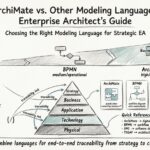
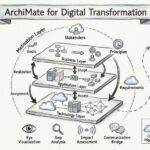
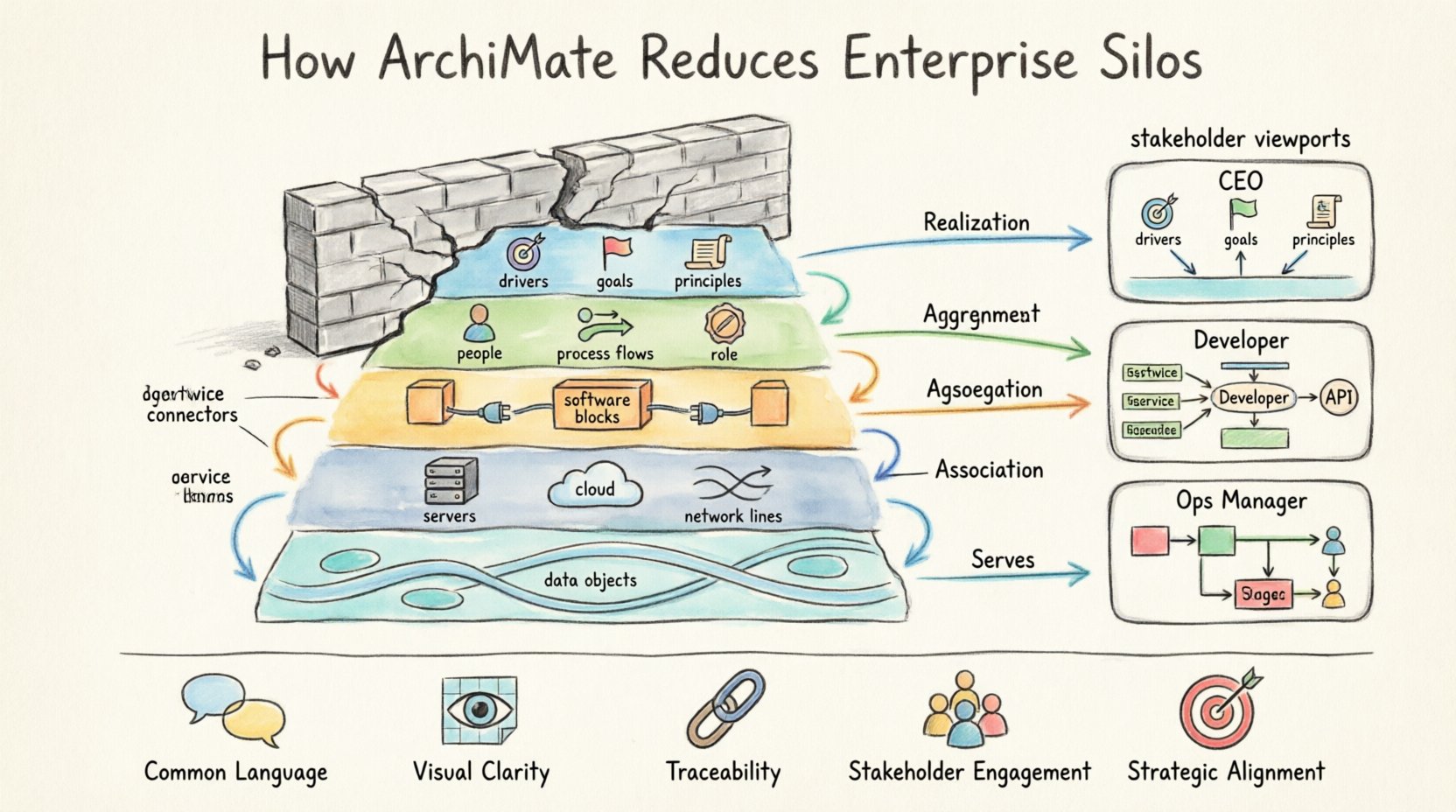
The most significant way ArchiMate reduces silos is through its layered structure. This structure forces the organization to consider interactions across different domains. Instead of viewing Business, Application, and Technology in isolation, ArchiMate mandates the mapping of relationships between them. 🔄
1. The Strategy Layer
This layer addresses the “Why” and “What” of the enterprise. It includes elements such as:
- Drivers: The internal or external factors pushing for change (e.g., new regulation, market shift).
- Goals: The desired outcomes resulting from addressing drivers.
- Principles: The guiding rules that constrain decisions (e.g., “Cloud First”).
- Requirements: Conditions that must be met to achieve goals.
By placing Strategy at the top, ArchiMate ensures that all downstream activities are justified by a clear business intent. This prevents IT projects from being built in a vacuum.
2. The Business Layer
This layer represents the human and process elements of the organization. It includes:
- Business Actors: People or organizations performing activities.
- Business Processes: The workflows that transform inputs into outputs.
- Business Roles: The responsibilities assigned to actors.
- Business Services: The services offered to customers or other parts of the business.
Mapping the Business Layer allows stakeholders to see how work gets done. It highlights where bottlenecks occur and where automation is possible.
3. The Application Layer
Software applications support the business processes. Key elements include:
- Application Services: The capabilities provided by software.
- Application Functions: The internal logic within an application.
- Application Components: The physical or logical building blocks of the software.
Understanding the Application Layer helps IT teams manage complexity. It clarifies which applications support which business processes and which are redundant.
4. The Technology Layer
This layer covers the infrastructure that hosts the applications. It includes:
- System Software: Operating systems, databases, middleware.
- Hardware: Servers, storage, network devices.
- Network: The connectivity infrastructure.
Linking Technology to Applications ensures that infrastructure decisions are driven by software requirements, not just hardware availability. 🖥️
5. The Data Layer
Data is the fuel of the enterprise. ArchiMate defines elements like Data Objects and Information Objects. Mapping data flows between Business, Application, and Technology layers ensures that information integrity is maintained across the landscape.
🔗 Relationships: The Glue That Holds It Together
Layers alone do not solve silos; the relationships between them do. ArchiMate defines specific relationship types that force architects to document how elements interact. This explicit documentation is where silos are exposed and resolved.
Key Relationship Types
- Realization: One element provides the means for another to exist. For example, an Application Service realizes a Business Service. This answers: “How do we achieve this business goal?”
- Assignment: An element is responsible for another. A Business Role is assigned to a Business Process. This clarifies accountability.
- Aggregation: A whole-part relationship. A Business Process is composed of Business Functions. This helps in decomposition.
- Association: A general link between elements, often used for information flow. It connects a Business Actor to a Business Process.
- Serves: An Application Service serves a Business Service. This directly links IT capabilities to business needs.
By requiring these relationships to be modeled, ArchiMate prevents “black box” thinking. Every technology component must justify its existence by serving a business service, which must realize a business goal. This chain of logic eliminates orphaned systems.
👥 Views and Viewpoints: Tailoring the Message
One reason silos persist is that different stakeholders need different information. A developer needs technical detail; a CEO needs strategic impact. ArchiMate addresses this through Views and Viewpoints. 📊
Viewpoints
A Viewpoint defines the conventions, concerns, and purpose of a specific audience. It answers:
- Who is the audience?
- What is their concern?
- Which elements and relationships are relevant to them?
Views
A View is the actual representation (diagram or document) created according to a Viewpoint. For example:
- Business Viewpoint: Focuses on processes, roles, and services. Used by Operations Managers.
- Application Viewpoint: Focuses on software components and interfaces. Used by Development Leads.
- Technology Viewpoint: Focuses on infrastructure and networks. Used by System Administrators.
- Strategy Viewpoint: Focuses on drivers and goals. Used by Executive Leadership.
By creating specific views, organizations ensure that stakeholders are not overwhelmed by irrelevant data. This clarity reduces friction and encourages participation from all departments.
🔄 Traceability: Impact Analysis and Governance
Silos thrive when change happens in isolation. If a team updates a database without knowing the upstream applications, system failures occur. ArchiMate enables traceability, allowing architects to perform impact analysis before changes are made. 🛡️
Downstream and Upstream Analysis
Using the relationship definitions, architects can trace:
- Upstream: What business goals require this technology? If the technology changes, how does the goal suffer?
- Downstream: What technology components support this business process? If the process changes, what needs to be updated?
Governance Benefits
- Compliance: Regulatory requirements can be mapped directly to controls and technologies.
- Cost Management: Redundant applications can be identified and retired, reducing licensing and maintenance costs.
- Risk Reduction: Single points of failure are identified when mapping dependencies.
📊 Comparing Approaches: With vs. Without ArchiMate
To understand the impact of adopting this framework, consider the difference in organizational behavior.
| Aspect | Without Standardized EA Framework | With ArchiMate Adoption |
|---|---|---|
| Communication | Varies by department; jargon barriers exist. | Unified terminology across business and IT. |
| Change Management | Reactive; impact discovered after deployment. | Proactive; impact analyzed via traceability. |
| Strategic Alignment | Goals often disconnected from execution. | Direct links from Strategy to Technology layers. |
| Asset Visibility | Shadow IT and orphaned systems common. | All components mapped to business services. |
| Stakeholder Engagement | IT projects viewed as opaque. | Clear Views tailored to stakeholder needs. |
This table illustrates that the benefit is not just in the diagrams, but in the governance and clarity they enforce. 📈
🚀 Implementation Considerations
Adopting ArchiMate is a journey, not a switch. It requires cultural change and process adjustment. To succeed without creating new silos, consider the following.
1. Start with the Business
Begin modeling the Business Layer. Involve business process owners early. If the business does not recognize the value in the initial models, adoption will stall. Ensure the models reflect reality, not just theory.
2. Focus on Motivation
Do not skip the Motivation Layer. Documenting the Drivers and Goals ensures that every architecture artifact has a business justification. This keeps the focus on value delivery rather than technical neatness.
3. Iterate and Evolve
The architecture landscape changes. Models must be living documents. Establish a maintenance rhythm where models are reviewed and updated during major project cycles. A static model quickly becomes obsolete and creates a false sense of security.
4. Integrate with Processes
Embed architecture reviews into the project lifecycle. When a project starts, it should reference the relevant ArchiMate views. When a project ends, it should update the architecture. This integration prevents the “architecture vs. project” conflict.
🛠️ The Role of the Architecture Repository
While ArchiMate defines the language, a repository is needed to store the artifacts. This repository acts as the single source of truth. It should support:
- Version Control: Tracking changes over time.
- Access Control: Ensuring sensitive data is only visible to authorized personnel.
- Search and Query: Allowing users to find elements across the entire landscape.
- Export Capabilities: Generating reports for specific stakeholders.
The repository enables the traceability discussed earlier. Without it, the relationships defined in ArchiMate diagrams cannot be queried or analyzed at scale.
🌐 Expanding the Scope: Sustainability and Innovation
Modern EA must address sustainability and innovation. ArchiMate supports these emerging concerns through flexibility.
Sustainability
Organizations can model carbon footprints and energy consumption within the Technology Layer. By linking these metrics to Business Goals, leaders can make decisions that balance performance with environmental responsibility. 🌱
Innovation
New technologies (AI, Blockchain, IoT) often enter the organization chaotically. ArchiMate provides a structure to evaluate these technologies. Architects can model the “As-Is” state, the “To-Be” state, and the Migration Path. This structured approach reduces the risk associated with adopting new tech.
🧩 Overcoming Adoption Challenges
Even with a robust framework, challenges arise. Common hurdles include:
- Complexity: The language can seem overwhelming to non-architects. Mitigation: Use simplified views for general audiences.
- Maintenance Effort: Keeping models current is labor-intensive. Mitigation: Automate data collection where possible; integrate with project management tools.
- Cultural Resistance: Teams may feel micromanaged. Mitigation: Focus on the benefits for the teams (e.g., reduced rework, clearer requirements).
Success depends on demonstrating value early. Show a quick win where ArchiMate prevented a costly error or identified a redundant license. 🏆
🎯 Strategic Alignment and Long-Term Value
The ultimate goal of Enterprise Architecture is to ensure that the organization’s structure supports its strategy. ArchiMate facilitates this by making the connections visible. When the link between a strategic driver and a specific server is clear, budget decisions become easier. When a process change is mapped, the impact on IT systems is known.
This visibility creates a culture of accountability. Departments understand how their work fits into the whole. Silos are replaced by a cohesive ecosystem. The organization becomes more agile because it can see the ripple effects of change. 🌊
📝 Summary of Benefits
To recap, the adoption of ArchiMate provides tangible improvements to the enterprise architecture landscape.
- Common Language: Eliminates ambiguity between business and IT.
- Visual Clarity: Complex relationships become understandable diagrams.
- Traceability: Enables accurate impact analysis and governance.
- Stakeholder Engagement: Tailored views ensure relevant information reaches the right people.
- Strategic Alignment: Ensures technology investments support business goals.
By reducing silos, ArchiMate empowers organizations to navigate complexity with confidence. It transforms architecture from a documentation exercise into a strategic asset that drives business value. The journey requires discipline, but the result is a resilient, aligned, and adaptable enterprise. 🚀