

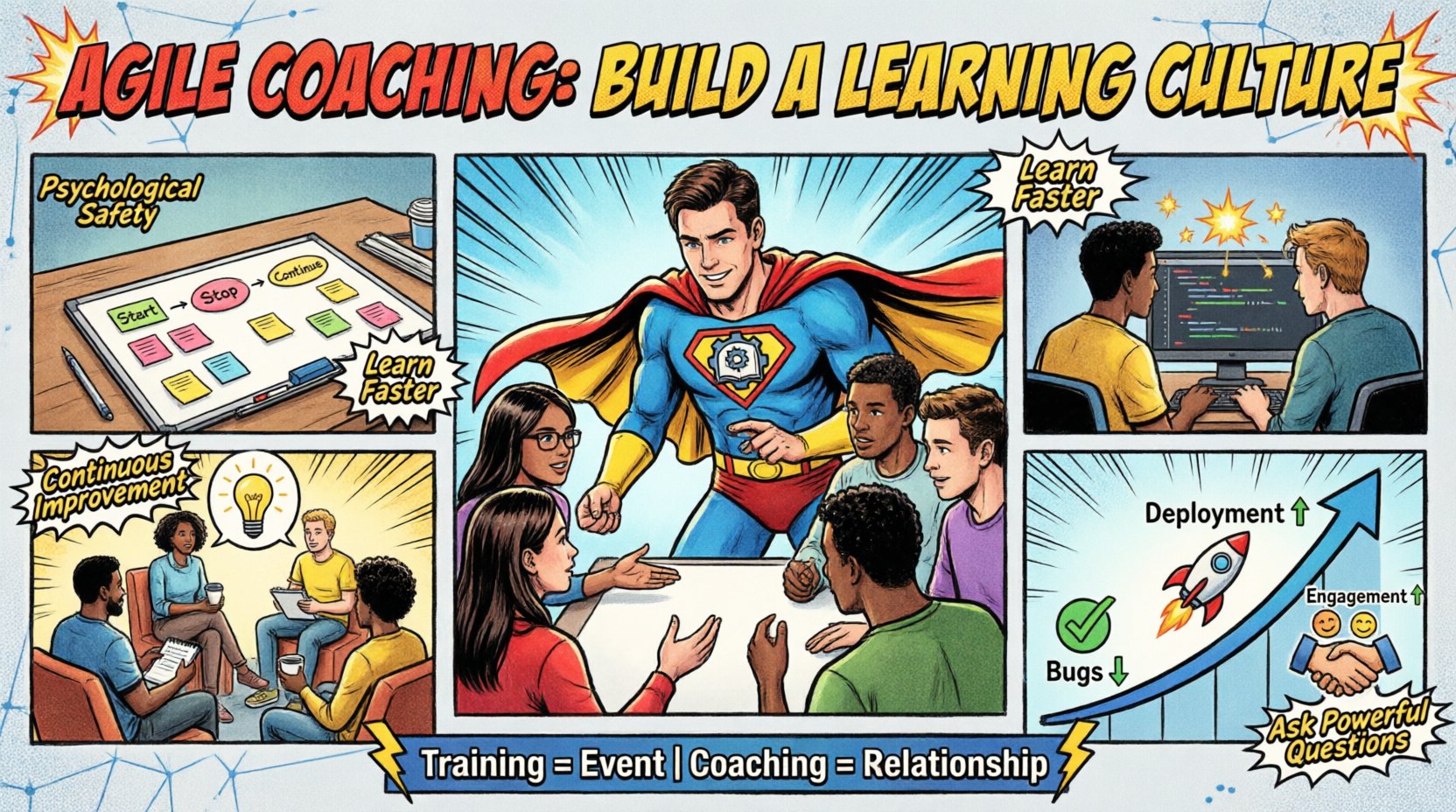
In the fast-paced environment of modern software delivery and product development, static knowledge is a liability. The only sustainable advantage an organization can hold is the ability to learn faster than the competition. This is where agile coaching transitions from a tactical intervention to a strategic imperative. It is not merely about implementing processes; it is about cultivating a mindset where continuous improvement becomes the default state of operation.
This guide explores how to build a robust culture of continuous learning within agile teams. We will look at the mechanics of learning, the specific role of the coach, and the practical steps required to embed growth into the daily rhythm of work.
Why Continuous Learning Matters in Agile 📈
Agile frameworks were born out of the need for adaptability. However, adaptability without learning is just reacting. When teams commit to continuous learning, they shift from simply doing work to understanding work. This distinction changes everything.
Reduced Technical Debt: When developers learn from mistakes in real-time, they refactor code proactively rather than accumulating debt for later.
Increased Resilience: Teams that understand the “why” behind their tools and processes recover faster from outages or market shifts.
Higher Engagement: Professionals seek growth. Providing a path for learning reduces turnover and boosts morale.
Faster Time-to-Market: Learning how to automate testing or improve deployment pipelines directly shortens the feedback loop.
Without a deliberate focus on learning, teams often fall into the trap of “agile theater”. They hold the meetings, but the behaviors do not change. Continuous learning ensures that the how evolves alongside the what.
The Role of the Agile Coach in Learning 🤝
An agile coach does not teach specific technologies or methodologies like a traditional instructor. Instead, the coach facilitates the environment where learning can occur. This requires a shift in perspective from expert to guide.
Key Responsibilities
Creating Psychological Safety: Learning requires vulnerability. If a team fears blame for errors, they will hide them. The coach must build a container where failure is viewed as data, not a crime.
Asking Powerful Questions: Rather than providing answers, the coach asks questions that lead the team to discover solutions themselves. This reinforces critical thinking.
Removing Obstacles: Learning takes time. If a team is blocked by administrative burdens, learning will be deprioritized. The coach clears the path.
Modeling Behavior: Coaches must demonstrate their own learning. Admitting mistakes publicly and sharing new insights sets the tone for the rest of the organization.
Strategies to Embed Learning into Workflow 🛠️
Learning cannot be an afterthought or an event that happens once a year. It must be woven into the fabric of the sprint cycle. Here are specific, actionable strategies to implement.
1. Structured Retrospectives for Growth
Retrospectives are the heartbeat of agile. However, they often drift into complaint sessions. To turn them into learning engines, focus on specific formats:
Start, Stop, Continue: A classic format that forces action items regarding behavior.
Mad, Sad, Glad: Focuses on emotional intelligence and team dynamics.
Five Whys: A root cause analysis technique used to understand the underlying cause of a problem, preventing recurrence.
Learning Goals: Dedicate the first 15 minutes of every retrospective to a specific learning topic or a “win” that was discovered.
2. Communities of Practice (CoP)
CoPs are groups of people who share a concern or passion for something they do and learn how to do it better as they interact regularly. They are voluntary, which is key to their success.
Focus Areas: Front-end architecture, testing strategies, DevOps practices, or soft skills like communication.
Format: Monthly meetings featuring internal demos, guest speakers, or deep-dive discussions.
Outcome: Knowledge transfer across teams that prevents silos and spreads best practices.
3. Pairing and Mob Programming
These practices are not just about getting code written; they are about knowledge diffusion.
Pair Programming: Two developers work at one workstation. One drives (types), the other navigates (reviews). This reduces errors and spreads context.
Mob Programming: The whole team works on the same thing at the same time. This is excellent for onboarding new members or solving complex architectural problems quickly.
4. Internal Hackathons
Setting aside time for innovation allows teams to experiment without the pressure of delivery. This is where new tools are tested, and new workflows are trialed. The goal is not necessarily a production-ready product, but a validated learning.
Overcoming Common Barriers 🚧
Implementing a learning culture is not without friction. Organizations often encounter resistance. Recognizing these barriers early allows for proactive management.
Barrier | Impact | Strategy to Overcome |
|---|---|---|
Lack of Time | Teams feel they are too busy delivering features to learn. | Integrate into Sprint: Dedicate capacity (e.g., 10-20%) specifically for learning and technical improvement within the sprint plan. |
Management Pressure | Leaders focus solely on velocity and output, punishing time spent on learning. | Shift Metrics: Measure outcomes like cycle time and defect rates, not just story points completed. Show the link between learning and long-term velocity. |
Resistance to Change | Team members are comfortable with the status quo and fear new processes. | Small Wins: Start with small, low-risk experiments. Celebrate the success of these small changes to build momentum. |
Lack of Skills | Individuals do not know how to coach themselves or learn effectively. | Training: Provide access to external resources, books, and workshops to build foundational learning skills. |
The Difference Between Training and Coaching 🎓
It is crucial to distinguish between training and coaching when building this culture. Confusing the two leads to wasted resources and frustration.
Training: Focuses on knowledge transfer. It is a one-way flow from expert to learner. Example: A workshop on a new programming language.
Coaching: Focuses on behavior change and unlocking potential. It is a collaborative process. Example: A coach helping a team figure out how to adopt the new language into their workflow without breaking production.
A culture of continuous learning needs both, but coaching sustains the learning over time. Training is an event; coaching is a relationship.
Measuring the Impact of Learning 📊
How do you know if the culture is actually shifting? You cannot measure “learning” directly, but you can measure the outcomes of learning. Use a combination of qualitative and quantitative data.
Quantitative Indicators
Lead Time for Changes: Does it take less time to deploy code as the team learns automation?
Defect Rate: Is the number of bugs escaping to production decreasing?
Cycle Time: Are tasks moving through the system faster due to improved efficiency?
Training Participation: How many team members are engaging in CoPs or workshops?
Qualitative Indicators
Survey Feedback: Regular pulse surveys asking about psychological safety and growth opportunities.
Observation: Are teams collaborating more? Are they discussing architecture more often?
Retention: Are high-performing employees staying longer?
Sustaining the Momentum 🔄
Building a culture is not a destination; it is a journey. Once the initial enthusiasm fades, the natural tendency is to revert to old habits. To prevent this, leadership must reinforce the value of learning consistently.
When a team member shares a lesson learned, recognize it publicly. When a team invests time in refactoring, acknowledge the long-term benefit. Make learning visible. If it is not celebrated, it is assumed to be optional.
Leadership Alignment
Agile coaches cannot do this alone. Leadership must align with the vision. If a manager says “we value learning” but promotes only those who finish tasks fastest, the message is contradictory. Leaders must walk the talk.
Allocate Budget: Ensure there is money for books, courses, and conference attendance.
Protect Time: Do not schedule meetings during learning hours.
Share Knowledge: Leaders should share what they are learning. It humanizes the hierarchy and encourages curiosity.
Final Thoughts on Growth 🌱
Building a culture of continuous learning is about respecting the intelligence and potential of every team member. It acknowledges that no one has all the answers, and that the best solutions come from collective inquiry.
For the agile coach, this is the most significant work you can do. You are not just helping teams deliver software; you are helping them grow as professionals. The code will change, the frameworks will evolve, but the ability to learn will remain the most valuable asset an organization possesses.
Start small. Focus on one team. Implement one new practice. Observe the results. Iterate. The goal is not perfection, but progress. By committing to this path, you create an environment where innovation thrives, and the team is prepared for whatever comes next.
Remember, the journey of learning never ends. As long as the team is growing, the organization is alive.