

Enterprise Architecture is often described as the bridge between strategy and execution. However, bridging that gap requires more than just diagrams and models. It demands a foundation of principled thinking. As a Lead Enterprise Architect, your role is not merely to document systems, but to guide decisions that align with organizational goals. ArchiMate provides a standardized language for this purpose, enabling clear communication across technical and business domains.
This guide explores how to leverage ArchiMate not just as a modeling notation, but as a framework for principled decision-making. We will examine the layers of the framework, the application of principles, and the governance required to maintain relevance. By adopting this approach, architects can ensure consistency, reduce redundancy, and support agile transformation without relying on buzzwords or superficial trends.
🧠 Understanding Principled Thinking in Enterprise Architecture
Principled thinking involves establishing a set of core rules and guidelines that govern how an organization designs and operates. These principles act as a compass, ensuring that every architectural decision moves the enterprise in the right direction. Without them, projects may drift, leading to siloed systems and conflicting standards.
When applied to ArchiMate, principles become the constraints and directives embedded within the model. They are not abstract concepts but actionable criteria that guide the selection of business capabilities, application services, and technology infrastructure. Here is why this approach is critical:
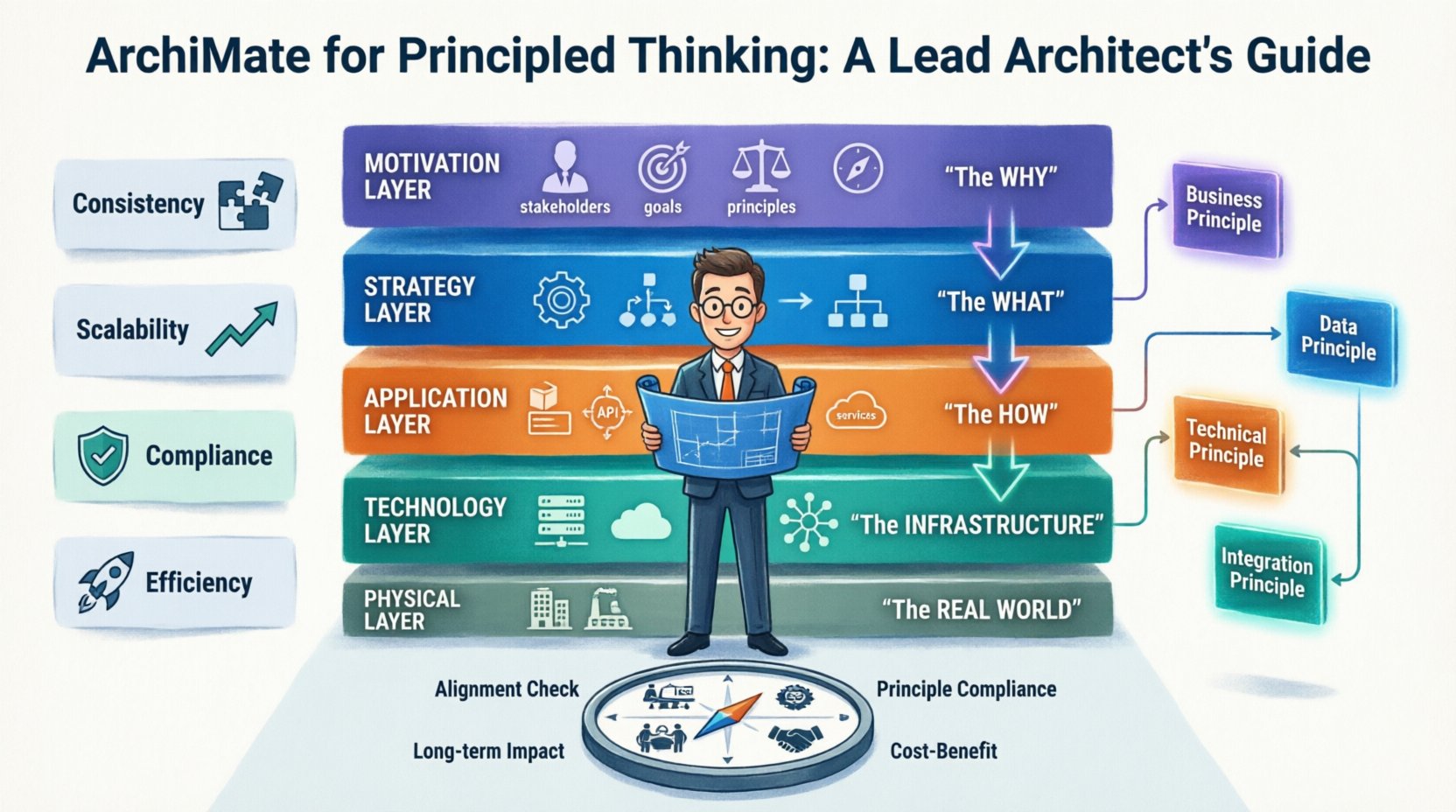
- Consistency: Ensures that different teams use the same definitions and patterns.
- Scalability: Allows architectures to grow without breaking existing structures.
- Compliance: Helps meet regulatory and internal policy requirements.
- Efficiency: Reduces duplication of effort and resources.
As a Lead Architect, your responsibility is to translate these high-level principles into tangible artifacts. You must ensure that the motivation layer reflects the strategy, while the implementation layers reflect the execution. This alignment prevents the common pitfall where strategy is defined in one document and execution happens in another, disconnected environment.
📐 The ArchiMate Framework: A Layered Approach
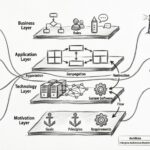
ArchiMate organizes architectural elements into layers. This structure helps separate concerns, allowing architects to focus on specific aspects without losing sight of the whole. Understanding these layers is essential for applying principles effectively.
1. Motivation Layer
This layer captures the “why” behind the architecture. It includes:
- Stakeholders: Who is affected by the change?
- Drivers: What forces the change (e.g., market pressure, regulation)?
- Goals: What are we trying to achieve?
- Principles: What rules must we follow?
- Requirements: What specific needs must be met?
2. Strategy Layer
The strategy layer translates motivation into actionable plans. It defines:
- Business Strategy: The long-term direction of the enterprise.
- Business Capabilities: What the business can do.
- Business Processes: How work gets done.
- Organization: Who performs the work.
3. Application Layer
This layer focuses on the software systems that support business processes. Key elements include:
- Application Services: Functionalities provided by the software.
- Application Components: Internal structures of the software.
- Application Interaction: How applications communicate.
4. Technology Layer
The technology layer represents the hardware and infrastructure. It includes:
- Node: Computational resources (servers, cloud instances).
- Device: End-user hardware (laptops, phones).
- Network: Communication pathways.
- System Software: Operating systems and middleware.
5. Physical Layer
For physical infrastructure, this layer captures real-world objects:
- Facility: Buildings and rooms.
- Equipment: Physical devices.
⚖️ Mapping Principles to Architecture Layers
To make principled thinking practical, we must map specific principles to the relevant layers of the framework. This ensures that governance is applied where it matters most. The following table illustrates how principles interact with different architectural domains.
| Principle Type | Focus Area | Example Principle | Layer Impact |
|---|---|---|---|
| Business Principle | Operational Efficiency | “Automation is preferred over manual intervention” | Business Process, Application Service |
| Data Principle | Information Quality | “Data must be accurate at the source” | Business Object, Application Component |
| Technical Principle | Security | “All external access requires authentication” | Technology Node, Network |
| Integration Principle | Interoperability | “Systems must use standard APIs” | Application Interface, System Software |
By defining principles in this way, you create a traceable link from high-level business goals to low-level technical configurations. This traceability is vital for auditing and compliance. When a change is proposed, you can check it against the principle set to determine if it aligns with the organizational strategy.
🔄 Decision Making and Trade-offs
Architecture is often about making difficult choices. Resources are finite, and competing demands exist. Principled thinking provides a framework for evaluating these trade-offs objectively. Instead of relying on personal preference or vendor influence, decisions are grounded in the established principles.
Consider a scenario where a team proposes a new application. The evaluation process should include:
- Alignment Check: Does this application support a defined business capability?
- Principle Compliance: Does the design adhere to security and integration principles?
- Cost-Benefit Analysis: Does the value justify the investment in the technology layer?
- Long-term Impact: Will this create technical debt or enable future agility?
Using ArchiMate to visualize these trade-offs helps stakeholders understand the consequences of their choices. For example, selecting a specific technology node might improve performance but violate a principle regarding vendor neutrality. Visualizing the dependency allows the group to weigh the risks explicitly.
🛡️ Governance and Maintenance
A model is only as good as its relevance. If the architecture is not maintained, it becomes a relic that no one trusts. Governance ensures that the model stays aligned with reality. This involves regular reviews, updates, and validation against the principles.
Key Governance Activities
- Architecture Review Boards: Groups that assess proposed changes against principles.
- Model Versioning: Tracking changes to the architecture over time.
- Stakeholder Engagement: Ensuring business leaders validate the motivation layer.
- Automated Checks: Using tools to flag deviations from defined standards.
Without governance, models tend to drift. The motivation layer might be updated, but the technology layer remains untouched. This disconnect leads to confusion. Regular synchronization ensures that the “why” matches the “how”. This is particularly important in agile environments where changes happen frequently.
⚠️ Common Pitfalls to Avoid
Even with a solid framework, there are common mistakes that undermine the effectiveness of principled thinking. Being aware of these helps you steer clear of them.
1. Over-Modeling
Creating detailed models for every single system leads to maintenance nightmares. Focus on the critical components that drive value. Detail should be proportional to the impact of the decision.
2. Ignoring the Motivation Layer
Many architects jump straight to the technology layer. Without understanding the business drivers, the technology becomes an end in itself. Always start with the Motivation layer to ensure alignment.
3. Static Principles
Principles should evolve as the business evolves. A principle that was valid five years ago might be obsolete today. Regularly review and refine the principle set.
4. Lack of Communication
Models are useless if no one understands them. Use the standard notation to ensure clarity. Avoid custom symbols that confuse stakeholders.
🚀 Future-Proofing Architectures
The business landscape is constantly shifting. Cloud computing, artificial intelligence, and remote work are changing how enterprises operate. Principled thinking allows architects to adapt to these changes without rebuilding the entire model. By focusing on the principles rather than specific tools, you create a flexible foundation.
For example, a principle stating “Infrastructure should be elastic” allows you to move from on-premise servers to cloud services without violating the core rule. The implementation changes, but the principle remains valid. This stability is key to long-term success.
📝 Final Thoughts on Architectural Leadership
Leading enterprise architecture requires a balance of technical depth and strategic vision. ArchiMate provides the structure to organize this complexity. However, the true value comes from the principled thinking that guides its use. When you embed principles into the model, you create a living system that supports decision-making.
As a Lead Architect, your goal is to enable the organization to move with purpose. This means reducing ambiguity and increasing confidence in architectural choices. By consistently applying principles and maintaining the model, you build trust with stakeholders. This trust is the currency of influence in enterprise architecture.
Remember that the framework is a tool, not a goal. It serves the business, not the other way around. Keep the focus on value creation, alignment, and sustainability. With a disciplined approach to principled thinking, you can navigate the complexities of modern enterprise architecture with clarity and impact.
Start by reviewing your current models. Are the principles clearly defined? Is the motivation layer active? Are the trade-offs documented? Addressing these questions will set the stage for a more effective architectural practice. The journey is ongoing, but the path is clearer when built on solid principles.