

In the modern enterprise landscape, complexity is the only constant. Large organizations often find themselves navigating a labyrinth of legacy systems, siloed departments, and disparate business strategies. Without a unified language to describe how these components interact, alignment becomes a guesswork exercise. This is where the ArchiMate modeling language proves its value. It offers a structured approach to documenting, analyzing, and visualizing enterprise architecture across multiple layers.
This article presents a comprehensive examination of a large-scale implementation project. It details the journey from initial skepticism to a mature architecture governance framework. The focus remains on methodology, process, and organizational change rather than specific software tools. We explore how a global financial services entity transformed its operational clarity using the ArchiMate standard.
📊 The Organizational Context
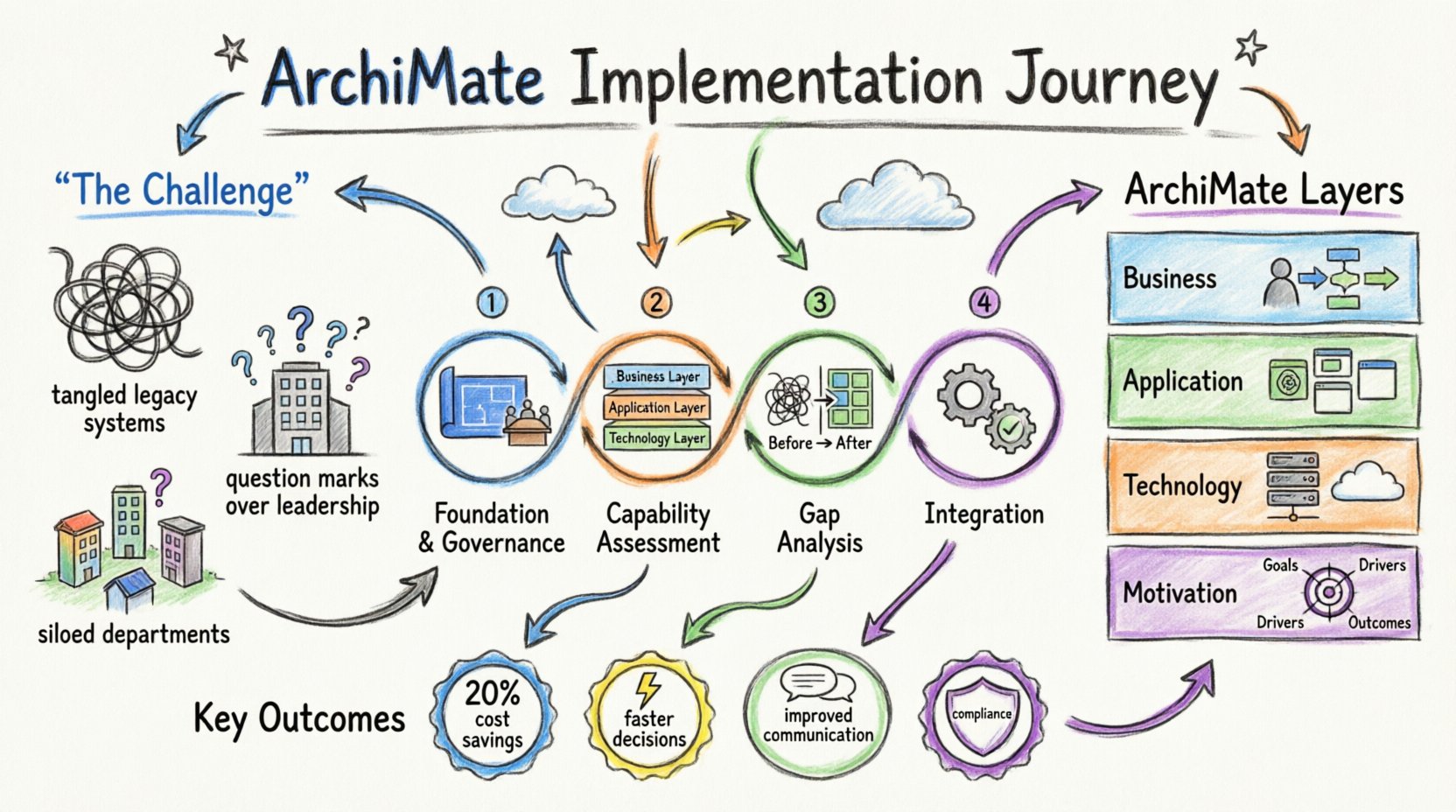
The subject of this case study is a hypothetical multinational corporation operating in the financial sector. At the onset of the initiative, the organization faced significant challenges typical of its size and age.
- Scale: Operations spanned over 30 countries with distinct regulatory requirements.
- Legacy Debt: A portfolio of systems accumulated over 20 years of incremental development.
- Siloed Teams: Business units operated independently, often duplicating efforts in technology and process design.
- Lack of Visibility: Senior leadership struggled to see the impact of proposed changes on the broader IT landscape.
The executive board recognized that without a cohesive architectural view, strategic decisions were being made in a vacuum. The goal was not merely to draw diagrams but to establish a single source of truth for how the business operated and how technology supported it.
🎯 Defining the Strategic Need
The decision to adopt an enterprise architecture framework was driven by three primary factors. These factors formed the foundation of the project charter.
1. Business-IT Alignment
There was a disconnect between the strategic goals set by the board and the execution by the technology teams. The architecture team needed a mechanism to trace business drivers down to the technology components that supported them.
2. Cost Optimization
Redundant applications were consuming budget without delivering proportional value. A clear map of the application landscape was required to identify consolidation opportunities.
3. Agility and Compliance
Regulatory changes were frequent. The organization needed a way to assess the impact of compliance requirements on existing systems quickly.
| Challenge | Impact | Architecture Solution |
|---|---|---|
| Siloed Information | Reinvented wheels, duplicated effort | Centralized modeling repository |
| Legacy Complexity | High maintenance cost, risk | Technology layer mapping |
| Strategy Drift | Projects misaligned with goals | Motivation layer linkage |
🚀 The Implementation Phases
The deployment of the framework was not a one-time event but a multi-year evolution. The project was divided into distinct phases to manage risk and ensure adoption.
Phase 1: Foundation and Governance
Before any modeling began, the governance structure had to be defined. This phase focused on establishing the rules of engagement.
- Architecture Board Formation: A cross-functional group was created to review and approve architectural artifacts.
- Standards Definition: Guidelines were set for naming conventions, layer definitions, and relationship types.
- Tooling Selection: A modeling environment was chosen that supported the open standard, ensuring portability and vendor neutrality.
Phase 2: Capability Assessment
The team began by documenting the current state. This involved capturing the existing business capabilities, applications, and infrastructure.
- Business Layer: Core processes such as “Customer Onboarding” and “Risk Management” were defined as business capabilities.
- Application Layer: Existing software systems were mapped to the capabilities they supported.
- Technology Layer: Hardware, networks, and cloud services were documented as the underlying technology.
Phase 3: Gap Analysis and Target State
Once the current state was visible, the team defined the target state. This involved designing future capabilities and identifying the gaps.
- Target Business Architecture: New capabilities were designed to support emerging market strategies.
- Target Application Architecture: Legacy systems were marked for retirement or modernization.
- Migration Planning: Roadmaps were created to transition from the current state to the target state.
Phase 4: Integration and Governance
The final phase involved integrating the architecture into daily operations. Governance became a routine part of project lifecycles.
- Project Intake: New initiatives were required to submit architecture impact assessments.
- Continuous Updates: The repository was updated regularly to reflect the changing landscape.
- Training: Ongoing workshops ensured that architects and stakeholders could read and contribute to the models.
🧩 Understanding the ArchiMate Layers
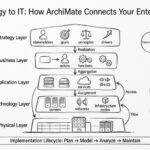
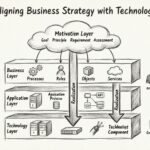
To understand the depth of this implementation, it is necessary to examine how the framework layers were utilized. The standard defines several distinct layers, each serving a specific purpose in the architecture.
Business Architecture
This layer describes the business strategy, governance, organization, and key business processes. In this case study, the team focused heavily on Business Capabilities.
- Function: Used to represent business functions and units.
- Role: Identified the actors responsible for specific functions.
- Process: Mapped the flow of work between roles and functions.
Application Architecture
This layer describes the logical software components and their relationships. The focus here was on Application Services.
- Application Component: Represented specific software modules.
- Interface: Defined how applications interacted with each other.
- Service: Abstracted the functionality provided by components.
Technology Architecture
This layer describes the hardware and software infrastructure. The team utilized Deployment Nodes and Communication Networks.
- Node: Physical or virtual devices where software runs.
- Device: Specific hardware endpoints.
- Connection: The network paths connecting nodes.
Motivation Layer
Often overlooked, this layer connects strategy to execution. It includes Goals, Principles, and Requirements.
- Goal: High-level objectives such as “Reduce Operational Cost”.
- Principle: Rules such as “Buy before Build”.
- Requirement: Specific constraints that must be met.
| Layer | Key Concepts Used | Primary Use Case in Study |
|---|---|---|
| Business | Capability, Process, Role | Process optimization and role clarity |
| Application | Component, Service, Interface | System integration and retirement planning |
| Technology | Node, Device, Connection | Infrastructure cost analysis |
| Motivation | Goal, Requirement, Principle | Strategic alignment and decision tracing |
🛠️ Modeling Relationships and Connections
Merely listing elements is insufficient. The power of the framework lies in the relationships that connect them. The implementation team established strict rules for how layers interacted.
Usage and Assignment
These relationships define dependency. For example, an Application Component uses a Business Process to deliver a service.
- Assignment: A role is assigned to a function.
- Usage: A process uses an application service.
Access and Flow
These relationships define the movement of data and value. An Information Object flows from one process to another.
- Access: A role accesses an information object.
- Flow: Data moves between processes or nodes.
Serving
This relationship connects the Application Layer to the Business Layer. It answers the question, “Which application serves this business function?”
- Application Service: Serves a Business Service.
- Business Process: Uses an Application Service.
🛡️ Governance and Maintenance
One of the biggest risks in enterprise architecture is the creation of artifacts that become outdated immediately after publication. To combat this, the organization implemented a rigorous governance model.
- Version Control: Every change to the model required a version increment. This allowed teams to roll back if a migration failed.
- Change Requests: No architectural change was implemented without a formal request. This request included impact analysis across all layers.
- Review Cycles: Quarterly reviews were conducted by the Architecture Board to ensure models remained accurate.
- Stakeholder Feedback: Regular sessions were held with business leaders to validate that the models reflected reality.
⚠️ Challenges and Mitigation Strategies
The journey was not without obstacles. Several significant hurdles emerged during the implementation.
1. Resistance to Documentation
Many developers and architects felt that modeling slowed down delivery. They viewed it as bureaucracy.
- Mitigation: The team demonstrated how modeling reduced rework. By visualizing dependencies early, costly errors were caught before coding began.
2. Complexity of the Model
As the repository grew, the models became dense and difficult to navigate. Stakeholders struggled to find the information they needed.
- Mitigation: Views were created. Instead of showing the entire architecture, specific views were generated for specific audiences (e.g., CIO view, CTO view, Business Owner view).
3. Data Integrity
Ensuring that the data in the repository was accurate required constant effort.
- Mitigation: Automated scripts were used to validate data consistency. Links between business capabilities and applications were enforced as mandatory fields.
4. Skill Gaps
The team lacked deep expertise in the specific modeling language.
- Mitigation: Certification programs were established. Senior architects were trained first and then acted as internal trainers for the rest of the organization.
📈 Outcomes and Tangible Benefits
After three years of implementation, the organization reported measurable improvements in several key areas. The benefits were not just theoretical but translated into operational efficiency.
- Reduced Redundancy: By mapping the application landscape, the team identified 15 duplicate systems. Consolidating these saved 20% in annual licensing costs.
- Faster Decision Making: When a regulatory change occurred, the impact assessment time dropped from weeks to days due to traceability in the model.
- Improved Communication: The standardized language allowed business and IT to discuss issues without ambiguity. Misunderstandings decreased significantly.
- Strategic Visibility: Leadership could now see exactly which projects contributed to strategic goals and which did not.
🧠 Lessons Learned for Future Initiatives
Based on the experience of this large corporation, several principles emerged that are critical for success in similar environments.
- Start Small: Do not attempt to model the entire enterprise in the first month. Start with a high-priority domain and expand.
- Focus on Value: Ensure every model serves a specific business purpose. If a diagram does not drive a decision, it should not exist.
- Invest in People: Technology is secondary to the skills of the people using it. Training and cultural buy-in are more important than features.
- Maintain the Repository: Architecture is a living entity. It requires dedicated resources to keep it current. Treat it like code that needs refactoring.
- Standardize Relationships: Define clear rules for how layers connect. Ambiguity in relationships leads to confusion in analysis.
🔍 The Role of the Motivation Layer
A specific highlight of this implementation was the rigorous use of the Motivation Layer. Many organizations skip this, but it was crucial for this corporation.
- Strategic Goals: Every project was linked back to a strategic goal. This prevented “zombie projects” that continued without purpose.
- Principles: Architectural principles were enforced through the model. For example, a principle stating “Cloud First” was validated against every deployment node.
- Requirements: Compliance requirements were explicitly modeled. This made it easy to generate reports for auditors.
🔄 Continuous Improvement
The implementation was not a destination but a continuous cycle. The organization established a feedback loop where operational data informed the architecture models.
- Performance Metrics: System performance data was linked to technology nodes in the model.
- Cost Tracking: Actual spend was mapped to applications to refine cost models.
- Change Logs: Every change in the production environment was logged and reflected in the architecture repository.
💡 Key Takeaways
The successful adoption of ArchiMate in a large corporation requires more than just a modeling language. It requires a commitment to structure, discipline, and continuous improvement. The case study demonstrates that when executed correctly, enterprise architecture frameworks provide the clarity needed to navigate complex environments.
- Clarity: A unified view reduces confusion and aligns stakeholders.
- Efficiency: Identifying redundancies saves significant resources.
- Agility: Understanding dependencies allows for faster response to change.
- Compliance: Traceability ensures regulatory requirements are met.
For organizations considering a similar path, the focus should remain on the value the architecture provides to the business. The tools and standards are merely enablers. The true success lies in the ability to make informed decisions that drive the organization forward.
This comprehensive guide illustrates that implementing an architecture framework is a journey of organizational transformation. It demands patience, rigor, and a willingness to challenge the status quo. By adhering to these principles, large corporations can achieve a level of architectural maturity that supports long-term growth and stability.