

As the enterprise architecture landscape evolves, organizations are increasingly seeking tools that balance high-level strategic vision with granular technical detail. With the official launch of ArchiMate 4 approaching in Q2 2026, the focus has shifted from simply listing components to creating integrated, stakeholder-friendly models. This guide explores how Visual Paradigm 18.0 leverages generative AI to streamline the adoption of ArchiMate 4, helping teams navigate new structural requirements like the Hexagonion Framework and native multiplicity with precision.
Embracing the Shift: Simplicity Over Comprehensiveness
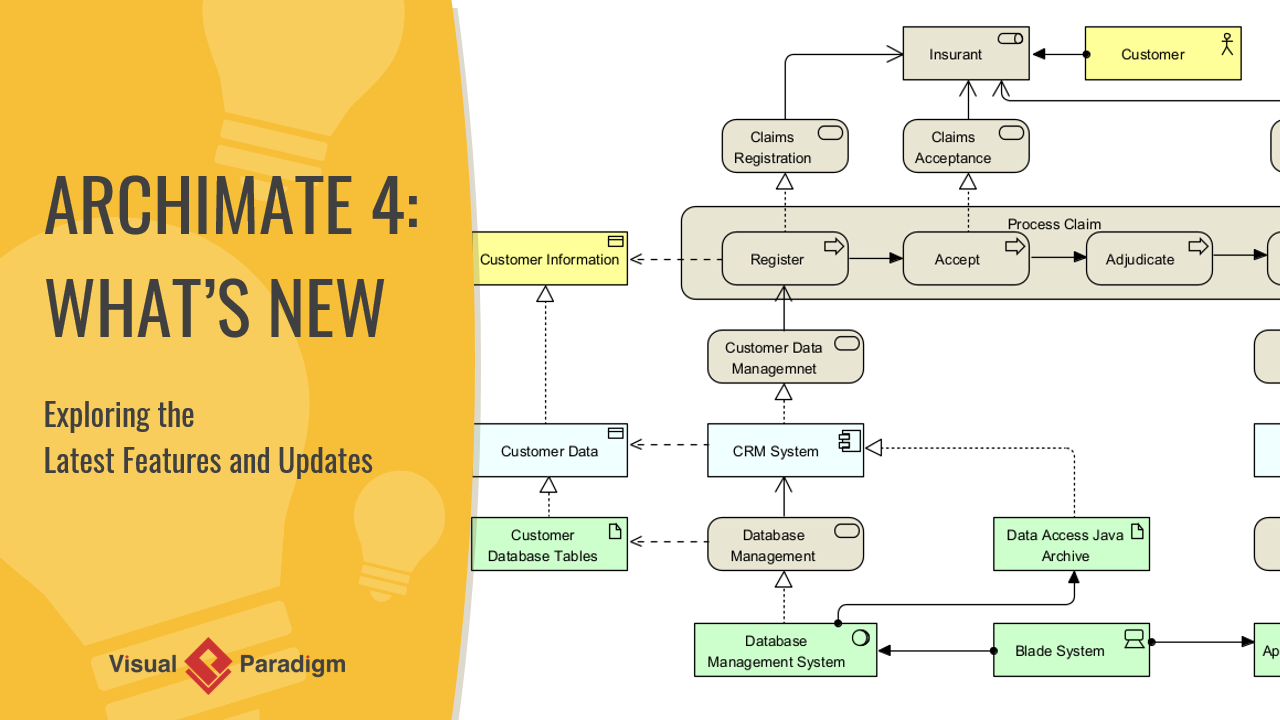
The fourth iteration of the ArchiMate standard introduces a philosophical shift: prioritizing simplicity for clarity while maintaining rigorous precision for advanced use cases. Gone are the days of navigating dense layers of redundant elements. Instead, ArchiMate 4 emphasizes a streamlined approach where stakeholders can quickly understand the value proposition without getting lost in technical minutiae.
Key changes in the standard include:
- The Hexagonion Framework: This structural update moves away from traditional layered views toward a more integrated set of “domains.” It encourages a holistic view of the enterprise, ensuring that technology, business processes, and people are modeled in a cohesive manner rather than as isolated silos.
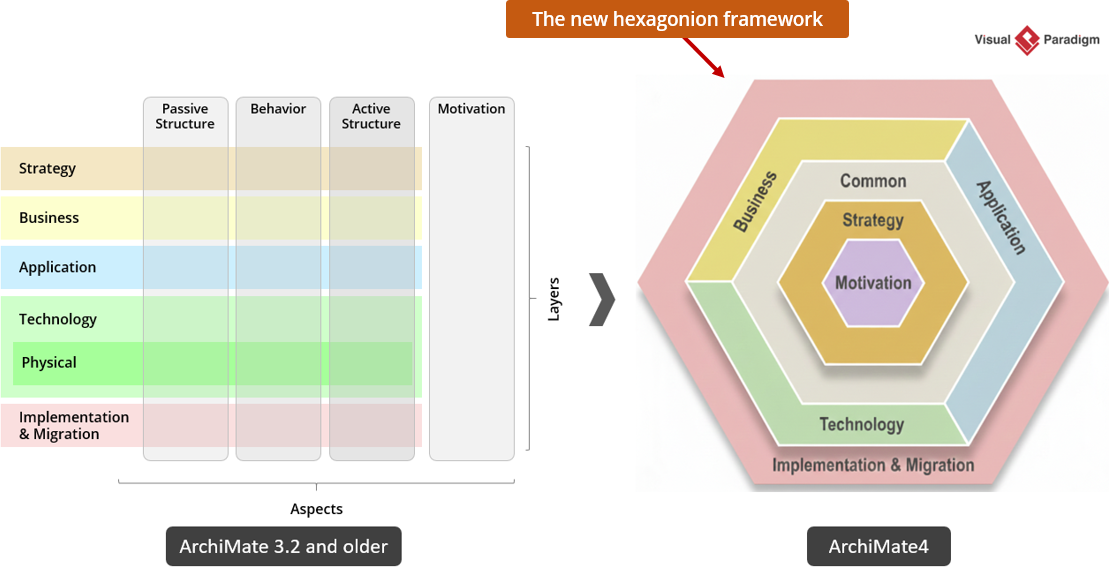
- Unified Behavior Elements: To reduce cognitive load, redundant behavior elements have been merged or retired. This consolidation ensures that models remain clean and that the intended behavior is described through fewer, more expressive elements.
- Common Domain: A new architectural space has been introduced to house elements shared across multiple areas of the enterprise. This facilitates better traceability and reuse of assets that sit at the intersection of business, application, and technology layers.
- Native Multiplicity: Perhaps the most significant technical enhancement is the ability to define specific cardinalities directly on connectors (e.g.,
1..*,0..1). This allows architects to define exactly how many instances of one element relate to another, removing ambiguity from relationship lines.
Modeling with Precision: Visual Paradigm Desktop 18.0
For teams requiring detailed refinement and collaborative work, Visual Paradigm Desktop (Version 18.0+) serves as the professional-grade engine. This platform supports ArchiMate 4 syntax and symbols, ensuring that every diagram created is ready for official documentation and impact analysis from the moment of creation.
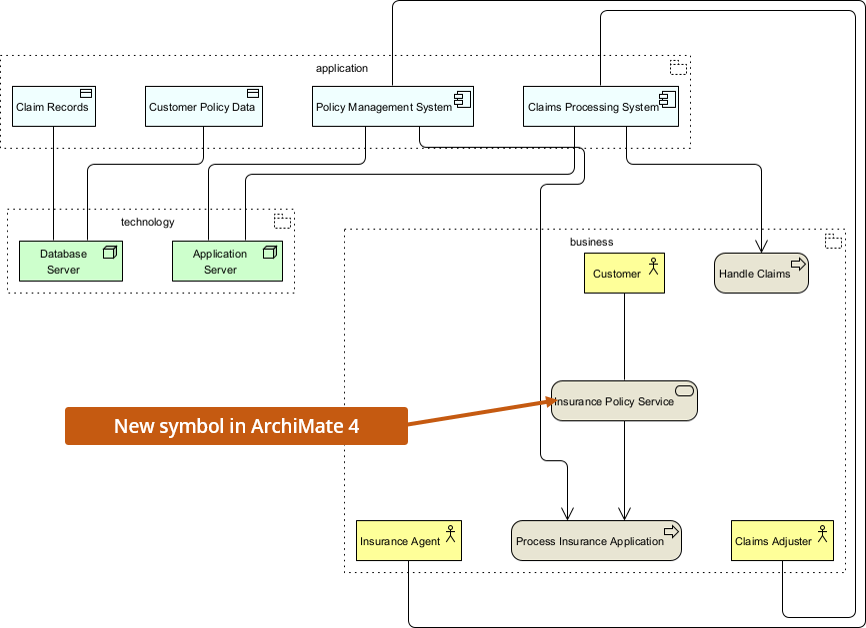
Below is an ArchiMate 4 diagram generated with Visual Paradigm’s AI ArchiMate 4 generation tool. You can see the use of new ArchiMate symbols from the Core domain.
Generating Viewpoint-Specific Models via AI
One of the most powerful capabilities in Desktop 18.0 is the Viewpoint-Specific AI Generation feature. Traditional modeling often involves building a full model and then viewing it later through a specific lens. With the new AI tools, you can dictate the scope immediately.
By navigating to Tools > AI Diagram Generation and selecting a specific ArchiMate viewpoint—such as “Application Usage,” “Deployment,” or “Execution”—the system tailors the generated content to that stakeholder’s specific concerns.
- Business Viewpoint: Highlights processes and organizational roles, hiding irrelevant technical details.
- Application Viewpoint: Focuses on software components and data stores relevant to specific processes.
- Technology Viewpoint: Provides a deep dive into deployment artifacts, infrastructure, and middleware.
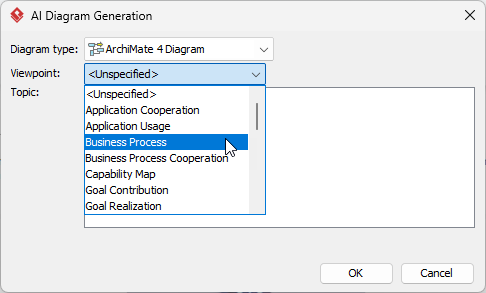
This approach ensures that a business analyst sees a clear path from strategy to service, while a system architect sees the underlying infrastructure, all generated from the same foundational logic but tailored for distinct audiences.
Standard and Multi-Model Editing
The integration of the Hexagonion Framework and Common Domain is seamless within the Desktop editor. Architects can drag and drop elements, automatically snapping connections to reflect the new domain structure. When defining relationships, the editor now enforces the syntax rules for Native Multiplicity. Instead of drawing a generic connecting line, you can specify constraints directly on the connector, ensuring the semantic meaning of the relationship is captured accurately. This reduces the risk of interpretation errors when moving from initial sketches to formal model specifications.
From Idea to Diagram: The Power of the AI Chatbot
Before diving into detailed modeling, many teams need a venue for rapid ideation. Visual Paradigm AI Chatbot bridges the gap between natural language concepts and formal architectural models.
Natural Language to Model
The Chatbot allows architects to describe a complex scenario in plain English. For instance, a user might type: “Generate an ArchiMate diagram for a cloud-based payroll service.” The AI analyzes this input and instantly constructs a visual structure that adheres to ArchiMate standards.
Seamless Import to the Desktop Environment
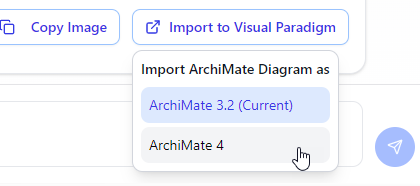
Once the Chatbot produces a satisfactory draft, the workflow continues in the professional modeling environment. By clicking the Import Visual Paradigm button and selecting “ArchiMate 4,” the generated model is transferred directly into your Visual Paradigm Desktop project. This eliminates the need for manual re-drawing, ensuring that the spirit of the conversation translates perfectly into a formal, editable asset ready for stakeholder review.
Conclusion
Adopting new architectural standards requires both a strategic mindset shift and the right technical tools. ArchiMate 4 offers a cleaner, more precise way to model enterprise architecture, focusing on integrated domains and clear relational constraints. By leveraging Visual Paradigm 18.0, organizations can navigate these changes efficiently. Whether generating high-level viewpoints for business stakeholders or defining precise connectivity rules for technical teams, the combination of generative AI and a modeling workspace streamlines the entire lifecycle. This reduction in manual labor allows architects to focus on the value-add analysis of the models rather than the mechanics of drawing them.
References
- Visual Paradigm 18.0 – Support for ArchiMate 4:
Official announcement of Visual Paradigm 18.0 as the first tool with ArchiMate 4 support, featuring the new Hexagonion framework, domain-based structure (replacing layers), unified behavior elements (Service, Process, Function, Event), generic Role & Collaboration, multiplicity on relationships, backward compatibility with ArchiMate 3.2, and enhanced editors, exports, and collaboration features. 🤝 - ArchiMate 4 Preview: Simplicity, Hexagonion & Goal-Driven Enterprise Architecture:
In-depth article previewing ArchiMate 4 changes (pre-release, expected Q2 2026), including shift from rigid layers to flexible domains (Motivation central, Common + Operational Core), unified generic behavior/collaboration elements, retired redundancies (e.g., no more layer-specific Interactions), added multiplicity for precision, and benefits like easier learning, better stakeholder communication, agile alignment, and outcome-focused modeling. 📈 - Native AI ArchiMate 4 Diagram Generation with Viewpoints – Visual Paradigm Desktop:
Details the built-in AI Diagram Generation tool in Visual Paradigm Desktop that instantly creates ArchiMate 4 diagrams from text descriptions, with selectable viewpoints to tailor models to specific stakeholder perspectives—accessible via Tools > AI Diagram Generation for fast, precise setup and immediate canvas editing. ⚡ - AI Chatbot for ArchiMate 4: Generate Models from Text & Import to Desktop:
Explains the workflow using the Visual Paradigm AI Chatbot to produce ArchiMate 4 diagrams from natural language prompts (e.g., cloud payroll systems), then import them as ArchiMate 4 models into Desktop for refinement—supports digital transformation modeling, requires Enterprise/Desktop edition, and streamlines initial architecture drafting. 💬 - Visual Paradigm 18.0: ArchiMate 4 with Hexagonion Framework – YouTube Overview:
Video from Visual Paradigm introducing ArchiMate 4 support in version 18.0, covering the Hexagonion metamodel (goal-centered domains), simplifications (unified elements, multiplicity), retirement of complex relationships, Common Domain additions, and how it makes enterprise architecture more accessible and outcome-driven. 🎥 - Introducing Visual Paradigm AI Chatbot: AI-Powered Diagram Generation:
Demonstration video showcasing the AI Chatbot as a modeling assistant that instantly generates professional diagrams—including ArchiMate—from plain-text descriptions, boosting productivity for enterprise architecture, UML, SysML, and more by automating creation and reducing manual effort. (Note: General AI workflow; ArchiMate support included.) 🚀
Related posts:
 From Prompt to Precision: A User’s Journey with Visual Paradigm’s Enhanced AI ArchiMate Genera
AI-Powered ArchiMate Diagrams for Beginners: A Step-by-Step Guide to Smarter Architecture Modeling with Visual Paradigm
From Prompt to Precision: A User’s Journey with Visual Paradigm’s Enhanced AI ArchiMate Genera
AI-Powered ArchiMate Diagrams for Beginners: A Step-by-Step Guide to Smarter Architecture Modeling with Visual Paradigm
 Myth-Busting ArchiMate: Separating Hype from Practical Value for Leaders
From Code to Community: How Visual Paradigm Pipeline Powers Agile IT Teams’ Collaborative Knowledge Hub
Myth-Busting ArchiMate: Separating Hype from Practical Value for Leaders
From Code to Community: How Visual Paradigm Pipeline Powers Agile IT Teams’ Collaborative Knowledge Hub
