

Creating a customer journey map without a clear understanding of who is traveling the path is a fundamental error. Many organizations rush to visualize touchpoints and interactions without first defining the human beings experiencing them. This approach leads to generic maps that fail to capture nuance, motivation, or friction. Before you draw a single line on a whiteboard, you must build robust customer personas. These profiles act as the compass for your entire experience strategy.
This guide details the process of identifying customer personas as a prerequisite to journey mapping. We will explore the data required, the methods for gathering it, and the specific attributes that make a persona actionable. By grounding your mapping efforts in real human behavior, you ensure that every decision is rooted in empathy rather than assumption.
Why Personas Precede Mapping 🧭
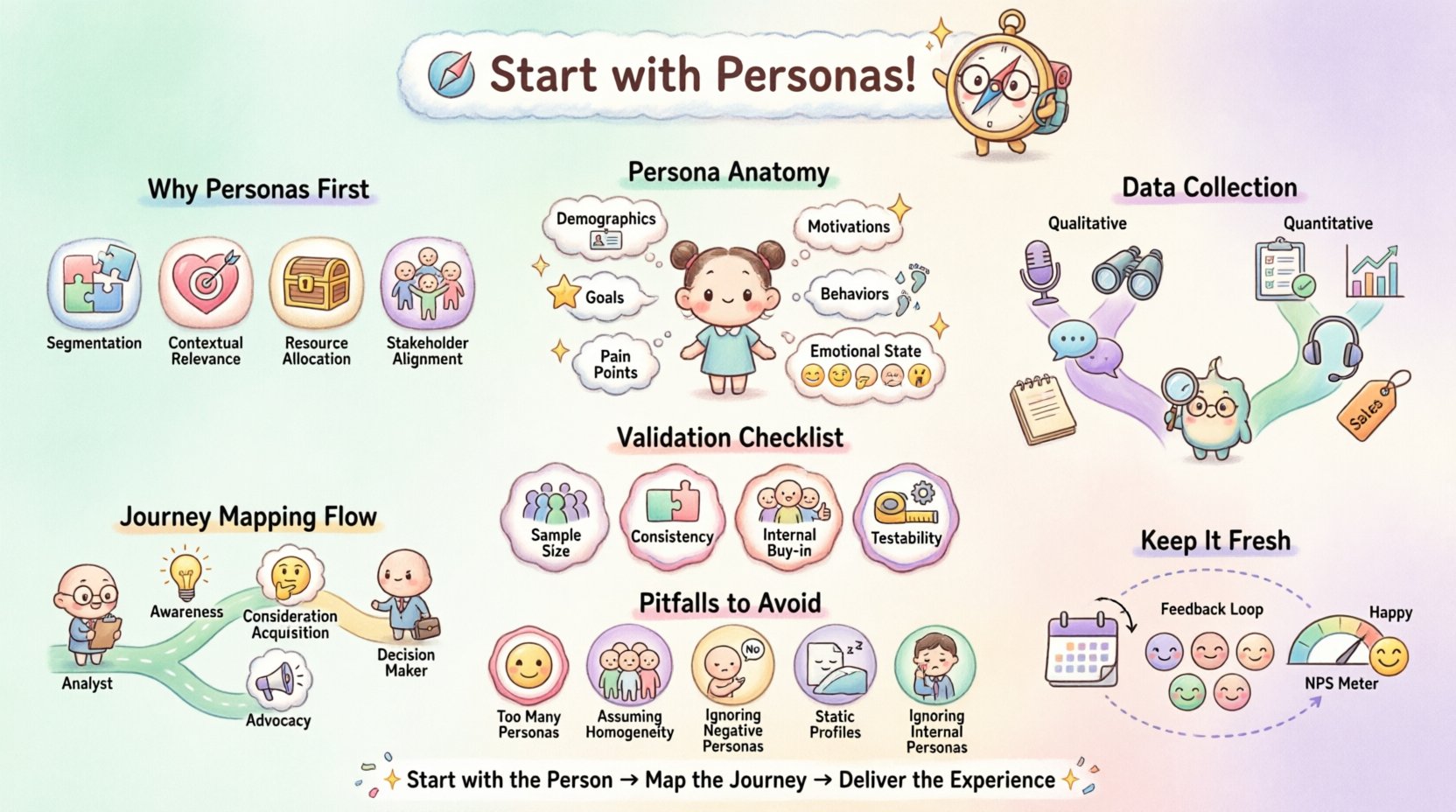
Customer journey maps are often treated as static documents. They are drawn once and filed away. However, without distinct personas, a map is merely a theoretical exercise. It describes a generic customer who does not exist. When you identify specific personas first, you allow the journey to branch into distinct scenarios. A journey for a new user looks different from a journey for a power user. A journey for a budget-conscious buyer differs from one seeking premium status.
- Segmentation of Experience: You stop trying to serve everyone with one path.
- Contextual Relevance: Touchpoints are tailored to specific motivations.
- Resource Allocation: You know which parts of the journey need the most attention based on persona pain points.
- Stakeholder Alignment: Teams agree on who they are building for before debating how it looks.
Skipping this step often results in a “one-size-fits-all” map. This creates friction for specific groups. For example, a technical support flow designed for an expert might confuse a novice. By defining personas early, you prevent these mismatches before the design phase begins.
The Anatomy of a Strong Persona 🧩
A persona is not just a job title and an age. It is a composite character based on real data and research. It represents a segment of your user base with shared goals and behaviors. To be useful for journey mapping, a persona must go beyond demographics. It requires psychographic depth.
When building these profiles, ensure you capture the following core elements:
- Demographics: Age, location, role, and industry context.
- Goals: What are they trying to achieve? What is the definition of success for them?
- Pain Points: What obstacles stand in their way? What frustrates them?
- Motivations: What drives their decision-making? Is it cost, speed, or quality?
- Behaviors: How do they interact with technology? Do they research thoroughly or buy on impulse?
- Emotional State: How do they feel at different stages of the process? Anxious? Excited? Skeptical?
Without these details, the persona is a silhouette. You cannot map a journey for a silhouette. You need the flesh and blood of their experience to understand where they might stumble.
Data Collection Methods 🔍
How do you gather the information needed to build these profiles? You cannot guess. You must listen. Effective persona development relies on a mix of qualitative and quantitative data. Relying on one source creates bias. Triangulating data ensures accuracy.
Qualitative Research
Qualitative methods dive deep into the “why” and “how” of user behavior. These methods are essential for understanding emotions and motivations.
- One-on-One Interviews: Direct conversations allow you to probe deeper into specific experiences. Ask open-ended questions about their past challenges.
- Contextual Inquiry: Observe users in their natural environment. See how they use your product or service in the wild.
- Focus Groups: Gather a small group to discuss their needs. This can reveal shared frustrations and common language.
- Diary Studies: Ask users to log their activities and feelings over a period of time. This captures longitudinal data.
Quantitative Research
Quantitative methods provide the scale and breadth needed to validate the qualitative findings. They answer the “how many” question.
- Surveys: Distribute structured questionnaires to a large audience. Look for trends in behavior and satisfaction.
- Analytics Review: Analyze existing data to see how users actually behave. Where do they drop off? Where do they spend the most time?
- Customer Support Logs: Review tickets and chats. These are direct records of user struggles and questions.
- Sales Records: Look at purchase history and deal velocity. What factors influence the decision?
Validating Your Personas ✅
Once you have drafted your profiles, you must validate them against reality. A persona that is not grounded in truth is a fiction. It will lead you to make poor strategic decisions. Validation ensures that the segments you are targeting actually exist in your market.
Use the following checklist to verify your personas:
- Sample Size: Do you have enough data to support this segment? Is it a niche or a significant portion of your audience?
- Consistency: Do the goals and behaviors align across different data sources? If interviews say X but analytics say Y, investigate further.
- Internal Buy-in: Do sales, support, and product teams recognize these personas? If they say, “That’s not who our customers are,” you need to re-evaluate.
- Testability: Can you design an experience for this persona that you can measure? If you can’t track success, the persona is too vague.
Mapping Personas to Journey Stages 🛤️
Once the personas are defined and validated, they become the anchor for your journey map. You do not map one journey for all. You map the journey for Persona A, then Persona B. This reveals where the experiences diverge.
Consider the stages of a typical journey: Awareness, Consideration, Acquisition, Retention, and Advocacy. Different personas move through these stages differently.
Example: B2B Tech Buyer
A technical buyer might spend weeks in the Consideration stage. They need documentation, case studies, and security reviews. A business owner might skip technical details and focus on ROI and speed. The map must reflect this variance.
| Stage | Persona A (The Analyst) | Persona B (The Decision Maker) |
|---|---|---|
| Awareness | Seeks technical blogs and whitepapers. | Seeks industry reports and news. |
| Consideration | Compares feature lists and specs. | Compares pricing models and contracts. |
| Acquisition | Runs a pilot program. | Signs the contract. |
| Support | Uses self-service knowledge base. | Requests a dedicated account manager. |
By visualizing these differences, you can identify gaps in your service. You might realize you have great tools for the Analyst but no resources for the Decision Maker. This insight drives strategic improvements.
Common Pitfalls to Avoid ⚠️
Building personas and mapping journeys is complex. There are several traps that teams often fall into. Recognizing these early helps you avoid wasted effort.
- Creating Too Many Personas: If you have more than five personas, you likely have too many segments. Focus on the primary archetypes that drive the majority of value.
- Assuming Homogeneity: Do not assume everyone in a segment behaves exactly the same. There is always variance within a group.
- Ignoring Negative Personas: Not every customer is a good fit. Defining who you do not want to serve is just as important as defining who you do.
- Static Profiles: People change. Markets change. Personas must be living documents that evolve with your data.
- Ignoring Internal Personas: Your employees are also customers. A support agent has a journey too. Consider the internal user experience as well.
Integrating Personas into Strategy 🔄
The work does not end with the map. You must integrate these insights into your broader strategy. How does this persona influence product development? Marketing copy? Customer support training?
Use the persona as a filter for decision-making. When a new feature is proposed, ask: “Does this help Persona A achieve their goal?” If the answer is no, reconsider the investment. This keeps the team focused on value.
Communication Channels
Each persona prefers different communication styles. Some prefer email, others prefer chat. Some prefer video tutorials, others prefer text guides. Your mapping should identify these preferences and ensure your content meets them where they are.
- Email: Good for detailed updates and formal communication.
- Chat: Good for quick questions and immediate support.
- Phone: Good for complex issues requiring empathy.
- Documentation: Good for self-service and reference.
Maintaining Persona Relevance 📈
Market conditions shift. Customer expectations evolve. A persona created two years ago might not reflect today’s reality. You need a process to keep your data fresh.
Establish a schedule for review. Quarterly or bi-annually, revisit your personas. Check if the goals have changed. Check if new pain points have emerged. Update the profiles accordingly. This ensures your journey maps remain accurate and useful.
Feedback Loops
Continuous feedback is essential. Use NPS scores, customer satisfaction surveys, and usage data to validate your assumptions. If you see a drop in retention for a specific segment, check if the persona has changed or if the journey broke.
The Impact of Accuracy 📊
Investing time in identifying customer personas before mapping begins pays off in the long run. It reduces rework. It increases conversion rates. It improves customer satisfaction. When you build for a specific human, rather than a generic user, you create resonance.
Teams that skip this step often find themselves redesigning flows repeatedly. They realize too late that they missed a key pain point. By starting with the persona, you set a solid foundation. You ensure that the journey you map is the one your customers actually take.
Final Thoughts on Execution 💡
The process of identifying personas is iterative. It requires collaboration across departments. It demands honesty about what you know and what you need to learn. It is not a one-time event but a continuous practice of understanding your audience.
When you commit to this discipline, you transform your journey mapping from a theoretical exercise into a practical tool for growth. You gain clarity on who you are serving. You understand the hurdles they face. You can design paths that lead to success.
Start with the person. Map the journey. Deliver the experience. This order ensures that every step is intentional and every touchpoint is meaningful.