

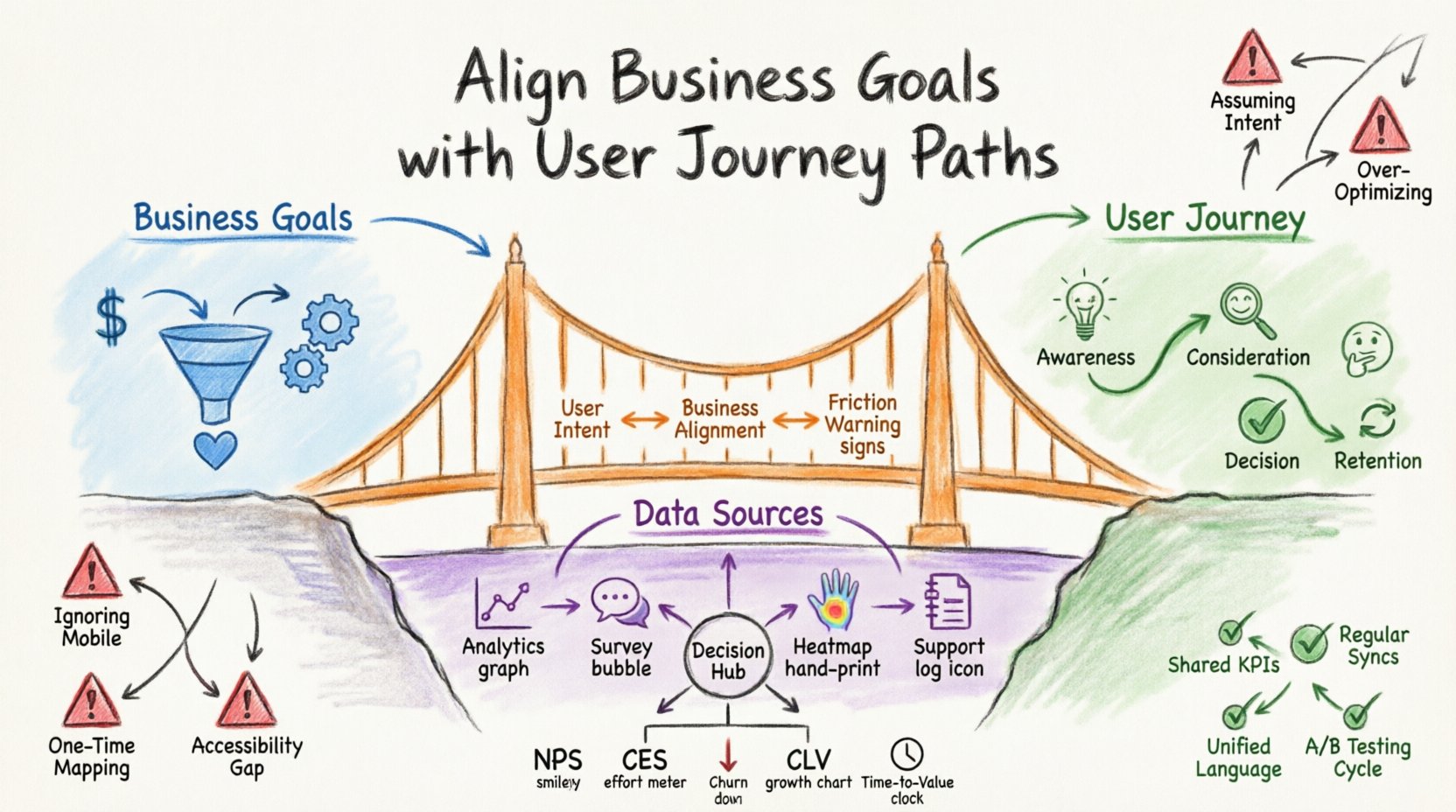
In the modern digital ecosystem, the distance between what a company wants to achieve and what a customer actually experiences can be vast. This gap often leads to friction, lost revenue, and frustrated stakeholders. The bridge across this divide is the strategic alignment of business goals with user journey paths. When these two elements work in harmony, organizations create value that is sustainable and meaningful.
This guide explores the mechanics of synchronizing organizational objectives with the natural flow of user interaction. We will look at the structural requirements for this alignment, the data needed to support it, and the collaborative efforts required to maintain it. By the end of this overview, you will understand how to build a cohesive strategy where profit motives and user needs reinforce each other rather than compete.
Understanding the Dual Objectives 💡
Before mapping can begin, the distinct nature of the two sides must be clearly defined. Business goals are typically quantitative, focused on growth, retention, and efficiency. User journey paths are qualitative, focused on navigation, emotion, and task completion. Misalignment occurs when a business push overrides user intent.
- Business Goals: These include metrics such as monthly recurring revenue, customer acquisition cost, and lifetime value. They are often set by leadership and finance teams.
- User Goals: These include finding specific information, resolving an issue quickly, or completing a transaction without confusion. They are driven by human psychology and behavioral patterns.
When these objectives conflict, the result is often a funnel that looks healthy in spreadsheets but fails in reality. For example, a business might want to increase average order value. If the user journey forces a complex upsell at the checkout, the user may abandon the cart. The path must be smooth for the user to reach the business goal naturally.
Defining the Core Objectives 🎯
Alignment starts with clarity. Vague directives like “improve the experience” are insufficient for strategic planning. Teams need specific, actionable definitions for what success looks like from both perspectives.
Business Side Definitions
- Revenue Targets: Specific dollar amounts or percentage growth.
- Conversion Rates: The percentage of visitors who complete a desired action.
- Operational Efficiency: Reducing support tickets or time-to-resolution.
- Brand Perception: Sentiment analysis and market share growth.
User Side Definitions
- Task Completion: Can the user finish what they came to do?
- Cognitive Load: Is the information easy to process?
- Emotional Response: Does the user feel confident and satisfied?
- Accessibility: Can everyone access the content regardless of ability?
Creating a matrix that maps these definitions helps visualize where they overlap. Where they do not overlap, there is a risk of friction. The goal is to find the intersection where a business win is also a user win.
Mapping the Journey 🗺️
Mapping the journey is the process of visualizing the steps a user takes. This is not merely drawing a flowchart; it is documenting the emotional and logical progression of the user. To align business goals, every step on this map must be evaluated for its impact on organizational targets.
Identifying Touchpoints
Touchpoints are the moments of interaction between the user and the brand. These can be digital or physical. Each touchpoint offers an opportunity to advance the user while moving the business needle forward.
| Touchpoint Stage | User Intent | Business Goal Alignment | Potential Friction |
|---|---|---|---|
| Awareness | Discovering a need or solution | Lead generation and brand visibility | Irrelevant content or aggressive ads |
| Consideration | Evaluating options | Education and trust building | Complex pricing or missing specs |
| Decision | Choosing a solution | Conversion and transaction | Hidden fees or slow checkout |
| Retention | Using the product or service | Upselling and advocacy | Technical bugs or poor support |
Visualizing the Flow
Visualizing the flow requires removing assumptions. You must look at the actual data to see where users drop off. If a business goal requires users to reach a specific page, but the journey map shows a high drop-off rate before that page, the goal is unattainable without fixing the path.
- Entry Points: Where do users arrive? Search, social, or direct?
- Navigation Paths: How do they move between pages?
- Exit Points: Where do they leave the site?
- Decision Nodes: Where do users make choices?
By mapping these elements, you can identify bottlenecks. A bottleneck is a point where the user journey hinders the business goal. Removing the bottleneck allows both to flow freely.
Bridging the Gap with Data 📊
Data is the common language between business strategy and user experience. Without data, alignment is based on opinion. With data, alignment is based on evidence. Integrating data sources allows teams to see the full picture of user behavior.
Quantitative vs. Qualitative
Quantitative data tells you what is happening. Qualitative data tells you why it is happening. Both are required for true alignment.
- Analytics: Page views, time on page, bounce rates, and conversion rates. This shows the volume and velocity of traffic.
- Surveys: Post-interaction feedback asking users to rate their experience. This captures sentiment.
- Heatmaps: Visual representations of where users click and scroll. This reveals interest levels.
- Support Logs: Records of issues reported by users. This highlights pain points.
Connecting Metrics to Goals
Every metric tracked should have a purpose related to either the business or the user. If a metric does not serve either purpose, it is noise. Noise creates confusion and dilutes focus.
For instance, tracking total page views might seem positive, but if users are bouncing back immediately, it indicates a mismatch between the content and their intent. A better metric is pages per session with scroll depth. This indicates engagement and relevance.
Linking specific journey steps to specific business KPIs creates accountability. If the checkout page is the primary conversion point, then the metrics for that page must be scrutinized daily. Any change to that page must be tested to ensure it does not harm the user experience while trying to improve the business metric.
Overcoming Organizational Silos 🧱
One of the biggest barriers to alignment is organizational structure. Marketing, sales, product, and support often operate in separate departments with different incentives. This fragmentation leads to disjointed journeys.
Breaking Down Barriers
- Shared KPIs: Teams should share at least one key performance indicator. For example, if Product and Support share a goal for customer satisfaction, they are more likely to collaborate.
- Regular Syncs: Cross-functional meetings ensure that everyone knows the current state of the journey.
- Unified Language: Avoiding jargon that silos create helps everyone understand the user context.
The Role of Leadership
Leadership plays a critical role in enforcing alignment. If leadership prioritizes short-term revenue over long-term user health, the journey will suffer. Strategic decisions must account for the impact on the user path.
When a new feature is proposed, it must be reviewed against the user journey map. Does it help the user get to their goal faster? Does it align with the brand promise? If the answer is no, the feature should be reconsidered regardless of its potential revenue.
Measuring Success Together 📈
Success is not a static state. It is a continuous measurement of how well the goals and the journey remain synchronized. Regular reviews ensure that changes in the market or user behavior do not drift the strategy.
Key Performance Indicators
Tracking the right numbers is essential. Here are some indicators that reflect both business and user health:
- Net Promoter Score (NPS): Indicates user loyalty and advocacy.
- Customer Effort Score (CES): Measures how easy it is for users to complete tasks.
- Churn Rate: Shows how many users stop using the service over time.
- Customer Lifetime Value (CLV): Predicts the total revenue a business can expect from a single customer account.
- Time to Value: How long it takes a user to realize the benefit of the product.
Feedback Loops
Feedback must flow from the front line to the strategy team. Frontline support staff hear the most direct complaints. Product managers hear the most technical constraints. Marketing hears the most about expectations. Combining these insights creates a robust feedback loop.
Implementing a system to capture this feedback is vital. This could be as simple as a weekly report or as complex as an automated dashboard. The key is consistency. If feedback is ignored, alignment will decay over time.
Common Pitfalls to Avoid ⚠️
Even with the best intentions, teams can stumble. Recognizing these common mistakes helps prevent them from derailing the strategy.
- Assuming User Intent: Never assume you know what a user wants. Test your assumptions with real data.
- Over-Optimizing: Trying to optimize every single button or word can lead to analysis paralysis. Focus on the high-impact areas first.
- Ignoring Mobile: A significant portion of traffic comes from mobile devices. A journey that works on desktop may fail on a phone.
- Disregarding Accessibility: Excluding users with disabilities limits your market and violates ethical standards.
- One-Time Mapping: A journey map is not a document to be filed away. It is a living artifact that must be updated regularly.
Iterative Refinement Process 🔄
The journey is never truly finished. Markets change, technology evolves, and user behaviors shift. The alignment process must be iterative. This means constantly testing, learning, and adjusting.
Testing and Learning
A/B testing is a powerful tool for refining the journey. By presenting different versions of a page or flow, you can see which one performs better against your goals. However, testing must be done with ethical considerations in mind.
- Hypothesis: State what you think will happen.
- Experiment: Run the test with a control group.
- Analysis: Review the data to see if the hypothesis was correct.
- Implementation: Roll out the winning version if it aligns with both goals.
Staying Agile
Agility allows teams to pivot quickly when the data suggests a change is needed. If a new business goal emerges, the journey map must be updated to reflect it. If a user pain point is discovered, the journey must be adjusted to remove it. Flexibility is the key to longevity.
Case Study Scenarios 🏢
Consider a scenario where a subscription service wants to increase renewal rates. The business goal is clear. The user journey involves signing up, using the service, and renewing.
Initially, the team pushes for aggressive renewal reminders. This meets the business goal but annoys users, leading to higher churn. After analyzing the journey, the team realizes users struggle to find the value they derived from the service. They adjust the journey to include a monthly value summary. This helps the user remember the benefit and meets the business goal of renewal. Both sides win.
Another scenario involves an e-commerce site. The goal is to increase average order value. The journey shows users adding items to the cart but leaving. The team adds a discount code field early in the journey. Users feel empowered to find deals. They complete the purchase. Revenue goes up. The journey remains smooth. This demonstrates how tweaking the path can serve both objectives.
Final Thoughts on Strategic Alignment 🌟
Aligning business goals with user journey paths is not a quick fix. It is a fundamental shift in how an organization views its relationship with its customers. It requires patience, data, and a willingness to put the user first. When done correctly, the result is a resilient business that thrives because it respects the people who support it.
The journey of alignment is ongoing. As your organization grows, your maps will grow. As your users evolve, your goals will evolve. The constant is the need for harmony between what you want to achieve and how your users interact with you. By maintaining this balance, you build a foundation for sustainable growth.
Start by auditing your current journey. Identify where the friction lies. Engage your teams in a conversation about the data. Then, begin the process of weaving your objectives together. The path forward is clear when you walk it with the user in mind.