Modern Flowcharting: Architecting the Visual Paradigm + VPasCode + AI Ecosystem
In the realm of software engineering and system analysis, the flowchart remains the most ubiquitous tool for visualizing logic. However, the traditional method of manually dragging shapes has been revolutionized by a powerful triad of technologies: Visual Paradigm, VPasCode, and Artificial Intelligence. This tutorial explores the architectural synergy of these tools, moving beyond static drawings to create “living” documentation that evolves with your codebase.
Phase 1: The Foundation of Standards (Visual Paradigm)
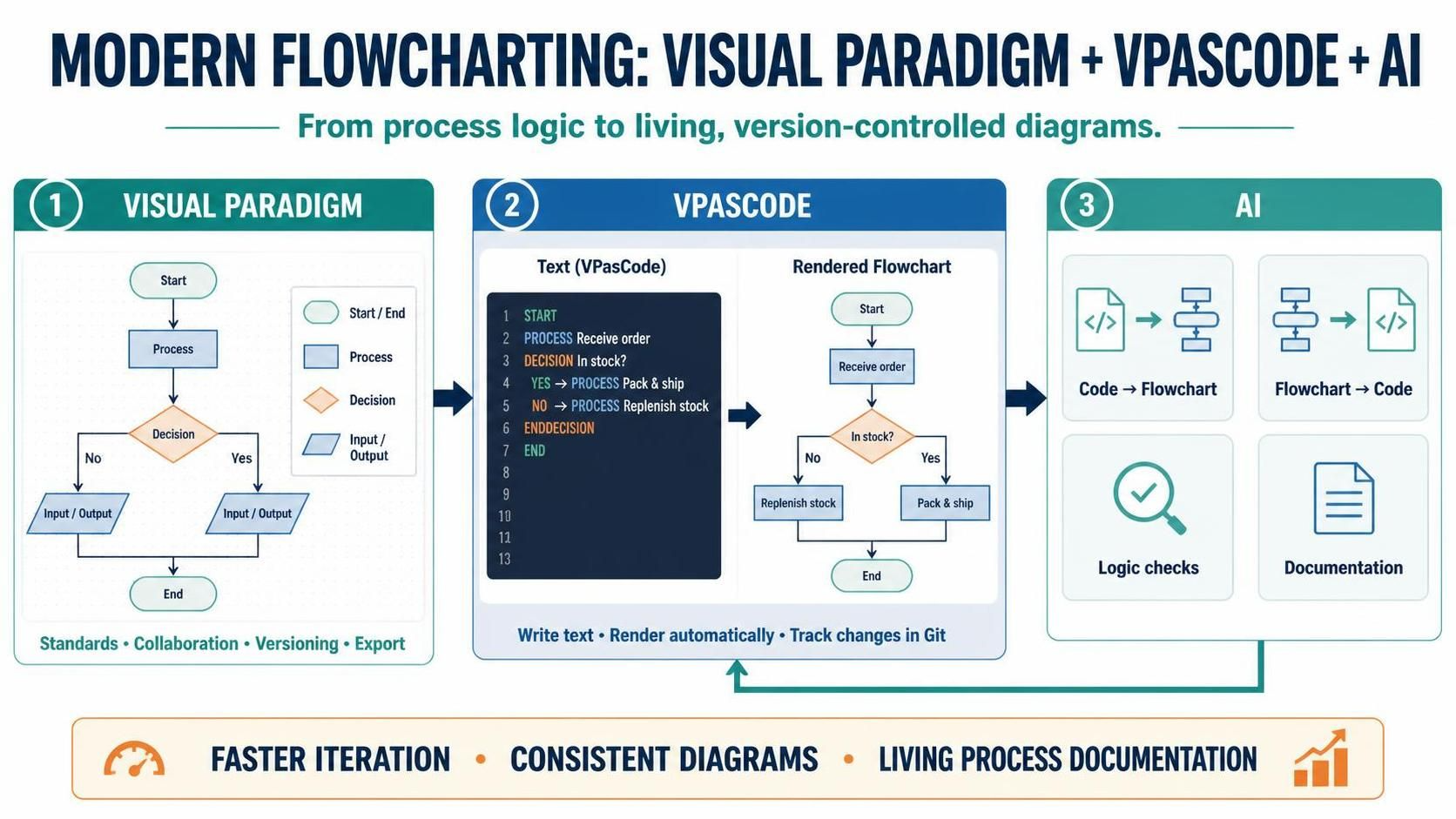
The journey begins with Visual Paradigm, the robust canvas upon which this ecosystem operates. While modern tools offer speed, they must not sacrifice clarity. Visual Paradigm enforces the rigorous standards of the industry, ensuring that diagrams are universally understood by professionals worldwide.
Universal Conventions
At its core, this tool relies on a strict symbology that prevents ambiguity:
- Ovals: Designated strictly for Terminals (Start and End points).
- Rhombuses: Reserved for Decisions (Branching logic).
- Parallelograms: Used for Input/Output operations.
- Rectangles: The standard for Processes.
By enforcing these conventions, Visual Paradigm ensures that a diagram created by one developer looks and reads exactly the same as one created by another, eliminating the “stylistic drift” common in free-form drawing tools.
Phase 2: The “Code-First” Revolution (VPasCode)
Once the standards are set, efficiency becomes the priority. This is where VPasCode changes the workflow. Instead of manually positioning shapes on a canvas—a slow, error-prone process—developers adopt a “Code-First” approach.
Textual Representation
VPasCode interprets concise textual descriptions to render complex diagrams automatically. This shift offers three distinct advantages:
- Speed: Rapid iteration on logic is possible because you are typing, not dragging.
- Version Control: Diagrams are now stored as text files. This means they integrate cleanly with Git, allowing for diff tracking, branching, and merging just like source code.
- Consistency: The rendering engine ensures that every diagram generated follows the same layout rules, removing human error from the visual design.
Understanding the Syntax
Let us examine how logic is translated into text within the VPasCode environment. The syntax is designed to be readable, resembling pseudocode:
START
PROCESS Receive order
DECISION In stock?
YES -> PROCESS Pack & ship
NO -> PROCESS Replenish stock
ENDDECISION
END
In this snippet, the tool automatically interprets the YES and NO branches, routing them to the correct process blocks and rendering the diamond shape for the decision point.
Phase 3: The AI Augmentation Layer
The final piece of the puzzle is the integration of Artificial Intelligence. AI acts as the intelligent bridge between the textual definition of logic and the visual representation, as well as the actual source code.
Bi-Directional Transformation
AI capabilities in this ecosystem are bidirectional:
- Code-to-Flowchart: You can paste a function or a block of pseudocode, and the AI will generate the corresponding VPasCode description, which is then rendered into a flowchart. This is invaluable for documenting legacy systems or onboarding new team members.
- Flowchart-to-Code: Conversely, you can feed a completed flowchart back into the AI to generate boilerplate code or identify logic gaps. This ensures that the diagram remains a true reflection of the implementation.
Optimization and Documentation
Beyond generation, AI serves as a quality assurance tool. It can analyze the flowchart to flag:
- Redundant branches that serve no purpose.
- Unreachable code paths.
- Logical inefficiencies that could slow down the process.
Furthermore, AI can auto-annotate these diagrams, generating the accompanying documentation required for technical specifications.
Conclusion: From Static to Living
The combination of Visual Paradigm, VPasCode, and AI transforms flowcharts from static, one-time drawings into living, version-controlled artifacts. This workflow ensures that your process documentation is faster to iterate, consistent in style, and optimized for logic—all while adhering to the universal standards that make flowcharts a timeless tool in engineering.