Mastering Enterprise Modeling: A Stakeholder-Centric Guide to Visual Paradigm Architectures
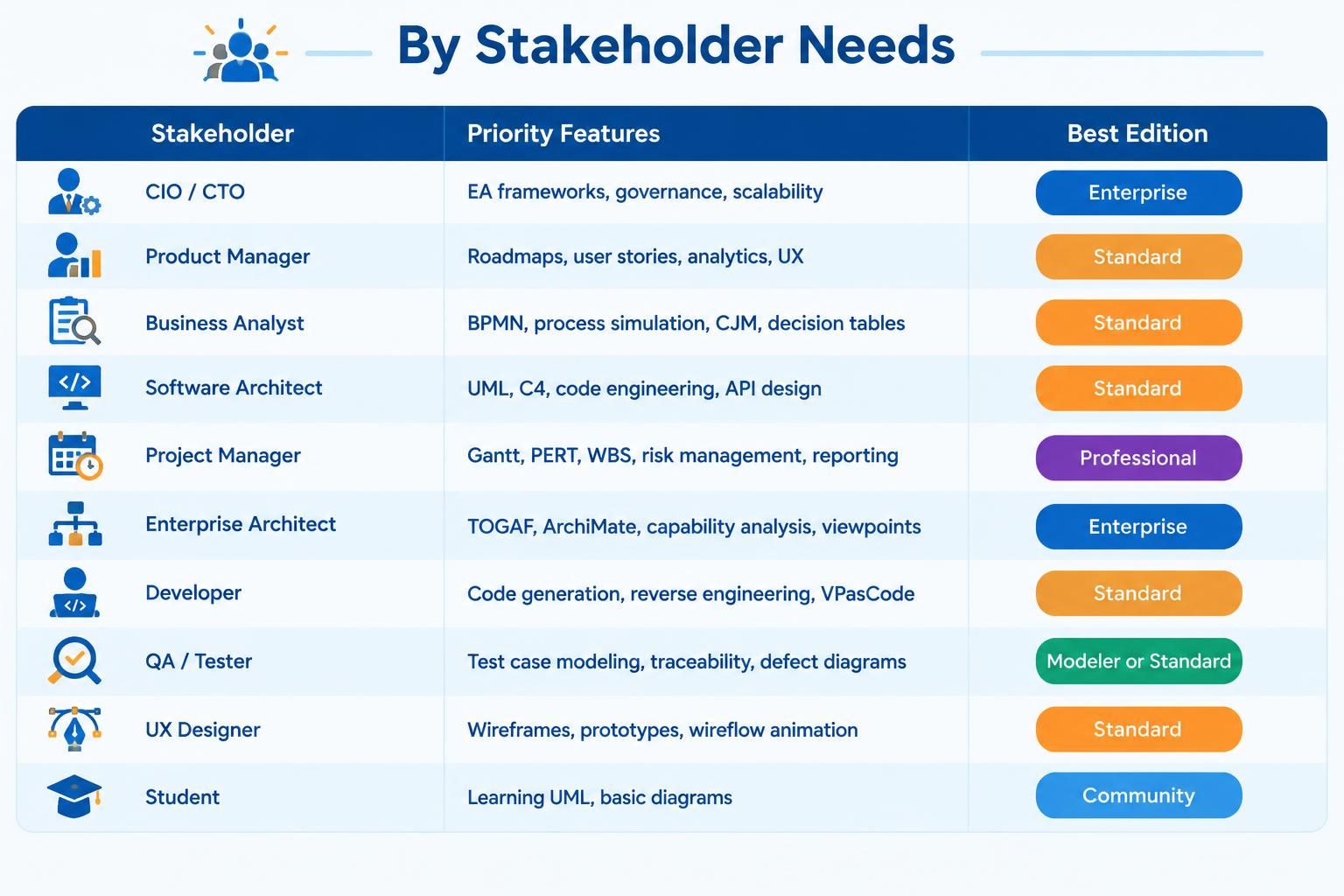
In the complex ecosystem of software development and enterprise architecture, a “one-size-fits-all” tool rarely exists. Different roles within an organization require distinct modeling languages, analysis tools, and reporting capabilities. The provided data illustrates a strategic alignment between Stakeholder Needs and specific Visual Paradigm Desktop Editions. This tutorial dissects this hierarchy, explaining the technical rationale behind why specific roles require specific feature sets and how these tools facilitate the System Architecture lifecycle.
The Strategic Role of the Enterprise Architect
At the apex of the architecture hierarchy sits the Enterprise Architect. This role is not merely about drawing boxes; it is about governance, strategy, and ensuring that IT capabilities align with business goals. The “Best Edition” for this role is the Enterprise edition, which is justified by the inclusion of rigorous frameworks.
Frameworks and Viewpoints
The Enterprise Architect relies on TOGAF (The Open Group Architecture Framework) and ArchiMate. These are not just diagram styles; they are standardized languages that allow architects to describe the enterprise in a way that is universally understood across business, application, and technology layers. The “Capability Analysis” and “Viewpoints” mentioned in the features list are critical for handling complexity. Viewpoints allow the architect to filter the massive model to show only what is relevant to a specific stakeholder group, such as security officers or financial planners.
Governance and Scalability
For the CIO / CTO, the priority shifts to EA frameworks and scalability. When managing an organization’s technology, the architecture must be robust enough to handle thousands of interconnected components. The Enterprise edition provides the governance tools necessary to control access, manage versioning of architectural assets, and ensure that the system design remains consistent as the organization grows.
The Developer’s Ecosystem: From Code to Concept
Bridging the gap between abstract design and concrete implementation is the role of the Software Architect and the Developer. The “Standard” edition is identified as the optimal tool for these roles, specifically because it integrates Code Engineering and UML.
The C4 Model and API Design
Modern software architecture often utilizes the C4 model (Context, Containers, Components, Code) to visualize software structure. Unlike traditional UML class diagrams which can become overly complex, C4 focuses on high-level context and container interactions. The Standard edition supports API design, allowing architects to define endpoints and data contracts before a single line of code is written. This is essential for microservices architectures where API contracts define the interface between services.
VPasCode and Code Generation
For the Developer, the most powerful feature is VPasCode (Visual Paradigm as Code). This capability allows for the definition of software elements using a concise, text-based syntax that is then rendered into diagrams. This ensures that the documentation is never out of sync with the codebase, as the “single source of truth” is the code itself. Additionally, reverse engineering allows the tool to read existing codebases and automatically generate UML class diagrams, helping developers understand legacy systems.
Business Process and User Experience
The Business Analyst and Product Manager operate in the realm of requirements and user value. Their focus is on “Standard” features like BPMN (Business Process Model and Notation) and User Stories.
Simulation and Decision Logic
BPMN is the industry standard for workflow modeling. However, the true power lies in process simulation. By assigning time and resource data to process steps, analysts can predict bottlenecks before implementation. The inclusion of Decision Tables and CJM (Customer Journey Maps) allows for a granular analysis of complex business rules and the emotional path of the user, ensuring that the software solves the right problems.
UX and Prototyping
The UX Designer requires tools for wireframes and wireflow animation. In the Standard edition, this means moving beyond static images to interactive prototypes. This allows stakeholders to click through a user flow, testing the navigation logic and UI responsiveness before the development team begins coding. This “shift left” in testing reduces the cost of fixing design errors.
Project Management and Quality Assurance
Finally, the Project Manager and QA / Tester ensure that the project is delivered on time and works correctly. The Project Manager requires the Professional edition for Gantt charts, PERT (Program Evaluation and Review Technique), and WBS (Work Breakdown Structure).
Risk Management and Reporting
These tools are essential for resource allocation and timeline estimation. The ability to link these project management tasks back to the actual requirements or design models is a key feature of the Professional edition, ensuring that scope creep is tracked and managed.
Traceability in QA
For the QA / Tester, the priority is traceability. This refers to the ability to link a specific test case back to a requirement, and from that requirement to the specific code component. Defect diagrams help visualize where bugs cluster within the system architecture, guiding developers to the areas that require the most rigorous testing.
Summary of Edition Alignment
| Role | Primary Focus | Key Feature | Recommended Edition |
|---|---|---|---|
| Enterprise Architect / CIO | Strategy & Governance | TOGAF, ArchiMate | Enterprise |
| Project Manager | Timeline & Risk | Gantt, WBS | Professional |
| Software Architect / Developer | Implementation & Code | C4, VPasCode, UML | Standard |
| Business Analyst / UX | Process & Experience | BPMN, Wireframes | Standard |
| Student | Learning | Basic UML | Community |
By selecting the edition that aligns with these specific stakeholder needs, organizations can optimize their workflow, reduce redundant tooling costs, and ensure that every team member has the precise modeling capabilities required to succeed.