Mastering BPMN Sub-Processes: The Art of Process Decomposition
In the world of Business Process Management, clarity is king. When a business process becomes too complex to be understood in a single view, the modeling approach must evolve. This is where Sub-Processes become the most critical architectural tool in your BPMN (Business Process Model and Notation) toolkit.
Sub-Processes are not merely visual conveniences; they serve a fundamental purpose in managing complexity. By utilizing them, you can transition from a chaotic “spaghetti diagram” to a structured, hierarchical model that serves both executive stakeholders and operational staff.
The Concept of Process Decomposition
Process Decomposition is the strategic act of breaking down a massive, monolithic process into manageable, logical chunks. Think of it like a digital map. If you try to view an entire continent on one screen, you see only general borders. To find a specific street, you need to zoom in.
When modeling a complex workflow like Employee Recruitment, attempting to draw every single step—from posting a job ad to issuing a laptop—on a single page results in a diagram that is nearly impossible to read. It overwhelms the viewer with data and obscures the main business goal.
The Solution:
- Top-Level View (Macro): The main diagram displays only the core, high-level phases. This is the “Table of Contents” for your process.
- Sub-Process View (Micro): The detailed logic, specific executors, and decision gates are hidden inside “collapsed” boxes.
Architectural Breakdown: The Recruitment Flow
Let us walk through the architecture of a standard Employee Recruitment process to see how decomposition works in practice. In a tool like Visual Paradigm, this structure is built using a hierarchy of diagrams.
1. The Top-Level Context Diagram
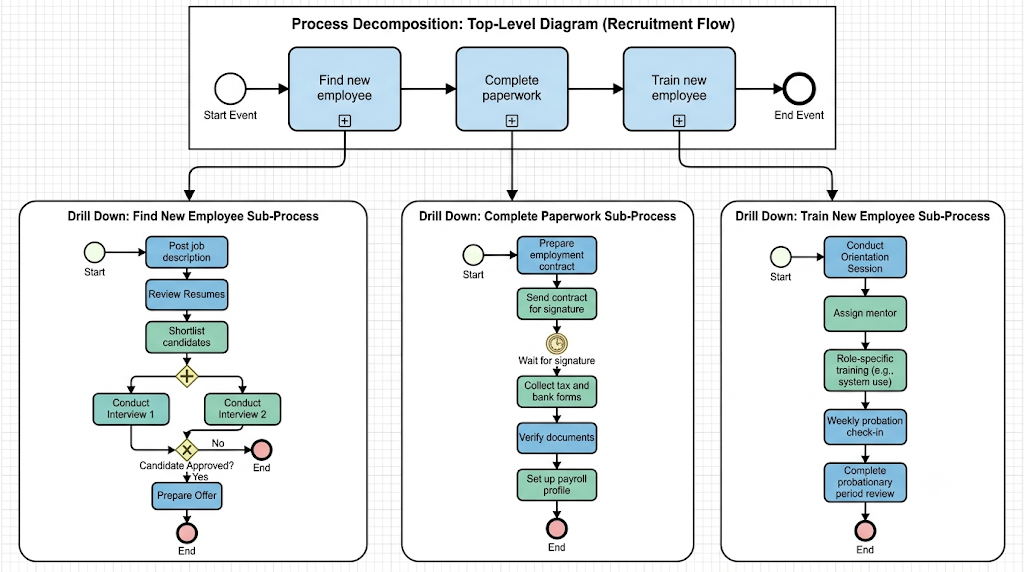
At the highest level of abstraction, the process is defined by three distinct phases. This view provides a “bird’s-eye view” of the workflow, allowing a stakeholder to understand the flow without getting bogged down in administrative details.
The flow follows a simple linear progression:
- Start Event: The process initiates when a hiring need arises.
- Find New Employee: A Sub-Process containing the search and selection logic.
- Complete Paperwork: A Sub-Process handling the administrative onboarding.
- Train New Employee: A Sub-Process managing the integration and probation period.
- End Event: The process concludes when the employee is fully onboarded.
2. The Drill-Down: Granular Details
When you need to execute the process or refine it, you “drill down” into the specific Sub-Process boxes. This creates a separate, detailed diagram for each phase.
Phase A: Find New Employee
This Sub-Process is likely the most complex. It involves dynamic decision-making. The diagram reveals a loop where resumes are reviewed, and if candidates are not approved, the process may require a new interview or a return to the selection pool. It includes specific gateways for “Candidate Approved?” ensuring quality control before an offer is prepared.
Phase B: Complete Paperwork
This phase is typically linear but critical for compliance. It details the exact sequence of document handling: preparing the contract, waiting for the signature, collecting tax forms, and finally setting up the payroll profile. The focus here is on data integrity and legal requirements.
Phase C: Train New Employee
The final phase focuses on human capital development. It maps out the orientation session, the assignment of a mentor, and specific role-based training. It also includes a “Weekly Probation Check-in,” indicating a recurring activity or a loop that continues until the probation period is successfully reviewed.
The Strategic Benefits of Sub-Processes
Why go through the effort of creating multiple diagrams? The benefits are tangible and affect both the modeling lifecycle and the business users.
- Readability and Usability: A high-level diagram can be printed on a single sheet of paper or viewed clearly on a mobile device. It allows non-technical users to grasp the “Big Picture” instantly.
- Modular Maintenance: This is perhaps the most important technical advantage. If the company changes its tax policy, you only need to open the “Complete Paperwork” Sub-Process. You do not have to navigate through a massive, tangled Recruitment diagram to make the change.
- Contextual Management: Different teams own different parts of the process. HR manages “Finding,” Legal manages “Paperwork,” and IT manages “Training.” Sub-processes allow these teams to work independently on their specific diagrams without stepping on each other’s toes.
Conclusion
By mastering Process Decomposition, you transform your BPMN diagrams from static drawings into dynamic, maintainable architectural blueprints. Whether you are documenting the simple steps of an onboarding process or the complex logic of a global supply chain, Sub-Processes are the key to keeping your models clean, professional, and easy to understand.