Mastering BPMN: 5 Common Mistakes to Avoid for Clearer Process Models
Business Process Model and Notation (BPMN) is the universal language for business process management. It allows organizations to visualize complex workflows, from simple approvals to intricate supply chains. However, the power of BPMN lies in its clarity. When models become confusing, the primary goal of process analysis is lost.
Whether you are a business analyst using tools like Visual Paradigm or a process owner mapping out a new workflow, avoiding specific modeling pitfalls is crucial. This guide breaks down the five most common mistakes found in BPMN diagrams and provides the architectural wisdom to correct them.
1. Using Symbols Incorrectly
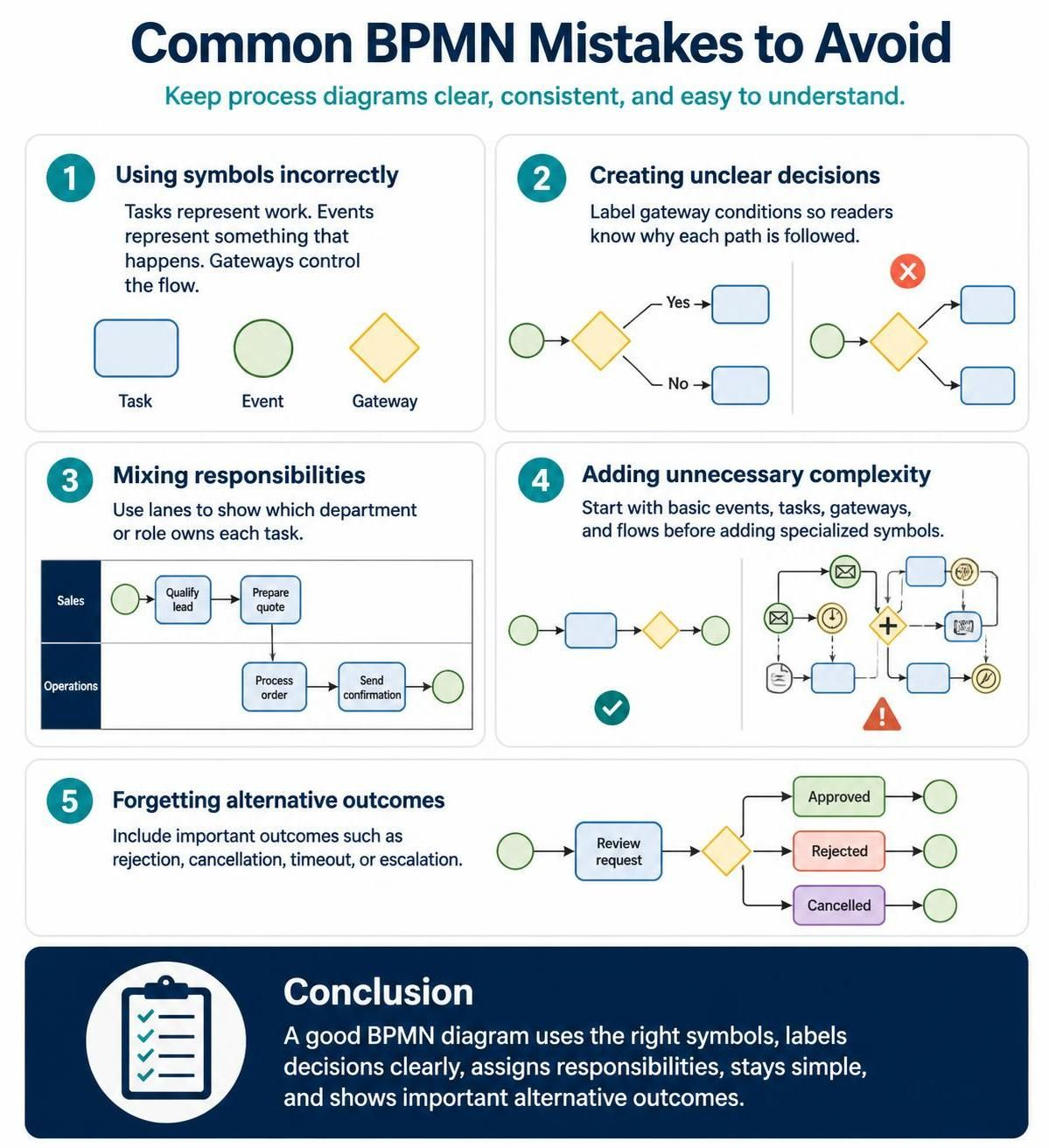
The foundation of any BPMN diagram is the correct usage of shapes. A common error is treating a Task, Event, and Gateway as interchangeable placeholders. In the BPMN 2.0 specification, these shapes have strict definitions:
- Tasks (Rectangles): Represent specific units of work performed by an actor (e.g., “Sign Contract”).
- Events (Circles): Represent something that happens—either a trigger (Start) or a result (End). They define the “when,” not the “what.”
- Gateways (Diamonds): Control the flow of the process. They determine where the process goes next, but they do not perform work themselves.
If you place a Gateway inside a Task, you are creating a logical paradox. The flow must move from an Event to a Task, then to a Gateway, and finally to another Event or Task.
2. Creating Unclear Decisions
Gateways are essential for branching logic, but they often become bottlenecks of confusion. The most frequent mistake is leaving a Gateway unlabeled or without flow conditions.
Imagine a reviewer following a process line. They encounter a diamond shape. Without a label, they have to guess the criteria for the next step. Did the system auto-approve? Did a manager manually reject it? In a standard gateway, the reader must see labels like “Yes”, “No”, or specific data values (e.g., Amount > 5000) on the sequence flows exiting the gateway.
Why Labels Matter
Unlabeled gateways force the reader to “read the room” rather than reading the diagram. In an automated system, an unlabeled gateway often results in a runtime error or a default path that was never intended.
3. Mixing Responsibilities (Swimlanes)
Processes rarely belong to a single person; they belong to departments. A “flat” diagram without lanes (swimlanes) hides the critical aspect of ownership. If “Sales” and “Operations” are mixed in one block of tasks, it becomes impossible to identify bottlenecks.
Consider a “Process Order” workflow. If the diagram lumps “Prepare Quote” (Sales) and “Process Order” (Operations) into one undivided area, the viewer cannot see the handoff. By using swimlanes, you create a visual boundary that clearly assigns:
- Task Ownership: Who is doing the work?
- Handoffs: Where does the data pass from one department to another?
Visual Paradigm and similar tools make this easy. Simply creating a Pool and adding Lanes ensures that every task is anchored to a specific role.
4. Adding Unnecessary Complexity
BPMN is incredibly powerful because it offers specialized symbols for everything from timers to complex event processing. However, the temptation to use “fancy” symbols can backfire. A beginner-friendly diagram often fails because it includes symbols that the audience does not understand.
Start Simple, Then Scale
Before introducing Intermediate Catching Events or Complex Gateways, ensure your basic flow is solid. If a process can be understood using just Events, Tasks, Gateways, and Sequence Flows, do not add a Timer Event unless the delay is critical to the business logic.
5. Forgetting Alternative Outcomes
Real-world processes are rarely linear. They are full of exceptions. A common oversight is modeling a process that only accounts for success. For example, a “Review Request” task that only has an arrow leading to “Approve” is a modeling lie.
Real processes include:
- Rejection: The request is denied.
- Timeout: The user did not respond in time.
- Cancellation: The process was stopped midway.
These alternative paths are vital for process analysis because they often consume the most resources. If you ignore them, you will underestimate the true cost and time of the process.
Conclusion: The Path to Mastery
BPMN is more than just drawing shapes; it is about communicating logic. By avoiding these five mistakes—misusing symbols, unlabeled gateways, mixing responsibilities, over-complicating symbols, and ignoring exceptions—you ensure your diagrams are actionable. Remember, the best way to learn is to start with a familiar process. Map out a daily routine, identify the triggers, and clearly mark the decisions. Once these fundamentals are clear, you can easily graduate to advanced BPMN features for complex automation.