Mastering BPMN 2.0: The Bridge Between Business Strategy and Technical Execution
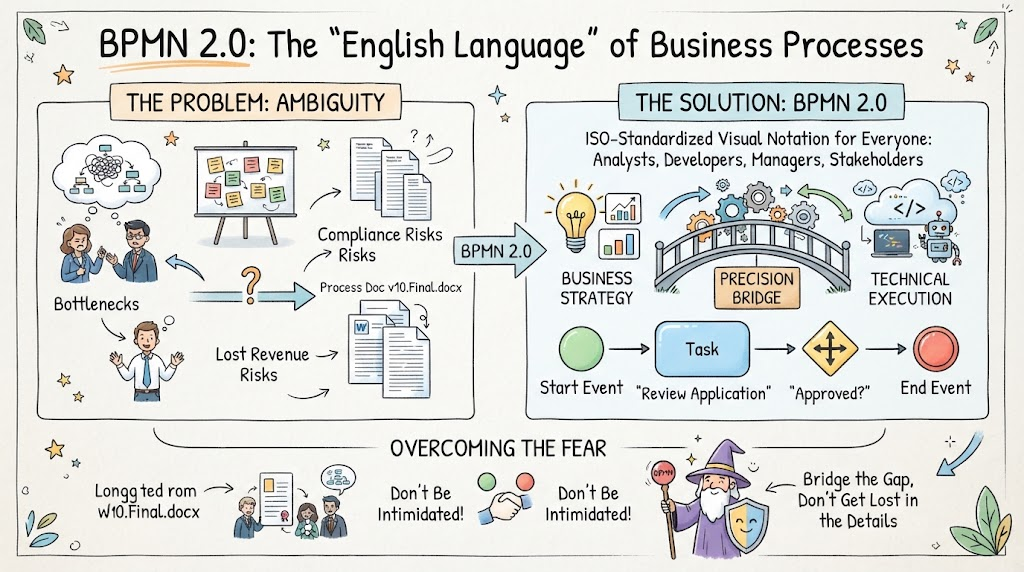
In the fast-paced world of business operations, ambiguity is a costly enemy. We have all experienced the frustration of a meeting where everyone seems to nod in agreement, only to realize later that three different people had three completely different ideas of how the process actually worked. This “process gap” leads to bottlenecks, compliance risks, frustrated employees, and lost revenue. While we have historically tried to document these workflows using flowcharts, sticky notes, or lengthy Word documents, these methods often fail to capture the complexity of modern business operations.
This is where BPMN 2.0 (Business Process Model and Notation) enters the picture. Think of BPMN as the “English language” of business processes. It is an ISO-standardized visual notation that allows business analysts, developers, managers, and stakeholders to speak the same dialect. Whether you are mapping out a simple employee onboarding workflow or designing a complex, automated loan approval system, BPMN provides the precision needed to bridge the gap between business strategy and technical execution.
The Problem: Ambiguity in Documentation
Before diving into the solution, it is crucial to understand the chaos we are trying to solve. Traditional documentation methods often suffer from a lack of standardization.
- The “Final.docx” Syndrome: Long, text-heavy documents often end up with names like
ProcessDocv10.Final.docx. These are prone to version control errors and are rarely updated. - The Sticky Note Dilemma: While great for brainstorming, sticky notes on a whiteboard lack the semantic rigor to define execution rules or exception handling.
- The Flowchart Trap: Generic flowcharts can describe logic, but they often lack the ability to model complex data flows, message exchanges between systems, or specific compliance requirements.
The result is a disconnect. Business Strategy is defined by high-level goals, while Technical Execution is defined by code and database schemas. Without a bridge, the technical team builds what they think the business wants, often leading to rework and “Lost Revenue.”
The Solution: BPMN 2.0 Precision Bridge
BPMN 2.0 acts as that critical “Precision Bridge.” It is an ISO-standardized visual notation designed to be understood by everyone in the room. It allows you to move from a high-level strategy to a detailed technical specification without losing meaning.
Core Building Blocks of the Bridge
At its heart, a BPMN diagram tells a story. It describes a process from start to finish using a standardized set of symbols. Let’s break down the fundamental components shown in our architectural visualization:
- Start Event (The Green Circle): This represents the trigger. A process doesn’t just happen; it starts because something occurred (e.g., a form is submitted, a time is reached, or a message is received).
- Task (The Blue Rounded Rectangle): This is the work being done. In the diagram, we see a task labeled “Review Application.” This is an atomic unit of work that must be completed.
- Gateway (The Yellow Diamond): This represents a decision point. The diamond with the “X” inside is an Exclusive Gateway. It asks the question: “Approved?” Based on the answer (Yes or No), the process flows down different paths.
- End Event (The Red Circle): This marks the successful completion of the process, or a termination condition.
The “Don’t Be Intimidated” Philosophy
One of the biggest barriers to adopting BPMN is the fear of complexity. Many professionals avoid it because they fear getting bogged down in obscure symbols and rigid rules. However, modern modeling tools like Visual Paradigm combined with AI assistance strip away the academic jargon. You don’t need to be a wizard to build a process model; you just need to understand the flow.
The goal is to “Bridge the Gap.” Instead of getting lost in the details of the code or the abstract nature of the strategy, BPMN allows you to visualize the exact path a piece of data takes from the moment a customer clicks “Submit” to the moment a loan is approved.
Practical Application: From Concept to Model
When you are modeling a process, you are essentially creating a contract between the business and IT. Let’s walk through the logic of the “Loan Approval” scenario mentioned in our context.
Step 1: Define the Trigger
Start with the green circle. What starts this process? Is it a manual entry? An API call? A scheduled batch job? In BPMN, you must be explicit.</p>Step 2: The Manual vs. Automated Tasks
In our example, “Review Application” is a task. Is this done by a human or a script? BPMN distinguishes between these. If it’s a human, it’s a User Task. If it’s a script, it’s a Service Task. This distinction is vital for the technical team.
Step 3: The Decision Logic
Here comes the diamond. The process hits the “Approved?” gateway. If the answer is “No,” what happens? Do we terminate? Do we send the application back to the customer? A robust model defines every path.
Visualizing the Flow
While we often rely on text descriptions, the power of BPMN lies in its visual nature. When you look at the diagram, you should instantly see the bottlenecks. If you see a “Review Application” task with no clear exit path other than a timeout, you have identified a risk. If you see a complex web of gateways, you know you have a complicated business rule that needs to be simplified.
Conclusion: Driving Real Business Value
By the end of this guide, the goal is not just to understand BPMN symbols, but to create professional, clear, and actionable process models. BPMN 2.0 is not about creating academic diagrams for a shelf; it is about creating a living blueprint for your business.
When you use BPMN, you eliminate the “Process Doc v10 Final” confusion. You replace ambiguity with precision. You turn a “Bottleneck” into a measurable metric. And most importantly, you empower your team to execute complex workflows with confidence, ensuring that the business strategy is perfectly aligned with the technical execution.