

Understanding the path a customer takes from initial awareness to loyal advocacy is fundamental to building a robust customer experience strategy. This process, known as customer journey mapping, relies heavily on the accurate definition of journey stages. Without clear boundaries between these phases, organizations risk misinterpreting customer needs and missing key opportunities for engagement.
Defining these stages is not merely an administrative exercise; it is an analytical discipline. It requires a deep dive into behavioral data, psychological drivers, and interaction patterns. When done correctly, it provides a blueprint for optimizing every touchpoint. This guide outlines the systematic approach to identifying and defining these critical stages without relying on specific proprietary tools.
🏗️ The Foundation of Journey Mapping
Before delineating specific stages, it is essential to understand what constitutes a customer journey. It is the sum of all interactions a person has with a brand across various channels and over time. However, a journey is not a straight line; it is often non-linear, looping, and complex.
To define critical stages effectively, you must first establish the scope. Is this journey for a specific product, a service, or the entire brand experience? The scope determines the granularity of the stages.
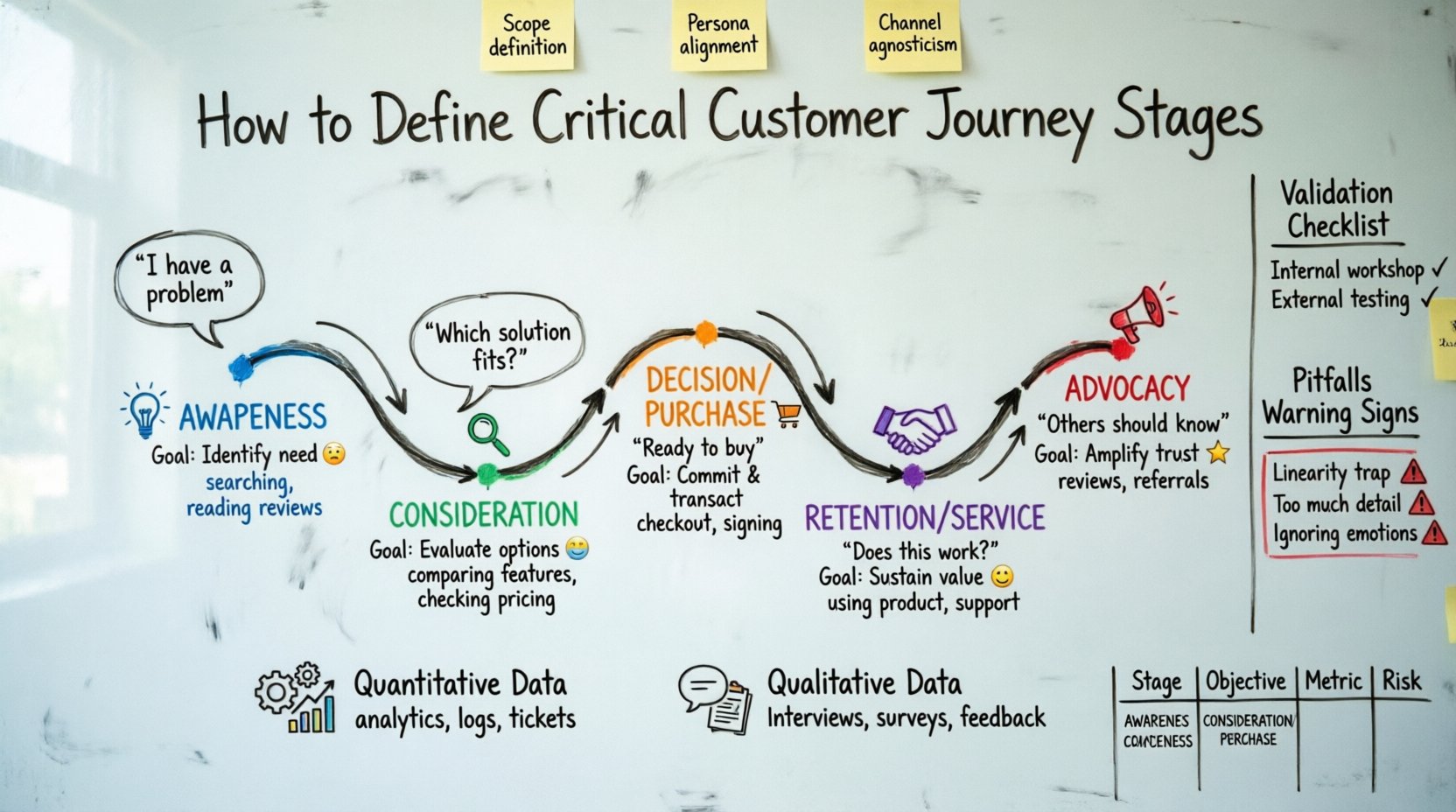
- Scope Definition: Clarify if the map covers the entire lifecycle or a specific transaction.
- User Persona Alignment: Ensure the stages reflect the behaviors of the target audience, not internal assumptions.
- Channel Agnosticism: Remember that stages exist regardless of whether the interaction is digital, physical, or telephonic.
Without a clear scope, the resulting map becomes too broad to be actionable. A journey map that tries to cover everything often fails to address specific pain points. Focusing on the critical path allows teams to prioritize resources where they matter most.
🧭 Identifying the Five Core Phases
While every industry has nuances, most customer journeys can be categorized into five distinct phases. These phases represent shifts in the customer’s mindset and relationship with the organization. Defining these phases helps in setting specific goals for each segment of the experience.
1. Awareness 📢
This is the entry point. The customer realizes they have a problem or a need. They have not yet looked for solutions, but they are conscious of a gap in their current situation.
- Customer Mindset: “I have a problem I need to solve.”
- Primary Goal: Discovering potential solutions.
- Key Activities: Searching online, reading reviews, hearing word-of-mouth recommendations.
- Emotional State: Confused, curious, or concerned.
In this stage, the brand must be discoverable. The content provided should be educational rather than promotional. The goal is to build trust by offering value before asking for commitment.
2. Consideration 💭
Once the customer knows they have a need, they begin to evaluate options. This is the research phase. They are comparing different providers, features, and price points.
- Customer Mindset: “Which solution fits my needs best?”
- Primary Goal: Narrowing down choices.
- Key Activities: Comparing features, reading case studies, checking pricing pages, visiting competitor sites.
- Emotional State: Skeptical, analytical, and cautious.
During consideration, credibility is paramount. Social proof, detailed specifications, and transparent pricing are critical. The customer is looking for reasons to choose you over the competition.
3. Decision / Purchase 🛒
This is the conversion point. The customer has selected a solution and is ready to transact. Friction here can lead to abandonment.
- Customer Mindset: “I am ready to buy, but I need to be sure.”
- Primary Goal: Completing the transaction smoothly.
- Key Activities: Adding to cart, entering payment details, signing contracts, scheduling onboarding.
- Emotional State: Anticipatory, hopeful, but potentially anxious about the cost or commitment.
Optimizing this stage means removing barriers. Complex forms, hidden fees, or unclear next steps can kill momentum. The process should feel secure and straightforward.
4. Retention / Service 🤝
After the purchase, the relationship does not end. This phase is about usage, support, and realization of value. If the customer does not see value here, they will churn.
- Customer Mindset: “Does this product actually work for me?”
- Primary Goal: Achieving desired outcomes and solving ongoing issues.
- Key Activities: Using the product, contacting support, attending training, renewing subscriptions.
- Emotional State: Satisfied, frustrated, or indifferent.
Support interactions are critical here. A positive resolution to a problem can strengthen loyalty more than a successful sale. Onboarding and education play a major role in ensuring the customer understands how to succeed.
5. Advocacy 📣
This is the final stage of the lifecycle loop. A satisfied customer becomes a promoter. They share their positive experience with others, effectively restarting the awareness phase for new prospects.
- Customer Mindset: “I love this, and others should know about it.”
- Primary Goal: Sharing experiences and referring others.
- Key Activities: Writing reviews, referring friends, posting on social media, participating in communities.
- Emotional State: Excited, proud, and loyal.
Encouraging advocacy requires nurturing. Loyalty programs, referral incentives, and community engagement can facilitate this transition. However, it must feel organic, not forced.
📊 Comparing Stage Objectives
To visualize the differences between these phases, consider the following breakdown of objectives and metrics.
| Stage | Primary Objective | Key Metric | Risk |
|---|---|---|---|
| Awareness | Visibility & Education | Traffic Volume | Being overlooked |
| Consideration | Trust & Comparison | Engagement Rate | Choosing a competitor |
| Decision | Conversion & Ease | Conversion Rate | Cart Abandonment |
| Retention | Value & Support | Churn Rate | Disappointment |
| Advocacy | Referral & Loyalty | NPS Score | Indifference |
🔍 Pinpointing Critical Touchpoints
Stages are the macro view, but touchpoints are the micro interactions. A stage contains multiple touchpoints where the customer interacts with the brand. Identifying which of these are critical is the next step in the definition process.
A touchpoint is any point of contact. Not all touchpoints hold equal weight. Some are friction points that cause drop-offs, while others are moments of delight. To define critical ones, you must analyze the data.
- High Frequency Touchpoints: Interactions that happen often, such as login screens or daily usage.
- High Impact Touchpoints: Interactions that significantly influence the outcome, such as the checkout process or a support call.
- Emotional Touchpoints: Moments that trigger strong feelings, whether positive or negative.
When mapping these, look for gaps. Are there moments where the customer expects information but receives silence? Are there points where the experience changes abruptly between channels? These gaps often define the criticality of a stage.
📈 Gathering the Right Data
You cannot define stages based on intuition alone. Evidence is required to validate the structure you are building. Data collection should be multi-faceted, combining quantitative and qualitative insights.
Quantitative Sources
Numbers tell you what is happening, but not why. Look for patterns in your existing data.
- Web Analytics: Track drop-off points in the funnel.
- Transaction Logs: Analyze purchase frequency and average order value.
- Support Tickets: Identify recurring issues that occur after specific stages.
Qualitative Sources
Stories tell you why things happen. This is where the human element comes into play.
- Customer Interviews: One-on-one conversations to understand motivations.
- Surveys: Net Promoter Score (NPS) and Customer Satisfaction (CSAT) surveys.
- Feedback Forms: Post-interaction ratings.
Triangulating these sources ensures a complete picture. For example, analytics might show a drop-off at the payment page, while interviews reveal that customers were worried about security. Both pieces of information are necessary to define that stage accurately.
🛠️ Validating Your Stages
Once you have drafted the stages and identified the touchpoints, you must test them. A journey map is a hypothesis until proven by reality. Validation ensures that the definitions match actual customer behavior.
Internal Validation
Start within the organization. Gather teams from sales, support, marketing, and product.
- Workshop Sessions: Bring stakeholders together to review the proposed stages.
- Reality Checks: Ask if the stages align with how the business currently operates.
- Gap Analysis: Identify where internal processes do not match the customer journey.
Internal alignment is crucial. If sales thinks one thing and support thinks another, the customer experience will feel disjointed. The definition of stages must be agreed upon across departments.
External Validation
Test the journey with actual users. This is often done through usability testing or shadowing.
- Usability Testing: Watch customers navigate the process in real-time.
- Journey Audits: Experience the journey yourself as a customer would.
- Pilot Programs: Test new processes on a small segment before full rollout.
If customers struggle to identify where they are in the process, your stages may be too vague. If they cannot find the information needed to move to the next stage, the transition is not defined well enough.
⚠️ Common Pitfalls to Avoid
Defining customer journey stages is prone to errors. Awareness of these common mistakes can save significant time and resources.
- Assuming Linearity: Customers do not always move forward. They may loop back from Retention to Consideration. The map must account for loops and regressions.
- Too Much Detail: A map with hundreds of touchpoints is unusable. Focus on the critical path and high-impact interactions.
- Ignoring Emotional States: A map that only tracks clicks misses the emotional journey. How the customer feels drives behavior more than the action itself.
- One Size Fits All: Different personas have different journeys. A buyer persona of a tech lead will differ from a budget manager. Define stages for each key persona.
- Static Maps: The journey changes over time. What worked last year may not work today. Regular reviews are necessary.
🔄 Continuous Improvement
The definition of critical stages is not a one-time task. It is an ongoing cycle of observation and adjustment. Markets shift, technologies evolve, and customer expectations rise.
Regularly revisit the journey map to ensure it remains accurate. Look for new patterns in data that suggest a change in behavior. If a new channel becomes dominant, a stage may need to be inserted or renamed. The map is a living document that should evolve with the business.
By maintaining a rigorous definition of stages, organizations can ensure that every investment in the customer experience yields maximum return. Precision in definition leads to precision in execution. This clarity allows teams to focus on solving real problems rather than hypothetical ones.
Start by auditing your current understanding. Gather your data. Listen to your customers. Build the map with evidence, not assumptions. The result is a clearer path to satisfaction and growth for everyone involved.