

Enterprise environments often suffer from fragmented information. Business leaders speak one language, while IT teams speak another. The disconnect between strategy and execution creates silos that hinder progress. This guide explores how ArchiMate serves as a standardized language to bridge these gaps. By adopting a structured approach to modeling, organizations can foster better alignment and transparency.
🧩 The Communication Challenge in Modern Organizations
Most large enterprises face a common obstacle: misalignment. Departments operate independently, leading to duplicated efforts and conflicting priorities. When business units do not share a common understanding of processes, the resulting friction slows down decision-making. Clear communication is not just about talking more; it is about speaking the same language.
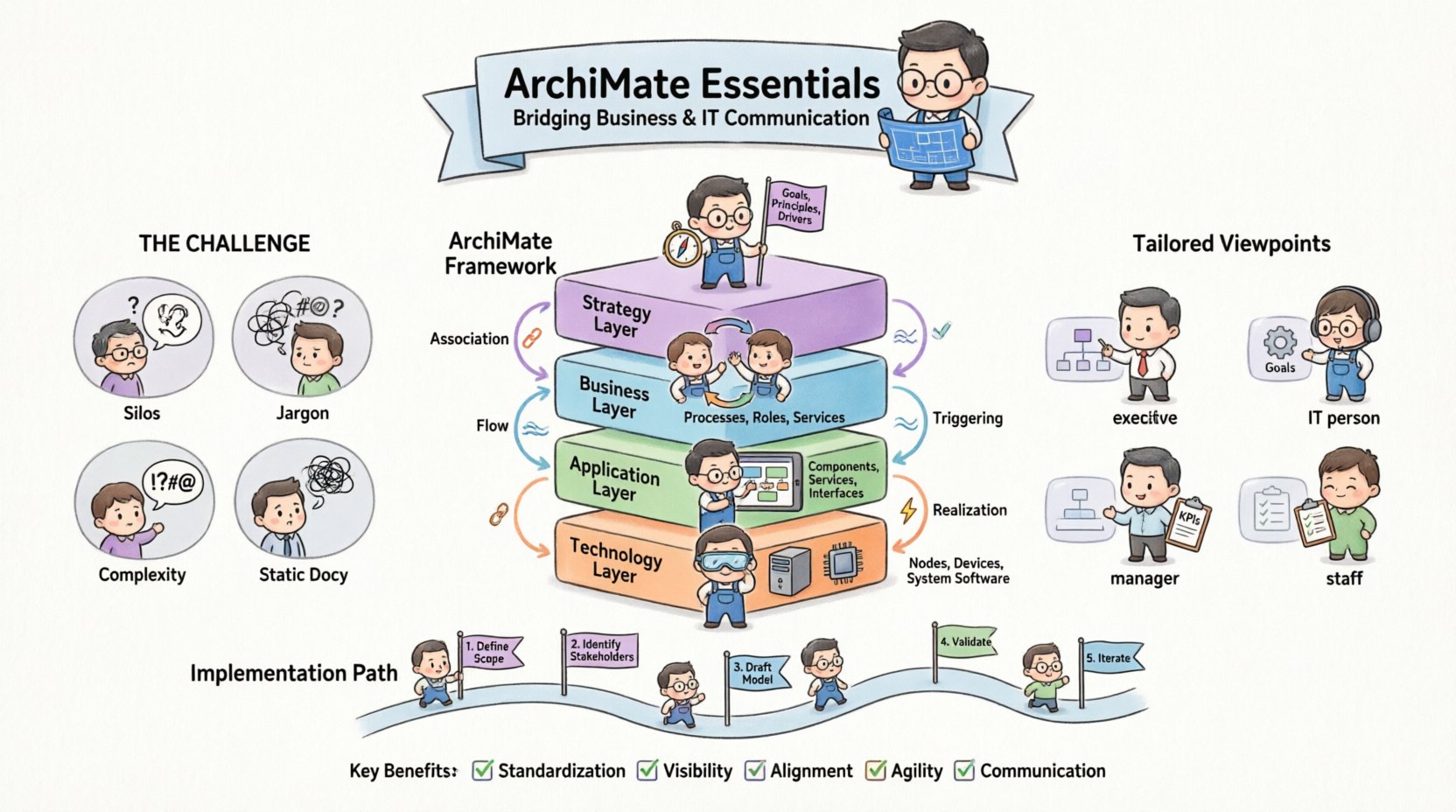
- Silos: Departments often hide information to protect their interests or due to a lack of trust.
- Jargon: Technical terms confuse non-technical stakeholders, and business acronyms confuse engineers.
- Static Documentation: PDFs and spreadsheets become outdated quickly, losing relevance.
- Complexity: Without a visual model, relationships between processes and systems remain invisible.
Addressing these issues requires a framework that is both rigorous and accessible. ArchiMate provides the necessary structure to visualize complex interactions without overwhelming the audience.
📐 What is ArchiMate? A Standardized Language
ArchiMate is an open and independent modeling language for enterprise architecture. It allows architects to describe, analyze, and visualize business strategies, processes, organization, information, and IT infrastructure. It is not a software product, but a specification that can be implemented by various tools.
Core Objectives
The primary goal is to enable a shared understanding. When stakeholders look at a diagram, they should see the same relationships and flows. This reduces ambiguity and ensures everyone is working from the same source of truth.
- Standardization: Uses a consistent set of symbols and rules.
- Abstraction: Allows views at different levels of detail.
- Integration: Connects business needs with technical capabilities.
🌍 Understanding the ArchiMate Layers
The framework divides the architecture into distinct layers. This separation helps manage complexity by isolating concerns. Each layer represents a specific aspect of the enterprise.
1. Business Layer
This layer focuses on the business processes, roles, and organizational structure. It answers the question: “What does the organization do?”
- Business Process: A collection of activities that achieve a specific goal.
- Business Role: An abstraction of a person or organization capable of performing a task.
- Business Service: A unit of functionality provided to a stakeholder.
2. Application Layer
This layer represents the software systems that support the business processes. It bridges the gap between business logic and technology.
- Application Component: A modular part of an application system.
- Application Service: A unit of functionality provided by an application.
- Interface: A boundary through which an application interacts with other elements.
3. Technology Layer
This layer describes the physical infrastructure. It includes hardware, network devices, and software platforms.
- Node: A computational resource, such as a server or device.
- Device: A hardware component like a router or computer.
- System Software: Software that manages hardware resources.
4. Strategy Layer
This layer connects the architecture to the organization’s vision. It defines goals, principles, and drivers.
- Goal: Something that an actor intends to achieve.
- Principle: A rule that guides behavior.
- Driver: A factor that influences the direction of the enterprise.
Understanding these layers is crucial for mapping how a change in the Technology Layer impacts the Business Layer.
🔗 Modeling Relationships and Connections
Elements are not isolated. They interact through relationships. Defining these connections correctly is vital for accurate communication. Misrepresenting a relationship can lead to flawed architecture decisions.
| Relationship Type | Description | Example |
|---|---|---|
| Association | A generic link between elements. | A Role performs a Process. |
| Flow | Data or material moves from one element to another. | A Document flows from a Process to a Document. |
| Specialization | One element is a specific type of another. | Manager is a specialization of Person. |
| Triggering | One event triggers another. | Order Received triggers Order Process. |
| Realization | One element realizes another. | A System realizes a Service. |
Using the correct relationship type ensures the logic holds up under scrutiny. For instance, confusing a “Flow” with an “Association” changes the meaning of the data movement.
👁️ Viewpoints: Tailoring the Message
Not every stakeholder needs to see every detail. A developer requires different information than a C-level executive. Viewpoints allow architects to create specific views tailored to specific audiences.
Key Viewpoint Categories
- Business Stakeholders: Focus on processes, services, and goals. Avoid technical jargon.
- IT Stakeholders: Focus on applications, interfaces, and infrastructure. Detail is key.
- Management: Focus on strategic alignment, costs, and drivers.
- Operational Staff: Focus on daily processes and roles.
Creating a single “big picture” model often fails because it is too complex. Instead, create multiple views that zoom in on specific areas of interest. This approach respects the time of the audience and delivers relevant insights.
🚀 Practical Steps for Implementation
Adopting a structured modeling approach requires a methodical plan. It is not a quick fix but a long-term investment in clarity.
1. Define the Scope
Start with a clear boundary. Do not try to model the entire enterprise at once. Select a specific domain, such as “Order-to-Cash” or “Employee Onboarding”.
2. Identify Stakeholders
Who needs to see this? Who owns the data? Who makes the decisions? Engage them early to gather requirements.
3. Draft the Initial Model
Create a baseline diagram. Use standard elements to represent the current state. Ensure the logic is sound before adding detail.
4. Validate with Stakeholders
Review the model with the identified stakeholders. Ask questions like: “Is this accurate?” and “Is anything missing?”
5. Iterate and Refine
Architecture is dynamic. Update the model as changes occur. Treat the model as a living document.
⚠️ Common Pitfalls to Avoid
Even with the best intentions, mistakes happen. Being aware of common errors can save significant time and effort.
- Over-Modeling: Adding unnecessary detail that confuses the audience. Keep it simple.
- Inconsistent Notation: Using different symbols for the same concept. Follow the standard.
- Lack of Context: Showing elements without explaining their relationship to the bigger picture.
- Ignoring the Business Layer: Focusing too much on technology without understanding the business value.
- Static Snapshots: Failing to show how processes evolve over time or change conditions.
🛡️ Governance and Maintenance
Once the models are created, they must be maintained. An outdated model is worse than no model at all, as it misleads decision-makers.
Establishing Governance
Define who is responsible for updating the models. Set a schedule for reviews. Ensure that changes in the real world are reflected in the models.
- Version Control: Keep track of changes over time.
- Access Control: Ensure only authorized users can edit critical models.
- Review Cycles: Schedule regular audits of the architecture.
📊 Measuring Success
How do you know if the communication has improved? Look for specific indicators of alignment and efficiency.
- Fewer Misunderstandings: Less time spent clarifying basic concepts in meetings.
- Faster Decision Making: Decisions are made with better visibility into dependencies.
- Better Change Management: Impact analysis is more accurate when changes occur.
- Increased Transparency: Stakeholders can see how their work fits into the larger goal.
💡 Tips for Effective Diagramming
Visual clarity is just as important as logical accuracy. A confusing diagram can undermine a perfect model.
- Use White Space: Do not clutter the page. Let the elements breathe.
- Consistent Layout: Align elements logically. Use grids to maintain order.
- Color Coding: Use color to distinguish between layers or statuses, but keep it consistent.
- Clear Labels: Ensure text is readable and concise. Avoid long paragraphs in boxes.
- Direction of Flow: Use arrows consistently to indicate directionality.
🤝 Bridging the Gap Between Business and IT
The ultimate value of this approach is the bridge it builds. When business and IT speak the same language, friction decreases. Projects move faster because requirements are clearer.
- Shared Vocabulary: Both sides use the same terms for processes and systems.
- Shared Goals: Everyone understands how IT supports business objectives.
- Shared Responsibility: Ownership of the architecture is distributed and clear.
🌱 Fostering a Culture of Architecture
Tools and models are useless without the right culture. Encourage teams to use the models in their daily work. Make architecture a part of the conversation, not just a deliverable.
- Training: Provide training on the notation and methodology.
- Accessibility: Make models easy to access and view.
- Recognition: Acknowledge teams that maintain high-quality models.
- Feedback Loops: Allow users to report errors or suggest improvements.
🔮 The Future of Enterprise Communication
As organizations become more complex, the need for clear communication grows. Automation and AI will likely play a role in maintaining these models. However, the human element of understanding context remains critical.
By grounding communication in a standard framework, organizations can navigate change with confidence. The focus shifts from arguing about definitions to solving actual business problems.
📝 Summary of Best Practices
To ensure success, keep these core principles in mind:
- Start with a clear scope and objective.
- Use standard elements and relationships consistently.
- Tailor views to specific stakeholder needs.
- Maintain the models actively and regularly.
- Focus on clarity and simplicity over complexity.
- Ensure business value is always visible.
- Engage stakeholders in the modeling process.
Adopting ArchiMate is a journey toward clarity. It requires discipline, but the payoff is a more agile and aligned organization. By visualizing the structure of the enterprise, teams can work together more effectively.
📌 Key Takeaways
- Standardization: Provides a common language for all departments.
- Visibility: Makes hidden dependencies visible to everyone.
- Alignment: Connects business goals with technical execution.
- Agility: Enables faster adaptation to change.
- Communication: Reduces ambiguity and misunderstanding.
The path to better enterprise architecture is paved with clear communication. With the right tools and mindset, any organization can achieve this.