


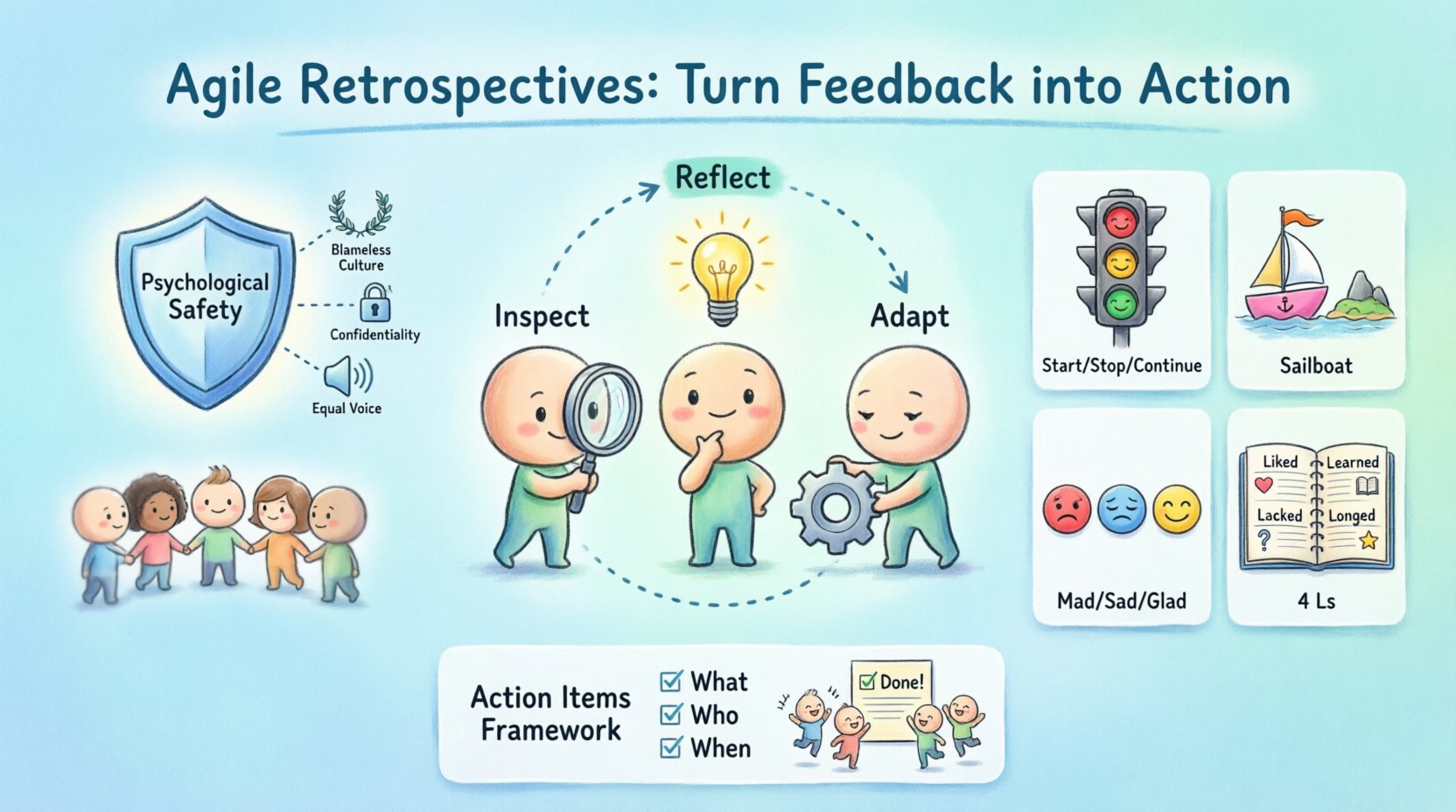
In the fast-paced world of software development and product delivery, teams often find themselves sprinting toward deadlines without pausing to assess their direction. The Agile Retrospective is the designated space for this necessary pause. It is not merely a meeting; it is a structured opportunity for a team to inspect itself and adapt its processes for the next iteration. When executed correctly, it transforms vague dissatisfaction into concrete, measurable progress.
🧭 Understanding the Purpose of Retrospectives
Many teams confuse the Sprint Review with the Retrospective. While the Review focuses on the product and stakeholder feedback, the Retrospective focuses on the process and the team. It is a closed session for the development team, product owner, and Scrum Master to discuss how they worked together.
The core objective is continuous improvement. This does not mean making drastic changes every single time. It means identifying small, incremental adjustments that compound over time to reduce friction, increase velocity, and improve morale. Without this mechanism, teams risk repeating the same mistakes cycle after cycle.
Inspect: Review what happened during the previous sprint.
Reflect: Discuss the dynamics, tools, and interactions.
Adapt: Decide on actionable changes for the next sprint.
🛡️ The Foundation: Psychological Safety
The most critical element of a successful retrospective is psychological safety. If team members fear blame, ridicule, or negative performance reviews, they will not speak honestly. They will offer surface-level feedback or remain silent. Creating an environment where vulnerability is accepted is the prerequisite for any real improvement.
Key Principles for Safety
Blameless Culture: Focus on the process, not the person. If a bug slipped through, ask “Why did our process allow this?” rather than “Who wrote this?”.
Confidentiality: What is discussed in the room stays in the room. This encourages openness.
Equal Voice: Ensure junior members feel as comfortable speaking as senior leads.
Time for Thought: Allow silence. Some people need time to formulate their thoughts before speaking.
📋 Preparation: Setting the Stage
A retrospective without preparation is often a complaint session that ends without resolution. Preparation involves setting the right expectations and choosing the right format. The facilitator plays a pivotal role here.
Pre-Retro Checklist
Invite Early: Send the calendar invite with a clear agenda.
Review Metrics: Have data ready (velocity, bug counts, cycle time) to ground the conversation in facts, not feelings.
Set the Tone: Remind the team of the goal: improvement, not judgment.
Choose a Format: Select a technique that fits the current team dynamic.
Facilitators should not be the only ones driving the conversation. Rotating the facilitator role ensures shared ownership of the process. If the Scrum Master facilitates every time, the team may become passive. Rotating empowers members to lead the discussion.
🛠️ Techniques for Gathering Feedback
Different situations call for different approaches. Using the same technique repeatedly can lead to fatigue. Below are several proven methods to structure the feedback session.
1. Start, Stop, Continue
This is a classic technique suitable for most teams. It categorizes actions into three buckets:
Start: New things the team should begin doing.
Stop: Practices that are ineffective or hindering progress.
Continue: What is working well and should be maintained.
2. The Sailboat
This visual metaphor helps teams understand their momentum. It uses a boat as the central image:
Wind: What is driving the team forward (motivation, good tools)?
Anchor: What is holding the team back (bureaucracy, technical debt)?
Island: The goal or destination the team is trying to reach.
Rocks: Potential risks or obstacles ahead.
3. Mad, Sad, Glad
Focuses on emotional intelligence and team sentiment. It is particularly useful after a high-stress sprint or a significant incident.
Mad: Frustrations or annoyances.
Sad: Missed opportunities or disappointments.
Glad: Wins and moments of pride.
4. 4 Ls (Liked, Learned, Lacked, Longed For)
This technique provides a balanced view of the sprint experience.
Liked: Positive aspects.
Learned: New skills or knowledge gained.
Lacked: Resources or support that were missing.
Longed For: What the team wishes had happened.
📊 Comparing Retrospective Techniques
Technique | Best Used When | Time Required | Focus Area |
|---|---|---|---|
Start, Stop, Continue | General process improvement | 45-60 mins | Actionable habits |
The Sailboat | Strategic alignment and risk assessment | 60-90 mins | Direction and obstacles |
Mad, Sad, Glad | High stress or emotional volatility | 45-60 mins | Team morale and sentiment |
4 Ls | Learning-focused sprints or onboarding | 45-60 mins | Knowledge and resources |
Timeline | Reviewing specific event sequences | 60 mins | Chronological flow of events |
🎯 From Feedback to Actionable Improvements
The most common failure point in retrospectives is the lack of follow-through. A team can spend an hour identifying problems and proposing solutions, only to return to the next sprint exactly as they were. To prevent this, every retrospective must end with a concrete action plan.
Defining Action Items
An action item is not a wish; it is a commitment. It must be specific and measurable. Vague statements like “improve communication” are insufficient. Instead, use the following framework:
What: The specific task to be done.
Who: The individual responsible for the task.
When: A deadline or the next sprint in which it will be completed.
Limiting the Scope
Teams often try to fix everything at once. This leads to burnout and failure. Select only the top one or two priorities. If you focus on too many changes, none of them will stick. Pick the issue that, if solved, would have the highest impact on the team’s workflow.
Tracking Progress
How do you know if the action item was completed? It should be visible. Add the action items to the team’s task board or a dedicated tracking list. Review the status of these items at the start of the next retrospective. This closes the loop and creates accountability.
🚧 Common Pitfalls and How to Avoid Them
Even experienced teams encounter obstacles. Recognizing these patterns early can save time and energy.
1. The Blame Game
Sign: Conversations shift to who made a mistake.
Fix: The facilitator must intervene immediately. Redirect the conversation to the process. Ask, “What part of our workflow allowed this to happen?”
2. Recurring Issues
Sign: The same problem is discussed every week.
Fix: This indicates that previous action items were not implemented or were insufficient. Revisit the previous sprint’s action items. If they were done, the solution was weak. If not, the ownership was unclear.
3. Dominant Voices
Sign: One or two people do all the talking.
Fix: Use techniques that require writing or anonymous input first. For example, have everyone write their points on sticky notes silently before placing them on the board. This levels the playing field.
4. No Facilitator
Sign: The meeting drags on, goes off-topic, or ends without a conclusion.
Fix: Appoint a facilitator. Their job is to keep the time, guide the format, and ensure everyone participates. Do not let the Product Owner or Lead Developer dominate the flow.
📈 Measuring Retrospective Success
How do you know if the retrospectives are working? You look for changes in behavior and outcomes over time.
Action Item Completion Rate: Are the agreed-upon tasks actually getting done?
Team Sentiment: Do team members report feeling more comfortable speaking up?
Reduced Friction: Are blockers being resolved faster?
Consistency: Is the team delivering predictably without unexpected surprises?
If you notice a drop in participation or a rise in complaints, it is a signal to change the format or the facilitation style. The process must serve the team, not the other way around.
🤝 Facilitation Roles and Responsibilities
While anyone can facilitate, understanding specific roles helps structure the meeting effectively.
The Facilitator
Guides the flow of the meeting. Ensures the agenda is followed. Manages time. Keeps emotions in check. Does not necessarily need to be the Scrum Master; rotating this role builds leadership skills across the team.
The Scribe
Records the discussion points, decisions, and action items. This can be done on a whiteboard, a shared document, or a physical notepad. The scribe must be visible to all participants so the information is transparent.
The Timekeeper
Keeps an eye on the clock. Alerts the group when they are running over on a specific section. This ensures the meeting ends on time and respects everyone’s schedule.
🔄 Iterating the Process
Just as the product evolves, the retrospective process must evolve. A technique that works for a newly formed team may not work for a mature team. Teams should periodically review their own retrospective process. Ask the team: “Is the retro format working for us? Do we need to try something different?”
This meta-approach ensures that the team remains in control of their improvement cycle. It reinforces the Agile principle of responding to change over following a plan. By adapting the way they improve, teams sustain their momentum.
🌱 Conclusion
Agile retrospectives are the engine of continuous improvement. They turn the abstract concept of “getting better” into a tangible, scheduled event. By prioritizing psychological safety, selecting the right techniques, and enforcing a strict discipline on action items, teams can transform feedback into a competitive advantage.
The goal is not perfection. The goal is progress. Every sprint offers a new opportunity to learn. Every retrospective is a chance to apply that learning. When a team commits to this cycle, they build a resilient, adaptable, and high-performing organization.