

In the fast-paced environment of modern software development and project management, the pressure to deliver value quickly is relentless. Teams are often encouraged to move faster, release more frequently, and adapt to changing requirements without missing a beat. However, the Agile Manifesto explicitly states a core principle that is frequently overlooked in the rush for speed: Sustainable Pace. This principle dictates that development processes should be maintained at a pace that can be sustained indefinitely without causing burnout, fatigue, or a decline in quality.
Ignoring this tenet leads to a cycle of overwork, missed deadlines, and eventual team collapse. Achieving a sustainable pace is not about working slower; it is about working smarter and respecting human limits. This guide explores how to embed sustainable pace into your Agile workflows, ensuring long-term productivity and team well-being.
Understanding the Core Principle 🧠
The concept of sustainable pace originated from the Agile Manifesto’s fourth principle: “Agile processes promote sustainable development. The sponsors, developers, and users should be able to maintain a constant pace indefinitely.” This is not merely a suggestion; it is a foundational requirement for success.
- Biological Reality: The human brain cannot operate at maximum cognitive load indefinitely. Sleep deprivation, stress, and constant context switching degrade decision-making abilities.
- Quality Impact: When teams rush, technical debt accumulates. Bugs increase, and refactoring becomes harder over time.
- Retention: High-performing individuals leave environments where they are constantly exhausted. Retention is a direct result of how a team treats its members’ time and energy.
Many organizations mistake speed for velocity. Velocity is a metric used to measure the amount of work completed in a sprint. Sustainable pace ensures that this velocity remains stable over time, rather than spiking briefly and crashing later. It is the difference between a marathon runner and a sprinter who collapses at the finish line.
Recognizing the Warning Signs of Burnout 🚩
Before a strategy can be implemented, you must be able to identify when the current pace is unsustainable. Burnout does not happen overnight; it is a slow erosion of morale and capacity. Leaders and team members must remain vigilant for specific indicators.
Behavioral Indicators
- Chronic Overtime: Regularly staying late or working weekends becomes the norm rather than the exception.
- Withdrawal: Team members become less engaged in meetings, stop volunteering for tasks, or avoid social interactions.
- Cynicism: A shift from constructive feedback to negative or dismissive attitudes toward goals and processes.
Output Indicators
- Inconsistent Velocity: Spikes in output followed by significant drops often signal periods of intense burnout.
- Increased Defects: A rise in bugs or issues found post-release indicates that quality is being sacrificed for speed.
- Missed Commitments: The team consistently fails to deliver what was committed to in sprint planning.
Comparison: Healthy vs. Unhealthy Patterns
| Indicator | Healthy Sustainable Pace | Unhealthy Burnout Risk |
|---|---|---|
| Meeting Attendance | Engaged, punctual, contributing | Distractions, late arrivals, silence |
| Work Hours | Consistent 40-hour week, clear boundaries | Irregular hours, weekend work, late nights |
| Communication | Open, collaborative, supportive | Frustrated, defensive, isolated |
| Work Quality | Stable, meets acceptance criteria | Declining, technical debt increases |
| Energy Levels | Consistent throughout the sprint | High at start, low by end (crunch mode) |
Strategies to Maintain Sustainable Velocity 🛠️
Implementing sustainable pace requires intentional changes to how work is planned, tracked, and executed. It involves a shift in mindset from “how much can we cram in?” to “how much can we sustain?”.
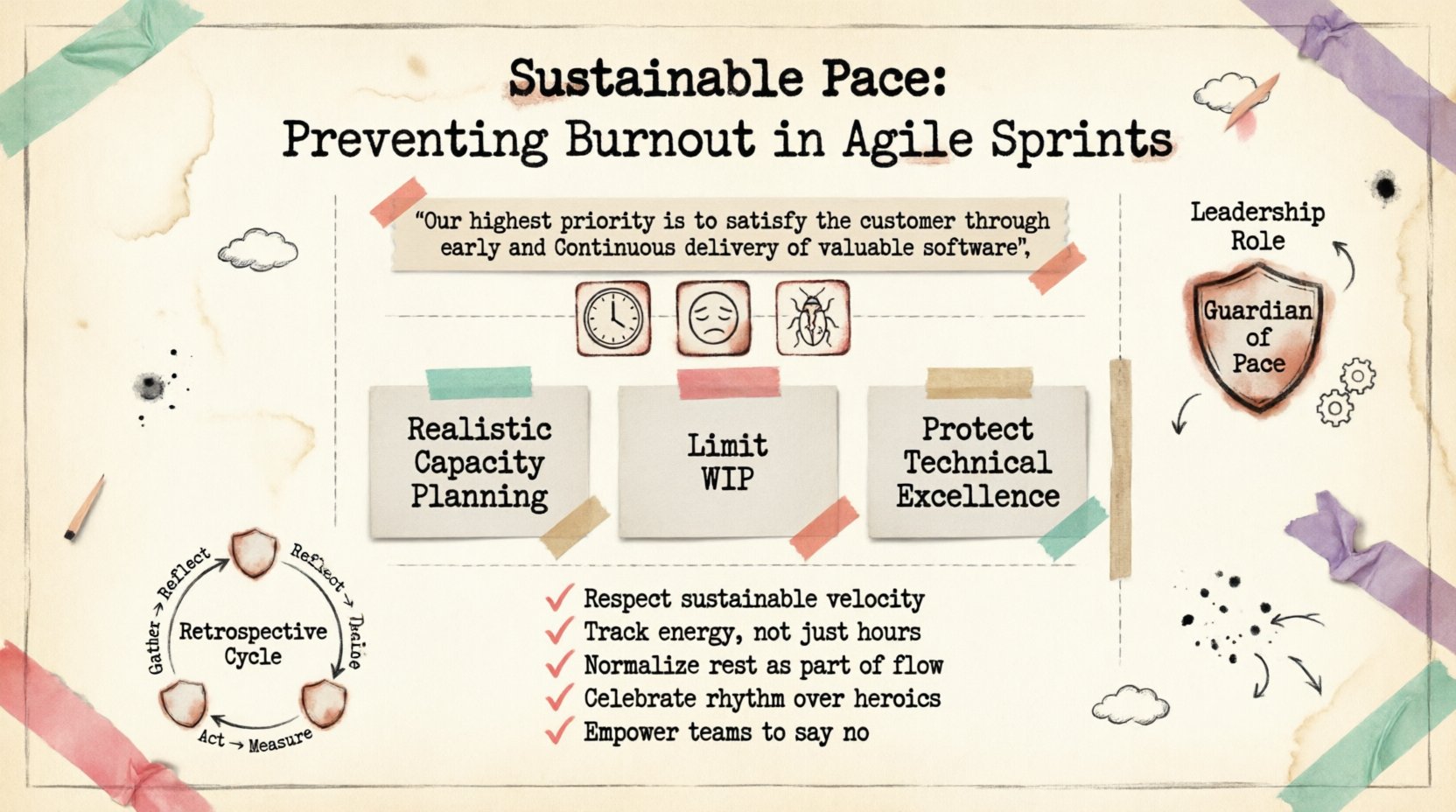
1. Realistic Capacity Planning
One of the most common errors in sprint planning is assuming 100% availability. Humans are not machines. They take breaks, attend meetings, handle support tickets, and experience personal emergencies. To maintain a sustainable pace, capacity planning must account for these realities.
- Calculate Available Hours: Do not plan based on 8 hours a day. Account for administrative tasks, interruptions, and breaks. A common rule is to plan for 60-70% of total available time.
- Respect the Sprint Length: Do not extend sprints to accommodate overflow. If work is not done, it returns to the backlog. Overloading a sprint breaks the rhythm.
- Buffer for Complexity: Acknowledge that unknowns exist. Leave room in the schedule for exploration and problem-solving.
2. Limit Work in Progress (WIP)
Context switching is a major productivity killer. When team members juggle too many tasks simultaneously, their focus fragments, and the time required to complete tasks increases. Limiting WIP ensures that tasks are finished before new ones are started.
- Focus on Completion: Encourage the team to pull only what they can finish in the current cycle.
- Visual Management: Use boards to make WIP limits visible. If a column is full, no new items enter.
- Collaborative Help: If a task is blocked or stuck, the team should swarm to unblock it rather than starting a new task.
3. Protect Time for Technical Excellence
Technical debt is the hidden tax of unsustainable pace. If you never allocate time for refactoring, testing, or documentation, the codebase becomes brittle. Sustainable pace requires protecting time for health.
- Allocate 20%: Dedicate a portion of every sprint to technical improvements, even if no new features are planned.
- Definition of Done: Ensure the Definition of Done includes code review, testing, and documentation.
- Refactoring as a Feature: Treat technical improvements as items in the backlog with equal priority to features.
The Role of Leadership in Pace Management 👥
Leadership sets the tone for the team. If managers demand faster delivery without adjusting expectations, burnout is inevitable. Leaders must model healthy behaviors and protect the team from external pressures.
- Shield the Team: Absorb pressure from stakeholders. Do not let external deadlines dictate internal sprint commitments.
- Encourage Rest: Explicitly encourage team members to take breaks, use vacation time, and disconnect after hours.
- Measure Health, Not Just Output: Track team sentiment and sustainability metrics alongside velocity. If health drops, velocity will eventually follow.
- Model Boundaries: Leaders should not send emails late at night or expect immediate responses during weekends.
Leveraging Retrospectives for Continuous Improvement 🔄
The Retrospective is the primary tool for inspecting and adapting the team’s process. It is not just for fixing bugs; it is for fixing the way the team works together. A sustainable pace strategy must be discussed openly here.
Key Questions to Ask
- Did we feel rushed during this sprint?
- Were we able to finish what we committed to?
- How did our energy levels feel from start to finish?
- What interruptions impacted our flow?
- Are we carrying too much debt from previous sprints?
Actionable Outcomes
Identify specific actions to improve pace. This might look like:
- Reducing the number of meetings.
- Implementing a “no-meeting Wednesday”.
- Improving the quality of requirements to reduce rework.
- Adjusting the sprint length to better match work cycles.
If the team consistently reports high stress, the sprint length may need to be shortened, or the scope reduced. The goal is to find the rhythm that allows the team to operate at their peak without exhaustion.
Managing Capacity vs. Commitment ⚙️
A critical distinction in Agile is the difference between what you think you can do and what you commit to do. Many teams fall into the trap of over-committing to please stakeholders.
- Capacity is Reality: Based on historical data and available hours.
- Commitment is Promise: Based on capacity and agreed priorities.
- Slack is Necessary: Leaving 10-20% of capacity unplanned allows for unexpected issues without breaking the pace.
When stakeholders ask for more, the team should respond with data, not emotion. Show them the historical velocity and the capacity constraints. Explain that adding more work now will reduce quality later. This builds trust based on reality rather than false promises.
The Long-Term Impact on Organizational Health 🌱
Adopting a sustainable pace is not just a team-level tactic; it is an organizational strategy. Companies that prioritize pace over speed often outperform those that burn out their workforces.
- Consistency: Stakeholders can rely on predictable delivery dates.
- Innovation: Rested minds are better at creative problem-solving than exhausted ones.
- Stability: Lower turnover rates reduce the cost of hiring and onboarding.
- Resilience: Teams that are not running on fumes can handle crises better.
It takes time to shift this culture. It requires patience from leadership and courage from the team to say “no” to over-commitment. However, the payoff is a system that delivers value consistently for years, not just months.
Practical Steps to Start Today 🚀
Changing the pace does not require a major overhaul. Start with small, manageable adjustments.
- Review Past Sprints: Look at velocity trends. Are they stable or volatile?
- Conduct a Health Check: Ask the team to rate their stress levels anonymously.
- Adjust Planning: Reduce the number of stories committed in the next sprint by 15%.
- Enforce Breaks: Encourage the team to step away from their screens during lunch.
- Monitor Retros: Make “pace and energy” a standing agenda item in every retrospective.
By focusing on these areas, you create an environment where work is done with intention and care. This approach respects the human element of software development and ensures that the product is built by healthy, engaged people.
Summary of Key Takeaways 📝
- Sustainable Pace is a Principle: It is written into the Agile Manifesto and is essential for long-term success.
- Burnout is Preventable: Recognizing the signs early allows for intervention before damage is done.
- Planning Matters: Realistic capacity planning and WIP limits are critical tools.
- Leadership Sets the Tone: Managers must protect the team from external pressures.
- Retrospectives are for Health: Use them to discuss energy and workflow, not just bugs.
- Quality Cannot Be Compromised: Technical debt is a debt that must be paid to maintain pace.
Maintaining a sustainable pace is an ongoing practice, not a one-time fix. It requires constant attention to the team’s well-being and a commitment to realistic planning. By prioritizing the health of the team, you ensure the longevity and success of the project itself. The goal is not to finish the sprint today at the cost of tomorrow, but to build a rhythm that allows for continuous delivery without exhaustion.