

Integrating a new developer into an existing agile team is a critical process that extends far beyond granting access to repositories. It is about embedding a new mind into a complex system of workflows, cultural norms, and collaborative rhythms. When done correctly, this transition accelerates productivity and strengthens team cohesion. When done poorly, it creates friction, slows velocity, and risks early turnover.
This guide outlines a structured approach to welcoming new talent. It focuses on the mechanics of agile integration, the importance of psychological safety, and the practical steps required to move from orientation to contribution. We will cover the timeline, the roles involved, and the specific habits that define a healthy agile onboarding experience.
Understanding the Agile Mindset Shift 🧠
Before diving into logistics, it is essential to recognize that agile is not merely a set of meetings. It is a philosophy of work. New developers often arrive with experience from traditional waterfall environments or academic settings. They may expect detailed specifications before writing code. Agile, however, thrives on adaptive planning and empirical feedback.
The onboarding process must address these mental models early. Developers need to understand that requirements evolve. They need to see that working software is valued over comprehensive documentation. This shift requires patience and explicit explanation.
- Iterative Development: Explain that features are built in small increments, not monolithic releases.
- Customer Collaboration: Highlight how feedback loops drive decision-making.
- Responding to Change: Clarify how plans adjust based on new information without penalizing the team.
- Continuous Improvement: Show how the team learns from every cycle through retrospectives.
Without this conceptual foundation, a new hire may view agile ceremonies as bureaucratic overhead rather than value-generating activities. Addressing this early prevents future friction during sprint planning or refinement sessions.
Preparation Before the First Day 📅
Onboarding begins before the new employee arrives. A well-organized environment signals respect for their time and reduces cognitive load during the initial weeks. Preparation involves technical setup, documentation curation, and team alignment.
Technical Environment Readiness
Ensure all necessary hardware and software access is ready. Do not make the new developer wait for IT tickets to resolve before they can start learning. This includes:
- Development machines or cloud environments provisioned.
- Access to the version control system and issue tracking tools.
- Installation of necessary compilers, linters, and local development tools.
- Access to the codebase with appropriate permissions (read/write access to relevant repositories).
Documentation Curation
Documentation serves as the memory of the team. It should be accessible and up-to-date. A new hire should not need to ask a senior engineer for basic setup instructions. Key documents include:
- Architecture Diagrams: Visual representations of the system structure.
- Setup Guides: Step-by-step instructions for initializing the local environment.
- Contribution Guidelines: Rules for branching, committing, and merging code.
- API Specifications: Documentation for internal and external interfaces.
The First Week: Foundation & Access 🔑
The initial week is about immersion. The goal is not to ship code but to understand the context. Heavy coding tasks should be avoided. Instead, focus on reading, observing, and asking questions.
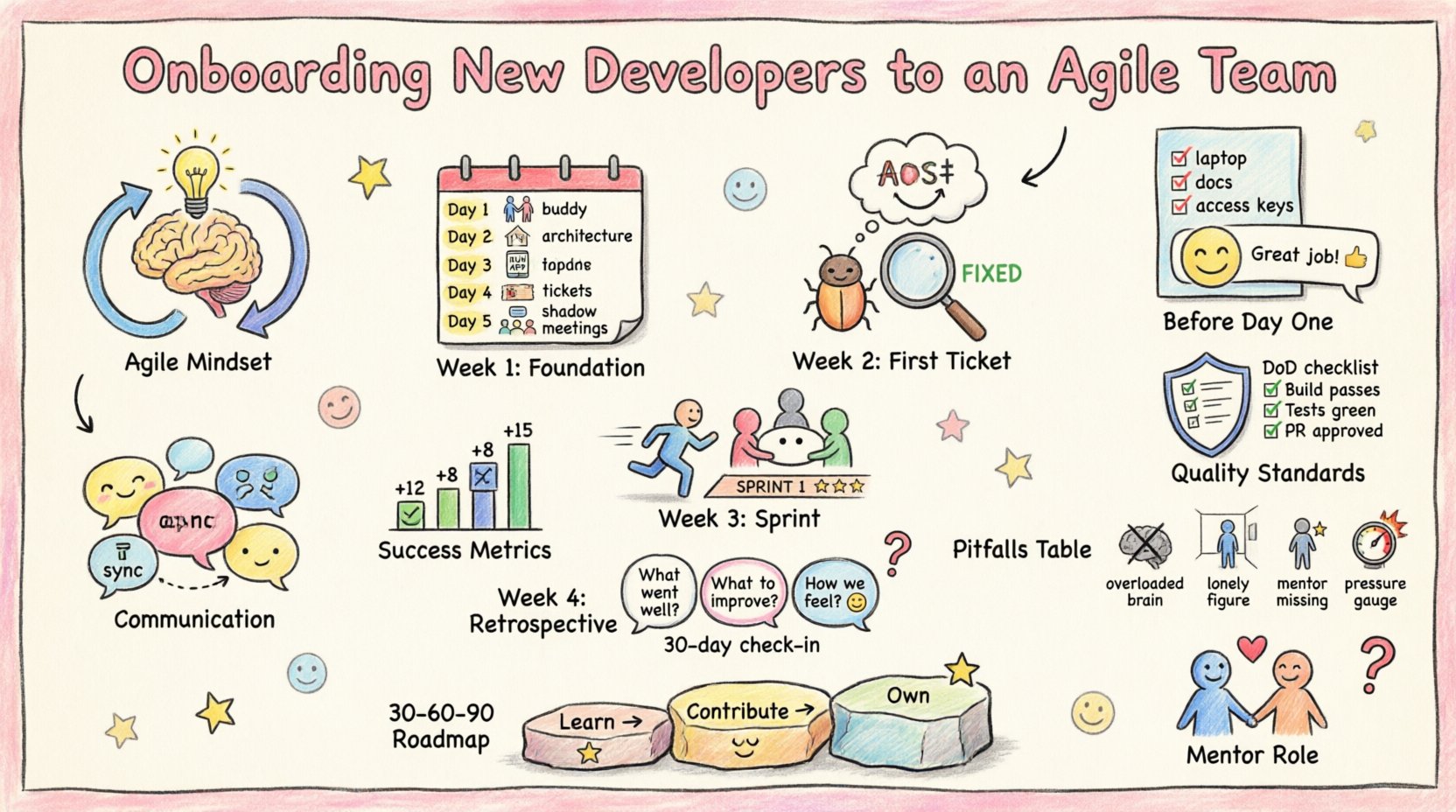
- Day 1: Welcome, introductions, and setting up the workspace. Assign a buddy or mentor immediately.
- Day 2: Review of high-level architecture and system design. Walkthrough of the tech stack.
- Day 3: Running the application locally. Understanding the build and deployment pipelines.
- Day 4: Reading existing tickets and understanding the backlog structure.
- Day 5: Shadowing a sprint planning session and a daily standup.
During this period, the mentor should be available for quick questions. The focus is on lowering the barrier to entry. If the developer can run the code on their machine by the end of the week, the technical setup phase is successful.
Week Two: The First Ticket & Code Review 🛠️
By the second week, the developer should be ready to touch the code. The first task should be low-risk but meaningful. It serves as a proof of concept for the development workflow.
Selecting the Right Task
Do not assign a critical production bug or a complex new feature immediately. Look for:
- Technical Debt: Refactoring tasks that improve code quality without changing external behavior.
- Documentation Updates: Clarifying comments or updating README files.
- Unit Tests: Writing tests for existing, well-understood functions.
- Bug Fixes: Minor issues with clear reproduction steps.
The Code Review Process
Code reviews are where culture is often solidified. They should be constructive, not punitive. The new developer must understand that feedback is about the code, not the person.
- Expectations: Explain the criteria for merging code. What makes a pull request ready?
- Responsiveness: Senior engineers should respond to reviews quickly to maintain momentum.
- Clarity: Comments should be specific and actionable. Avoid vague remarks like “this is messy”.
This phase builds confidence. A successful merge of the first contribution validates their understanding of the workflow.
Week Three: Sprint Participation 🏃
Now the developer should participate in the sprint cycle as a full member. This means committing to work during planning and delivering value during the sprint.
Sprint Planning
Encourage the new hire to estimate tasks. This helps them understand the complexity of the codebase. However, remind them that estimates are not promises; they are predictions based on current knowledge.
- Story Pointing: Explain how the team assigns complexity points.
- Capacity Planning: Discuss how availability (meetings, PTO) affects sprint capacity.
- Clarification: Allow them to ask questions about user stories before committing.
Daily Standups
Introduce the rhythm of the standup. The format is usually: What did I do? What will I do? Are there any blockers?
- Conciseness: Keep updates brief to respect the team’s time.
- Transparency: Encourage speaking up about blockers early. Hiding problems delays resolution.
- Listening: Remind them to listen to others’ updates to understand dependencies.
Week Four: Retrospective & Feedback 🗣️
After the first full sprint, it is time to reflect. The retrospective is a dedicated time for the team to inspect itself and define improvements.
Encouraging Participation
A new developer might feel hesitant to critique the process. Frame the retrospective as a safe space for everyone.
- Anonymous Inputs: Allow them to submit feedback anonymously if they prefer.
- Focus on Process: Encourage feedback on tools and workflows rather than people.
- Action Items: Ensure that changes discussed are implemented to show their input matters.
30-Day Check-In
Conduct a formal check-in between the manager and the new developer. This is distinct from the sprint retrospective.
- Comfort Level: Ask how they feel about the team culture.
- Resource Needs: Identify any tools or information they still lack.
- Goal Alignment: Discuss their personal growth goals and how they align with team objectives.
The Role of the Mentor 🤝
Assigning a mentor is one of the most effective strategies for agile onboarding. The mentor is a guide, not a manager. They provide context and support without holding performance evaluation power.
Mentor Responsibilities
- Context Provider: Explain the “why” behind architectural decisions.
- Gatekeeper of Questions: Be the first point of contact for technical queries.
- Cultural Ambassador: Introduce the developer to informal team dynamics.
- Safety Net: Review code before it goes to the wider team to catch major issues early.
Setting Boundaries
The relationship should be structured. Regular 1:1 meetings should be scheduled. However, the mentor should not enable dependency. The goal is to make the mentor obsolete over time as the new developer gains autonomy.
Communication & Collaboration Norms 📢
Agile teams rely heavily on communication. New developers must learn the specific channels and etiquette used by the team.
Channels and Etiquette
- Instant Messaging: When to use chat vs. email. How to tag people appropriately.
- Video Calls: Camera etiquette during meetings. Recording policies.
- Documentation: Where to write notes. How to link tickets to documentation.
Async vs. Sync
Modern teams often balance synchronous meetings with asynchronous work. New hires need to understand this balance.
- Deep Work: Respect for focus time. Do not interrupt for non-urgent matters.
- Documentation First: Prefer written updates over meetings when possible.
- Response Times: Establish expectations for how quickly messages should be answered.
Technical Standards & Quality 🛡️
Quality is non-negotiable in agile. Technical debt accumulates quickly if standards are not enforced from day one.
Code Standards
- Linting: Automated checks for style and syntax.
- Formatting: Consistent indentation and naming conventions.
- Testing: Requirements for unit, integration, and end-to-end tests.
Definition of Done (DoD)
The DoD is a checklist that a user story must meet to be considered complete. This prevents “almost done” work from entering the codebase.
- Code Review: At least one peer review completed.
- Tests Passing: All automated tests must pass.
- Documentation: User and technical docs updated.
- Performance: No degradation in system performance.
Enforcing the DoD early ensures the new developer understands the quality bar expected of them.
Measuring Success 📈
How do you know the onboarding was successful? Metrics can help, but they should be used carefully to avoid gaming the system.
Key Indicators
- Time to First Commit: How long until they push code?
- Time to First Merge: How long until their code is accepted?
- Velocity: Does their contribution flow match team expectations over time?
- Retention: Do they stay and grow within the organization?
Qualitative Feedback
Quantitative metrics tell part of the story. Qualitative feedback from the team and the new hire is equally important.
- Peer Feedback: Do other team members feel the new hire is a good collaborator?
- Self-Assessment: Does the developer feel confident in their role?
- Manager Feedback: Are they meeting the goals set in their probation period?
Common Pitfalls to Avoid ⚠️
Even with the best intentions, onboarding can go wrong. Being aware of common mistakes helps teams navigate the process smoothly.
Table: Common Pitfalls and Solutions
| Pitfall | Impact | Solution |
|---|---|---|
| Information Overload | Paralysis and confusion. | Bundle information into weekly themes. Allow absorption time. |
| Ignoring Culture | Social isolation and disengagement. | Include social events and informal chats in the plan. |
| No Mentorship | Feeling abandoned and stuck. | Formalize the buddy system with clear expectations. |
| High-Pressure Tasks | Loss of confidence and errors. | Start with low-risk tasks. Build confidence before complexity. |
| Assumed Knowledge | Assumptions lead to rework. | Verify understanding. Ask them to explain concepts back to you. |
30-60-90 Day Roadmap 🗺️
For a structured approach, consider a phased roadmap. This provides a clear expectation of progress for both the manager and the developer.
Table: The 30-60-90 Day Plan
| Phase | Focus Area | Key Deliverables |
|---|---|---|
| Days 1-30 | Learning & Integration | Environment setup, first code review, shadowing meetings. |
| Days 31-60 | Contribution & Independence | Independent tickets, active sprint participation, team feedback. |
| Days 61-90 | Ownership & Optimization | Leading a feature, mentoring others, process improvement suggestions. |
Final Considerations 💡
Onboarding is an investment. It requires time and resources that might seem scarce in the short term. However, the return on investment is a team member who is productive, engaged, and aligned with the agile culture.
There is no one-size-fits-all solution. Every team has unique dynamics. The strategies outlined here should be adapted to fit your specific context. The core principle remains constant: treat the new developer as a partner in the journey, not just a resource to be filled.
By prioritizing clarity, support, and psychological safety, you create an environment where new talent can thrive. This leads to a resilient team capable of adapting to change and delivering value consistently. The process does not end at 90 days; it evolves as the developer grows within the organization.
Remember that the goal is sustainable growth. A rushed onboarding might save time today but costs momentum tomorrow. Take the time to get it right. Your future self and your team will thank you for the foundation you build.