


Software development is rarely a straight line. It is a complex journey of building, breaking, and rebuilding. In the context of Agile methodologies, the pressure to deliver value quickly is constant. This pace often leads to the accumulation of technical debt. While short-term compromises can accelerate delivery, unchecked debt eventually slows velocity, increases bug rates, and drains team morale. This guide explores how to manage technical debt effectively within Agile sprints without sacrificing the core principles of iterative delivery.
Technical debt is not inherently negative. It is a strategic decision to prioritize speed over perfection. However, like financial debt, it incurs interest. If left unmanaged, the interest payments consume the majority of resources, leaving little room for innovation. The goal is not to eliminate debt entirely, as that is impossible, but to manage it strategically so it does not become a barrier to progress.
🤔 What Is Technical Debt?
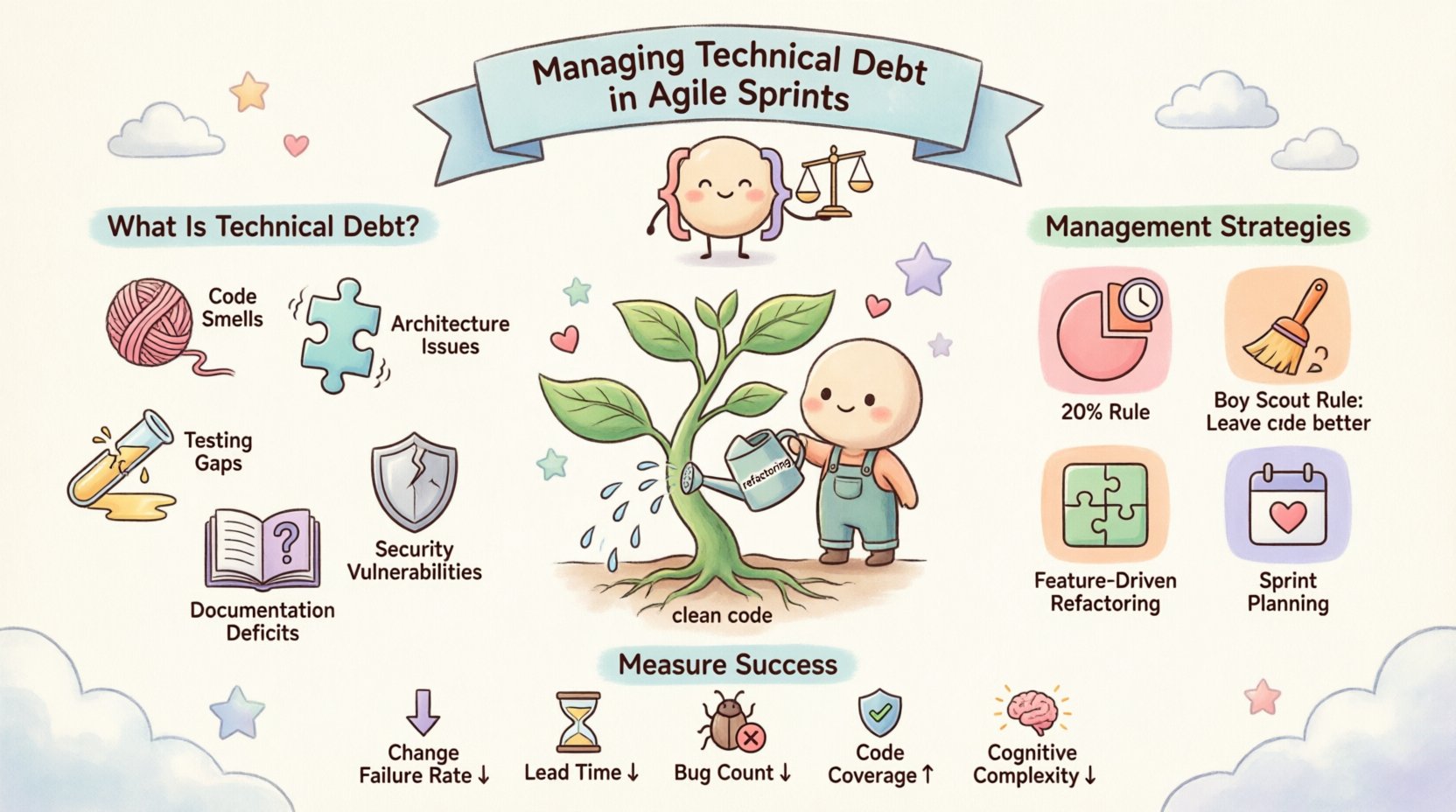
Technical debt refers to the implied cost of additional rework caused by choosing an easy, limited, or quick solution now instead of using a better approach that would take longer. It manifests in various forms:
Code Smells: Messy, duplicated, or hard-to-understand code.
Architecture Issues: Rigid structures that resist change.
Testing Gaps: Lack of automated tests leading to regression risks.
Documentation Deficits: Missing or outdated guides for the system.
Security Vulnerabilities: Unpatched dependencies or unsafe practices.
Understanding the distinction between good and bad debt is crucial. Good debt is taken consciously to meet a critical business deadline, with a plan to pay it back later. Bad debt is often accidental, resulting from a lack of knowledge, time pressure without planning, or poor communication. The former is a tool; the latter is a trap.
⚡ Why Agile Environments Accumulate Debt Faster
Agile frameworks emphasize working software over comprehensive documentation. While this is a strength, it can become a weakness if misinterpreted. The iterative nature of sprints encourages rapid iteration. When every sprint focuses solely on new features, the underlying foundation often gets neglected. Several factors contribute to this phenomenon:
Feature Creep: Expanding scope without adjusting resources forces shortcuts.
Sprint Pressure: The commitment to finish stories by the end of the sprint can lead to cutting corners.
Resource Turnover: When team members leave, knowledge is lost, and new code is written without understanding legacy constraints.
Lack of Visibility: Debt is often invisible until it causes a production incident.
Without explicit processes to address non-functional requirements, the system becomes brittle. The team spends more time fixing bugs than building new capabilities. This is often referred to as the “death spiral” of software maintenance.
📋 Identifying and Categorizing Debt
You cannot manage what you cannot see. The first step in managing technical debt is making it visible. This requires a shift in how the team tracks work. Instead of hiding debt behind vague descriptions, it must be documented and tracked alongside features.
🔍 Sources of Identification
Teams should actively solicit debt items from multiple sources:
Code Reviews: Reviewers should flag structural issues that do not block the immediate feature but need attention.
Static Analysis: Automated tools can scan the codebase for complexity, duplication, and security issues.
Incident Reports: Post-mortem meetings often reveal the root cause of failures as technical debt.
Team Retrospectives: Developers often know best where the code is fragile. They should be encouraged to raise these issues openly.
Customer Feedback: Slow performance or confusing user flows often indicate underlying architectural debt.
📝 Categorization Framework
Once identified, debt items should be categorized to help with prioritization. A common approach involves classifying debt based on impact and urgency:
Category | Definition | Example |
|---|---|---|
Critical | Blocks new work or causes immediate risk | Security vulnerability, broken build |
High | Significantly slows development velocity | Hardcoded values, missing unit tests |
Medium | Increases cognitive load but does not block work | Long function names, minor duplication |
Low | Good to have for future maintainability | Code style inconsistencies, cosmetic issues |
🎯 Prioritization Strategies
Not all debt needs to be paid immediately. Teams need a framework to decide when to refactor and when to ship. The decision matrix should balance business value against technical risk.
💰 Cost of Delay
One effective method is evaluating the Cost of Delay. If a piece of debt prevents a critical feature from being released, it should be prioritized. If the debt only affects internal efficiency, it can be scheduled for later sprints. Consider the following questions:
Does this debt prevent us from meeting a contract obligation?
Will fixing this reduce the time spent on future features?
Is the risk of failure high if we do not address this?
🧩 The Refactoring Story
Debt should be treated as a first-class citizen in the backlog. Instead of vague tasks like “Fix code,” create specific stories:
Refactor Module X to reduce complexity: This allows for faster feature addition in Module X.
Implement integration tests for Service Y: This reduces regression risk.
Update dependencies for Library Z: This secures the build pipeline.
By writing these as proper user stories, stakeholders can understand the value. The “user” is often the development team or the business, and the “value” is reduced maintenance time or lower risk.
💻 Integrating Refactoring Into Sprints
The biggest challenge is fitting debt repayment into a schedule that promises new features. There are several proven strategies for integration.
📅 The 20% Rule
Some teams allocate a fixed percentage of sprint capacity to technical improvement. For example, reserving 20% of the sprint for debt reduction. This ensures consistent progress without derailing feature delivery. However, this must be flexible. During a crisis, capacity might shift; during a quiet period, it might increase.
🔄 Boy Scout Rule
This principle suggests leaving the code better than you found it. Every time a developer touches a file to fix a bug or add a feature, they should fix a small piece of debt in that file. This accumulates over time without requiring dedicated sprint time. It requires discipline and peer support to ensure it does not become a distraction.
🤝 Feature-Driven Refactoring
Often, the best time to refactor is when you are already working on a related feature. If you are changing a module, take the opportunity to clean up its structure. This is known as “refactoring in place.” It avoids the context switching of dedicating a whole sprint to debt and ensures the refactoring is tested by the immediate feature work.
📅 Sprint Planning Adjustments
Product Owners and Developers must agree on capacity allocation. During sprint planning, the team should explicitly account for debt work. If the team commits to 100% of their velocity for features, they will burn out or cut corners. A realistic plan acknowledges that maintenance is part of the work.
📊 Measuring Success and Velocity
How do you know if your strategy is working? You need metrics that reflect health, not just output. Velocity alone can be misleading. A team might increase velocity by ignoring debt, but that is a false gain.
📈 Key Performance Indicators
Change Failure Rate: The percentage of deployments causing a failure in production. This should decrease as debt is managed.
Lead Time for Changes: How long it takes from code commit to deployment. Refactoring often reduces this by simplifying the pipeline.
Bug Count: The number of defects reported in production or staging.
Code Coverage: The percentage of code covered by automated tests.
Cognitive Complexity: A measure of how difficult the code is to understand.
📉 Velocity Trends
Monitor velocity over time. If velocity drops significantly, it may indicate debt has accumulated too much. If velocity is stable but bug rates are high, debt is likely being ignored. The goal is a stable velocity with high quality. Teams should aim for a “steady state” where velocity is predictable and sustainable.
🧱 Building a Sustainable Culture
Process alone is not enough. Culture determines whether debt management succeeds or fails. The team must feel safe to admit when code is messy. Blameless post-mortems are essential.
🤝 Shared Ownership
Technical debt is not just a developer problem. It is a product problem. When the Product Owner sees the backlog, they should see debt items alongside feature items. They need to understand that “no debt” is never an option, but “controlled debt” is the goal. Stakeholders should be educated on the trade-offs.
🗣️ Open Communication
Developers should feel comfortable pushing back on scope creep that increases risk. Technical leads should advocate for quality in sprint planning. This requires trust. If developers feel their concerns are ignored, they will disengage, and quality will suffer.
🎓 Continuous Learning
Training helps prevent debt. When team members learn best practices, they write cleaner code. Knowledge sharing sessions, brown bag lunches, and pair programming can reduce the likelihood of introducing new debt.
⚠️ Common Pitfalls to Avoid
Even with a plan, teams can stumble. Awareness of common mistakes helps avoid them.
Ignoring Debt Until It Crashes: Waiting for a critical failure to address debt is reactive, not proactive.
Over-Refactoring: Spending too much time on perfection can delay business value. Focus on what is needed now.
Hidden Work: Failing to track debt in the backlog makes it invisible to stakeholders.
Lack of Definition of Done: If “Done” does not include code quality standards, debt will accumulate every sprint.
One-Off Fixes: Temporary patches that become permanent solutions. Always aim for a permanent fix.
💡 Negotiating with Stakeholders
Stakeholders often prioritize features over maintenance. Communicating the value of debt repayment requires speaking their language: risk, cost, and time.
Explain Risk: “If we do not fix this, the next feature will take twice as long.”
Quantify Time: “This bug fix will take 3 days. Refactoring this now will take 1 day but save 5 days later.”
Show Metrics: Present data on how long it takes to add features now versus six months ago.
Offer Choices: Give stakeholders options. “We can ship the feature by Friday with higher risk, or by next week with lower risk.”
🔮 Future-Proofing Your Process
As the team grows and the system evolves, the strategy for managing debt must evolve too. What works for a team of five may not work for a team of fifty. Regularly review your processes. Are you still using the same metrics? Are the definitions of “Done” still relevant? The environment changes, and so should the approach.
Consider introducing automated gates in the pipeline that prevent low-quality code from merging. This reduces the burden on humans to catch errors. However, automation is a tool, not a strategy. It supports the culture of quality but does not create it.
Finally, remember that technical debt is a management issue. It is about balancing competing priorities. The best teams are those that recognize the trade-off openly and make conscious decisions about when to take on debt and when to pay it down. This transparency builds trust and ensures long-term sustainability.