


The landscape of software development is shifting beneath our feet. As organizations navigate the complexities of digital transformation, the fundamental unit of work—the user story—faces a pivotal moment of change. Traditionally, a user story serves as a placeholder for a conversation, a simple card that captures a need from an end-user’s perspective. However, the integration of artificial intelligence into product workflows is reshaping how these narratives are written, refined, and executed. This evolution is not about replacing the human element but augmenting the precision and depth of product planning.
Modern product teams are discovering that the fusion of human intuition and machine processing power offers a pathway to greater efficiency. When we look at the trajectory of agile methodologies, it becomes clear that static templates are giving way to dynamic, data-informed structures. The goal remains consistent: deliver value to the customer. The methods to get there are becoming more sophisticated. This guide explores the mechanics of this transition, examining how AI influences the lifecycle of a user story without diminishing the critical thinking required in product management.
📝 The Traditional User Story: A Baseline for Understanding
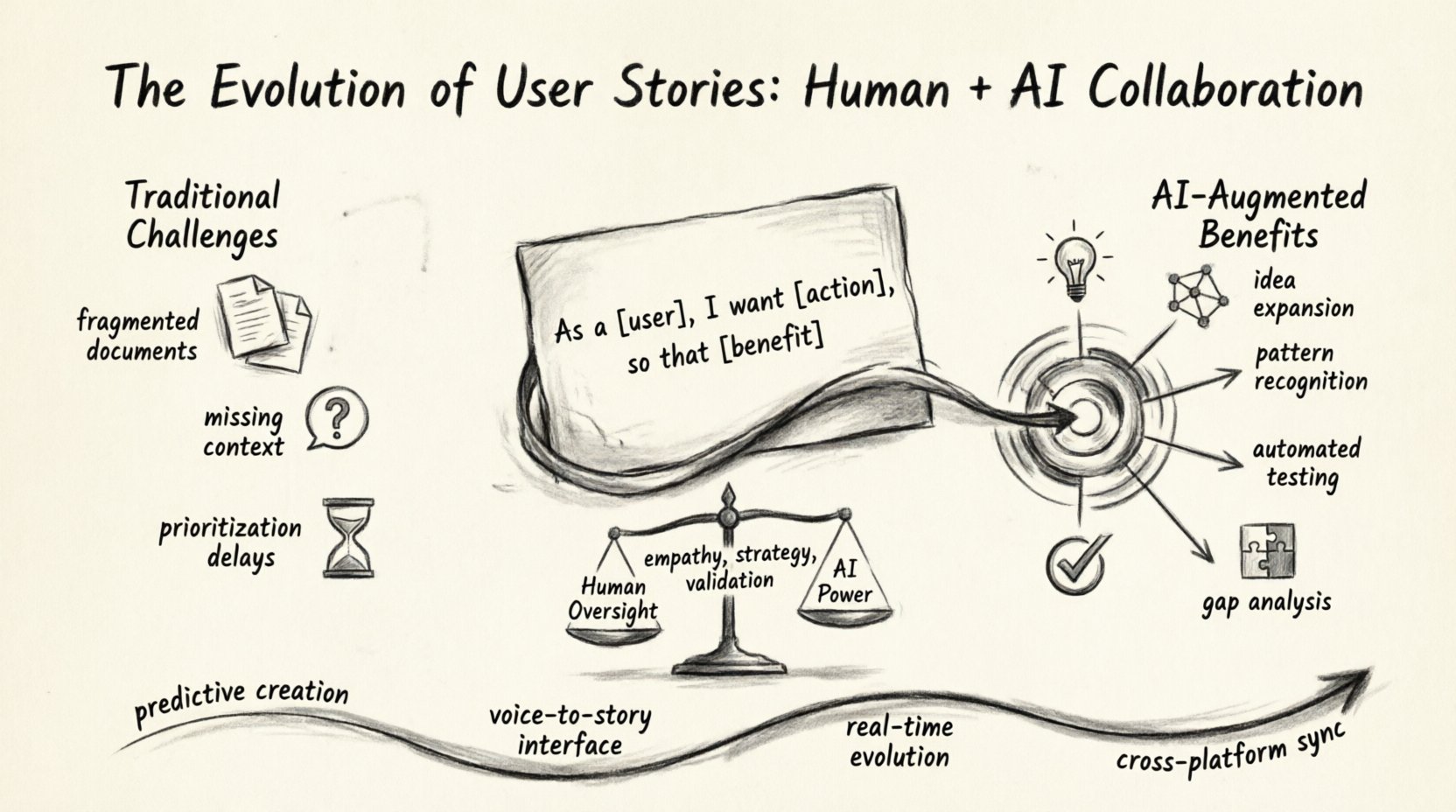
Before examining the future, we must ground ourselves in the present. The classic user story follows a specific format: As a [type of user], I want [an action], so that [a benefit/value]. This format is deceptively simple. It relies heavily on the empathy and understanding of the product owner or business analyst. The quality of the output depends on the clarity of the conversation between the stakeholder and the development team.
While this approach has served the industry well for decades, it faces challenges in scale. As products grow more complex, the volume of stories increases, and the nuance required to describe them expands. Manual documentation often leads to:
- Consistency Gaps: Different authors write stories with varying levels of detail and tone.
- Missing Context: Technical constraints or edge cases are sometimes overlooked during the initial drafting phase.
- Prioritization Delays: Identifying high-value stories among a growing backlog takes significant manual effort.
- Acceptance Criteria Ambiguity: Conditions of satisfaction may be vague, leading to rework during testing.
These friction points create opportunities for technological intervention. The introduction of AI tools allows teams to standardize the input process while retaining the flexibility needed for creative problem-solving.
🧠 AI as a Co-Pilot in Requirement Gathering
Artificial intelligence is not merely a tool for generating text; it acts as a collaborative partner in the early stages of product development. When a product team begins brainstorming, AI can assist in expanding a rough idea into a structured narrative. This process shifts the role of the product manager from a scribe to an editor and strategist.
Here is how AI supports the requirement gathering phase:
- Idea Expansion: When a stakeholder provides a high-level goal, AI can suggest potential user roles and specific actions that align with industry standards.
- Pattern Recognition: Machine learning models can analyze historical backlog data to identify common phrasing or structural elements that correlate with successful delivery.
- Gap Analysis: AI can review a draft story against existing stories to flag missing dependencies or potential conflicts.
- Language Simplification: Complex technical jargon can be translated into plain language, ensuring that the story is accessible to all stakeholders, including non-technical team members.
This assistance does not remove the need for human judgment. Instead, it reduces the cognitive load on the writer, allowing them to focus on the why rather than the how of the documentation.
🛠️ Structural Changes in Story Crafting
The format of the user story itself is undergoing a quiet transformation. We are moving away from the singular narrative card toward a more data-rich artifact. In modern teams, a user story is no longer just a sentence; it is a hub of connected information. AI facilitates the linking of these data points seamlessly.
Consider the following structural enhancements that are becoming standard:
- Dynamic Acceptance Criteria: Instead of a static list, AI can generate test cases directly linked to the story requirements. These criteria update as the development progresses.
- Automated Traceability: Links between the story, design documents, and code commits are maintained automatically, ensuring full traceability without manual tagging.
- Contextual Metadata: Additional tags regarding performance requirements, security constraints, or accessibility standards are appended based on the story’s content.
This structural shift ensures that the story remains relevant throughout the entire development lifecycle. It transforms the story from a static ticket into a living document that evolves alongside the software.
🧪 Validation and Testing Integration
One of the most significant impacts of AI on user stories occurs during the validation phase. Traditionally, the acceptance criteria defined in the story are checked manually by QA engineers. This process is prone to human error and can be time-consuming. AI integration streamlines this by automating the verification of requirements.
The workflow changes in the following ways:
- Test Case Generation: Based on the acceptance criteria, AI can draft unit tests and integration tests before a single line of code is written.
- Visual Validation: For UI-related stories, AI can compare the implemented interface against the design specifications to ensure pixel-perfect alignment.
- Behavioral Simulation: AI bots can simulate user interactions to verify that the user journey flows as described in the story.
- Regression Detection: When a story is completed, AI can quickly scan the codebase to ensure the change has not negatively impacted existing functionality.
This tight coupling between the story and the testing phase reduces the feedback loop. Issues are identified earlier, which lowers the cost of fixing them and increases the overall velocity of the team.
🤝 Collaboration Dynamics in Modern Teams
The introduction of AI changes the social dynamics of a product team. It alters how developers, designers, and product owners interact. Rather than viewing AI as a threat to their roles, successful teams view it as a facilitator of deeper collaboration.
Key shifts in collaboration include:
- Shared Language: AI tools help bridge the gap between technical and non-technical teams by standardizing terminology.
- Reduced Meetings: With better automated documentation, fewer meetings are needed for status updates. Teams spend more time on strategy and less on reporting.
- Real-time Feedback: Developers can query the AI about a story to get immediate context, reducing the need to interrupt a product owner for clarification.
- Inclusive Participation: Non-native speakers or team members who prefer written communication can contribute more effectively through AI-assisted drafting tools.
This environment fosters a culture of continuous improvement. The focus shifts from managing the documentation to managing the value being delivered.
⚖️ Ethical Considerations and Human Oversight
As we integrate AI into our workflows, we must address the ethical implications. The primary concern is the potential for bias in the generated content. If an AI model is trained on historical data that contains biases, those biases may be reflected in the user stories.
To mitigate these risks, teams must adhere to strict governance:
- Human-in-the-Loop: Every AI-generated story must be reviewed and approved by a human product owner. AI suggests, humans decide.
- Diverse Training Data: Organizations must ensure that the data used to train their models represents a diverse range of user personas.
- Transparency: Teams should be transparent about which parts of a story were generated by AI and which were written by humans.
- Privacy Protection: User data used to inform stories must be anonymized to protect individual privacy.
Trust is the currency of this new workflow. If the team does not trust the AI output, the tool will not be used. If they use it blindly, they risk quality issues. Balance is essential.
🔮 Predictions for the Next Decade
Looking ahead, the evolution of user stories will likely accelerate. We can anticipate several trends that will define the next phase of product development. These predictions are based on current technological trajectories and the needs of complex software systems.
1. Predictive Story Creation
AI will move from reactive generation to predictive modeling. Based on market trends and user behavior, the system will suggest stories before the team even begins planning the next sprint.
2. Natural Language Interfaces
Product managers will be able to speak their stories into a system, and the AI will convert them into structured tickets with all necessary metadata attached automatically.
3. Real-time Story Evolution
User stories will update dynamically based on live usage data. If a feature is not being used as expected, the story itself might trigger a flag for review or redesign.
4. Cross-Platform Consistency
AI will ensure that a user story implemented for a mobile app aligns perfectly with the web and desktop versions, maintaining a consistent experience across all touchpoints.
📊 Comparison: Traditional vs. AI-Augmented Workflows
To visualize the differences, we can compare the traditional approach with the AI-augmented approach across several key dimensions.
| Dimension | Traditional Approach | AI-Augmented Approach |
|---|---|---|
| Creation Time | Hours per story | Minutes per story |
| Consistency | Dependent on author skill | Standardized via templates |
| Test Coverage | Manual creation post-development | Automated generation pre-development |
| Context | Often fragmented | Centralized and linked |
| Human Role | Scribe and Editor | Strategist and Validator |
| Bias Risk | Human bias present | Requires active monitoring |
📋 Best Practices for Adoption
For teams looking to adopt these new methodologies, a phased approach is recommended. Rushing into full automation can lead to confusion and resistance. Instead, consider these best practices:
- Start Small: Begin by using AI for one part of the process, such as generating acceptance criteria, before expanding to full story creation.
- Train the Team: Ensure all members understand how the AI tools work and what their limitations are.
- Define Guardrails: Set clear rules about what the AI can and cannot do. For example, it should never change the priority of a story without human approval.
- Measure Impact: Track metrics such as cycle time, defect rate, and team satisfaction to evaluate the success of the integration.
- Iterate on the Prompt: Treat the prompts used to generate stories as code. Refine them regularly to improve output quality.
🌟 The Human Element Remains Central
Despite the technological advancements, the core value of a user story remains human-centric. The story is a promise to the customer. It represents an understanding of their needs, frustrations, and goals. AI can help structure that promise, but it cannot feel the empathy required to make it authentic.
The future of product development is not about humans vs. machines. It is about humans with machines. By leveraging AI to handle the repetitive and structural aspects of user story management, teams free up their cognitive resources to focus on innovation, strategy, and user empathy. The user story will continue to exist, but it will look different. It will be richer, more connected, and more accurate.
As we move forward, the most successful product teams will be those that adapt to these changes with agility. They will view AI not as a replacement for their expertise, but as a powerful amplifier of their capabilities. The journey is ongoing, and the tools are evolving rapidly. Staying informed and willing to experiment will be the key to thriving in this new environment.
The evolution of the user story is a testament to the resilience of agile methodologies. By embracing new technologies, we ensure that the principles of collaboration, flexibility, and customer focus remain at the heart of software development. The story is far from over; it is simply entering a new chapter.
Related posts:
 How to Write Your First User Story: A Step-by-Step Guide for New Product Managers
 Myth-Buster: Why “As a user, I want…” Is Not Always the Best Way to Start a Story
 How to Write User Stories That Cut Down on Clarification Meetings by Half
 The Ultimate Checklist for Reviewing User Stories Before Adding Them to the Backlog