

Product teams often face a common challenge: stakeholders arrive with powerful ideas that lack definition. They might say, “The dashboard needs to be more intuitive” or “We need a feature that helps users save time.” These statements are good starting points, but they do not translate directly into development work. To bridge this gap, teams need a structured approach to requirements gathering. This guide details how to convert vague concepts into actionable user stories within a single session.
Success in this area relies on clarity, structure, and the right set of questions. By following a disciplined process, you can ensure that every idea captured during the meeting has a clear definition, value proposition, and set of acceptance criteria. This reduces rework, aligns expectations, and keeps the development pipeline moving efficiently.
Why Vague Ideas Create Development Debt 🛑
When requirements are left open to interpretation, the cost of ambiguity accumulates. Developers may build one thing, while stakeholders envision another. This misalignment leads to:
- Rework: Building features that must be discarded or changed later.
- Delays: Time spent clarifying requirements after the work has begun.
- Confusion: Team members unsure of the priority or the end goal.
- Quality Issues: Lack of clear acceptance criteria often results in incomplete functionality.
Turning a vague idea into a user story is not just about writing text; it is about uncovering the underlying need. It involves shifting from “what they want” to “what problem they are solving.” This shift requires active listening and specific interrogation techniques.
Preparation: Setting the Stage for Success 📋
You cannot expect to extract precise details from a stakeholder without preparation. The meeting environment and your mental state matter. Before the session begins, ensure the following:
- Define the Scope: Know what is out of bounds for this specific meeting. Are we discussing the entire product roadmap or a specific sprint goal?
- Invite the Right People: Ensure the decision-makers are present. If someone needs to approve the final story, they must be in the room to validate it immediately.
- Prepare Visual Aids: Have a whiteboard, sticky notes, or a digital canvas ready. Visualizing the flow helps stakeholders articulate their thoughts better than text alone.
- Review Existing Backlog: Check if the idea overlaps with existing work. This prevents duplication and helps you position the new story in context.
Having these elements in place signals professionalism and focus. It tells the stakeholder that their time is valued and that the output will be high quality.
The Three-Phase Meeting Framework ⏱️
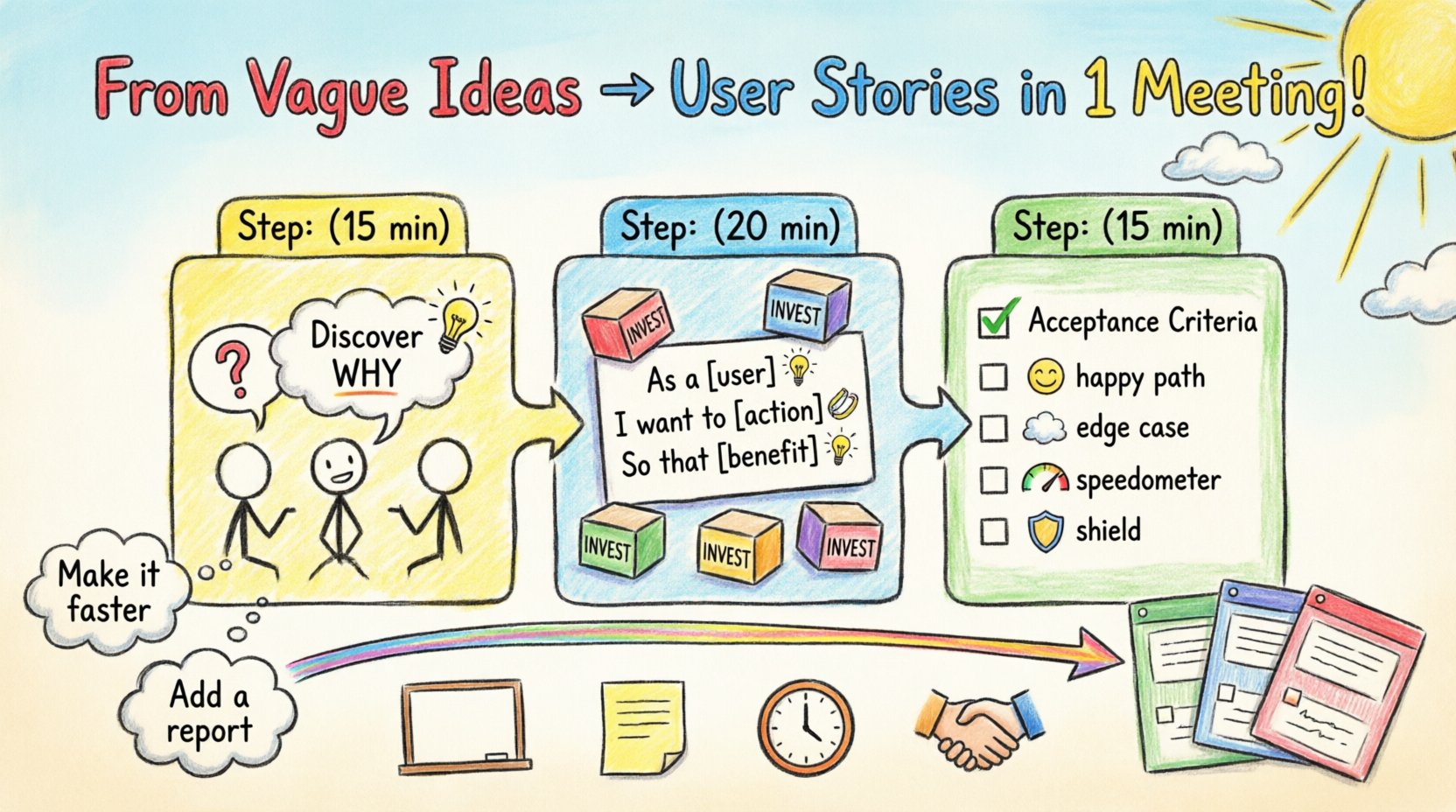
To maintain momentum and avoid getting lost in conversation, divide the meeting into three distinct phases. Each phase has a specific objective and a set of output goals.
Phase 1: Discovery and Context (15 Minutes) 🗣️
The goal here is to understand the “Why.” Stakeholders often focus on the “What.” Your job is to dig for the motivation behind the feature.
- Ask Open Questions: Start with “What problem are we trying to solve?” rather than “What features do you want?”
- Identify the User: Who is the specific persona using this feature? Is it an admin, a customer, or a partner?
- Map the Current Flow: Ask the stakeholder to describe the current process. Where does it break down?
- Define Success: How will we know this feature is working? Is it speed, conversion rate, or error reduction?
Take notes on these answers. They will form the backbone of the value proposition in your user story.
Phase 2: Structuring the Story (20 Minutes) ✍️
This is the core translation phase. You take the raw information from Phase 1 and format it into a standard user story structure. Use the following template:
As a [role],
I want to [action],
So that [benefit].
Iterate on this sentence with the stakeholder until it is precise. For example, if they say, “I want a search bar,” you might refine it to, “As a customer, I want to search by SKU so that I can find specific items quickly.”
Ensure the story adheres to the INVEST criteria:
- Independent: Can this be built without other stories?
- Negotiable: Are the details open to discussion?
- Valuable: Does it deliver value to the user?
- Estimable: Can the team estimate the effort?
- Small: Can it be completed within a sprint?
- Testable: Are there clear criteria to verify it works?
Phase 3: Acceptance Criteria and Validation (15 Minutes) ✅
A story without acceptance criteria is incomplete. This phase ensures the team knows exactly when the work is done. Use the Gherkin syntax or simple bullet points to define the conditions.
- Happy Path: What happens when everything goes right?
- Edge Cases: What happens if the user enters invalid data?
- Performance: Are there speed requirements (e.g., loads in under 2 seconds)?
- Constraints: Are there security or compliance rules to follow?
Review these criteria with the stakeholder to confirm they match their expectations. If they agree, the story is ready for the backlog.
Refining Vague Inputs into Clear Outputs 🔄
Not all stakeholder inputs are created equal. Some are high-level visions, while others are specific bugs. Use the table below to see how different types of input should be handled during the meeting.
| Vague Input | Clarifying Question | Actionable Story Output |
|---|---|---|
| “Make the app faster.” | “Which screens are slow? What is the current load time vs. target?” | “As a user, I want page load times under 2 seconds so I don’t lose interest.” |
| “Add a report.” | “Who needs this report? What data points are essential?” | “As a manager, I want a weekly sales summary so I can track performance.” |
| “Improve security.” | “Is this about login, data encryption, or access control?” | “As a system, I want to enforce two-factor authentication so that unauthorized access is prevented.” |
| “Better mobile experience.” | “What specific actions fail on mobile? What devices are targeted?” | “As a mobile user, I want to submit forms with one hand so I can complete tasks while walking.” |
Notice how the output column transforms a feeling or a wish into a concrete requirement that developers can implement.
Techniques for Handling Resistance or Ambiguity 🛡️
During the meeting, stakeholders may push back or remain vague despite your questions. Here are strategies to handle these situations without derailing the session.
1. The “Five Whys” Technique
When a stakeholder gives a surface-level answer, ask “Why” up to five times. This drill-down method often reveals the root cause of the request. For example:
- Stakeholder: “We need a button here.”
- You: “Why is that button needed?”
- Stakeholder: “To get more clicks.”
- You: “What do you want them to click?”
- Stakeholder: “To sign up for the newsletter.”
- You: “So the goal is newsletter acquisition. Can we measure that?”
This reveals that the story is actually about conversion, not just a button placement.
2. Use Concrete Examples
Abstract concepts are hard to grasp. Use examples from similar systems or real-world scenarios. Say, “Imagine you are in a coffee shop. You want to order a coffee. If the app does X, then you can pay at the counter.” This grounds the conversation in reality.
3. Timebox the Discussion
If the conversation goes off track, gently steer it back. “That is an interesting point, but let’s park it for the next session so we can finish the current story.” This keeps the meeting on schedule and respects everyone’s time.
Writing the Story: Best Practices 📝
Once the conversation concludes, you must document the story accurately. The documentation serves as the contract between the business and the engineering team. Follow these guidelines:
- Keep it Concise: Do not write a novel. A paragraph or two is sufficient for the description.
- Focus on User Value: Ensure the “So that” part clearly states the benefit. Avoid technical jargon here.
- Use Active Voice: Write “The system calculates tax” instead of “Tax is calculated by the system.” This makes the requirement active and clear.
- Link Related Stories: If this story depends on another, link them. This helps the team understand the sequence of work.
Do not include design files or technical solutions in the story description. Leave the “How” to the development team. The story should define the “What” and the “Why.”
Common Pitfalls to Avoid ⚠️
Even with a good process, mistakes happen. Be aware of these common errors when refining requirements.
- Assuming Knowledge: Do not assume stakeholders know technical limitations. Explain constraints clearly, but do not let them dictate the technical architecture.
- Mixing Multiple Features: Do not bundle three different features into one story. This makes estimation impossible and testing difficult. Split them into separate stories.
- Skipping Acceptance Criteria: Never leave the “Definition of Done” blank. This leads to arguments later about whether the work is complete.
- Ignoring Non-Functional Requirements: Performance, security, and accessibility are not optional. They must be included as criteria, not afterthoughts.
- Finalizing Without Validation: Never close the meeting without confirming that the stakeholder agrees with the written story. Ask them to sign off on the text.
Post-Meeting Follow-Up 📩
The work does not end when the meeting adjourns. The immediate follow-up is crucial for maintaining the momentum generated in the session.
- Distribute Notes: Send a summary of the agreed-upon stories to all attendees within 24 hours.
- Create the Items: Input the stories into the backlog immediately. Do not wait for the next planning session.
- Review with the Team: Walk the engineering team through the new stories. Ensure they understand the acceptance criteria before sprint planning begins.
- Schedule a Review: If the story is complex, schedule a brief follow-up call to clarify any emerging questions during development.
Measuring the Success of Your Approach 📊
How do you know this method is working? Look for these indicators over the next few sprints:
- Reduced Rejection Rate: Fewer stories are returned from testing due to unclear requirements.
- Faster Estimation: The team can estimate stories more quickly because the scope is well-defined.
- Stakeholder Satisfaction: Stakeholders feel heard and see their ideas implemented accurately.
- Consistent Velocity: The team completes more work per sprint because there is less ambiguity to resolve.
These metrics provide objective evidence that the investment in better requirements gathering pays off.
Final Thoughts on Clarity and Execution 💡
Transforming vague ideas into actionable user stories is a skill that improves with practice. It requires patience, empathy, and a structured mindset. When you focus on the user’s problem rather than the stakeholder’s wish list, you create value that resonates with everyone involved.
By dedicating time to the meeting structure, asking the right questions, and enforcing clear acceptance criteria, you eliminate the noise. You leave the room with a clear path forward. This clarity is the foundation of a healthy product development lifecycle.
Remember, the goal is not just to write stories; it is to build the right product efficiently. With this framework, you are equipped to handle ambiguity and deliver results that matter.
Related posts:
 The Complete Checklist for Writing High-Quality User Stories in Agile Teams
 Q&A: Answering the Top 10 Confusing Questions About User Stories for New Agilites
 Stop Wasting Time on Bad User Stories: A Practical Tutorial for Beginners
 How to Use User Stories to Align Engineering, Design, and Product Teams Effectively