

In modern software development, the gap between a vague idea and a shipped feature often comes down to one critical artifact: the user story. When done correctly, these narratives bridge the divide between business value and technical implementation. They serve as the primary vehicle for communication, ensuring that everyone from product owners to developers shares a unified understanding of what needs to be built and why.
However, a poorly constructed story leads to ambiguity, rework, and delayed releases. It forces the team to guess at requirements rather than execute on clear direction. This guide provides a rigorous framework for crafting stories that drive clarity and efficiency. We will explore the structural components, the INVEST criteria, and the collaborative practices necessary to maintain a healthy backlog.
🧩 Understanding the Core Structure
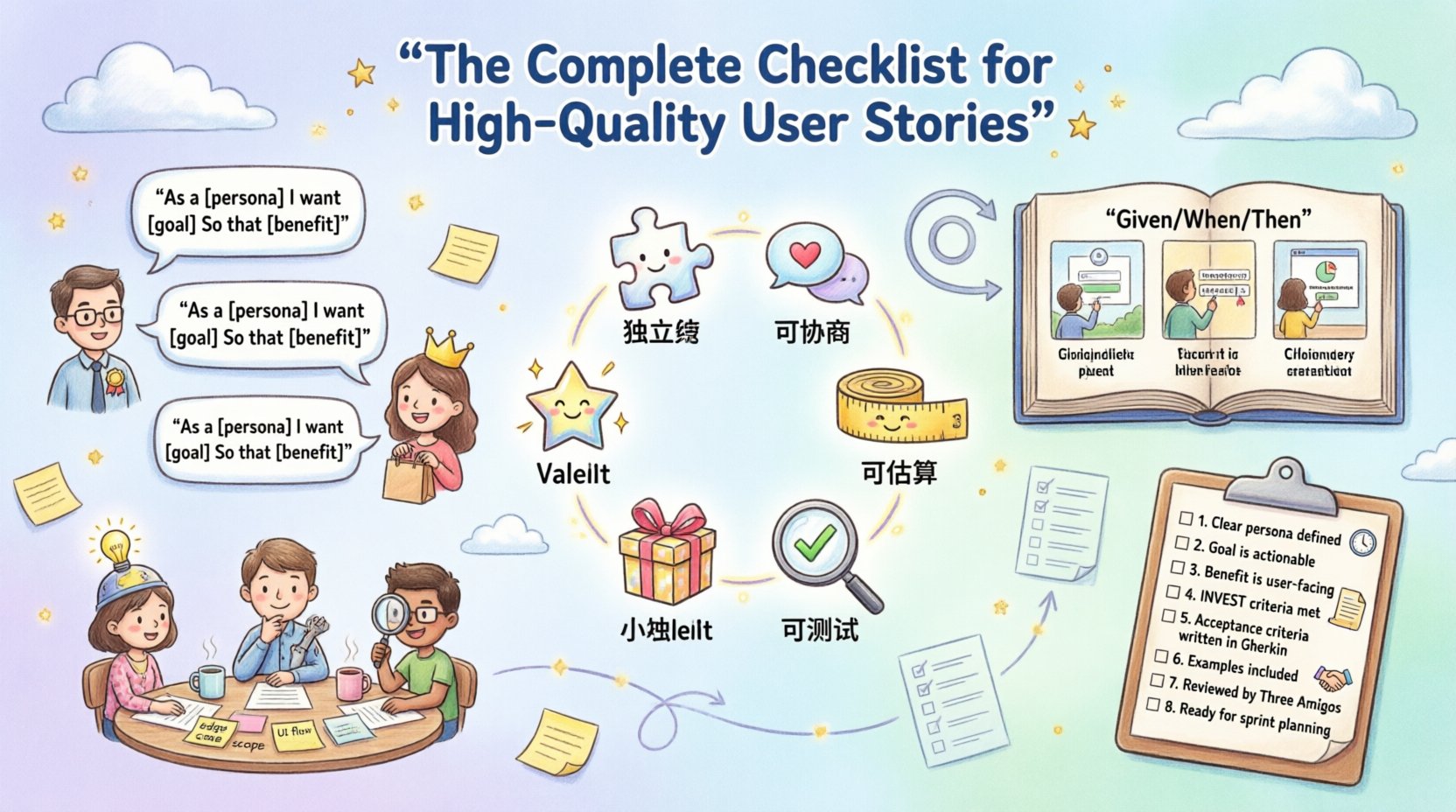
The foundation of a user story is its ability to capture the voice of the user. It is not merely a task description; it is a promise of value. The standard format provides a template that ensures the three essential elements of a story are present: the persona, the action, and the benefit.
The classic template reads:
- As a [type of user]
- I want [some goal]
- So that [some benefit/value]
Each section serves a specific purpose in the communication chain:
- As a [Persona]: This defines the context. Who is experiencing this? Is it an admin, a guest, or a premium subscriber? The persona dictates the permissions and the interface complexity.
- I want [Goal]: This describes the functionality. It must be an action that the system can perform to satisfy the user’s need.
- So that [Benefit]: This articulates the value. Why does this feature exist? If you cannot answer this, the story may not be worth the development effort.
Example:
- Bad: “Add a login button.” (Missing persona and value)
- Good: “As a registered customer, I want to log in using my email, so that I can access my saved orders quickly.”
📊 The INVEST Model for Story Quality
Not every user story is created equal. To ensure stories are manageable and effective, teams often apply the INVEST model. This acronym serves as a litmus test for the quality of a story before it enters a sprint. Each letter represents a criterion that the story must satisfy.
1. Independent
Stories should ideally be independent of one another. While dependencies exist in complex systems, a well-structured backlog attempts to minimize them. If Story A cannot be built without Story B, consider splitting them or managing the dependency explicitly. Independent stories allow the team to prioritize based on value rather than technical sequence.
2. Negotiable
A story is a placeholder for a conversation, not a contract. It should be open to discussion regarding the implementation details. If the story is written as a rigid specification document, it stifles innovation. The team should negotiate the “how” while agreeing on the “what” and “why”.
3. Valuable
This is the most critical component. A story must deliver value to the end user or the business. If a feature is technically impressive but offers no utility to the customer, it does not belong in the product backlog. Always ask: “Does this move the needle?”
4. Estimable
The team must be able to estimate the effort required to complete the story. If a story is too vague, estimation is impossible, and the sprint planning process breaks down. If the team cannot provide a relative size (e.g., story points), the story needs more information or splitting.
5. Small
Stories should be small enough to be completed within a single iteration or sprint. Large stories (often called Epics) should be broken down until they fit the timebox. A story that takes two weeks to build is too large for a one-week sprint.
6. Testable
A story must have a clear definition of completion. There must be a way to verify that the story is done. If you cannot write a test case for the story, you cannot know when it is finished. This ties directly into Acceptance Criteria.
📝 Crafting Acceptance Criteria
Acceptance criteria (AC) are the conditions that a software product must satisfy to be accepted by a user, customer, or other stakeholders. They act as the boundary for the story. Without AC, a developer might implement the feature, only to realize later that it does not meet the specific needs of the product owner.
Effective acceptance criteria should be:
- Specific: Avoid words like “fast,” “easy,” or “secure.” Instead, use measurable metrics like “loads in under 2 seconds” or “encrypts data using AES-256.”
- Clear: Written in plain language that both technical and non-technical stakeholders can understand.
- Verifiable: There must be a pass/fail condition.
Using Gherkin Syntax
Many teams adopt a structured format known as Gherkin for acceptance criteria. It uses natural language keywords to define scenarios:
- Given: The initial context or state of the system.
- When: The event or action that occurs.
- Then: The expected outcome or result.
Example:
- Given the user is logged out
- When they enter an incorrect password twice
- Then the system displays a warning message
Edge Cases and Negative Scenarios
Acceptance criteria should not only cover the happy path (the ideal scenario). They must also define how the system behaves when things go wrong. This prevents developers from ignoring error handling.
- Empty State: What happens if the user has no data?
- Invalid Input: What happens if the user types text into a number field?
- Network Failure: What happens if the internet disconnects during a save operation?
🤝 Collaboration and Refinement
Writing a user story is rarely a solitary task. It is a collaborative effort that involves multiple perspectives. Relying solely on a product owner to write stories often results in missing technical constraints or QA edge cases. This is why the “Three Amigos” concept is widely adopted.
The Three Amigos
This term refers to a meeting involving three key roles:
- Product Owner: Defines the value and the business requirements.
- Developer: Identifies technical feasibility, complexity, and implementation details.
- Quality Assurance (QA): Identifies edge cases, test scenarios, and potential risks.
When these three review a story together before the sprint begins, they uncover ambiguities early. This process is known as backlog refinement or grooming.
Refinement Sessions
Refinement is not a one-time event. It is an ongoing activity that happens throughout the sprint cycle. During these sessions, the team:
- Breaks down large Epics into smaller stories.
- Clarifies requirements.
- Adds missing acceptance criteria.
- Estimates the size of the stories.
By the time a story enters a sprint, it should be “ready.” This means it is clear, estimated, and accepted by the team.
⚠️ Common Pitfalls and Anti-Patterns
Even experienced teams can fall into traps that degrade the quality of their backlog. Recognizing these patterns helps in maintaining high standards.
1. The “Task” Story
A common mistake is writing a story that describes a technical task rather than a user value. For example, “Upgrade the database server.” This is a task, not a story. A user story for this would be: “As a user, I want the site to load faster, so that I can complete my purchase without frustration.” The upgrade is the implementation, not the story itself.
2. Vague Language
Words like “optimize,” “enhance,” or “fix” are subjective. They lead to different interpretations between the developer and the tester. Always quantify improvements. Instead of “optimize,” use “reduce page load time by 50%.”
3. Missing Context
Stories often fail because they lack context. The developer might not know the business rules that govern the feature. Screenshots, mockups, or links to design documents should be attached to the story to provide visual context.
4. Ignoring Technical Debt
While user stories focus on features, technical debt must be acknowledged. Sometimes, a story needs to include a note about refactoring or updating documentation. While these might not be user-facing, they are necessary for long-term health.
✅ The Pre-Flight Checklist
Before a story moves from “To Do” to “In Progress,” it should pass a final review. Use this checklist to ensure quality and readiness.
| Check Item | Criteria | Status |
|---|---|---|
| Format | Does it follow the “As a… I want… So that…” structure? | ☐ |
| Persona | Is the user type clearly defined? | ☐ |
| Value | Is the benefit to the user or business explicit? | ☐ |
| INVEST | Is it Independent, Negotiable, Valuable, Estimable, Small, and Testable? | ☐ |
| Acceptance Criteria | Are there at least 3 clear pass/fail conditions? | ☐ |
| Attachments | Are there design mockups, wireframes, or reference links? | ☐ |
| Estimation | Has the team agreed on the relative effort? | ☐ |
| Dependencies | Are external dependencies identified and managed? | ☐ |
🔄 Maintenance and Iteration
A backlog is a living document. Stories change as the market shifts or as new information comes to light. It is normal for a story to be refined multiple times before it is built. Do not treat the initial write-up as the final version.
When a story is rejected during testing, it should be treated as a learning opportunity. Analyze why the acceptance criteria were missed. Was the requirement unclear? Was the edge case overlooked? Use this feedback to improve future story writing.
🔍 Measuring Success
How do you know if your user stories are improving? Look at the metrics surrounding the development process:
- Velocity Stability: If the team’s velocity fluctuates wildly, stories may be inconsistently sized or estimated.
- Defect Rate: A high number of bugs post-release may indicate unclear acceptance criteria.
- Sprint Completion: Are stories being completed within the sprint, or are they spilling over?
- Team Confidence: Do developers feel confident about what to build when they pull a story?
🏁 Final Thoughts
Writing high-quality user stories is a skill that improves with practice. It requires empathy for the user, technical insight from the team, and business acumen from the product owner. By adhering to the INVEST model, defining clear acceptance criteria, and engaging in regular collaboration, teams can reduce ambiguity and increase delivery speed.
Remember that the story is a tool for conversation, not a replacement for it. Use the checklist provided here as a guide, but remain flexible to the needs of your specific team and project. The goal is not perfection in the writing, but clarity in the execution.
Related posts:
 Case Study: How a Clear User Story Format Reduced Dev Team Retrospective Time
 Component Breakdown: Anatomy of a Perfect User Story for Product Managers
 Common Pitfalls in User Story Acceptance Criteria and How to Fix Them Quickly
 A Beginner’s Guide to User Story Templates That Work Across Different Industries