

Enterprise architecture provides the blueprint for organizational alignment, ensuring that business strategies translate into tangible outcomes. Within this discipline, ArchiMate serves as a standardized modeling language designed to describe, analyze, and visualize complex business structures. One of the most critical constructs within the Business Layer is the Value Chain Diagram. This visual representation maps how an organization creates value for its stakeholders through a sequence of activities.
Creating a robust value chain diagram requires a clear understanding of the underlying elements and their interrelationships. This guide walks you through the process of constructing a Value Chain Diagram using ArchiMate principles. We will focus on the semantic structure, the logical flow, and the specific notation required to ensure clarity and precision. By the end of this article, you will have a functional diagram that effectively communicates your business logic without ambiguity.
🧠 Understanding the Value Chain in ArchiMate
A value chain is not merely a list of tasks; it is a structured representation of how value is delivered. In the context of enterprise architecture, this involves mapping the flow of value from a triggering event to a realized outcome. The ArchiMate framework provides specific elements to model this flow, ensuring that every step contributes to the overarching business objective.
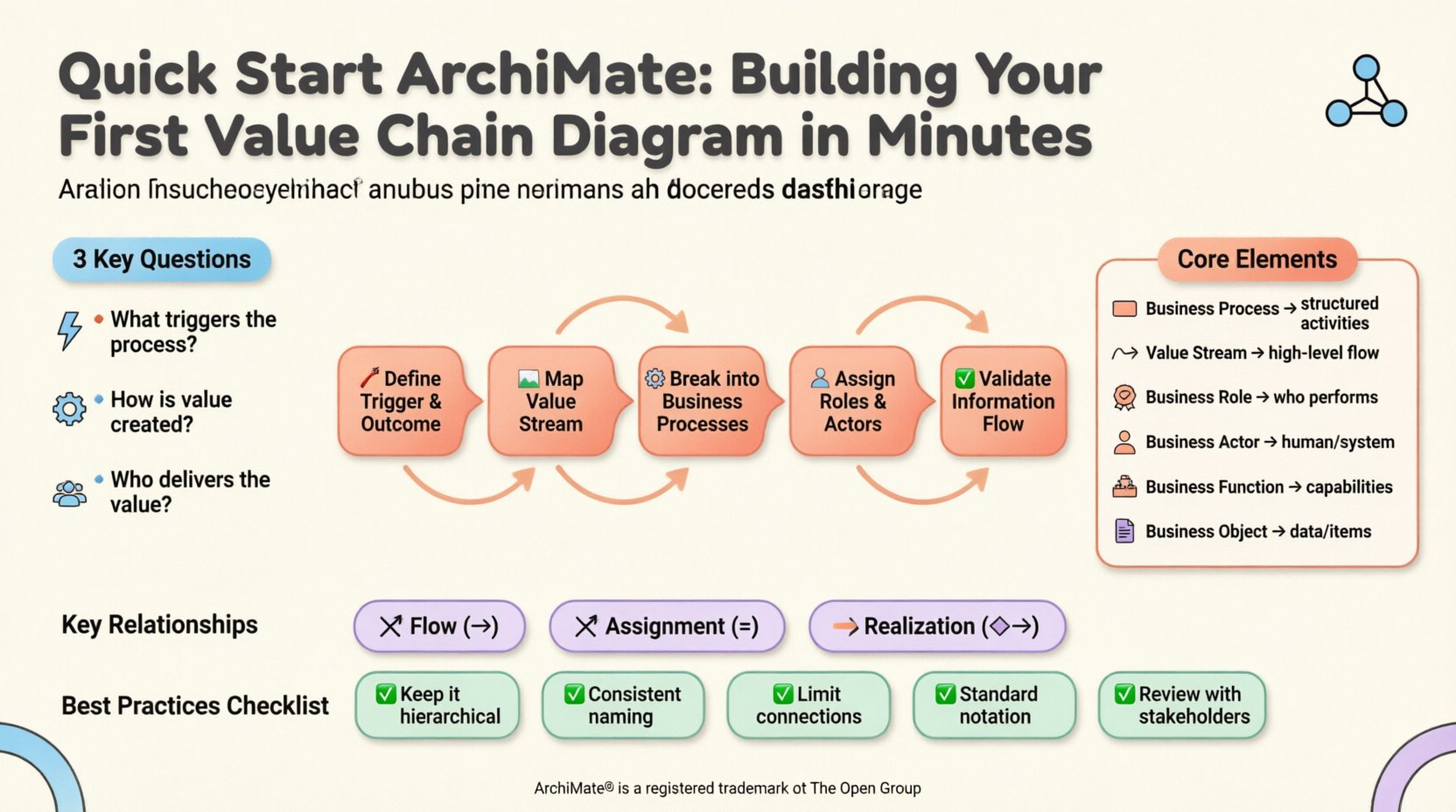
When you construct a value chain diagram, you are essentially answering three fundamental questions:
- What triggers the process? This is the initial event or demand that sets the chain in motion.
- How is value created? This involves the specific business processes and activities that transform inputs into outputs.
- Who delivers the value? This identifies the roles and stakeholders responsible for executing the activities.
Unlike generic flowcharts, an ArchiMate value chain diagram includes semantic richness. It distinguishes between the value stream (the high-level flow) and the specific business processes that execute it. This distinction allows architects to zoom in on operational details while maintaining a strategic overview.
📦 Core Elements for Value Chain Modeling
To build an accurate diagram, you must first identify the correct elements. The Business Layer of ArchiMate contains a specific set of constructs designed for this purpose. Below is a comprehensive breakdown of the primary elements you will encounter when constructing a value chain.
| Element | Definition | Usage in Value Chain |
|---|---|---|
| Business Process | A structured set of activities and actions designed to accomplish a specific goal. | Represents the specific steps taken to transform inputs into outputs. |
| Value Stream | A sequence of activities that creates value for a specific stakeholder. | Defines the high-level flow from trigger to outcome. |
| Business Role | A unit of organizational behavior, such as a person or a team, that performs a specific function. | Indicates who is assigned to execute the processes. |
| Business Actor | A human or system that performs a role. | External entities or internal departments initiating or receiving value. |
| Business Function | A cohesive set of business capabilities that are required to achieve an organizational goal. | Groups related processes under a functional umbrella. |
| Business Object | A piece of information that is relevant to a business process. | Represents the data or items flowing through the chain. |
Understanding the nuance between these elements is crucial. For instance, a Business Function is static and represents capability, whereas a Business Process is dynamic and represents action. In a value chain diagram, you typically focus heavily on Processes and Value Streams, supported by Roles and Actors.
🛠️ Step-by-Step Guide to Building the Diagram
Constructing a value chain diagram is a methodical process. It requires planning the structure before placing elements onto the canvas. Follow this sequence to ensure logical consistency and semantic correctness.
Step 1: Define the Trigger and Outcome
Every value chain begins with a trigger and ends with an outcome. The trigger is the event that initiates the value stream. This could be a customer request, a regulatory requirement, or a market shift. The outcome is the value delivered to the stakeholder as a result of the activities.
- Identify the Business Actor that initiates the process.
- Define the Business Event that serves as the trigger.
- Specify the Value that is realized at the end of the chain.
Without a clear start and end point, the diagram lacks direction. Ensure that the trigger is distinct from the first process. The trigger sets the context, while the process executes the work.
Step 2: Map the Value Stream
Once the boundaries are set, define the Value Stream. This element encapsulates the entire sequence of activities. It acts as a container for the high-level flow. In the modeling environment, you will typically place the Value Stream as a overarching structure or a primary flow line.
Key considerations for the Value Stream include:
- Coherence: Ensure the activities within the stream logically follow one another.
- Completeness: Verify that no critical steps are missing between the trigger and the outcome.
- Clarity: Use the Value Stream to show the general progression, avoiding too much detail at this stage.
Step 3: Break Down into Business Processes
The Value Stream is composed of specific Business Processes. These are the actionable steps that deliver value. You should decompose the Value Stream into manageable chunks. Each process should have a clear input and output.
When mapping these processes:
- Group related processes logically.
- Avoid creating processes that are too granular or too broad.
- Ensure every process contributes directly to the value realization.
Use arrows or flow connectors to indicate the sequence. In ArchiMate, the Flow relationship is used to show the movement of value or information from one element to another. This establishes the temporal order of operations.
Step 4: Assign Roles and Actors
Processes do not execute themselves; they require execution. This is where Business Roles come into play. Assign a specific role to each process to indicate responsibility. A role represents the capability or function required, while the Actor represents the actual entity performing it.
- Identify the Business Role needed for each process.
- Link the Role to the Process using the Assignment relationship.
- If applicable, link the Role to a Business Actor using the Assignment relationship.
This step adds organizational context to the diagram. It clarifies who is accountable for the value creation. It also helps in identifying gaps where roles might be missing or overloaded.
Step 5: Validate the Information Flow
A value chain is not just about actions; it is about the transformation of information and objects. Identify the Business Objects that are created, modified, or consumed during the processes. This ensures the diagram reflects the data requirements of the business.
Use the Access relationship to show which processes create or read specific objects. This adds a layer of technical detail that supports integration and data governance efforts later.
🔗 Relationships and Semantics
The power of ArchiMate lies in its relationships. They define how elements interact. In a value chain diagram, three primary relationships are critical: Flow, Assignment, and Realization.
1. Flow Relationship
The Flow relationship indicates the movement of value or information. It is directional and sequential. In a value chain, you will use this to connect Business Processes to one another. It answers the question: “What comes next?”
- Use Flow to connect Process A to Process B.
- Ensure the flow represents a logical progression.
- Do not use Flow for organizational assignments; use Assignment instead.
2. Assignment Relationship
Assignment links a Role to a Process or a Business Actor to a Role. It answers the question: “Who does this?” This relationship is fundamental for defining organizational responsibility within the diagram.
- Link Role to Process to show responsibility.
- Link Actor to Role to show execution.
- Multiple Roles can be assigned to a single Process if collaboration is required.
3. Realization Relationship
Realization connects an abstract concept to a concrete implementation. In the context of a value chain, this might link a Business Function to a Business Process. It indicates that the Process realizes the capability defined by the Function.
- Use Realization to link high-level capabilities to specific actions.
- This helps bridge the gap between strategy and execution.
- Ensure the relationship is bidirectional in meaning, even if the arrow points one way.
📊 Best Practices for Clarity
To maintain a high standard of quality in your modeling, adhere to these best practices. They ensure the diagram remains readable and useful over time.
- Keep it Hierarchical: Do not try to show the entire value chain in one view. Use layers or sub-diagrams for deep detail. Start with the high-level Value Stream, then drill down into specific Processes.
- Consistent Naming: Use clear, action-oriented names for processes. Instead of “Process 1,” use “Process: Validate Customer Request.” This improves readability significantly.
- Limit Connections: Avoid crossing lines where possible. Use grouping containers to manage complexity. If the diagram becomes cluttered, it loses its value as a communication tool.
- Standard Notation: Stick to the standard shapes and colors defined by the ArchiMate specification. Do not invent custom symbols unless absolutely necessary for internal context.
- Review with Stakeholders: A diagram is only as good as its understanding. Walk through the model with business stakeholders to validate the logic.
🚫 Common Pitfalls to Avoid
Even experienced architects can make mistakes when modeling value chains. Being aware of these common errors can save you time during the review process.
- Confusing Flow with Assignment: Do not use Flow to connect a Role to a Process. Use Assignment. Flow is for value/information movement.
- Over-Engineering: Do not model every single task. Focus on the business value steps. Operational details can be documented elsewhere.
- Ignoring the Trigger: A value chain without a trigger is just a list of processes. Ensure the initiating event is clearly defined.
- Mixing Layers: While integration is important, keep the Business Layer diagram focused on business concepts. Avoid cluttering it with Application or Technology elements unless showing direct realization.
- Disconnected Outcomes: Ensure the final outcome is clearly linked to the stakeholder value. If the chain ends without a value realization, it is incomplete.
🌐 Integration with Other Layers
An ArchiMate model is rarely isolated. The Business Layer connects to the Application and Technology Layers. When building a value chain, consider how it interacts with supporting systems.
- Application Services: Identify which application services support the business processes. This can be shown using the Access relationship.
- Business Capabilities: Link the business processes to the underlying capabilities they enable. This helps in capability mapping.
- Cost and Risk: Consider adding attributes for cost or risk to the processes. This adds analytical depth to the value chain.
By understanding these connections, you ensure that the value chain is not just a theoretical construct but a reflection of the actual operating model. This alignment is critical for successful transformation initiatives.
✅ Validation Checklist
Before finalizing your diagram, run through this checklist to ensure completeness and accuracy.
- ☑ Is there a clear Trigger Event?
- ☑ Is there a defined Value Outcome?
- ☑ Are all processes linked in a logical sequence?
- ☑ Is every process assigned a Business Role?
- ☑ Are Business Actors assigned to the Roles?
- ☑ Are information flows (Objects) correctly mapped?
- ☑ Are relationships (Flow, Assignment) used correctly?
- ☑ Is the notation consistent with the ArchiMate standard?
🔍 Final Thoughts on Value Chain Modeling
Building a value chain diagram in ArchiMate is a disciplined exercise in clarity. It forces you to articulate how value is created, who creates it, and what enables it. By following the steps outlined above and adhering to the semantic rules of the language, you create a model that serves as a reliable reference for stakeholders.
The goal is not to create a perfect diagram on the first attempt. It is to create a living model that can evolve as the business changes. Start with the high-level flow, refine the details, and ensure that every element has a purpose. This approach ensures that your enterprise architecture remains relevant and actionable.
With practice, the construction of these diagrams becomes intuitive. You will find that the structure itself guides your thinking, revealing gaps in logic and opportunities for optimization. The Value Chain Diagram is more than a visual aid; it is a tool for strategic alignment.