

In modern organizations, the disconnect between executive vision and technical execution is a persistent challenge. 🤔 Business leaders define the direction, while IT teams manage the infrastructure that supports operations. Without a unified language, these groups often speak past one another. This is where Enterprise Architecture becomes vital. Specifically, the ArchiMate framework provides a standardized method to bridge this gap. It translates abstract business strategies into concrete technical requirements.
This guide explores the mechanics of ArchiMate and how it facilitates alignment from the C-suite down to the data center. We will examine the layers, the relationships, and the practical application of this framework without relying on specific proprietary tools.
Understanding the Core Concept 🧠
ArchiMate is an open and independent enterprise architecture modeling language. It is maintained by The Open Group. The primary purpose is to describe, analyze, and visualize the relationships between business processes, organizational structures, information systems, and technology infrastructure.
Think of it as a universal grammar for architects. Just as grammar allows writers to construct clear sentences, ArchiMate allows architects to construct clear models of an organization. It ensures that everyone involved understands the same definitions for terms like “process,” “service,” and “component.”
- Standardization: It provides a consistent vocabulary across departments.
- Visualization: Complex relationships become visible through diagrams.
- Alignment: It links strategic intent with operational reality.
When organizations adopt this framework, they move away from siloed documentation. Instead of separate spreadsheets for business goals and separate server diagrams for IT, a single model connects them. This holistic view is essential for digital transformation initiatives.
The Architecture Layers Explained 🏛️
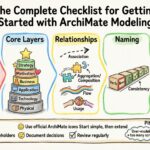
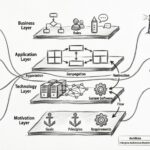
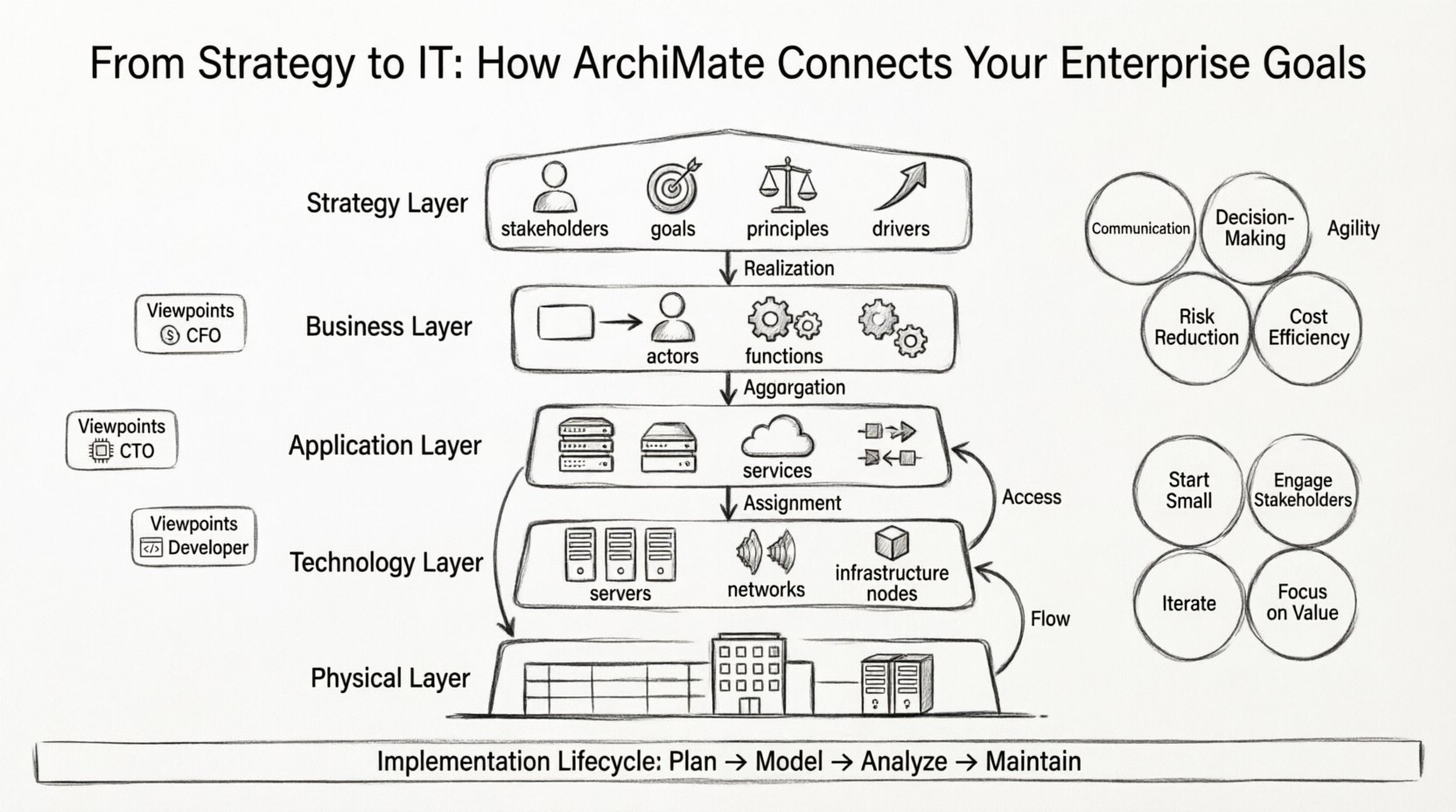
The power of ArchiMate lies in its layered approach. It breaks down an enterprise into distinct but interconnected layers. This separation of concerns allows architects to focus on specific domains without losing sight of the whole system.
1. Strategy Layer
This is the foundation of your architectural model. It defines the Why of the organization. It includes elements such as:
- Stakeholders: Who is involved? (e.g., Board, Customers, Partners).
- Goals: What is the organization trying to achieve? (e.g., Market Expansion, Cost Reduction).
- Principles: The rules that guide decision-making.
- Drivers: Internal or external factors pushing for change.
By documenting these elements, you create a clear target. IT investments can then be traced back to specific strategic goals.
2. Business Layer
Here, the focus shifts to What the organization does. This layer models the execution of business strategy. Key elements include:
- Business Actors: Entities performing activities (people, organizations).
- Business Processes: Flows of work that deliver value.
- Business Functions: Groups of activities with a common purpose.
- Business Objects: Data being created, managed, or used.
Mapping these processes reveals inefficiencies. For example, you might find that a specific business process relies on multiple redundant applications, creating unnecessary complexity.
3. Application Layer
This layer represents the How from a software perspective. It describes the software systems that support the business processes. Elements include:
- Application Services: Functions provided by a system.
- Application Functions: Specific capabilities of a software component.
- Application Interfaces: Points of interaction between systems.
- Application Components: Self-contained software units.
Understanding this layer helps IT teams manage the application portfolio. It clarifies which software is critical and which is legacy.
4. Technology Layer
This layer covers the Infrastructure that hosts the applications. It is the physical and virtual environment. Elements include:
- Technology Services: Capabilities provided by infrastructure (e.g., Database, Network).
- Technology Functions: Specific technical capabilities.
- Technology Components: Hardware or software units (e.g., Servers, Routers).
- Technology Nodes: Physical locations or logical nodes.
5. Infrastructure and Physical Layers
While often grouped with technology, these layers deal with the tangible assets. This includes data centers, cabling, and power supplies. They represent the physical reality behind the logical nodes.
Comparing the Layers
| Layer | Focus | Key Question | Example Element |
|---|---|---|---|
| Strategy | Intent & Vision | Why are we doing this? | Goal: Increase Revenue |
| Business | Processes & Organization | What do we do? | Process: Order Fulfillment |
| Application | Software Systems | How do we support the process? | Application: CRM System |
| Technology | Infrastructure | Where does it run? | Server: Database Cluster |
This table summarizes the hierarchy. As you move down the layers, the focus shifts from abstract intent to concrete implementation. The connections between these layers are what make ArchiMate effective.
Connecting the Dots: Relationships 🔗
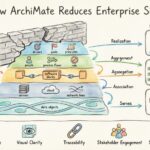
Simply having layers is not enough. The true value comes from the relationships that link them. These relationships define how changes in one layer affect another. ArchiMate defines specific relationship types to ensure precision.
1. Realization
This relationship indicates that something is instantiated by something else. For example, a Business Process is realized by an Application Component. It means the software actually performs the work defined in the business model.
2. Aggregation
This suggests a whole-part relationship. A Business Function might aggregate several Business Processes. It helps in understanding the composition of complex capabilities.
3. Assignment
This links an active element to a passive element. For instance, a Business Actor is assigned to a Business Process. It clarifies who is responsible for what.
4. Access
This defines how one element uses another. A Business Process accesses an Application Service. This is crucial for understanding dependencies. If the application service changes, the business process is impacted.
5. Flow
This relationship connects elements that pass data or material between them. It is often used to show the movement of information from one process to another or from a system to a user.
By mapping these relationships, you create a traceability chain. If a strategic goal changes, you can trace exactly which business process, application, and server component is affected. This is known as impact analysis.
Viewpoints and Views 👁️
A complete enterprise architecture model can become incredibly complex. Presenting every detail to every stakeholder is ineffective. ArchiMate addresses this through Viewpoints and Views.
- Viewpoint: A specification for a view. It defines what aspects of the architecture are relevant for a specific stakeholder group. (e.g., Security, Performance, Business).
- View: The actual representation of the architecture tailored to a specific stakeholder. It is derived from the viewpoint.
For example, a CFO might need a View focused on cost and ROI. A CTO might need a View focused on infrastructure and integration. A developer might need a View focused on interfaces and data structures. ArchiMate allows you to slice the same model into these different perspectives without maintaining multiple contradictory models.
Implementation Lifecycle 🔄
Adopting an architecture framework is a process. It is not a one-time event. It requires a lifecycle approach to ensure the models remain relevant as the organization evolves.
Phase 1: Planning and Scoping
Before creating any models, you must define the scope. Which parts of the enterprise will be covered? What are the business drivers? This phase sets the boundaries. You decide whether to focus on a specific department or the entire enterprise.
Phase 2: Modeling and Design
This is the core creation phase. Architects use the framework to build the diagrams. They identify the elements and define the relationships. During this phase, it is vital to maintain consistency. Terminology must be uniform across all diagrams.
Phase 3: Analysis and Validation
Once the model is built, it must be validated. Does it reflect reality? Do the stakeholders agree? This phase often involves workshops where business and IT leaders review the diagrams. Discrepancies are identified and corrected.
Phase 4: Maintenance and Evolution
Organizations change. New technologies are adopted, and strategies shift. The architecture model must be updated to reflect these changes. This requires a governance process. Any significant change to the IT landscape should trigger a review of the relevant architectural models.
Benefits of Alignment 💡
Why invest the effort to build these models? The benefits are tangible and measurable.
- Improved Communication: Stakeholders from different backgrounds share a common visual language. Misunderstandings are reduced.
- Better Decision Making: Leaders can see the impact of potential changes before they happen. Decisions are based on data rather than intuition.
- Reduced Risk: By understanding dependencies, you can avoid single points of failure. You know what happens if a specific server goes down.
- Agility: When the business needs to pivot, the architecture team can quickly identify which systems need to be modified.
- Cost Efficiency: Identifying redundant applications or processes allows for consolidation. This reduces licensing and maintenance costs.
Common Challenges ⚠️
While the framework is powerful, implementation is not without obstacles. It is important to anticipate these issues.
- Complexity: Models can become too detailed. If the diagram has hundreds of elements, it becomes unreadable. Focus on the relevant level of abstraction.
- Adoption: People resist new processes. Training is essential. Stakeholders must understand why the modeling is happening.
- Data Quality: If the input data is incorrect, the model is useless. Garbage in, garbage out.
- Tool Dependency: While the framework is tool-agnostic, many organizations rely on specific software to manage models. Ensure the software supports the framework standards.
- Staleness: Models become outdated quickly if not maintained. Governance is required to keep them current.
Best Practices for Success ✅
To maximize the value of this approach, consider these recommendations.
- Start Small: Do not attempt to model the entire enterprise on day one. Start with a specific project or domain.
- Engage Stakeholders: Involve business and IT leaders early. Their input ensures the model is accurate.
- Iterate: Treat the architecture as a living document. Update it regularly.
- Focus on Value: Always tie architectural elements back to business value. Avoid modeling for the sake of modeling.
- Use Standard Notation: Adhere strictly to the official syntax. This ensures interoperability and clear understanding.
The Future of Enterprise Architecture 🚀
The landscape of enterprise architecture is evolving. The integration of cloud computing, artificial intelligence, and microservices is changing how we model systems. ArchiMate adapts to these changes through updates to its specifications.
Modern architectures are often hybrid. They combine on-premise infrastructure with cloud services. The modeling language must represent this fluidity. It allows architects to define the boundary between physical and cloud resources clearly.
Furthermore, the push for DevOps and continuous delivery requires faster architectural feedback loops. The ability to generate views quickly and update them frequently is becoming more critical. The framework supports this by allowing lightweight models that focus on specific aspects rather than massive monolithic documents.
Summary 📝
Bridging the gap between strategy and IT is a complex task that requires discipline and a structured approach. ArchiMate provides the structure needed to make this connection explicit. By defining layers, relationships, and viewpoints, it creates a map of the enterprise.
This map allows organizations to navigate change with confidence. It ensures that when a new strategic goal is set, the IT team knows exactly what to build. When a technical constraint arises, the business team understands the impact. This shared understanding is the foundation of a resilient and adaptable organization.
Implementing this framework takes time and commitment. It is not a quick fix. However, the long-term benefits of alignment, clarity, and risk reduction make it a worthy investment for any enterprise serious about its digital future. The path from strategy to execution is no longer a mystery; it is a documented journey.