


In the modern landscape of digital engagement, customers do not experience a brand through a single lens. They navigate a complex web of interactions spanning email, social media, physical locations, and customer support lines. This network of interactions is known as touchpoints. Structuring these touchpoints effectively is the backbone of a robust customer journey mapping strategy. Without a clear architecture for how these interactions connect, businesses risk creating friction, confusion, and lost opportunities.
This guide explores the methodology for organizing touchpoints across multiple marketing channels. We will examine the anatomy of the journey, the technical requirements for data consistency, and the operational steps needed to align teams. The goal is to create a cohesive experience that guides the customer naturally from discovery to advocacy.
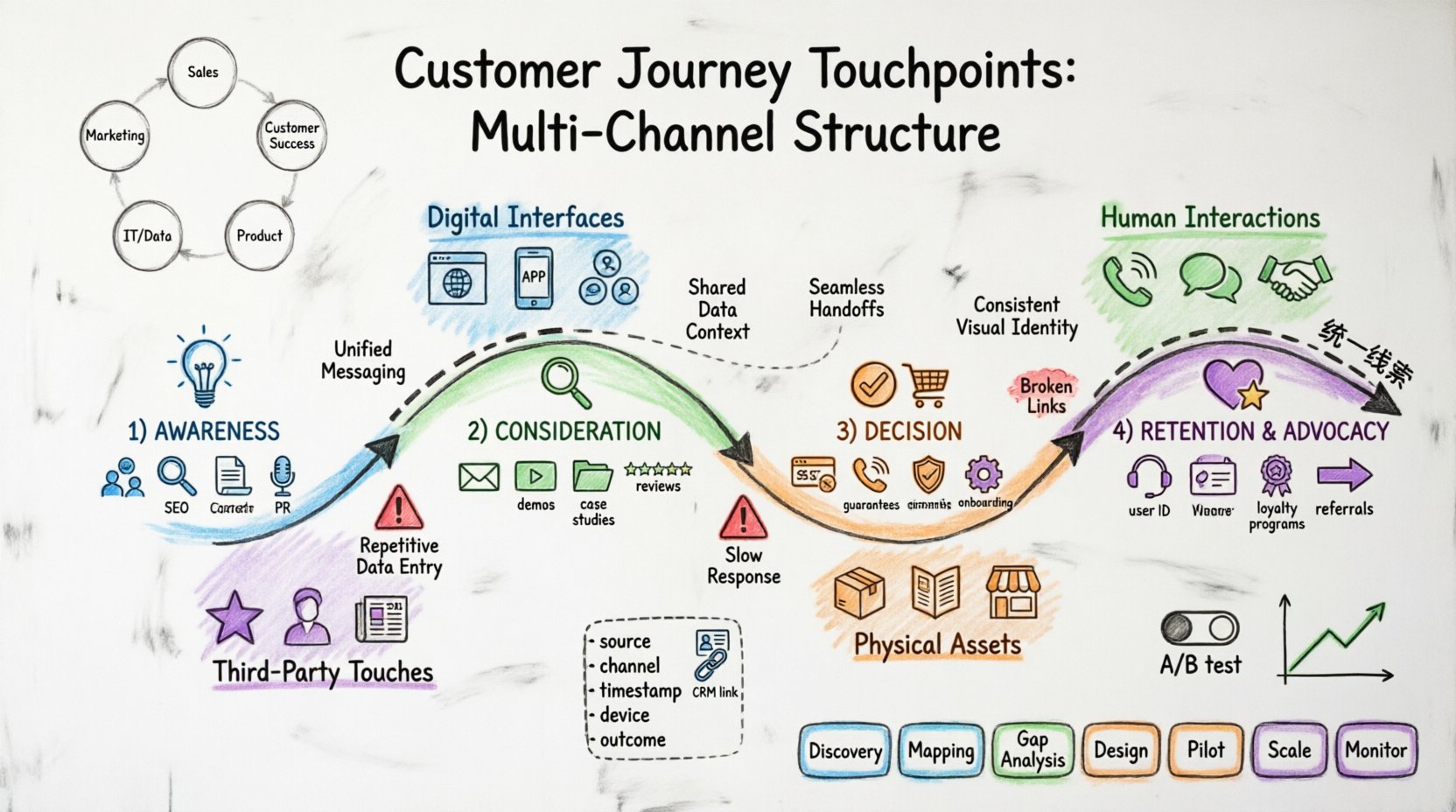
Understanding the Anatomy of a Touchpoint 🧩
A touchpoint is any point of contact between a customer and a brand. It is not merely a transaction; it is an interaction that leaves an impression. These impressions accumulate to form the overall brand perception. To structure them effectively, we must first categorize them based on their nature and placement within the buyer’s path.
Types of Touchpoints
Touchpoints vary significantly in their medium and the level of human intervention required. A comprehensive structure accounts for all of the following categories:
- Digital Interfaces: This includes websites, mobile applications, social media profiles, and email campaigns. These are often automated and scalable.
- Human Interactions: Sales calls, customer support chats, in-store consultations, and networking events. These carry high emotional weight.
- Physical Assets: Packaging, printed brochures, signage, and product placement in retail environments.
- Third-Party Touches: Reviews on external platforms, influencer mentions, and press coverage. These are out of direct control but critical to the narrative.
The Role of Context
Not all touchpoints hold equal weight at every stage of the journey. A brochure sent via mail might be relevant during the consideration phase but irrelevant during the post-purchase support phase. Structuring requires context awareness. You must map each touchpoint to a specific intent. If a touchpoint does not serve a clear purpose in moving the customer forward, it is noise and should be removed or repurposed.
Mapping the Customer Journey Stages 🗺️
Touchpoints cannot exist in a vacuum. They must be organized within the timeline of the customer lifecycle. Standard journey mapping divides this timeline into distinct stages. Each stage has a different primary objective, which dictates the type of touchpoints used.
Stage 1: Awareness
The objective here is visibility. The customer recognizes a problem or a need. Touchpoints in this stage should be broad-reaching and informative.
- Social Media Ads: Targeted campaigns designed to capture attention.
- Content Marketing: Blog posts, whitepapers, and educational videos.
- Search Engine Listings: Organic and paid search results.
- Public Relations: News articles and industry mentions.
Stage 2: Consideration
The customer is evaluating solutions. They are comparing options. Touchpoints here must be detailed, trustworthy, and comparative.
- Email Nurture Sequences: Educational content that deepens understanding.
- Product Demos: Interactive webinars or software trials.
- Case Studies: Proof of value through peer success stories.
- Review Sites: Third-party validation and ratings.
Stage 3: Decision
The customer is ready to commit. Friction must be minimized. Touchpoints here should be direct, reassuring, and facilitative.
- Checkout Processes: Streamlined payment flows.
- Sales Conversations: One-on-one negotiations or closing calls.
- Guarantees: Money-back policies or service level agreements.
- Onboarding Emails: Immediate confirmation and next steps.
Stage 4: Retention & Advocacy
The goal shifts to loyalty. The customer becomes a repeat buyer or promoter. Touchpoints here focus on value reinforcement and community.
- Support Tickets: Resolution of issues post-purchase.
- Feedback Surveys: Asking for input on the experience.
- Loyalty Programs: Rewards for continued engagement.
- Referral Programs: Incentives for bringing new customers.
Integrating Channels for Omnichannel Consistency 🔄
One of the greatest challenges in structuring touchpoints is ensuring consistency across channels. A customer might see an ad on Instagram, search for the brand on Google, and then visit a physical store. If the messaging, tone, or offer differs between these three interactions, trust erodes. This is known as channel fragmentation.
To prevent this, organizations must adopt an omnichannel approach. This does not mean being present everywhere; it means being consistent everywhere you are present.
Key Principles of Integration
- Unified Messaging: Core value propositions should remain consistent. While the format changes (e.g., a video ad vs. a landing page), the core message must not contradict itself.
- Shared Data Context: If a customer interacts with support on Twitter, the support agent should know about their recent website activity. Data silos break the flow of the journey.
- Seamless Handoffs: Moving from a digital touchpoint to a human one should feel natural. A chat session should transfer history to a phone call if the customer requests escalation.
- Consistent Visual Identity: Logos, color palettes, and typography should align across all platforms to reinforce brand recognition.
Channel Cross-Reference Matrix
The following table illustrates how different channels interact during specific journey stages. This helps in visualizing the structure.
| Journey Stage | Digital Channel | Human Channel | Physical Channel |
|---|---|---|---|
| Awareness | Social Ads, SEO | N/A | Billboards, Events |
| Consideration | Email, Webinars | Sales Calls | Product Samples |
| Decision | Checkout Page | Contract Negotiation | Point of Sale |
| Retention | App Notifications | Account Management | Membership Cards |
Structuring Data for Consistency 📊
Marketing channels generate vast amounts of data. Without a structured approach to collecting and organizing this data, you cannot measure the effectiveness of your touchpoints. Data structure is the invisible framework that supports the visible customer experience.
Standardizing Metadata
Every touchpoint should be tagged with specific metadata. This allows for aggregation and analysis later. Key data points to capture include:
- Source: Where did the interaction originate?
- Channel: Which medium was used (email, web, phone)?
- Timestamp: When did the interaction occur?
- Device: Was it mobile, desktop, or tablet?
- Outcome: Did the interaction lead to a conversion or drop-off?
- Content Identifier: Which specific asset was viewed or clicked?
Identity Resolution
To connect touchpoints across channels, you need to know that the user on the phone is the same as the user on the website. This is identity resolution. Without this, the journey looks like a series of disconnected events rather than a single narrative.
Techniques for identity resolution include:
- Logged-in Users: Using unique user IDs when accounts are created.
- Device Fingerprinting: Analyzing device characteristics to link sessions.
- Email Hashing: Matching hashed email addresses across platforms.
- CRM Integration: Linking marketing data directly to customer records.
Analyzing Gaps and Friction 🔍
Once the structure is in place, the next step is auditing it. You need to identify where the journey breaks down. Friction occurs when the customer has to work harder than necessary to achieve their goal. Gaps occur when the customer expects information or support and does not receive it.
Identifying Friction Points
Friction is often found in the transitions between touchpoints. For example, a customer fills out a form on a website but receives no confirmation email immediately. This creates anxiety. Common friction areas include:
- Repetitive Data Entry: Asking the customer to input the same information multiple times.
- Slow Response Times: Long waits for email replies or chat support.
- Broken Links: Dead ends in the digital path.
- Inconsistent Tone: A shift from friendly to robotic in communication.
Conducting a Touchpoint Audit
To find these issues, perform a systematic audit of your current touchpoint structure.
- Map the Current State: Document every existing interaction currently happening.
- Customer Testing: Walk through the journey yourself as a customer would.
- Feedback Collection: Review support tickets and complaints for recurring themes.
- Analytics Review: Look for high drop-off rates at specific stages.
- Staff Interviews: Ask sales and support teams where they hear the most confusion.
Optimizing for Conversion 📈
Structuring touchpoints is not just about organization; it is about performance. A well-structured journey removes barriers to purchase and encourages engagement. Optimization is an iterative process based on data.
Testing Variations
Different touchpoints require different testing strategies. You might test the copy on an email versus the layout of a landing page. Key areas to test include:
- Call to Action (CTA): The wording and placement of buttons.
- Timing: When emails are sent or when ads are shown.
- Format: Video vs. text, long-form vs. short-form.
- Personalization: Using data to tailor the message to the individual.
Attribution Modeling
Understanding which touchpoint contributed to a sale is crucial. Simple models might credit the last click, but complex journeys often involve multiple interactions. Multi-touch attribution models help distribute credit across the touchpoints that influenced the decision. This data informs where to invest resources.
Common Pitfalls to Avoid ⚠️
Even with a solid plan, organizations often stumble when implementing touchpoint structures. Being aware of these common errors helps in avoiding them.
- Channel Silos: Marketing teams working separately from sales and support. This leads to disjointed experiences.
- Over-Engineering: Creating too many touchpoints that overwhelm the customer. Simplicity is often more effective than complexity.
- Ignoring Mobile: Designing journeys primarily for desktop while ignoring mobile users. A significant portion of traffic is mobile-first.
- Data Hoarding: Collecting data without a plan to use it. Data must drive action, not just sit in a repository.
- Lack of Governance: No clear ownership of the journey map. Without an owner, the structure degrades over time.
Future Trends in Touchpoint Structure 🚀
The landscape of marketing channels is constantly evolving. New technologies and behaviors emerge regularly. Staying ahead requires a flexible structure that can adapt.
Predictive Engagement
Advancements in artificial intelligence allow brands to predict customer needs before they are explicitly stated. This shifts touchpoints from reactive to proactive. For example, suggesting a product based on usage patterns before the customer searches for it.
Hyper-Personalization
Generic segmentation is becoming less effective. The future involves micro-segmentation or even one-to-one marketing. Touchpoints will be dynamically generated based on the individual’s real-time context and history.
Voice and Visual Search
As voice assistants and image search grow, new touchpoints are emerging. Brands must ensure their content is optimized for these new interfaces. This includes structured data and conversational content.
Implementation Roadmap 🛠️
To move from theory to practice, follow this structured implementation plan.
- Phase 1: Discovery: Gather all existing data on customer interactions and interview stakeholders.
- Phase 2: Mapping: Create a visual representation of the current journey and identify key touchpoints.
- Phase 3: Gap Analysis: Compare the current state against the desired state and identify missing links.
- Phase 4: Design: Define the new touchpoint structure, including data flows and content requirements.
- Phase 5: Pilot: Launch the new structure in a controlled environment to test effectiveness.
- Phase 6: Scale: Roll out the structure across all channels and regions.
- Phase 7: Monitor: Continuously track performance metrics and iterate based on feedback.
Aligning Organizational Roles 🤝
A journey map is not just a marketing document; it is an operational blueprint. Success requires alignment across departments. Each team must understand their role in the touchpoint ecosystem.
- Marketing: Responsible for awareness and consideration touchpoints.
- Sales: Responsible for decision and negotiation touchpoints.
- Customer Success: Responsible for retention and advocacy touchpoints.
- IT/Data: Responsible for the infrastructure that connects these touchpoints.
- Product: Responsible for the product experience itself as a touchpoint.
Regular cross-functional meetings ensure that changes in one area are communicated to others. This prevents the silo effect where a marketing campaign drives traffic that the support team is not prepared to handle.
Final Thoughts on Journey Architecture 🏗️
Structuring touchpoints across multiple marketing channels is a critical discipline for modern business growth. It requires a blend of creative strategy, data analysis, and operational discipline. By focusing on consistency, context, and customer needs, organizations can build journeys that feel seamless and intuitive.
Remember that the journey is not static. Customer behaviors shift, and new channels emerge. The structure you build today should be flexible enough to accommodate tomorrow’s changes. Continuous improvement is the only way to maintain relevance. Focus on the data, listen to the customer, and refine the map. This approach leads to sustainable engagement and long-term loyalty.
Start by auditing your current state. Identify the friction. Build the structure. Measure the results. The path to a superior customer experience lies in the details of how these interactions are orchestrated.