
Mastering Living Docs: VP OpenDocs & AI Ecosystem Architecture
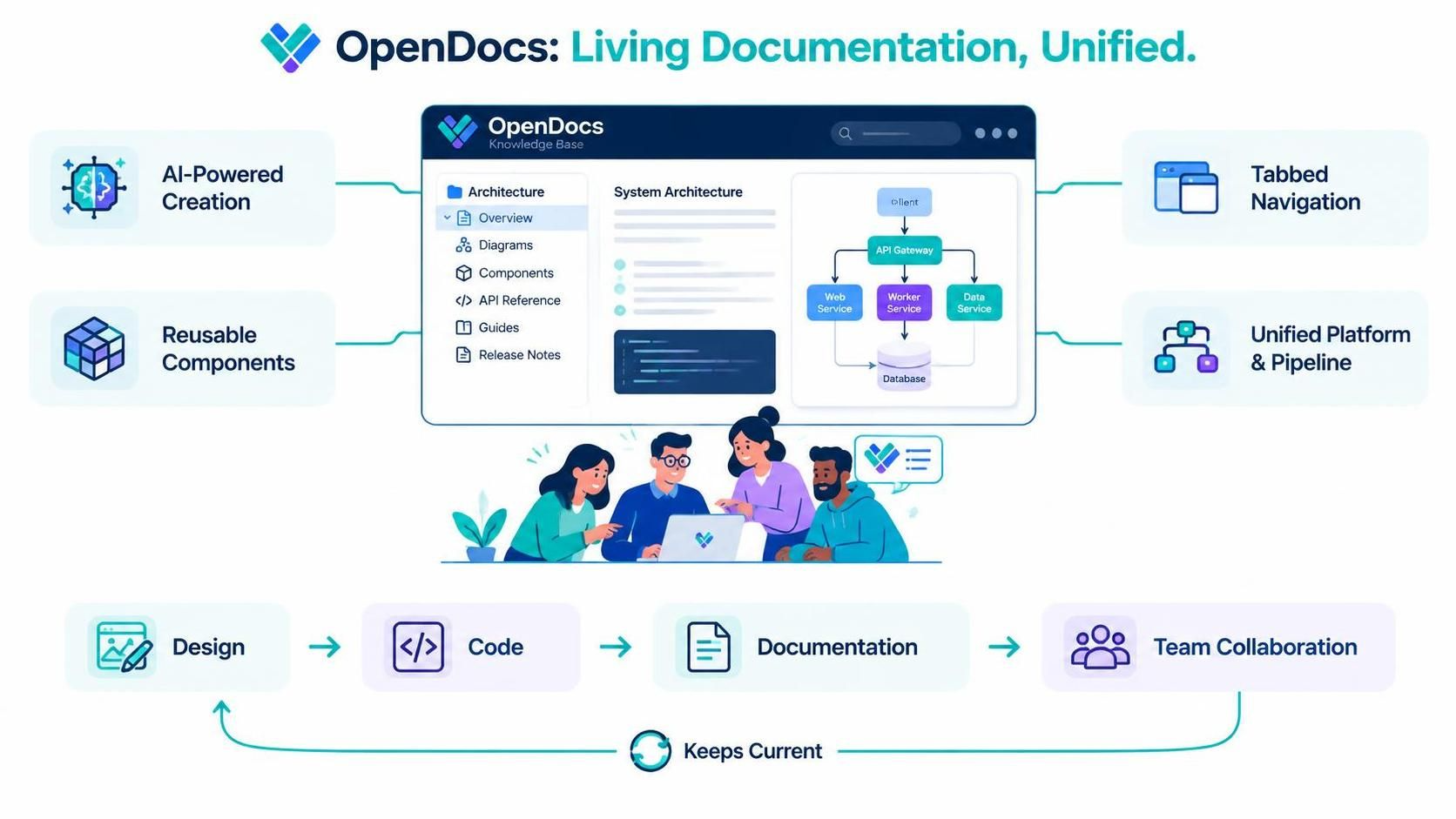
In the fast-paced world of software engineering, the gap between a system’s design and its actual implementation often leads to “documentation debt.” This occurs when technical specifications become outdated, leading to confusion and errors. Visual Paradigm OpenDocs represents a paradigm shift in how we approach technical knowledge management. It moves documentation from a static, text-heavy burden to a dynamic, living artifact that is intrinsically linked to the software development lifecycle.
This tutorial explores the architectural concepts, modeling capabilities, and workflow integration that make OpenDocs a cohesive solution for modern engineering teams. We will break down how AI, reusable components, and pipeline integration work together to create a unified knowledge base.
The Core Architecture: A Unified Knowledge Base
At the heart of the OpenDocs ecosystem is the concept of a “Living Documentation” system. Unlike traditional documentation generators that dump static HTML files into a directory, OpenDocs functions as an interactive, structured environment. The system architecture is built upon a central hub that aggregates various forms of technical information.
Visual Paradigm’s approach integrates the documentation directly with the modeling environment. This means that when you create a diagram—such as a System Architecture or a Sequence Diagram—the visual representation is not just an image; it is a data-rich component that can be referenced, updated, and linked within the documentation structure.
Key Structural Components
The system organizes information into a modular hierarchy. Based on the platform’s design, the architecture supports several critical pillars:
- Centralized Repository: A unified location where all documentation artifacts reside. This eliminates the need to switch between wikis, wikispaces, and local files.
- Tabbed Navigation: The user interface employs a tabbed structure to manage complex information. Users can switch between Architecture, Overview, Diagrams, Components, API Reference, Guides, and Release Notes without losing context.
- Visual-Textual Fusion: The system merges the clarity of written text with the precision of visual diagrams. This allows developers to see the “big picture” architecture alongside detailed component descriptions.
Modeling Concepts and Visual Structure
One of the most powerful aspects of OpenDocs is how it handles visual modeling. In the context of software architecture, diagrams serve as the primary language for communication. OpenDocs ensures that these diagrams are not static snapshots but are part of the active workflow.
System Architecture Diagrams
Consider a typical System Architecture diagram. In OpenDocs, this diagram is a core component. It illustrates the high-level structure of the software, showing how different services interact. For instance, a standard architecture might include:
- Client Layer: The entry point for users or external systems.
- API Gateway: A central traffic controller that manages requests, security, and load balancing.
- Service Layer: Distinct microservices such as Web Services, Worker Services, and Data Services.
- Data Persistence: The underlying database layer where data is stored.
When this architecture is integrated into OpenDocs, the diagram is not just a picture. It is a structured representation of the system. If the underlying model changes—for example, if a new Worker Service is added—the documentation can reflect these changes, ensuring the “Living” aspect of the documentation.
Reusable Components
Efficiency is key in large-scale engineering. OpenDocs leverages the concept of Reusable Components. This allows teams to define standard architectural patterns once and reuse them across multiple projects or documentation sections. Instead of redrawing a standard “Cloud Infrastructure” block or a specific “Authentication Flow,” engineers can instantiate these components, ensuring consistency across the entire organization’s knowledge base.
The AI-Enhanced Ecosystem
Visual Paradigm OpenDocs integrates Artificial Intelligence to streamline the creation of documentation. The “AI-Powered Creation” feature acts as a force multiplier for technical writers and engineers.
Traditionally, creating a knowledge base involves manually typing out descriptions and manually embedding diagrams. With AI integration, the process is accelerated. The system can assist in generating initial drafts, suggesting documentation structures, or even creating text descriptions based on existing models. This reduces the friction of writing and allows teams to focus on the content rather than the formatting.
Integration with the Unified Platform & Pipeline
The true power of OpenDocs is realized when it is connected to the broader Visual Paradigm Unified Platform and the development pipeline. This integration ensures that documentation remains aligned with the code.
The Development Lifecycle
The workflow depicted in the ecosystem follows a logical progression that mirrors the software development process:
- Design: The process begins with modeling. Engineers design the system using visual tools.
- Code: The design informs the coding phase. Code is generated or written based on the specifications.
- Documentation: OpenDocs automatically or semi-automatically pulls information from the design and code to generate documentation.
- Team Collaboration: The documentation is shared, reviewed, and refined by the team.
The critical loop here is the “Keeps Current” feedback mechanism. Because OpenDocs is integrated with the platform, changes in the design or code can trigger updates in the documentation. This prevents the common pitfall where documentation becomes a “dead end”—a source of truth that no one trusts because it is outdated.
Reducing Tool Fragmentation
Many organizations suffer from tool fragmentation, where design tools, code repositories, and documentation wikis are entirely separate. OpenDocs bridges this gap. By integrating with the Visual Paradigm ecosystem, it creates a cohesive environment where the “Single Source of Truth” is accessible to all stakeholders.
Conclusion
Visual Paradigm OpenDocs represents a significant evolution in technical documentation. By merging the clarity of text with the precision of visual diagrams, and by leveraging AI-powered generation and reusable components, teams can build modular, easy-to-navigate knowledge bases. Its integration with the Unified Platform ensures that documentation is not an afterthought but an integral part of the development workflow, keeping the team aligned and the knowledge base current.
For organizations seeking to reduce tool fragmentation and enhance collaboration, OpenDocs offers a cohesive, efficient, and visually engaging solution. It transforms documentation from a static requirement into a dynamic asset that drives engineering success.