
Mastering the Core Concepts of Mind Mapping with Visual Paradigm
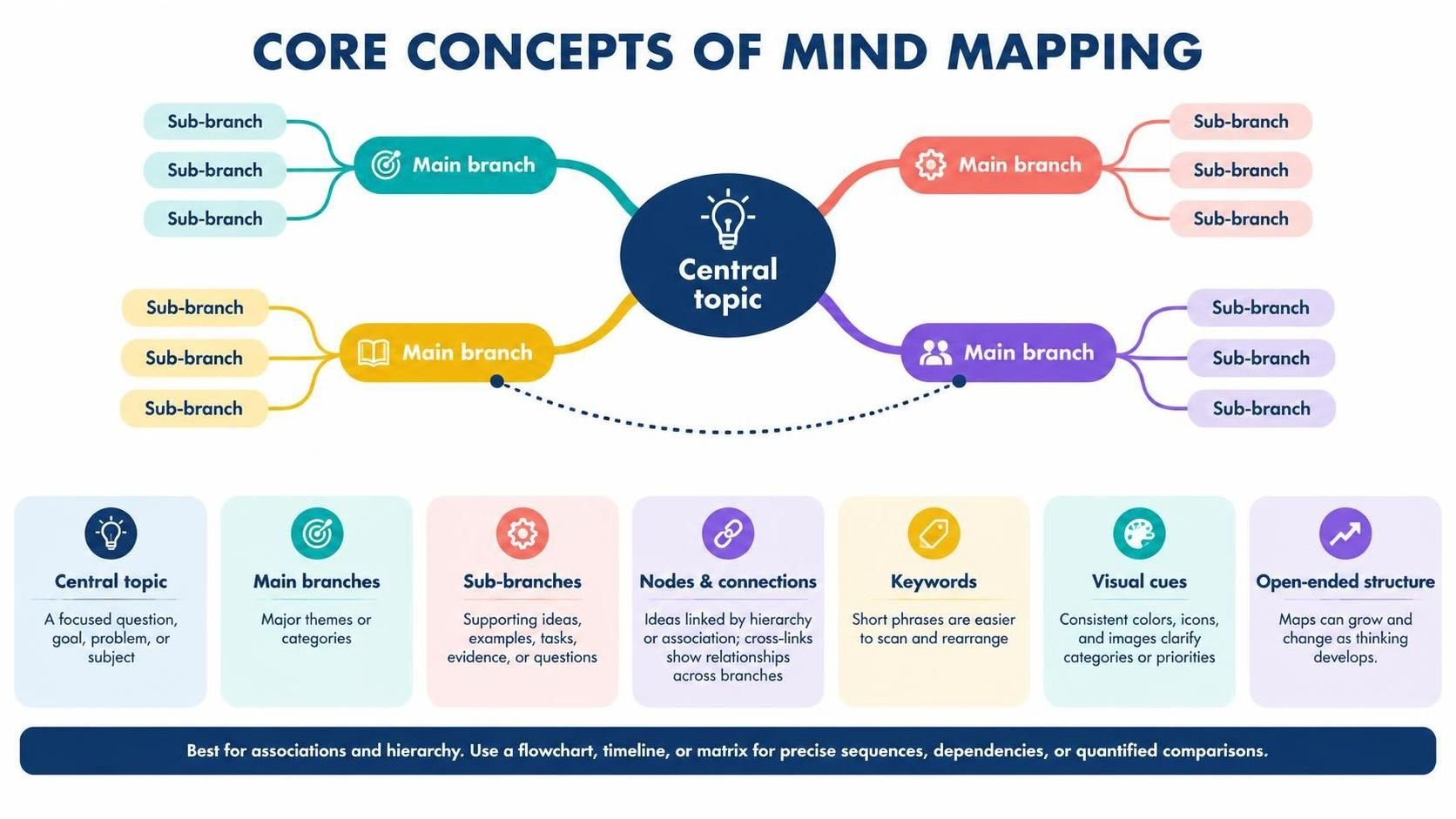
Mind mapping is more than just drawing lines to connect ideas; it is a powerful cognitive tool that visualizes complex information, facilitates brainstorming, and structures problem-solving processes. In Visual Paradigm and similar advanced modeling environments, understanding the foundational architecture of a mind map is the first step toward creating professional-grade diagrams.
This tutorial breaks down the anatomy of a mind map, exploring how nodes, branches, and visual cues work together to create a dynamic representation of thought. We will move from the central topic outward, examining how to structure your data effectively.
1. The Central Topic: The Anchor of Your Map
Every mind map begins with a Central Topic. This is the focal point of your diagram, representing the core question, goal, problem, or subject you are exploring. In Visual Paradigm, this is the root node from which all other ideas radiate.
- Specificity is Key: A common mistake is choosing a topic that is too broad. For instance, instead of simply labeling a topic “Customers,” which is vague, a specific central topic like “Plan a Customer Onboarding Process” provides immediate direction for the mapping exercise.
- Visual Hierarchy: The central topic is always the largest node, visually anchoring the map and establishing the context for everything that follows.
2. Main Branches: Major Themes and Categories
Extending from the central topic are the Main Branches. These represent the major themes, categories, or high-level components related to your central subject.
When constructing a map, it is crucial to start with a manageable number of main branches. You do not need to exhaust every single detail immediately. Instead, establish the primary categories first. As your thinking develops, you can expand these branches or add new ones. This approach prevents the diagram from becoming cluttered and helps maintain a clear logical flow.
3. Sub-branches: Supporting Details and Evidence
Once the main themes are established, the next layer consists of Sub-branches. These nodes hold the supporting ideas, examples, tasks, evidence, or specific questions related to their parent branch.
For example, if a main branch is “Customer Onboarding,” a sub-branch might be “Email Setup” or “Account Verification.” These sub-branches allow you to drill down into the specifics without losing sight of the broader context provided by the main branch.
4. Nodes, Connections, and Cross-Links
In the architecture of a mind map, Nodes are the containers for your ideas, while the Branches (lines) show the relationship between them. The position of a node conveys its place in the hierarchy—nodes closer to the center are generally more critical or abstract, while nodes on the periphery are more specific or detailed.
Cross-Links are a sophisticated feature in advanced mind mapping tools. These are connections that link ideas on separate branches. They are essential for showing relationships between concepts that do not share a direct parent-child relationship, helping you identify patterns or dependencies that span across different categories.
5. Best Practices: Keywords and Visual Cues
To ensure your mind map remains an effective cognitive tool, adhere to the principle of Keywords. Use short phrases rather than long paragraphs. Long text blocks are difficult to scan and can slow down the thinking process. If a concept requires nuance, add a note or a comment to the node rather than writing a paragraph directly on the branch.
Visual Cues such as colors, icons, and images play a vital role in distinguishing categories. For instance, you might use red branches for “Risks” and green branches for “Opportunities.” Consistency in these cues helps the brain quickly categorize information, while excessive decoration should be avoided as it can distract from the content.
6. The Open-Ended Nature of Mind Mapping
A mind map is a working representation, not necessarily a final plan. It is designed to be open-ended, allowing it to grow and change as your understanding of the subject develops. This flexibility distinguishes mind maps from rigid documentation methods.
However, it is important to recognize the limitations of this diagram type. A basic mind map excels at showing associations and hierarchy but is less suited for representing exact sequences, dependencies, or quantified comparisons. For those specific needs, tools like flowcharts, timelines, or matrices are often more appropriate.
Summary
By mastering the core concepts of the Central Topic, Main Branches, Sub-branches, and the strategic use of visual cues, you can leverage mind mapping to unlock new levels of creativity and clarity in your projects. Whether you are planning a complex process or brainstorming a new idea, a well-structured mind map provides the roadmap you need.