Mastering the TOGAF ADM: A Strategic Blueprint for Enterprise Transformation
In the rapidly evolving landscape of enterprise architecture, few frameworks are as robust or as widely adopted as the TOGAF Architecture Development Method (ADM). Whether you are a seasoned architect or a business analyst looking to bridge the gap between IT and business goals, understanding this cyclical process is essential. This tutorial breaks down the TOGAF ADM using the real-world example of FreshMart, a fictional grocery chain, to demonstrate how to transition from a disjointed legacy state to a modern, integrated digital ecosystem.
Understanding the Context: The FreshMart Scenario
Before diving into the phases, we must define the “Why.” TOGAF is not just about drawing diagrams; it is about solving business problems. Let’s look at the baseline state of our example company:
Current State Analysis
- Organization: FreshMart, a small grocery chain with five stores.
- Current Operations: Customers can only buy in-store. Employees rely on siloed systems for sales, inventory, accounting, and supplier orders.
- The Pain Points:
- Manual reporting and supplier orders via email.
- Selling products that are already out of stock.
- No online ordering capability.
- Lack of real-time data for senior management.
The Business Goal
FreshMart wants to create an online grocery ordering service connected to inventory, payments, suppliers, and accounting. The expected outcomes are increased sales, improved customer service, reduced manual work, and accurate, real-time inventory data.
The TOGAF Architecture Development Method (ADM) Cycle
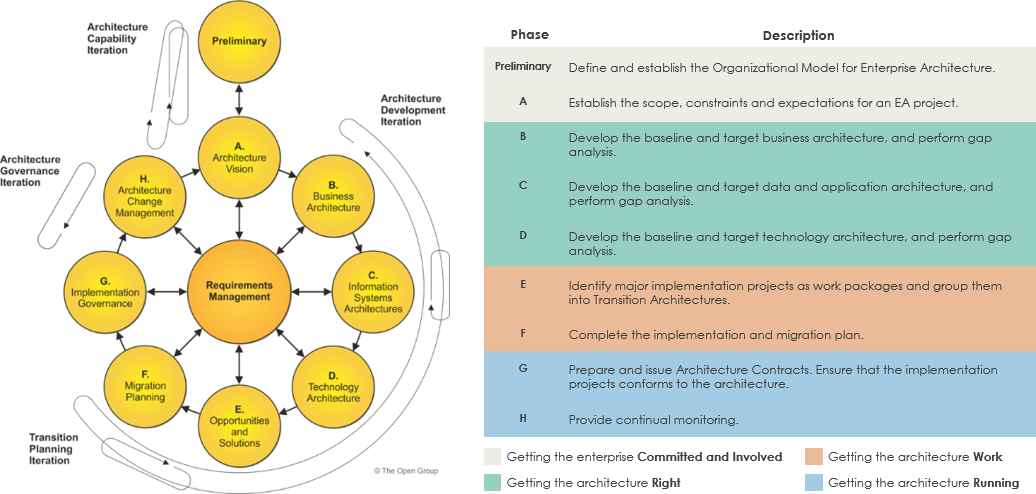
The TOGAF ADM is a cyclic process, meaning it is iterative rather than strictly linear. It consists of several distinct phases (A through H), supported by a central Requirements Management function that operates throughout the entire cycle.
Phase A: Architecture Vision
This phase sets the stage. The goal is to establish the scope, constraints, and expectations for the project.
- Action: We define the “Target Architecture”—how things should work in the future.
- FreshMart Application: The architecture team defines the vision of an integrated e-commerce platform. They identify stakeholders (Store Managers, IT, Suppliers) and agree on the high-level deliverables.
Phase B: Business Architecture
Here, we map out the business strategy, governance, organization, and key business processes.
- Action: Develop baseline and target business architectures and perform a Gap Analysis.
- FreshMart Application: We model the process of a customer ordering online. This reveals the gap between the current manual process (emailing suppliers) and the future automated process (system-triggered orders).
Phase C: Information Systems Architectures
This phase is divided into two sub-domains: Data Architecture and Application Architecture.
- Data Architecture: Defines how data flows. For FreshMart, this means creating a unified database where “Inventory” is the single source of truth.
- Application Architecture: Defines the software components. We move away from separate systems for Sales and Inventory toward an integrated suite.
Phase D: Technology Architecture
This phase defines the hardware and software infrastructure needed to support the Data and Application architectures.
- Action: Determine the cloud infrastructure, network requirements, and security protocols required to host the new online store.
Phase E: Opportunities and Solutions
Now we identify major implementation projects as work packages and group them into Transition Architectures.
- FreshMart Application: We decide whether to build the online store in-house or buy a SaaS solution. We create a roadmap that might involve migrating data first, then implementing the payment gateway, and finally launching the customer-facing website.
Phase F: Migration Planning
This phase completes the implementation and migration plan.
- Action: Detailed scheduling, resource allocation, and risk assessment are performed to ensure the transition from the “Current State” to the “Target State” is smooth.
Phase G: Implementation Governance
This phase ensures that the implementation projects conform to the architecture.
- Action: Architecture contracts are prepared and issued. If the development team deviates from the security protocols defined in Phase D, they are corrected here.
Phase H: Architecture Change Management
The cycle continues here to provide continual monitoring.
- Action: Once the system is running, FreshMart monitors it. If customer demand changes or new supplier technologies emerge, the architecture is updated, and the cycle may restart.
Iterative Cycles in the ADM
The image of the ADM cycle illustrates three types of iterations, showing that architecture is never “finished”:
- Architecture Capability Iteration: Refining the organizational model itself (e.g., establishing a new EA team).
- Architecture Development Iteration: Moving through the phases A-H to solve a specific problem (like the FreshMart project).
- Transition Planning Iteration: Repeating phases E and F multiple times to manage complex, multi-year migrations.
Conclusion
By applying the TOGAF ADM to the FreshMart scenario, we transform a chaotic list of problems into a structured, actionable roadmap. The method ensures that every technical decision—from the choice of database to the selection of payment processors—directly supports the overarching business goal of increasing sales and improving customer service.
For architects and developers looking to execute these complex diagrams and manage these cycles effectively, selecting the right tooling is critical. To streamline the creation of these architecture views, we highly recommend using Visual Paradigm TOGAF Tool. This robust software suite enables users to easily model the ADM cycle, perform gap analyses, and maintain the Architecture Repository, ensuring that the vision for a company like FreshMart becomes a tangible reality.