
Mastering CRC Cards: A Guide to Lightweight Object-Oriented Design
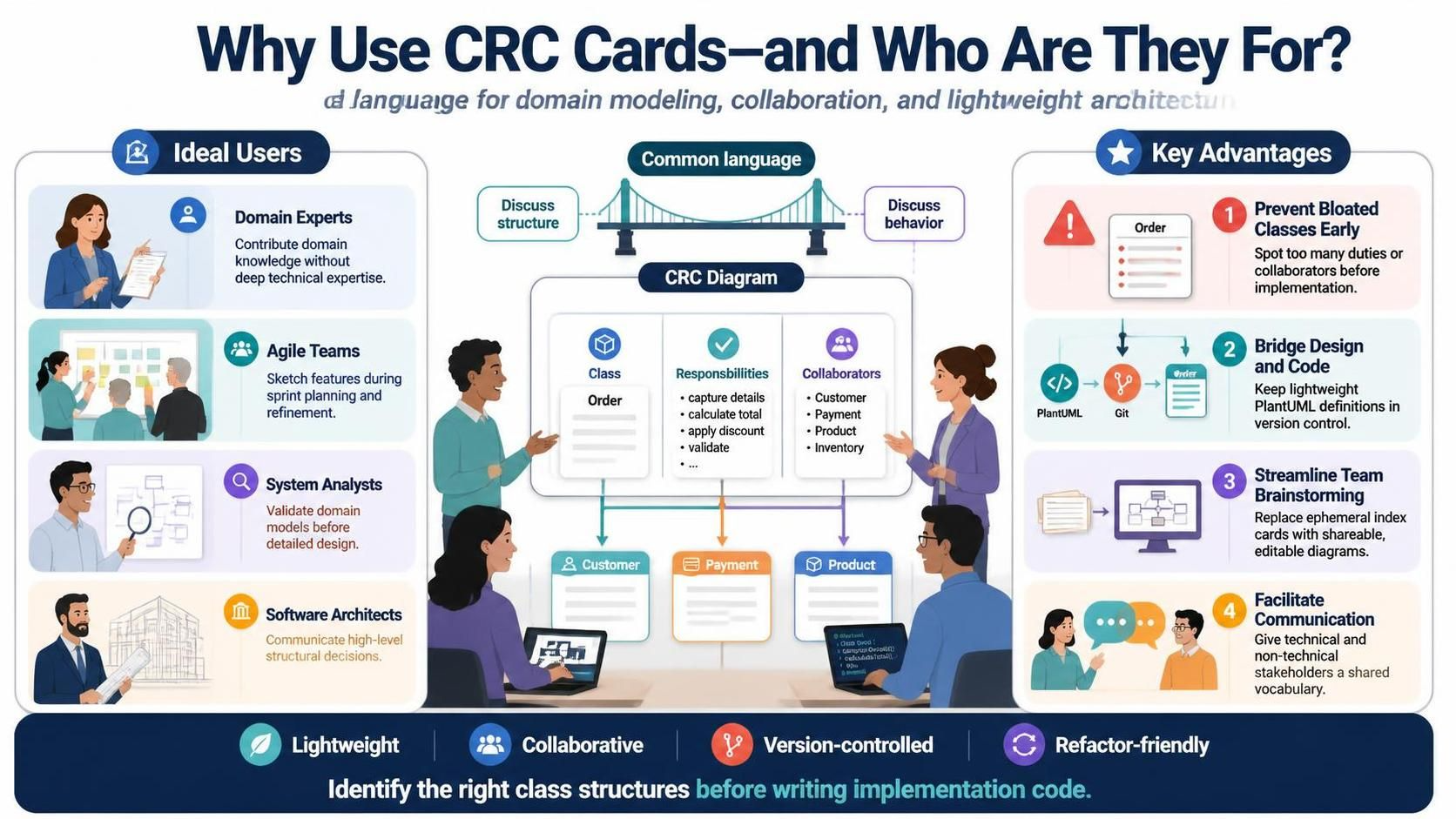
In the landscape of software engineering, few tools offer the same balance of simplicity and power as the CRC Card. Standing for Class-Responsibility-Collaborator, these cards represent a design technique used to identify the responsibilities of objects and the other objects they communicate with. Originally developed by Ward Cunningham and Kent Beck in the late 1980s, this method remains a cornerstone of Object-Oriented Design (OOD), bridging the gap between abstract domain concepts and concrete implementation code.
The Anatomy of a CRC Card
A CRC card is essentially a physical or digital index card divided into three distinct sections. This structure forces the designer to focus on the essential aspects of an object’s role within the system.
1. The Class Name
This is the identity of the object. In a typical scenario, this might be a noun representing a key entity in your domain, such as Order, Customer, or Payment.
2. Responsibilities
This is the “what.” It lists the duties the class must perform to support the system’s goals. These are typically verbs or verb phrases. For example, an Order class might have the responsibility to “calculate total,” “apply discount,” or “validate shipping address.”
3. Collaborators
This is the “who.” It lists the other classes that this object must interact with to fulfill its responsibilities. If an Order needs to calculate a discount, it might need to collaborate with a DiscountPolicy class. If it needs to validate an address, it might collaborate with a GeolocationService.
Who Should Use CRC Cards?
One of the most profound aspects of CRC design is its accessibility. It is not limited to senior engineers; rather, it is a collaborative tool designed for diverse groups within a development lifecycle.
- Domain Experts & Business Analysts: These individuals understand the business rules deeply but may not be familiar with syntax or complex UML notation. CRC cards provide an intuitive format where they can contribute to design discussions without needing deep technical expertise.
- Agile Teams: Scrum teams performing sprint planning or refinement sessions can quickly sketch out new features. The lightweight nature of CRC cards allows for rapid iteration on feature scope.
- System Analysts: Professionals performing early object-oriented analysis can use CRC cards to validate domain models before committing to detailed design or writing code.
- Software Architects: Architects utilize these diagrams to communicate high-level structural decisions to development teams, ensuring everyone agrees on the system’s skeleton.
Key Advantages of the CRC Method
Why choose CRC cards over heavy UML modeling tools like Sequence Diagrams or Class Diagrams in the early stages? The answer lies in their ability to streamline the design process.
Prevent Bloated Classes Early
By mapping duties side-by-side with collaborators, you can immediately spot “God Objects” or single-responsibility violations before writing any implementation code. If a class has too many responsibilities or depends on too many collaborators, it’s a clear signal that refactoring is needed.
Bridge Design and Code
CRC cards keep class definitions lightweight and readable. Using simple text structures, they can be stored in version control alongside your source code, acting as living documentation that evolves with the project.
Streamline Team Brainstorming
This method replaces physical index cards with a digital, version-controlled format that integrates smoothly into technical documentation. It allows teams to easily share, review, and update design decisions collaboratively.
Facilitate Communication
Perhaps most importantly, CRC cards provide a common language. They allow technical and non-technical stakeholders to discuss system structure and behavior using a shared vocabulary that is easy to grasp.
Implementing CRC in a Modern Workflow
In modern development environments, we often transition from physical index cards to digital tools that support version control and collaboration. This allows the design to be an integral part of the codebase.
When defining these structures digitally, it is crucial to maintain the clarity of the three sections. Below is an example of how a CRC card for an Order class might be structured in a text-based format.
' Class Definition
class Order {
    // Responsibilities
    : capture details()
    : calculate total()
    : apply discount()
    : validate()

    // Collaborators
    <> Customer
    <> Payment
    <> Product
    <> Inventory
}
Conclusion
CRC cards remain a vital tool for maintaining focus on the “why” and “how” of software design. They prevent the common pitfall of jumping straight into coding without a structural plan, ensuring that the resulting architecture is robust, maintainable, and aligned with business requirements.
To leverage these benefits effectively in a professional environment, it is highly recommended to utilize specialized tooling that combines the flexibility of digital text with visual clarity. Specifically, Visual Paradigm offers excellent support for creating and managing CRC diagrams. By using Visual Paradigm’s CRC card features, teams can easily convert abstract design notes into formal documentation that integrates seamlessly with their broader system architecture models.