
Mastering BPMN Standards: History, Architecture, and Modeling Best Practices
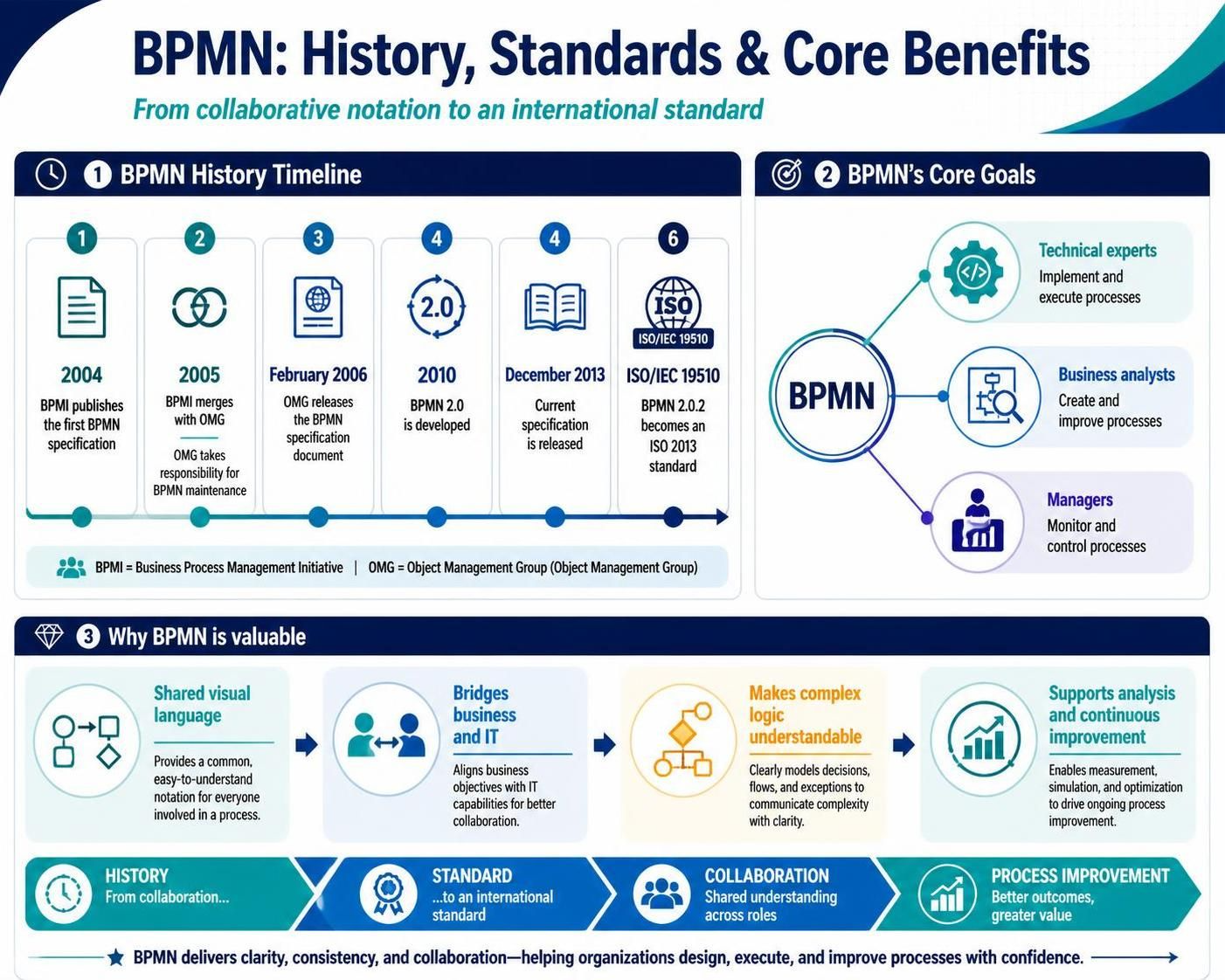
Business Process Model and Notation (BPMN) is the industry-standard graphical notation for modeling business processes. It serves as a universal language that bridges the gap between business stakeholders and technical developers. This tutorial explores the architectural evolution of BPMN, its core objectives, and why it remains the cornerstone of modern business process management.
1. The Evolution of BPMN Standards
Understanding the history of BPMN is essential for grasping its current authority in the industry. The standard has evolved from a collaborative initiative into a formal international specification.
A Timeline of Development
The journey began in 2004, when the Business Process Management Initiative (BPMI) published the first BPMN specification. This was a pivotal moment that established a common set of symbols for process modeling.
- 2005: The Merger – BPMI merged with the OMG (Object Management Group), the organization responsible for standards like UML. This gave BPMN the rigorous maintenance and governance of a major standards body.
- February 2006 – The OMG officially released the first BPMN specification document, solidifying the standard.
- 2010: Version 2.0 – A major milestone was reached with the development of BPMN 2.0. This version introduced a unified semantic model, allowing diagrams to be more than just visuals; they could now represent executable logic.
- December 2013 – The current specification was released, further refining the modeling capabilities.
- ISO Standardization – The latest version, BPMN 2.0.2, was formally published as an international standard: ISO/IEC 19510.
2. Core Objectives and Target Audience
BPMN is designed to be an inclusive modeling language that serves three distinct personas within an organization. Its architecture supports the entire lifecycle of a process.
The Three Pillars of BPMN Users
- Technical Experts (Implementers): These are the software developers and architects who need to execute the process. They require precise, executable logic to build the underlying application.
- Business Analysts: These professionals are responsible for creating, analyzing, and improving processes. They use BPMN to capture requirements and document workflows.
- Managers (Controllers): These individuals monitor and control processes. They rely on BPMN diagrams to visualize KPIs, identify bottlenecks, and ensure compliance.
3. Why BPMN is Valuable
The value of BPMN extends beyond simple diagramming. It provides a robust framework for organizational alignment and efficiency.
Shared Visual Language
BPMN provides a common, easy-to-understand notation. Unlike proprietary modeling tools that may require specific training, BPMN symbols (like gateways, events, and tasks) are intuitive enough for business users to interpret without deep technical knowledge.
Bridging Business and IT
One of the most significant benefits of BPMN is its ability to bridge the communication gap between business process design and implementation. By using a standard that both sides understand, organizations can ensure that the software being built matches the business requirements exactly.
Making Complex Logic Understandable
BPMN is not limited to simple linear flows. It is powerful enough to model complex business logic, including:
- Parallel and exclusive gateways for decision-making.
- Sub-processes for managing complexity.
- Exception handling and error management.
4. Implementation with Modern Tooling
To effectively model these standards, organizations rely on robust engineering tools. Visual Paradigm is a leading tool for BPMN modeling, offering comprehensive support for the entire BPMN 2.0 specification.
When using Visual Paradigm, users can leverage features that support the “executable” aspect of BPMN 2.0. This allows the model to be simulated or even deployed directly, ensuring that the diagram accurately reflects the system architecture.
Conclusion
From its origins in 2004 to its status as an ISO standard, BPMN has evolved into the definitive language for business processes. By providing a shared vocabulary for business analysts, technical experts, and managers, it empowers organizations to design, execute, and improve processes with confidence.