
Mastering BPMN 2.0 Modeling with AI: From Natural Language to Process Intelligence
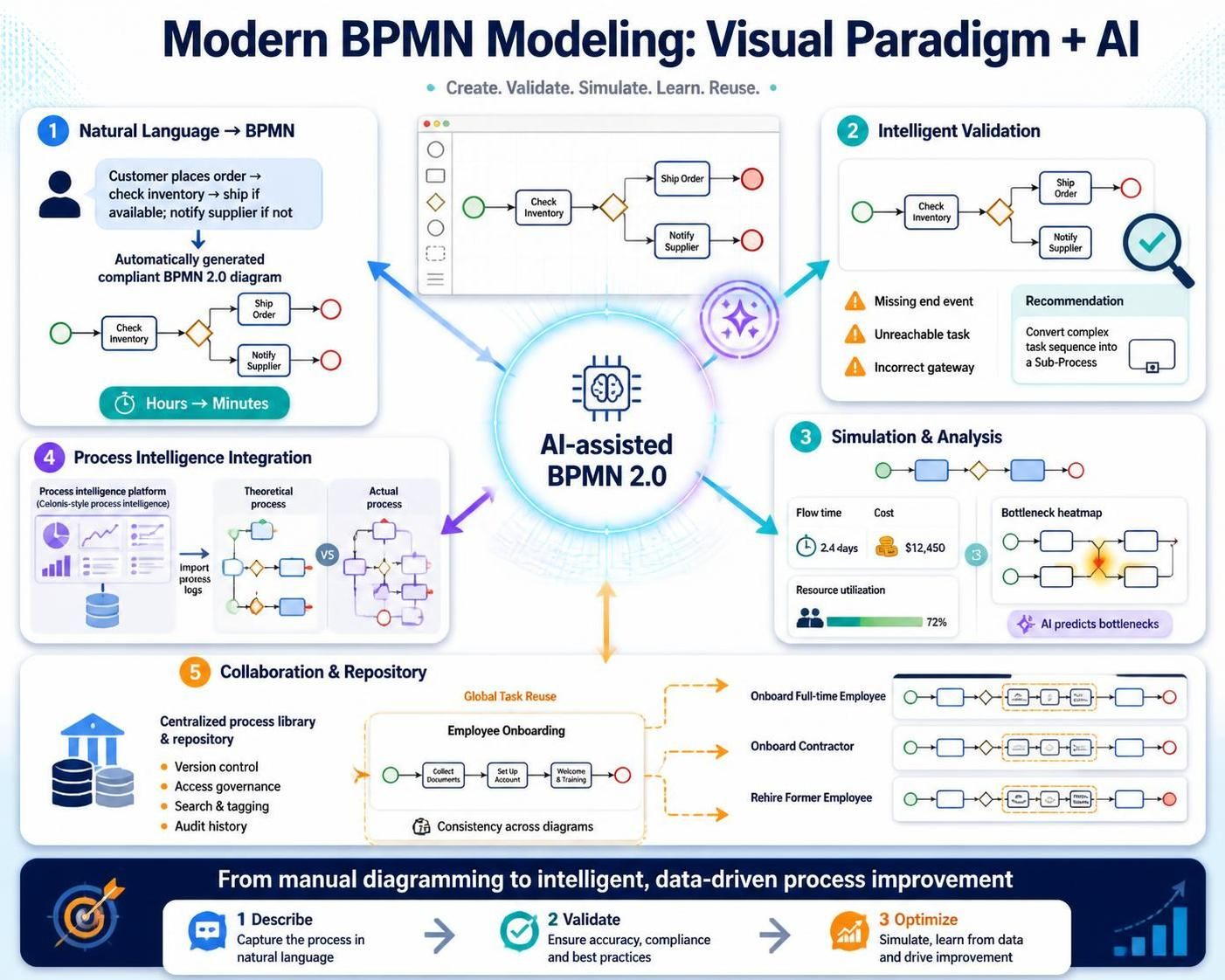
Business Process Management (BPM) has historically relied on manual diagramming, a process that is often time-consuming and prone to human error. However, the integration of Artificial Intelligence into modern tools like Visual Paradigm has revolutionized how we design, analyze, and optimize workflows. This tutorial explores the architecture of AI-assisted BPMN 2.0 modeling, guiding you through the transition from static diagrams to dynamic, data-driven process intelligence.
1. The Paradigm Shift: Natural Language to BPMN
The most transformative feature in modern BPM tooling is the ability to generate formal diagrams from plain English. This “Text-to-Diagram” capability bridges the gap between business stakeholders (who describe processes) and technical modelers (who build diagrams).
Instead of manually dragging and dropping shapes, users can describe a process flow in a chat interface. The AI engine parses the semantic meaning of the text and constructs a compliant BPMN 2.0 diagram automatically.
Workflow Example: Order Fulfillment
Consider a standard order fulfillment scenario. A user might input the following logic:
“When a customer places an order, check inventory. If available, ship item; if not, notify supplier.”
The AI engine interprets this sequence:
- Start Event: “Customer places an order”
- Task: “Check Inventory”
- Exclusive Gateway (XOR): The decision point (“If available” vs. “If not”)
- Parallel Paths: “Ship Order” vs. “Notify Supplier”
- End Events: Completion of the respective tasks
This reduces initial drafting time from hours to minutes, allowing modelers to focus on refinement rather than geometry.
2. Intelligent Validation: Beyond Syntax Checking
Once a diagram is generated, the AI acts as an expert auditor. It performs two critical functions: strict compliance checking and architectural optimization.
A. Syntax Checking & Error Detection
The AI engine scans the generated diagram against the rigorous BPMN 2.0 specification. It flags structural errors that could render a process invalid or unexecutable, such as:
- Missing End Events: Ensuring every path leads to a termination point.
- Unreachable Tasks: Identifying “islands” of logic that cannot be reached from the start event.
- Incorrect Gateway Usage: Ensuring the correct type of gateway (Exclusive vs. Inclusive) is used for the specific logic flow.
B. Best Practice Recommendations
AI doesn’t just find errors; it suggests optimizations. For example, if a diagram contains a long, linear sequence of tasks that logically belong together, the AI may recommend converting them into a Sub-Process. This improves readability and allows for modular design.
💡 Did You Know?
In BPMN 2.0, a “Gateway” without an outgoing sequence flow is a syntax error because the engine doesn’t know which path to take next. AI validation catches these “dead ends” instantly, ensuring your model is executable.
3. Simulation and “What-If” Analysis
A diagram is only as useful as the insights it provides. Visual Paradigm integrates simulation capabilities that allow organizations to test process performance before implementation.
- Flow Time & Cost: The system can calculate the theoretical duration of a process (e.g., “2.4 days”) and associated costs based on resource definitions.
- Resource Utilization: It predicts how busy a specific role or resource will be, identifying overloads.
- Bottleneck Prediction: Using AI, the system can analyze flow patterns to predict where delays are likely to occur, visualizing this via a “Bottleneck Heatmap.”
4. Integration with Process Intelligence
The most powerful aspect of modern BPM is closing the loop between the “Theoretical Process” (what we think happens) and the “Actual Process” (what actually happens).
Tools like Celonis and Visual Paradigm allow for the importation of process logs (event data) directly into the BPMN model. This enables:
- Process Mining: Automatically updating the diagram to reflect reality.
- Gap Analysis: Comparing the theoretical map against the actual execution data to find inefficiencies.
- Data-Driven Optimization: Making decisions based on empirical evidence rather than assumptions.
5. Collaboration and Repository Management
To maintain consistency across an organization, Visual Paradigm leverages Global Tasks (also known as Global Pools in some contexts, or reusable sub-processes). This allows teams to create a centralized library of common processes, such as “Employee Onboarding.”
By referencing a Global Task, teams ensure that:
- Version Control: Updates to the “Onboarding” process are reflected everywhere it is used.
- Standardization: Every department uses the exact same logic for hiring.
- Efficiency: Modelers do not need to redraw standard workflows repeatedly.
Conclusion: The Future of BPM
The journey from BPMN 1.x to BPMN 2.0 represents a maturation of business process management from an artistic endeavor to an engineering discipline. By combining a formal metamodel with AI and Process Intelligence tools, organizations can move beyond static maps. They achieve dynamic, data-driven process optimization that saves thousands of hours and drives measurable business performance.
For practitioners, the message is clear: Master BPMN 2.0 not just as a notation, but as the foundational language for digital transformation.