Mastering Conversation Diagrams: AI-Driven Supply Chain Modeling with BPMN
In the world of enterprise architecture and systems engineering, communication is just as critical as data flow. When you need to understand the business dialogue between different entities—rather than the internal logic of a single process—you need a specific type of diagram. Enter the Conversation Diagram.
This tutorial will guide you through the architecture of Conversation Diagrams, specifically focusing on how to model complex supply chain interactions using tools like Visual Paradigm’s AI-assisted capabilities. We will analyze a real-world logistics scenario involving Suppliers, Retailers, and Carriers to demonstrate how high-level abstractions clarify stakeholder communication.
What is a Conversation Diagram?
A Conversation Diagram is a high-level abstraction designed to show the summary of conversations (interactions) between participants. Unlike a detailed Sequence Diagram, which maps every single method call and return, a Conversation Diagram provides a “bird’s-eye view.”
It is ideal for:
- Executive Overviews: C-level stakeholders who need to know who talks to whom without getting bogged down in technical minutiae.
- System Boundaries: Defining which entities are external to the system and which are internal.
- Architectural Alignment: Ensuring that all stakeholders agree on the scope of the dialogue.
Deconstructing the Supply Chain Architecture
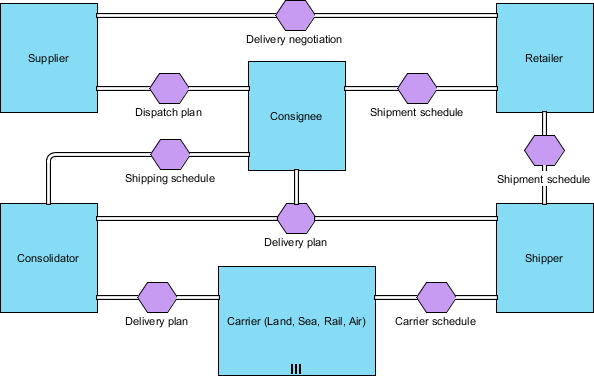
The diagram below represents a multi-modal logistics network. It visualizes how a central Consignee (the party receiving goods) interacts with a Supplier, Retailer, Consolidator, Shipper, and Carrier.
Note: In the context of VPasCode or similar modeling tools, the hexagon shapes represent specific “Conversation Types” or interaction events, while the rectangles represent the Participants (Actors).
Let’s break down the architecture step-by-step.
1. The Supplier & Retailer Interface
The top section of the diagram highlights the financial and planning relationship between the source of goods and the point of sale.
- Participants:
SupplierandRetailer. - Key Interaction:
Delivery negotiation. This is a high-level semantic event indicating that the terms of trade, pricing, and logistics are being agreed upon before any physical movement occurs.
2. The Consignee: The Central Hub
The Consignee sits at the heart of this model. In many supply chain models, this is the organization for whom the goods are being procured. The diagram reveals that the Consignee is not passive; it actively manages three distinct streams:
- Dispatch Plan (from Supplier): How goods are being sent out.
- Shipment Schedule (to Retailer): The timeline for delivering goods to the point of sale.
- Shipping Schedule (from Consolidator): The receipt of goods from a consolidation partner.
3. The Logistics Network (Bottom Layer)
The bottom of the diagram illustrates the physical execution layer. This is where the “heavy lifting” happens, involving multiple modes of transport.
- The Consolidator: This entity likely aggregates smaller shipments into larger loads to optimize transport. It communicates a
Delivery planto the Carrier. - The Shipper: This actor handles the
Shipment schedulefor the Retailer and receives theDelivery planfrom the Consignee. - The Carrier (Land, Sea, Rail, Air): This is the physical transport provider. The diagram explicitly lists the modes of transport, indicating a multimodal approach.
- Carrier Schedule: The specific timing of the transport assets (trucks, ships, planes).
Technical Implementation with VPasCode
Using Visual ParadigmAI or VPasCode allows you to generate these diagrams from natural language or structured data. The syntax typically requires defining the participants (actors) and the relationships (edges) with specific labels.
Below is a conceptual representation of how the logic is structured for the “Carrier” interaction, which is a critical part of the system’s operational layer.
// Define Participants
Actor Consignee
Actor Consolidator
Actor Carrier

// Define the Interaction Logic
// The Consignee triggers a "Delivery plan" to the Consolidator
Consignee -- "Delivery plan" --> Consolidator

// The Consolidator triggers a "Delivery plan" to the Carrier
Consolidator -- "Delivery plan" --> Carrier

// The Carrier responds with a "Carrier schedule"
Carrier -- "Carrier schedule" --> Consolidator
Understanding the “Hexagon” Semantics
In your modeling tool, you might notice hexagon nodes connecting the lines. In the context of Conversation Diagrams, these are not just decorative; they represent the Conversation Type. When you model this in VPasCode, you are essentially defining the payload of the interaction. For example:
- Dispatch Plan: Usually contains
Item ID,Quantity, andOrigin. - Carrier Schedule: Usually contains
ETA,Location, andTransport Mode.
Best Practices for Modeling Conversations
When creating these diagrams, especially for executive summaries, keep the following principles in mind:
- Focus on the “What”, not the “How”: A Conversation Diagram should describe what information is exchanged (e.g., “Delivery Plan”), not how it is technically transmitted (e.g., “via REST API”).
- Group by Business Domain: Notice how the diagram separates the “Negotiation” layer from the “Execution” layer. Always try to group interactions logically.
- Keep it High-Level: If you find yourself adding dozens of interaction lines, you are likely building a Sequence Diagram, not a Conversation Diagram. Step back and summarize.
Conclusion
By utilizing Conversation Diagrams, you can effectively communicate the complex web of interactions in a supply chain. Whether you are a developer defining API contracts or an executive reviewing logistics performance, this abstraction provides the necessary clarity without the noise of implementation details.
Remember: The goal of the diagram is not to show the code, but to show the conversation.